
The Mirror happened. I put up a short story about a woman whose reflection begins arriving half a second late, and it became, by a wide margin, the most read thing I have written here: 163 likes and 608 views, most of them inside the first forty-eight hours. Two hundred and eleven people came to this page on Saturday, which is a number I had no frame for. There are more than 850 of you now.
It also put me at number 18 Rising in Fiction. I know the leaderboard is volatile and I know I will not be there long. I want to say what it meant anyway. English is my third language. I did not come to this platform expecting to appear on a list of fiction writers in it, not even for an afternoon, and the reason I did is that a few people decided to pay for work they could already read for free. That is a strange and humbling way to arrive somewhere. Thank you to everyone who read, liked, restacked, or argued with me in the comments this week. You put me there.
I also took Part I of At the End of Time to Write Club, hosted by @David T Etheredge, and I want to recommend it properly rather than in passing. You sit in a room while people go through your story in front of you. One person tells you the paragraph you are proudest of is the first thing they would cut. The next person calls that same paragraph compact literary gold. You have to sit with both. In about forty minutes I was told by three separate readers that the story is thin on sensory detail, and when three people find the same gap independently, that stops being an opinion and becomes a fact about the draft. I was also told my opening spends words on ground that does not matter and I should start at the action. My instinct was to defend it. I am still thinking about it. What live feedback gives you, and solitary revision cannot, is a sense of which of your own instincts to trust. It costs an hour and it is worth a month of revision. If you write, go and sign up.
Two things coming. Saturday, the first story ever published through Forgotten Kin. And next week, the second review in A Literature That Refused to Die.

NEWS FROM THE ROAD
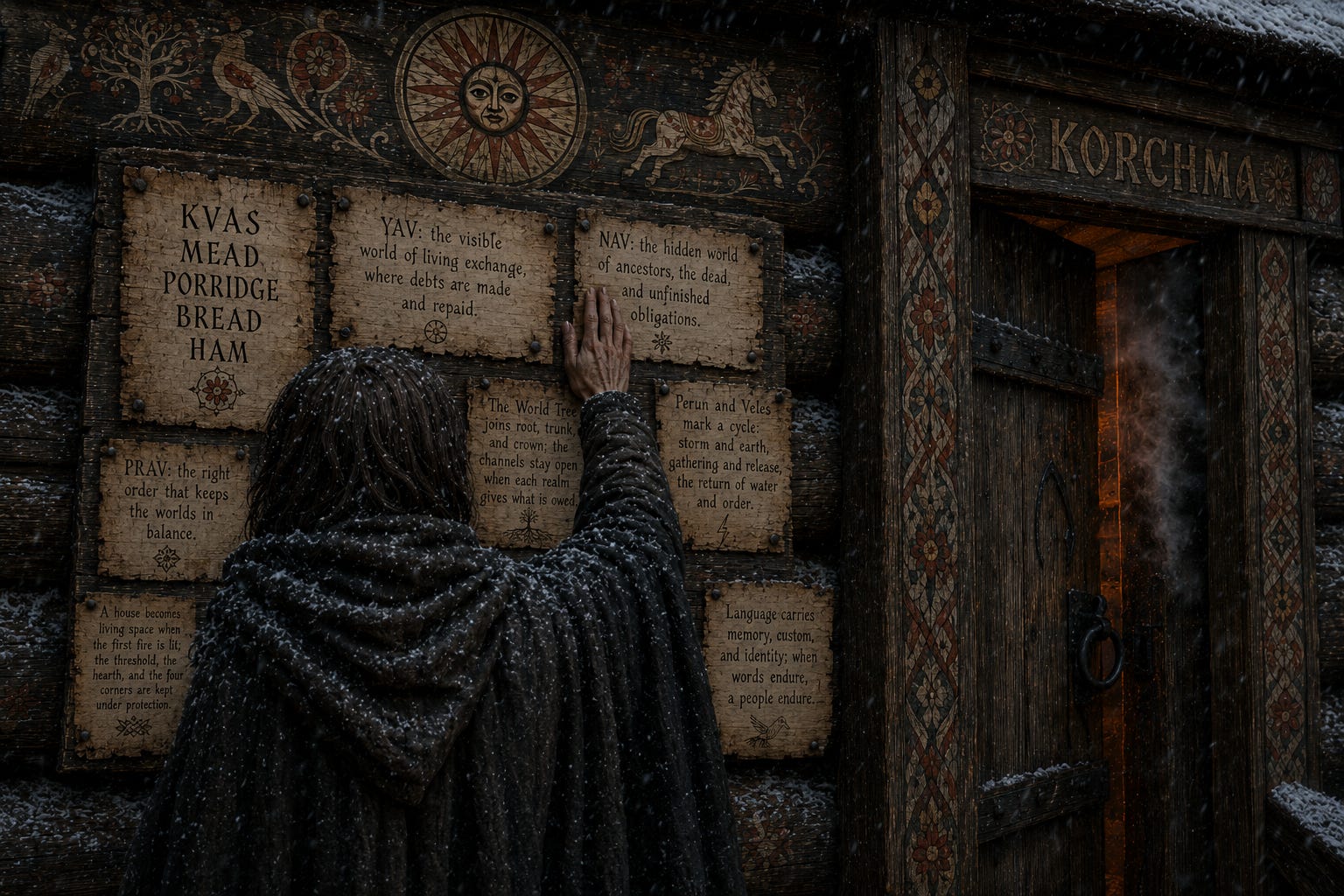
The Mirror came out of research, not invention. In the old villages, the moment a death was announced, every mirror in the house was covered. The reason given was that the soul was newly loose and could be caught in the glass. But there was a second reason, spoken less often: a mirror is a door with something on the other side of it, and a house in mourning is a house with its guard down. You did not leave doors open at a time like that. What I did not expect was how many of you already lived with the rules. Marcello Iori came back with the same customs from his own family: do not look into a mirror at night, do not let one face the bed, seven years of misfortune if you break one. The proscriptions are almost identical across languages that have no business agreeing. The folklore is not decoration. It is a set of instructions.
After Kulish, the Architecture of Belief series moves to Essays VI and VII, and VII has handed me the idea I have been chewing on all week: the edge always knows first. Authority radiates from its centres and thins as it travels. At the capital a royal seal is a reason, something that settles the question of what to do without further thought. At the frontier the same seal is only a claim, honoured or not depending on the weather and on how far away the army is. Which means people at the edge are permanently doing arithmetic that people at the centre never have to do, and they are therefore the first to notice when the arithmetic starts coming out differently. The frontier is never informed that the king’s authority is thinning. It has simply been living in the thinned version all along. So when the crisis finally reaches the centre it announces itself as sudden, and it was never sudden. It had been seeping inward from the edge for years.
For the fiction, that turns a border from a line into a gradient, and it is the most useful thing the research has given me in months. If belief is what holds a boundary, the boundary is thinnest where the belief is thinnest, and the thin place does not stay put. When a frontier village stops performing its rites with real conviction, not from apostasy but because nobody comes any more and the ceremony has gone to rote, the gradient steepens. Whatever lives where the density is lowest still lives where the density is lowest. That place has simply moved inward. Essay VI runs alongside it, on what happens when a failing authority reaches backwards for the sacred to shore itself up, and it contains the line I keep circling: understand what you are doing well enough to do it deliberately, and you have already begun to stop doing it.
Four people took out paid subscriptions this week, and I want to be precise about what that means, because it surprised me. Nothing of substance on this page was behind a gate when they subscribed. They paid for work that was already mostly free.
Morgan took out an annual subscription without ever having left a comment, a note, or a word. Some support arrives silently. It counts exactly the same, and I noticed.
Just Judy subscribed to support the page, and then spent the week improving my thinking. I had written that one exact detail beats ten vague ones, that you should not tell me the kitchen was cosy but show me the chipped cup nobody will throw away. She came back and corrected me: it is not the cup, it is the value someone assigns to it. One person throws it out. One glues it. One puts it on a shelf and it becomes a sacred thing. She was right, and it is a better rule than mine was.
Dirk Walvoord subscribed after reading The Mirror, and gave me the line I will be thinking about for a long time: that reaching the end of something I have written never feels like time that could have been spent on something else. And Dawn Axelson subscribed and said this page is exactly the resource needed for their own writing, which quietly told me which part of what I do is worth the most.
Go and look at all four of them. That is the only repayment available to me from here.
So, here is how the page works from now on.
The theoretical work stays free. Permanently. The scholarship on Slavic and steppe belief, A Literature That Refused to Die, the body of the Architecture of Belief essays, and the odd-numbered essays in Old Roots, New Soil. Being open is what I was supported for in the first place.
What goes behind a gate is the constructed world: the even-numbered companion essays in Old Roots, New Soil, the coming steppe folklore series, and the short Toward a Constructed World section at the end of the Architecture of Belief essays. That is where I stop reporting research and start showing how I bend it into fiction. Each of those runs a full week free before the gate comes down.
If you read this page as it publishes, you will never hit a paywall at all. Only the latecomers and the archive-divers will. It is less a paywall than a delay, You will have the same folklore I have. You will not have my working notes on how I use it.
Forgotten Tales and Forgotten Kin stay free forever, and not as a favour. They are not mine to gate. They are other people’s families.
Best comment goes to Western Refugee , on The Mirror. He wrote that the story does not rely on gore or jump scares but on something worse, the assumption that you are the one in control of your own identity, and that the horror is your consciousness being demoted to spectator while your body goes on performing you convincingly enough that nobody else would notice. Then the line that got me: we were not watching a haunting, we were witnessing an eviction. I wish I had thought of it in those words.
Forgotten Tales put up The Legend of the Naga Princess this week, from Hai Dang : a Cham origin story heard at a temple in Ho Chi Minh City, a serpent princess and a shipwrecked prince, and a kingdom annexed in 1832 whose people still tell the story of where they came from. In the comments he said what the project is better than I have managed to: that a myth is not a history lesson, it is a declaration that we were here, we are still here, we will always be here. Then Litharis Archives read it and immediately proposed a collaboration with him. That is the whole point of this, happening without my help, inside an hour.
I put up a note asking whose name you carry, and the answers were the exact question that project opens with. Matty Macaroo wrote about being named for a great-grandmother and being made to shout “Mighty Battle Maiden” until it reached her stone-deaf ears. Litharis Archives was named Nadine, meaning hope, after a long wait for a child. Lavinia Thompson carries her grandmother’s name and noticed her grandmother never passed on her own parents’. Candle carries the name of a grandmother she has no shared language with. The Stories We Carry has three surnames and a history in each one. Every one of you wrote something that can become the first draft of a submission without knowing there was a door. The door is Forgotten Kin, it is open, and I would be honoured to publish any of those.
Thank you also to Caryn Cordova, Seth R. Mitchell☕️Fantasy Auth, LC Douglass, John Madrid, Demetria Balfour, Histories & Hauntings, Matthew E Meurer, Renée Lucia, Chuck Lund, The Famazing Mack Devlin🌛, Anat Dagan, JAE Cole, Stefan Pasek, Kris Buckel - Library of Kris, Nate Wilson, Jason William Karpf, Jaeson Iskandar, Mari Montclair, Tianna Diamond, Eliseo F.G. McCarthy, and everyone else who turned up this week. Chuck Lund in particular told me Roy’s jokes are too frequent in Part II, and that a man facing a five-thousand-year-old monument with an AI warning him of danger should feel real unease at least once.
Saturday: The Mother With Two Burials. The first story through Forgotten Kin’s door, from E L Frederick. A woman dies of cholera on a Mississippi steamboat in November 1832, and her family has never agreed on where she was buried: in the river, or in a grave on the shore. Nearly two centuries on, they still have not chosen, and the telling does not choose either. There is also a five-year-old girl from that boat who, fourteen years later on the first day of the westward exodus, turned around and walked back, and was never seen again by anyone in the family. Her whole surviving story was one sentence. It is longer now. What made me sit down when this arrived: his grandmother closed her family book asking whoever read it to add what she did not know. So did mine. Two grandmothers, two families, two continents, the same sentence, both answered by a grandson.
Next week: Panteleimon Kulish and The Black Council. The first novel ever written in modern Ukrainian, written in 1845 by a man who was arrested with Shevchenko, invented the alphabet Ukrainian still uses, then spent the rest of his life changing his mind about everything until nobody could classify him. Franko called him a first-rate star. Others called him a traitor. He chose, for his subject, not Khmelnytsky’s triumph but the ruin that came after: a rigged Cossack election in 1663 where Moscow arranged the outcome before a vote was cast, and where the losing hetman, offered escape from a dungeon, refused it because he would not buy his own life with more blood. The novel’s hardest line is three words, свій на свого, one’s own against one’s own. Kulish wrote about what happens when a people turn on themselves and their enemies learn to use it. I will not draw the line to the present in that essay. Readers do not need my help with it.
The board will be back next week.
About Me & Index with links to my other work can be found here.

Comments
Nothing yet. Say the first thing.
Sign in to join the conversation.