
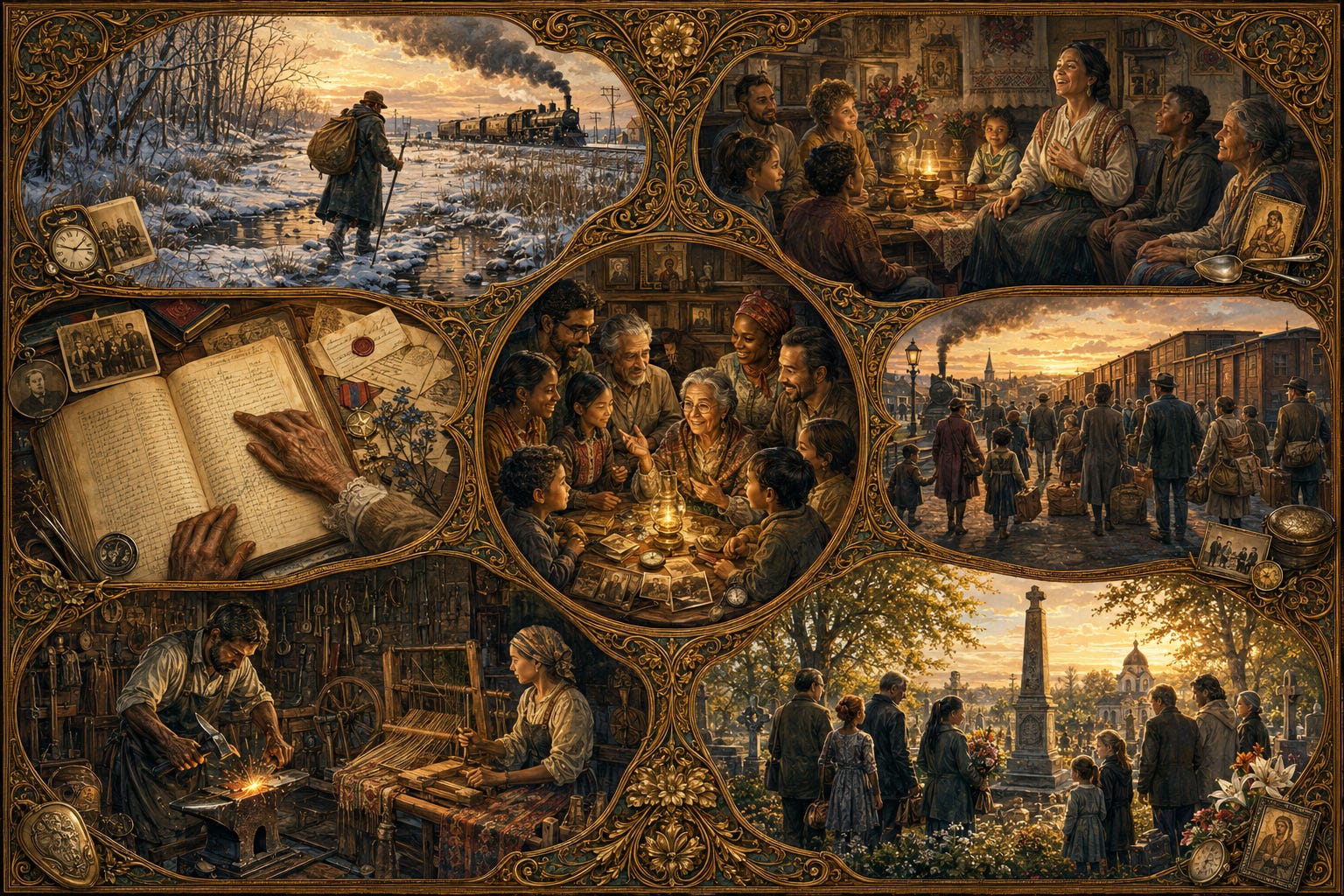
The first story to come through this door arrived as a typewritten family history, compiled over five years, that a grandmother in one American family could not finish in her lifetime. What follows is a single thread pulled out of it — a woman who died on a river in the autumn of 1832, and a family that has never agreed on where she was buried.

E L Frederick descends from the family in this telling through his mother’s line: from Samuel Shepherd, a Vermont wagonmaker, down through Rollins Don Carlos Shepherd — the youngest child in the story below — to Valie Shepherd Garrett, to Eula Mae Garrett Barnett, his grandmother, who wrote the introduction and dedication to the family’s history and closed it with a charge to everyone who would ever read it. The manuscript itself was compiled by the ancestral Shepherd family organization and typed and organized by two of the family’s women, his aunt among them. The Roxalana narrative rests on a written history by Sarah Caroline Shepherd Maeser, Samuel’s granddaughter, and on the manuscript of Robert Leroy Shepherd, typed by his daughter Alta.
What reached his hands was not a finished thing. It was a draft, and a request.

A family legend from the American frontier — Vermont to Ohio to Missouri to Illinois, and westward. Told in English, from the family's own manuscript, with the record set beside the memory wherever the two can be distinguished.
My grandmother, Eula Mae Garrett Barnett, wrote the introduction and dedication to our family’s history — not a bound book but a typewritten manuscript, compiled over five years by the family organization, typed by hands that included my aunt’s. She was not writing about distant strangers: her own mother, Valie Shepherd, was a daughter of Rollins Don Carlos Shepherd, the youngest child in the story that follows. Near the middle of it, before telling the hardest story she had, she stopped to plead with everyone who would ever read it:
“…please be aware of how valuable a personally written record can be to coming generations.”
She was writing about Samuel Shepherd, my third-great-grandfather, born 1790 in Castleton, Vermont — a wagonmaker who left almost nothing in his own hand. We do not even know whether he could write more than his own name. So the book does what families do: it takes “the threads of information that come to us” and tries “to weave them together, to piece out the fabric of his life.” What follows is that weave — family memory where we have it, record where one survives, and my grandmother’s honest wondering where we have neither.
In the fall of 1832, Samuel and his wife, Roxalana Ray Shepherd — my third-great-grandmother — left Ohio to gather with their church to Missouri. Roxalana had given birth to her last son, William Ray, only weeks before. Samuel’s granddaughter, Sarah Caroline Shepherd Maeser — a first cousin of my great-grandmother Valie — set down the family’s telling:
“In the fall of 1832, Samuel Shepherd took his family, the oldest girl age eleven, and the youngest but a few weeks old and set out to make the journey to Jackson County, Missouri to participate in the building up of Zion.”
No one recorded the route. The book believes — and says plainly that it is belief — that they went by water: down the Ohio River by flatboat, then up the Mississippi by steamboat toward St. Louis. And it wonders, in my grandmother’s voice, whether Roxalana “faced the journey with any foreboding of tragedy.”
Somewhere on that river, cholera came aboard. Sarah Caroline’s telling:
“Cholera broke out on the steamboat on which they were traveling and the mother succumbed to the disease.”
Roxalana Ray Shepherd died on a boat on the Mississippi River on 11 November 1832. And here the family memory divides — and has stayed divided ever since. Some tellings say she was buried in the waters of the Mississippi. But Sarah Caroline insisted:
“The father landed with his seven little children, and the dead body of his wife. The little babe died soon after.”
A river burial in one telling; a landing, and a grave somewhere on the shore, in the other. The book does not choose between them. It only asks:
“Where was Roxalana Ray Shepherd buried? Was the young child buried with her? We will probably never know.”
Samuel went on because there was nothing else to do — up the Missouri River with six motherless children: Sarah Adeline, eleven; Lucelia, ten; Marcus Lafayette, eight; Fanny Jane, about five; Julia Ann, about three; and Rollins Don Carlos — my great-great-grandfather, and my grandmother Eula’s own grandfather — not yet two. The book closes her story the way the family has carried it for nearly two centuries:
“We only know that each of us owe a debt of gratitude to this pioneer mother who lost her life while making it possible for her children to reach Zion and have the opportunity to grow in the gospel.”
(The divided memory has outlived the book. The shared family tree on FamilySearch today records her burial place as “Mississippi River, St. Louis, Missouri” — the river telling — while Sarah Caroline’s landing telling survives in the family book. A hundred and ninety years on, the family still hasn’t chosen.)
The record confirms the epidemic itself. Cholera ran the Ohio and the Mississippi in exactly the family’s window — Cincinnati by 2 October 1832, St. Louis by mid-October, New Orleans by the end of the month, carried upriver on the steamboats — and the newspapers of that season counted the dead boat by boat. One month after Roxalana died, the Saints’ own newspaper in Independence, The Evening and the Morning Star, urged emigrants to come to Zion by land rather than by water, because of “the fear and trouble of the Cholera.” The warning ran one issue too late for her. Historians of the river record that steamboat cholera dead were most often landed and buried on shore, in unmarked graves — which quietly favors Sarah Caroline’s telling. And yet the river version is the one the family tree keeps. Both remain.
What my grandmother could not know, the record now adds — and here even the records disagree with one another. Samuel’s mother, Diadamia Hopkins, is buried in the village cemetery at Wickliffe, Ohio, a few miles from the home the family had just left. Her broken marble stone still lies in the grass there, its inscription weathered away; her name survives on the cemetery’s roll, with a “David Shipard” in the next plot and an unnamed family grave beyond him. She died at the beginning of November 1832 — the cemetery’s records say 1 November; the family tree says 10 November, which was Samuel’s own forty-second birthday. Roxalana died on the river on 11 November. However the dates settle, mother and wife were taken within days of each other, one at home and one on the road — and Samuel, in motion on the frontier, almost certainly did not learn of his mother’s death until long after he had buried, or surrendered, his wife. Over his father, David, the sources quarrel: the printed genealogy my grandmother’s book quotes has him dying in Castleton, Vermont on 1 November 1832, but older records say 1 November 1822 — and the decade matters, because a father dead in 1822 would explain why the family moved to Ohio in 1823, exactly the year the family memory says they came. Both dates are preserved; neither is chosen.
Fourteen years later the family was uprooted again — driven from Missouri to Illinois, and then, in 1846, out of Illinois altogether, joining the great westward exodus of their people. And on the first day out, something happened that the family never explained, only remembered:
“All family stories tell of her leaving the camp on the first day out and going back…”
Fanny Jane — the little girl who had been five on the river when her mother died — walked back to stay with her married sister Sarah Adeline, who had chosen not to go. My grandmother’s book offers two guesses and admits they are guesses: perhaps Fanny Jane “simply could not bear to be separated from the sister who had been like a mother to her”; perhaps she was already in love with the young man she later married. No one knows.
History can at least draw the stage she walked across. A family’s first day out was short: ferry over the Mississippi, a few miles into Iowa Territory, a halt at noon. Fanny Jane stood perhaps a hard day’s walk from her sister’s door — and walking back meant recrossing the river her mother had died on. And here is the thing the later tellings forget: no one in that camp knew where the road ahead ended. In the spring of 1846 the destination was simply “the West,” somewhere beyond the mountains, and families fully expected that those who stayed could follow in a later season. She sent word to her father by friends she met on the road. It may not have felt, to her or to anyone, like goodbye. Only the years made it one — the family’s horizon kept moving, valley after valley, until a cousin could write of her: “She was never seen after by any member of the family.”
Nearly everything else about Fanny Jane is gone. Her entire surviving story is one sentence, set down by a cousin:
“She married, had two children and died while still a young woman.”
No record of her husband’s name. No record of her children. A life, then a story, then a sentence. This telling is so that the sentence is not the end.
It no longer is. In preparing this telling, we searched the records my grandmother never saw, and the sentence opened back into a life. Fanny Jane married William Van Burkleo on 20 December 1846 in Marion County, Missouri, across the river from Quincy — within six months of walking back. My grandmother’s guess that a young man drew her home was very likely right. The 1850 census finds her at Fall Creek, Adams County, Illinois, and the tree gives her not two children but three: Mary Ellen, born 1847; George, born about 1852; and Sarah Ann, born 1853. George appears to have died young — which would make the family’s memory of “two children” not wrong, but exact for the two who lived. Her second daughter carries the name of the sister she walked back for — Sarah — though whether that was the intent, only the family may guess. Fanny Jane died on 8 June 1855, fourteen days before her twenty-eighth birthday. William followed in 1858, and the children were left orphans — which may be why the Shepherds, a thousand miles west, lost the thread entirely. The daughters grew up and married: Mary Ellen to Barnett Blankenship, Sarah Ann to George Chaney. Sarah Ann lived until 1922.
My grandmother closed her book asking us to add the details she did not know. Fanny Jane’s husband, her children, and her dates are added here, one hundred and seventy years after she slipped away from the camp.
Sarah Adeline’s thread, at least, was picked back up. She settled in Iowa and did not see her family again for a lifetime — until she attended a Shepherd family reunion in Omaha, where her brother Marcus Lafayette and her sister Julia Ann were waiting. The family record calls it “63 years after the separation”; the newspapers set a boundary the number cannot cross, for Julia Ann died in May 1899. The likeliest occasion is the summer of 1898, when Omaha’s great Trans-Mississippi Exposition drew scattered families from across the West — and if so, the sixty-three years count not from the wagons leaving Nauvoo but from some earlier parting the family alone remembered. The number is the memory’s; the boundary is the record’s; the embrace in Omaha belongs to both.
My grandmother ended her dedication with a charge to the generations after her — to fill in what she could not, to keep a record of our own, “so that the chain may be unbroken.” I did not learn until after I had begun carrying her book into a new form that another grandmother, in another family, on another continent, had ended her family book with nearly the same request. This telling is one link of that chain.
This is just a single piece of the misery that my ancestors, and their neighbors, lived through. It would have been my grandmother’s wishes that these stories be kept quietly in the family. I disagree. Some stories need to be told. Some misery is best not kept in the dark corners of memory.
— E. L. Frederick, Grandson of Eula & Louis Barnett
The family in this story belonged to The Church of Jesus Christ of Latter-day Saints — its members called Latter-day Saints, or Mormons, after the Book of Mormon, their scripture. The church was founded in 1830 in New York State by Joseph Smith, whom members accepted as a prophet. Its converts practiced “gathering”: rather than worship where they lived, they moved — sometimes across oceans — to build a promised community they called Zion.
That gathering brought them repeatedly into conflict with their neighbors, and repeatedly into flight. In 1831 Zion was designated in western Missouri, and thousands of converts moved there. They were driven from county to county, and in 1838 the governor of Missouri ordered that the Mormons be “exterminated or driven from the State” — roughly ten thousand people expelled in winter, their land signed away under guard. They rebuilt across the river in Illinois, raising a city called Nauvoo that grew as large as Chicago then was. In 1844 Joseph Smith was killed by a mob; in 1845 the house-burnings resumed in the countryside. In 1846 they abandoned Nauvoo and started west in covered wagons, wintering in shanties and dugouts on the Missouri River, where hundreds died. From there they crossed a thousand miles of plains and mountains to the valley of the Great Salt Lake — then outside the United States — company after company, for twenty years. About seventy thousand people made the crossing before the railroad came in 1869.
This family was in Missouri for the expulsions, in the Nauvoo exodus of 1846, and on the plains. When their telling speaks of Zion, the Saints, or the gospel, that is the language the family carried; it is preserved here the way they said it.
Filed under The Journey.
Published with the submitter as co-author, under the byline of his choosing. Every person named in this telling died between 1832 and 1998; the family chose full names, as honor. One living relative appears in the story and is unnamed at the submitter’s direction — her credit stands in the family’s own manuscript.
Forgotten Kin publishes family memory as memory, not as verified history. Where this telling could distinguish record from memory, it does so in place; where it could not, it says so.
Project Forgotten Kin: About & Index with links to my other work can be found here.

Comments
Nothing yet. Say the first thing.
Sign in to join the conversation.