
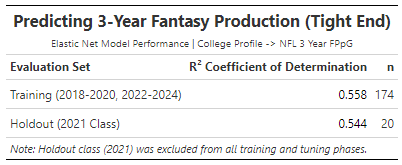
The tight end model EXCITES ME. I am actively trying to trade in my pre-draft leagues for two specific players. One of which, I am very confident in. If you would like to review my 2025 model, it is here. The R^2 for the 2026 model is .558 and I do believe it is the best Dynasty model out there. Enjoy. Data will be at the end of the post.
For the past eight seasons, I have been obsessed with predicting NFL outcomes given college production, metrics, and athleticism data. In 2026, it is clear that we have more information than ever and parsing out what to pay attention to can be difficult. Unlike most other platforms who have been around for a few seasons, PFF’s deep history of collecting data at both the college and NFL level since 2014 allows us endless possibilities to create statistically robust models.
This article is going to focus on my 2026 Tight End model and predicting future NFL success for 2026 rookies given their college production, explosiveness, athleticism, and PFF grades. I will be defining future NFL success for this article as the average fantasy points per game in a player’s first three seasons.
We are going to limit our sample to any player who takes a snap in the NFL or is drafted; I consider these NFL caliber players. To me this is a reasonable filter to have a healthy sample of players for our model to learn and intuitive enough to make practical sense.
This model utilizes a tuned Elastic Net regression to forecast three-year fantasy production by analyzing deep-level interactions between PFF grades, RAS, and collegiate production metrics. By cross-validating across multiple draft classes, the algorithm identifies the optimal balance of variables to isolate the stickiest indicators of NFL success.
In a similar fashion to the wide receiver model, I broke every player down into a seasonal basis and looked at some key metrics:
Coverage Strength of Schedule: using PFF coverage grades for every defense a given wide receiver faced, we can create a tailored strength of schedule coverage grades. To further improve this, we can decompose every conference into average heights, weights, and recent draft scores. When combining the two, we have a much better picture of how well the defense is able to cover any given wide receiver.
Teammate Quality Score: For receivers, teammate quality has a direct effect on potential targets. If Brock Bowers is competing with George Pickens and Ladd McConkey, we should treat his situation differently than if he was without any competition. I created a Teammate Quality Score based on the weighted PFF receiving grades of other players on a given receiver’s team.
Actual Production Metrics: Lastly, I used traditional production metrics like Yards per Team Pass Attempt and Seasonal Dominator as well as some improvements on those traditional metrics that I created.
After creating all these seasonal variables for each tight end, I used principal components analysis to create a raw season score. This gives us an overall idea of how “good” any given tight end’s season was. To take this a step further, in conjunction with their age and strength of schedule, I use season scores to compute an overall career score.
For example, we want to exponentially reward a player like Brock Bowers who excelled against SEC competition while he was very young. We might want to punish a player’s production if they are old and playing weaker competition. All of this data wrangling and math comes together to form my career production score.
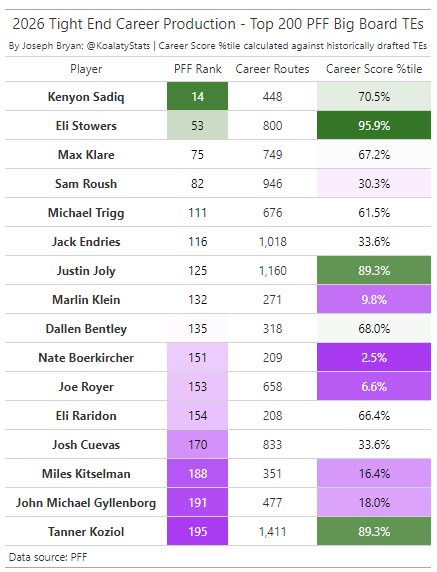
Note: the tight end production score focuses on receiving ability and does not take any run blocking into account.
Kenyon Sadiq is the consensus #1 tight end in the 2026 draft, but his production falls behind a few other tight ends in this class. Sadiq’s best season was in the 58th percentile of tight end seasons. Most tight ends, even when drafted, are not very productive. When comparing Sadiq’s career score to drafted tight ends, he falls in the 70th percentile, but when comparing to first round tight end selections, Sadiq’s career score falls in the 27th percentile.
Eli Stowers on the other hand has three seasons scoring better than a 71st percentile season score. His two seasons at Vanderbilt each earned a 95th percentile season score.
Below here lies: Explosiveness, Athleticism (including some in game athleticism metrics), PFF grade percentiles against historically drafted players, and the final model results. I will also go over my thoughts towards sleepers and players that i would consider “must have” or “must stash”
I provide year-round football content including weekly writeups during the season, dynasty, and redraft!
Comments
Nothing yet. Say the first thing.
Sign in to join the conversation.