
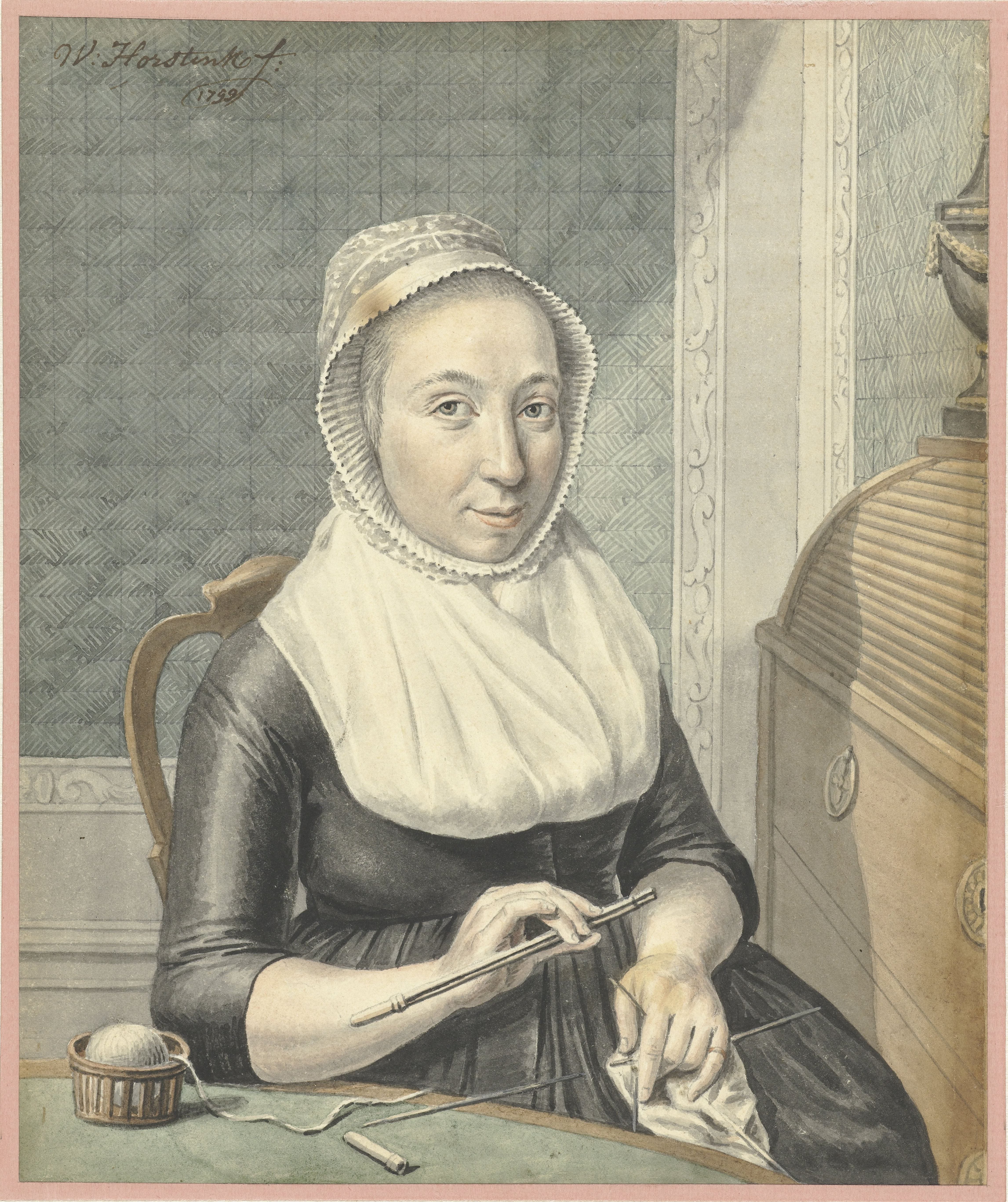
In 1814, a woman from Cotterdale in the Yorkshire Dales was recorded walking three miles to market at Hawes, a bag of wool balanced on her head, knitting the whole way there. She knitted while she bought and sold. She knitted on the walk home. By the time she reached her own door, she had, more days than not, a finished pair of men’s stockings to show for the round trip. Nobody thought to marvel at it: in the dales, knitting while doing something else entirely was simply how it was done. The tool that made it possible was a knitting sheath, a small carved piece of wood tucked into a belt or an apron string at the hip, with a hole bored in one end to hold a needle steady. With one needle anchored, her other hand was free to move without the job of holding anything in place. It worked, in effect, as a third hand.
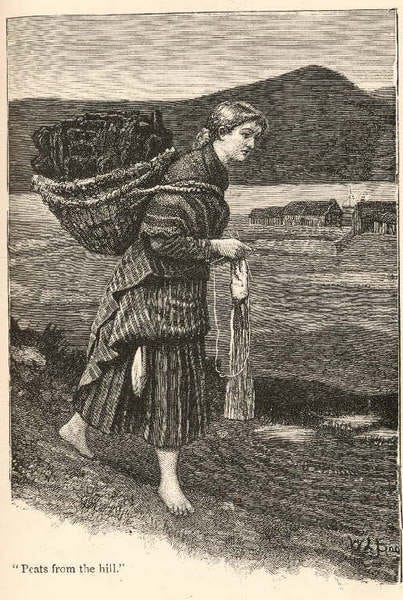
From the sixteenth century onward, hand knitting became a serious source of income across the hillier, wool-producing parts of the British Isles: Wales, the north of England, the Highlands, Shetland. Stockings knitted in Swaledale and Wensleydale alone were worth at least £40,000 a year in the 1820s, carried to market at Richmond, Kirkby Stephen, and Kendal, where in 1770 some 5,000 people worked in the stocking trade. Knitting schools opened in York in 1590 and Lincoln the year after, teaching children the craft early enough that speed became second nature. Everywhere this kind of knitting took hold, some version of the sheath came along with it.
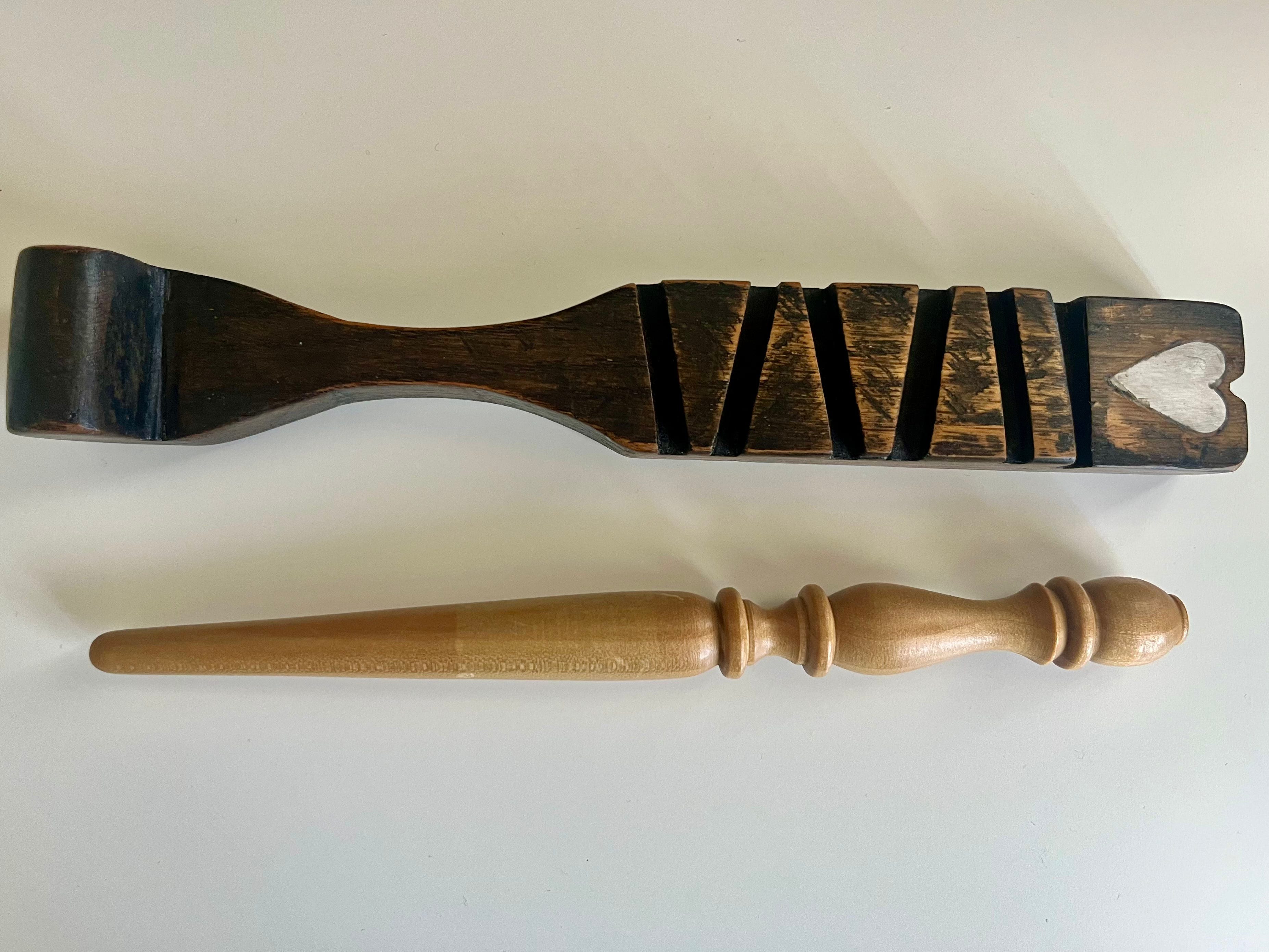
In the Dales, sheaths were carved into shapes now catalogued by name: the goose-wing, the spindle, the chain, each valley developing its own profile so consistently that an unlabelled sheath can often be placed within a few miles just by its silhouette. Shetland knitters used a leather pad stuffed with horsehair and pierced with holes, worn as a belt. Women in Aberdeenshire twisted a tight cone of straw. Cornish knitters favoured a long straw cushion they called a “truss.” In parts of America, a goose quill sewn into a scrap of cloth and pinned to the dress did the same job with nothing but a feather and thread. The sheath turns up in even stranger places, too: an 1837 medical treatise records a Paris surgeon, in the year 1700, extracting a knitting sheath, several inches of turned boxwood, from a patient who had evidently not been using it to knit.
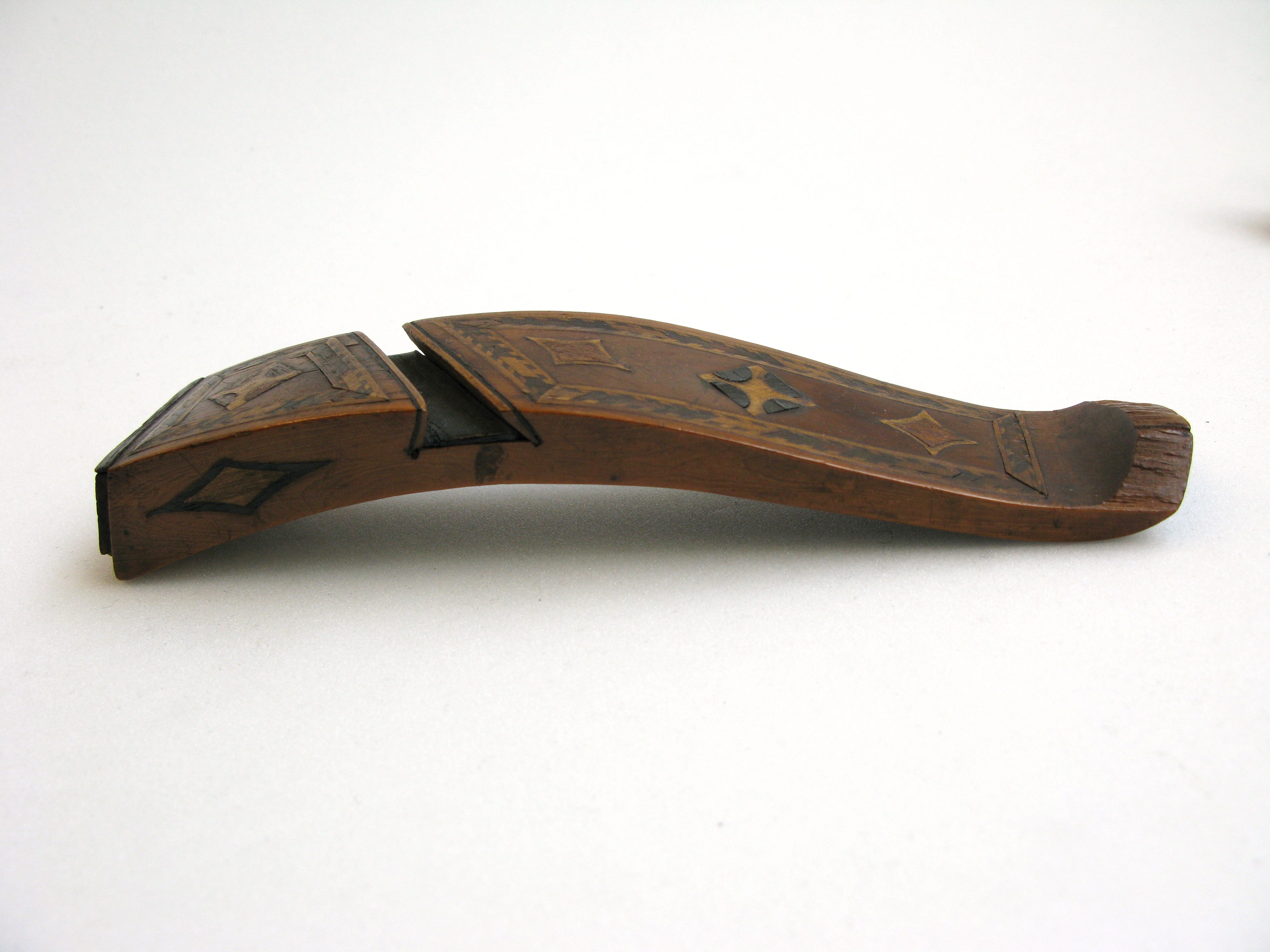
Wooden sheaths were also often love tokens: carved by young men for the women they intended to marry, dated and initialled, sometimes with a line of verse worked into the wood. “My hart is fixt, I cannot change, I like my choice too well,” reads one from the eighteenth century. Others simply carry a date: 1679, 1728, 1843. But the sheath’s true job had nothing to do with romance. As one long-time collector of them put it, they were “just the thing for poorer people, people who could not afford to stop knitting, and people who had to knit on their feet.” Speed was income, and income depended on never quite putting the work down.
The sheaths that survive into museum collections and private hands are disproportionately the carved, dated, sentimental ones, the kind somebody’s family kept in a drawer for generations before giving it to a museum. A plain sheath with no heart, no initials, no love story attached to it did the real work: propped at a hip for ten or twelve hours a day, worn down, split, or simply lost.
By the early twentieth century, this kind of income knitting was already becoming rare. One of the last people in Dent to depend on it, Mary Allen, still used a knitting stick well into the 1900s. A pair of fingerless gloves she made for her brother, heading to France in the First World War, survives today at the Dales Countryside Museum with the words “God be with you” knitted into the pattern. But even as that generation’s grandmothers kept a sheath in a drawer somewhere, the practice everywhere else had been pushed out by fashion, and then policy.
Sometime around Victoria’s accession, upper-class English knitters took up a new way of holding their needles, gripped like a pen, wrist turned, meant to look graceful. A trade paper in 1888 sniffed at the sight of women knitting at a concert, calling it a “new freak,” dwelling on the rings on her fingers and the elegance of her hands and saying almost nothing about her stitches. The style was slower than sheath knitting and less practical, and that was rather the point: it signalled that a woman knitted for pleasure, with no need to earn a wage by it. Working knitters copied the elegant style before they ever gave up their sheaths. School authorities finished the job, steering children away from the supported-needle method on the grounds that it was “harmful to the posture, producing a weak chest and rounded shoulders.” A tool built for economic survival was retired for looking poor.
It has started to make a come back, in pockets. Gansey knitters chasing the tight, even gauge those sweaters need have started picking the sheath back up, or its Norfolk cousin, the “shield,” because a needle held steady at the hip takes over a job that unsupported hands otherwise do alone, and that eases strain for a lot of knitters over a long session. Shetland’s leather knitting belt never really went away: Hazel Tindall, holder of the actual, verified world record for fastest knitting (85 stitches a minute, a long way short of the 200 sometimes claimed for the old Dales knitters, but real), still knits with one at her hip.
I have been trying the knitting sheath and Shetland-style belt myself these past few weeks. Something that common for that long doesn’t just disappear without a reason, and I wanted to find out what a tool built for full-time income knitting still has to offer someone who does this for pleasure, not a living. The belt I have had more practice with, and I can already feel why it persists: it holds the needle steady enough that one hand stops doing two jobs at once, and I feel I can knit for much longer periods than before. The sheath I am still working out, mostly the angle of it against my hip.
The fairest test of a tool like this is to use it for what it was probably used for most: a pair of 1880s-pattern men’s stockings, knitted on 1.5mm needles, as called for in the pattern. I bought the yarn for this last week, and managed to get started over the weekend. If you want to follow along, I’ll be posting progress on the stockings every couple of weeks, for paid subscribers.
Peter Brears, “The Knitting Sheath,” Folk Life 20 (1981–82): academic survey, cataloguing regional sheath types across northern England and Wales from provenanced museum collections.
Irena Turnau, “The History of Peasant Knitting in Europe: A Framework for Research,” Textile History 17:2 (1986): a country-by-country survey of peasant knitting across Europe.
Anu Pink, “Knitting Style: The Grace of Noble Ladies or the Speed of Peasant Girls?” Studia Vernacula 11 (2019), pp. 64–77: on the Victorian shift to “elegant” knitting.
Mary Thomas, “Mary Thomas’s Knitting Book” (1938), excerpted at principlesofknitting.com: the primary twentieth-century account of how sheath knitting was actually done, with a useful modern fact-check of her speed claims.
June Hall, “North of England Knitting Sheaths,” PieceWork (2017): a Cumbrian collector’s account of regional types and the economics of the northern stocking trade.
“The Terrible Knitters of Dent,” Out of the Box Learning / Dales Countryside Museum: the source for Mary Allen’s First World War gloves.
Jeni Hawkins, “A Knitter’s Day Trip: Dales Countryside Museum,“ Modern Daily Knitting (2023): a lovely account of the knitting sheaths and other treasures on display at the museum in the Yorkshire Dales.
Comments
Nothing yet. Say the first thing.
Sign in to join the conversation.