
This week: A hosts' hangout marking one year of K-Pop Demon Hunters. Jo, Andy and Emily reconstruct how the film moved from a modest start last summer to a fan-powered franchise, and ask what Netflix needs to do to bridge the gap to the 2029 sequel.
K-Pop Demon Hunters dropped on Netflix on 20 June 2025 without major fanfare, in fact, the first week was modest. Then the audience found it, Netflix put all the music videos on YouTube the same weekend, and by week five the film had passed Leo as the biggest animated film on Netflix at the time. A year on, the wins are stacked: an Oscar, toy deals with Hasbro, Mattel and Jazwares, late night appearances, an NFL halftime show and a Macy’s Thanksgiving Day Parade slot. The question now is what comes next.
Andy’s take is that the slow start may have been a hidden advantage. The audience took ownership of the film before the industry caught up and named it a hit, so by the time week five arrived and the records started falling, the property already belonged to its fans. That is important. A bigger opening might have positioned it as a Netflix release, and thus been perceived as overly corporate. The quieter one let it become something kids felt they had discovered.
Jo’s recollection backs this up. The KPDH phenomenon sits in her memory as an autumn moment, because September was when the playground currency really took hold. Teens came back to school singing the songs, planning Halloween costumes and trading dance routines. The music did its work over the holidays, and the back-to-school routine supercharged the IP at a point where the trajectory normally starts to turn downward.
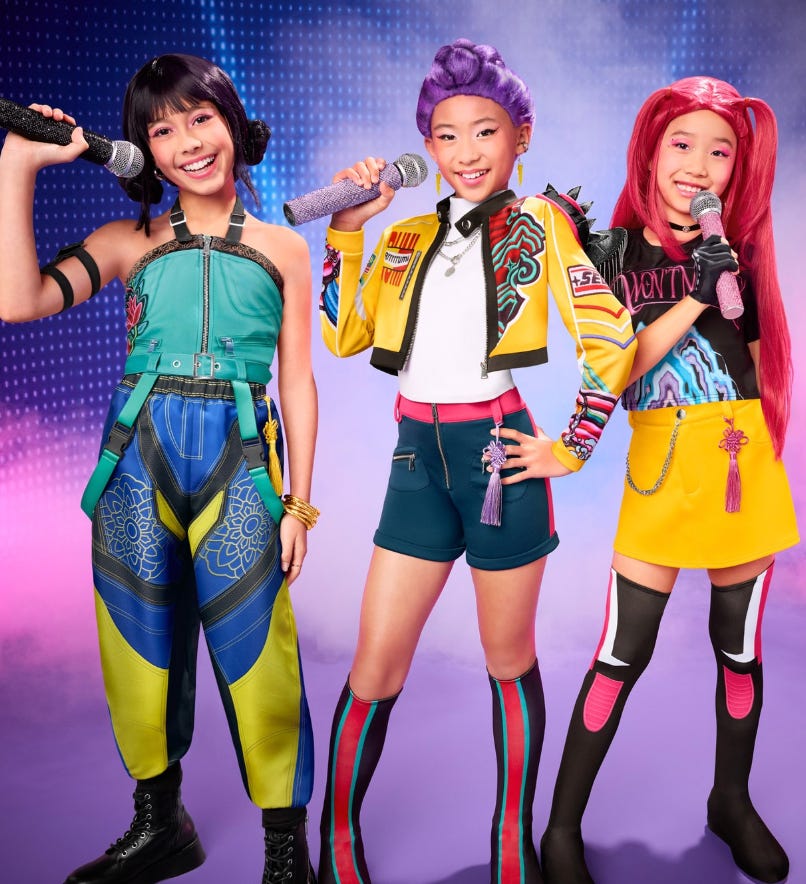
Emily made the case that streaming was central to the ignition. Kids could rewatch the film in each other’s houses, learn the choreography on the green outside and return to it again and again. The High School Musical parallel sits here. Pre-streaming, Disney Channel would play the premiere movie once or twice a day for three weeks to bed it in. Streaming hands that same repetition to the audience to control, and it’s a key factor in turning them into fans.
Emily also pointed out that the title itself, K-Pop Demon Hunters, may have been a barrier for parents at the cinema box office. Paying for a ticket for an eight-year-old to see something with “Demon Hunters” in the name is a different ask to letting them put it on at home. Streaming helped sidestep any hesitation.
The multiplier then came from the music ecosystem. The IP lived on Spotify, on radio and on Netflix simultaneously. Andy drew the parallel to Bluey’s concurrent run on ABC, Disney and BBC. Cross-platform presence at scale makes a property feel everywhere at once.
Jo’s Roblox tracker tells the clearest version of the fan-powered story. At its height there were over 300 unofficial K-Pop Demon Hunters experiences on the platform. A year on, the official Netflix and Twin Atlas experience is still only the fifth most popular K-Pop Demon Hunters experience on Roblox. Four fan-made experiences sit above it. Netflix has taken a sensible approach and lets the fanbase do what it wants there.
That is a striking data point for a 2026 franchise. The owner of the IP is not the most popular destination for its own fans inside the largest UGC platform. The fan economy is doing work the official rights owner cannot replicate. This is a new shape for IP management, and one to watch especially as other digital-native franchises emerge.
The sequel is scheduled for 2029, a four-year gap from the original. But it’s going to be key to get the sequel right, even at the expense of whatever franchise appetite Netflix quarterly earnings demands. A bad sequel melts the entire thing. The conundrum is what fills the space between now and then.
Netflix’s franchise management has been strong. Music video playlists on the service ranked as the 18th biggest TV title on Netflix in H2 2025. The PR run and consumer products rollout, including the dual Mattel and Hasbro deal, have been a credit to the team. Plush is on shelves at WHSmith and Penneys. Mattel’s doll line came with significant pent-up demand. But Emily’s point remains; that there is no new story content. A year in, fans have the original film and nothing more.
Andy mentioned the comparison made against Frozen. Frozen sat in a pre-social media moment with less competition for attention. K-Pop Demon Hunters fans are swimming in a sea of infinite content, and silence in that environment is a faster slide into anonymity than it was a decade ago. Netflix has to empower the fan base actively rather than assume it will hold.
Jo’s suggestion was lower-lift content between now and 2029: graphic webtoon-style story extensions, vertical microdramas focused on character relationships rather than grand narrative. Andy liked the microdrama route, pointing to the soap opera elements in the source material. Song fragments referenced in the episode are already being extended by fans into full versions. Emily mentioned material ‘from the cutting room floor’ that came from the original creative team gives Netflix something to work with that does not risk stepping on the 2029 storyline.
___
Here’s a previous post you might like 👇🏼:
WEBTOON’s Sydney Bright on turning webcomics into animation.
·
May 18
This week: A conversation with Sydney Bright, Head of Global Animation at WEBTOON, on how the world’s largest digital comics platform identifies titles for screen adaptation, the signals to streamers from the 145 million monthly readers, and why community IP is becoming one of the most defensible assets in family development.
___
Netflix has another animated film, Swapped, reportedly tracking as their second biggest animated title behind K-Pop Demon Hunters. Two consecutive hits would start to look like a strategy, though Emily was clear we need another one or two before it can be called a formula. Sea Beast and Leo had momentum that did not sustain. Whether Swapped marks a return to form or a one-off matters for what kids producers can expect from Netflix’s animated slate.
The live concert deal is another marker. The format will not feature in-film characters in person but a replicable touring experience built around the music IP. Execution will tell us a lot about how Netflix thinks about their IP extension beyond screen.
A year on, the K-Pop Demon Hunters story is a useful corrective to the assumption that opening weekend is the most important number. Fan ownership, music multipliers and patient release cadence built something durable when the conditions were right. The four-year gap to the sequel is the next test, and how Netflix fills it will define whether this stays a decade-defining franchise or fades back into the catalogue.
Listen to the full Kids Media Club podcast episode for the full hosts’ hangout on a year of K-Pop Demon Hunters. Connect with us at www.kidsmediaclubpodcast.com or find Jo Redfern, Andy Williams and Emily Horgan on LinkedIn.
See you next time!
No posts
Comments
Nothing yet. Say the first thing.
Sign in to join the conversation.