
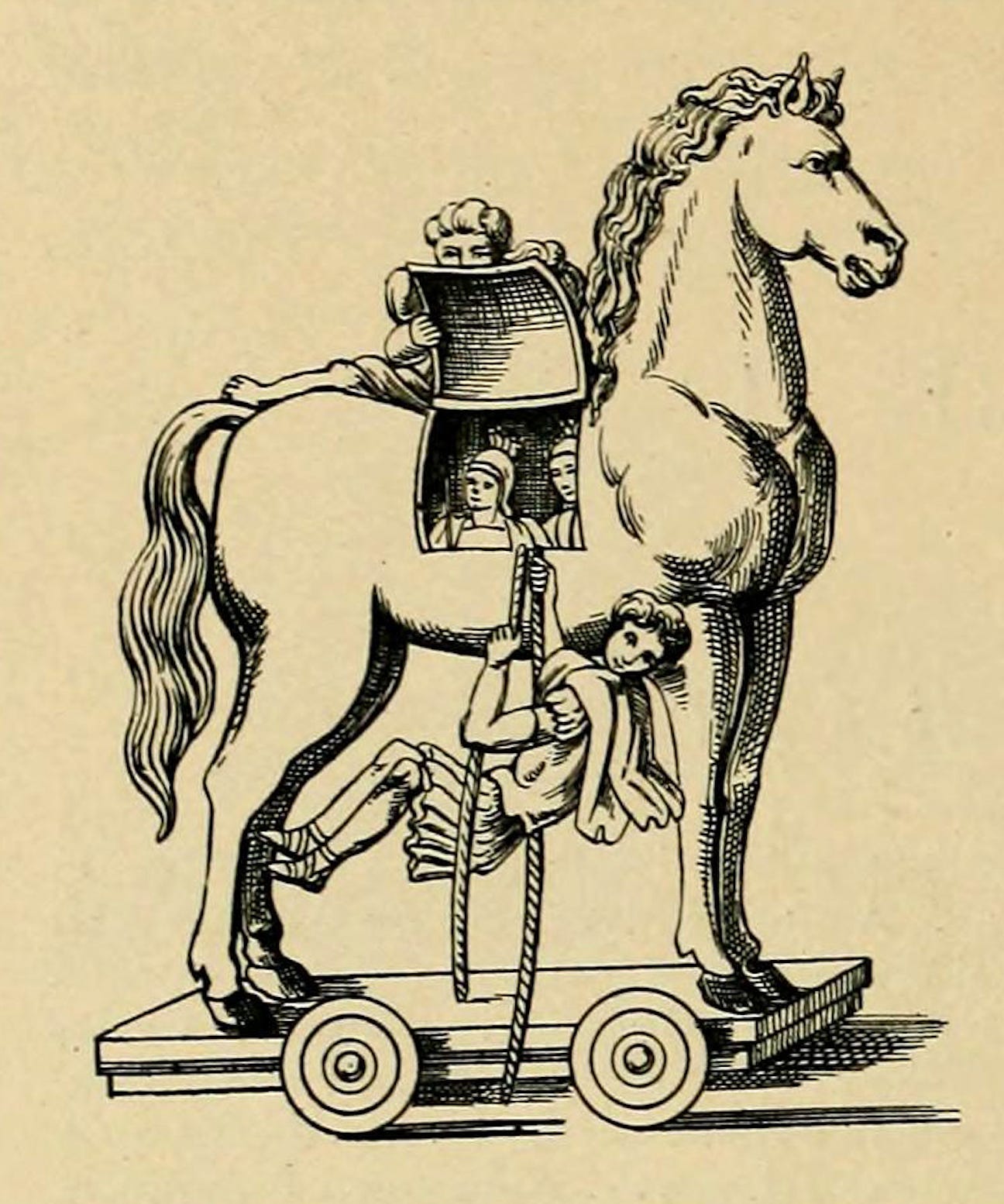
Trojan horse from Histoire des Jouets, 1902
Coming soon…my best ever pancake recipe. No buttermilk, no baking powder, no nonstick pan. But first, this, which I’ve been working on for a while.
With Christopher Nolan’s new Odyssey film out, my mind is swirling with Trojan horses. In Homer’s poem, the hollowed-out wooden horse ‘chock-full of fighters’ from the Greek army actually features only briefly. Here is how the deception of the wooden horse is recounted in my sister Emily Wilson’s wonderful translation (which by the way has returned to the bestseller lists off the back of the Nolan film, which is pretty great going for a nearly 3000 year-old text!):
‘Meanwhile,
Odysseus brought in a gang of men
into the heart of Troy, inside the horse.
The Trojans pulled the thing up to the summit,
And sat around discussing what to do.’
Ultimately, the Trojans decide to treat the horse as harmless and leave it inside their gates to ‘pacify the gods’ and therefore Troy is ‘doomed to ruin’.
In the film, the horse plays a bigger role than in Homer - and why wouldn’t it, when you have a Hollywood budget and a marvellous props department? I thought the horse itself looked extraordinary though I couldn’t quite convince myself that Matt Damon had been the wily genius behind the plan. Still, no matter how many times you have heard the story of the wooden horse, it never loses its power. The Trojan horse succeeds because it looks like a gift to the gods. It gets welcomed in by the very people who will be hurt by it.
This story of trickery and things being welcomed in when they shouldn’t be made me think of the ultra-processed food industry. The UPF industry offers us things that look so much like gifts that we bring them inside the hallowed ground of our own homes. Some of those gifts are simply the products themselves in all their comforting familiarity: the sweetness, the saltiness, the crispness and the softness and all those cherished memories of family celebrations or good times with friends. It’s a rare person who doesn’t harbour some fondness and nostalgia for at least a few ultra-processed foods and drinks and probably dozens of them (I know I do). We remember how our Grannies fed us plates of custard creams; or how we drank Diet Coke with our friends until we were giggling from the caffeine; and we are already primed to have someone come along and tell us that the ultra-processed scare is a bit of a fuss about nothing.
The industry also offers us ‘gifts’ in the form of consoling stories which make us believe that they are on our side in this complicated world of modern eating - they make us think they are against shame, against elitism, against feeling of being judged for what we eat.
It is hardly news that the ultra-processed food biz is brilliant at marketing itself. The very definition of a UPF - according to Carlos Monteiro, the Brazilian scientist who first came up with the concept - is that they are products that are ‘aggressively marketed’ to give them market advantages over real food. But the part of this story that doesn’t usually gets told is that the marketing doesn’t just happen through adverts and food labels. The most effective food marketing of all is the kind that we don’t even recognise happening because it’s a series of thoughts we have allowed to be planted in our own brains by people we trust. These thoughts become so well-grooved that we don’t spot them as intruders. These arguments encouraging us to trust UPFs get broadcast on social media or in newspaper articles or even in newsletters by friendly voices who, like that horse, are not what they seem.
‘You can help derail the cycle of shame’ said a speaker addressing a room full of American dieticians at a food conference in 2023. Who was this person? A public health researcher? A food psychologist? An eating disorder expert? No. As reported in a brilliant investigation by The Washington Post and The Examination in April 2024, this was Amy Cohn, a senior manager for nutrition and external affairs at General Mills - a food company whose breakfast cereal brands include Lucky Charms, Cinnamon Toast Crunch, Trix and Cheerios. Cohn’s presentation at the food conference positioned General Mills as being part of the anti-diet movement. According to The Washington Post, Cohn ‘denounced the media for “pointing the finger at processed foods” and told the dietitians in the room that they could help combat this harmful shame.
In the course of 2024, at least ten professional dietitians went on Instagram or TikTok using the hashtag #DerailTheShame and tagging General Mills. Some of the dietitians - who used the hashtag #sponsored indicating that General Mills was rewarding them in some way for their content - also posed with packets of Cheerios and talked about how affordable and healthy and vitamin-enriched the cereal was.
This #DerailTheShame campaign was far from a one-off. The Examination’s excellent investigations on this subject have revealed multiple other examples of dieticians, doctors and fitness coaches on Instagram and TikTok pushing industry-friendly messages ‘such as advice to let children eat unlimited sweets and reassurances that aspartame, a common sugar substitute in diet sodas, is not unhealthy’. Social media gurus with millions of followers were being paid by The Canadian Sugar Institute and The American Beverage Association, a lobbying group representing Coca-Cola and PepsiCo, among others.
Another hashtag much-used by industry-paid influencers was #safetyofaspartame. In 2023, the World Health Organisation changed its stance on aspartame, classifying it as ‘possibly carcinogenic’ to humans. Industry-paid influencers were quick to respond with a series of messages which sounded eerily similar to one another. Some of the influencers posted videos insisting that aspartame did not cause cancer in humans and saying that a small adult would need to consume as much as 36 cans of Diet Coke a day before it posed a risk. These videos did not make it clear that the posts had been paid for by lobbying groups for the soft drinks industry.
The fact that industry was working so closely with social media influencers only came to light because in 2023 the Federal Trade Commission in the U.S. sent warning letters threatening penalties against a dozen health influencers - including a U.K. based doctor who has gained hundreds of thousands of followers from posts claiming to combat misinformation about food. Collectively, these influencers had over 6 million followers on Instagram and TikTok. As a result of this FTC crackdown, we now know that numerous posts from food and diet ‘influencers’ had failed to disclose who had paid them for their posts; or had made the disclosures in a way that it wasn’t ‘clear and conspicuous’ enough for a casual reader to spot. A month after the crackdown, most of the influencers had either deleted the posts in question or edited them to make it clear that they were paid ads.
This investigation from The Examination was particularly ‘jaw-dropping’ as food politics expert Maron Nestle wrote on her blog. But in a sense it was nothing new. Nestle own’ excellent book Unsavory Truth documented the systematic ways in which Big Food has skewered nutrition research by funding studies that are effectively marketing pretending to be science. One of the most notorious examples was Coca-Cola funding something called the Global Energy Balance Network which for many years promoted the idea that lack of exercise rather than what we eat was the key contributor to obesity. One of the leaders of this network was quoted in The Guardian in 2015 as having said that the media focused too much on “eating too much, eating too much, eating too much, blaming fast food, blaming sugary drinks, and so on”.
Remember these stories next time you see someone on social media suggesting that we must not ‘demonise’ ultra-processed food. The UPF industry’s biggest aim is to make sure we don’t stop buying their products so that they carry on making profits. Thanks to the excellent work of Chris Van Tulleken and others, the dominant place of ‘ultra-processed food’ in our lives is finally starting to be questioned by millions of people. The inevitable counter-response from industry is to try to sow doubt in our minds so that we keep buying.
In order to be effective Trojan horses, these influencer messages defending UPFs will look and sound superficially very plausible. They may even come from accounts which mostly seem to be promoting real ingredients and family cooking. You shouldn’t be expecting these influencers to say that ultra-processed foods are entirely without their problems. Thanks to Chris van Tulleken’s book, public opinion has moved on to the point where a blanket defence of UPFs as something entirely healthy would make us suspicious. The way to gain our trust is - as in the example above - by plastering their messages with with arguments or positions that almost anyone would agree with such as ‘shame is bad’.
The thing about effective propaganda is that there will always be plenty of truth scattered into the mix. The people delivering the message may even present themselves as warriors against food myths and lies. If you heard someone - even someone you trusted - simply deliver a message such as ‘ultra-processed foods are great for your health’, you might not believe them. But if you hear them say ‘shame about food is terrible and therefore we mustn’t attack ultra-processed foods’, that’s a message you can more easily get behind. Weight stigma is real. Body shaming is real. And these things are both horrible, toxic things that blight the way people feel about themselves and undermine the joy of eating. I can imagine a younger version of myself being very susceptible to a message such as #DerailTheShame.
For most of my teenage years, my eating was somewhat disordered and I was in a cycle of binging and restricting. A miasma of shame hung over me every time I ate anything I didn’t deem to be ‘good’. I also had close friends who suffered miserably from anorexia and I hated to see how, eaten up by shame, they denied themselves their own right to nourishment: this most basic of human needs. Social media didn’t exist then but if it had existed and if I had seen a beautiful young dietitian telling me we should stop being ashamed and just eat more Cheerios, it would have pushed many of my buttons (not least because I have a soft spot for American Cheerios which are so much tastier than the British ones). Back then, I would have been automatically and unthinkingly pro anyone who said they were anti food shame. I probably wouldn’t have imagined in my wildest dreams that #DerailTheShame was a smokescreen paid for by industry because it would have looked like a gift to me.
It’s now pretty clear that the Ultra-Processed Food industry has borrowed the tactics of Big Tobacco in manufacturing doubt in our collective minds about the extent to which their products are to blame for the huge rise in diet-related ill health over the past couple of decades. For anyone who is still unsure about the evidence base on UPFs being a key driver of chronic diseases around the world, there was a very thorough overiew in The Lancet last year. This review found that the probability that a high UPF diet is bad for human health is ‘substantiated by more than 100 prospective studies, meta-analyses, randomised controlled trials, and mechanistic studies, covering adverse outcomes across nearly all organ systems’.
What the #DerailTheShame campaign shows - is that anyone who spends any time on any kind of media, social or otherwise, will have been exposed to some arguments about food which are actually coming from and being paid for by the Ultra-Processed Food Industry, even if it seems as if they are coming from somewhere else. These arguments might be voiced by someone who has worked hard to build up our trust, such as feeding gurus with thousands of followers, authors, nutritionists, TV presenters, even a genuine medical doctor or a university professor.
And this industry funding of influencers is nothing new. More than ten years ago in 2015, following criticism after The New York Times broke the story of Coca-Cola’s funding of the Global Energy Balance Network, the company vowed to be more transparent about its funding of advocacy. Coca-Cola disclosed that over a five year period, it had paid nearly a hundred million dollars on partnerships with health organisations including more than $2 million directly to 115 health experts. Coca-Cola didn’t disclose exactly what these experts were being paid to do. What we do know is that more than half of them were dieticians, a fifth were academics and the rest were mostly medical professionals, fitness experts, authors and chefs. According to reportage by Kyle Pfister on observer.com, some of the dieticians spoke up to defend aspartame against safety concerns while others had been vocal about the supposed benefits of mini cans of Coke as a sensible ‘snack’. Other experts funded by Coca-Cola had written popular nutrition books, one of which presented mini cans of Coke as a great way to do ‘mindful eating’!
How can we get better at spotting these ultra-processed smokescreens? There are certain tropes and arguments about UPFs that come up time and again from their critics and I’ll get you started with five of them.
Am I saying that every person who talks about food on social media or mainstream media in these ways is part of the UPF lobby? No. It’s perfectly possible to be a defender of ultra-processed food just because you can’t bear anything that looks like health faddiness or foodie-ism; or because you genuinely adore Twixes and Pringles and packaged breakfast cereals; or because you’ve been drinking two cans of Diet Coke a day most of your life and ‘it never did you any harm’.
There’s also the fact that many people defending UPFs against its critics may be ordinary people who have been genuinely convinced by the industry-paid influencers. This lobby has been so effective in doing its job that over time, the rest of us start doing their job for them (not least because we are almost all eating and loving at least some of their products). That’s exactly how it works.
If you are wondering whether something is an industry Trojan Horse or a genuine opinion, a simple rule of thumb is to ask yourself: who really benefits from these arguments? Remember that on the surface, a skilled UPF lobbyist will be telling you that they are on YOUR side and fighting only for YOU against the food shamers and the elitists. But if you dig a little deeper, the real beneficiary is always the industry.
‘We mustn’t demonise ultra-processed food’ (also sometimes expressed as ‘we mustn’t shame ultra-processed food’ or ‘we mustn’t be judgmental about ultra-processed food’). I’ve already discussed this a lot here but it’s worth repeating because it is such an effective UPF Trojan horse and used such a lot by those serving as a front for industry.
Part of what’s odd about the vehemence with which this argument gets made is that the people making it never seem to mention the role that the UPF industry itself plays in generating food shame. When you walk round a supermarket, almost every single food product which has loud diet claims on the label will be a UPF. From protein-fortified cereals to ‘light yoghurts’ and ‘diet’ or ‘slimline’ drinks to sugary ‘gut health’ kefir, there are thousands of UPFs blaring at you that there is something wrong with the way that you eat and drink and that you should try harder. A ‘light yoghurt’ (flavoured with artificial sweeteners) may make you wrongly feel ashamed for choosing a full-fat plain Greek yoghurt. A lower fat ‘baked’ crisp (made with potato flakes and emulsifier) seems to stand in judgment over an ordinary potato crisp made from nothing but potatoes, oil and salt.
There is a natural human impulse - and a generous one too - to be against ‘demonisers’ let alone 'shamers’ of anything. If I said ‘we mustn’t demonise crack cocaine’, or ‘we mustn’t demonise Nazis’, a part of you would want to agree because who wants to be a demoniser of anything? Just using the word ‘demonise’ raises the temperature of the debate and makes you want to rush to the defence of the thing being attacked.
The question to ask yourself is: am I being asked to refrain from shaming the people who eat these products? Am I being not to shame my own body? In which case, yes, let’s please stop with all the shaming and the judgment. Let’s stop talking about an ‘obesity crisis’ and start talking about a food crisis. There should be no shame for any of us who eats these UPFs when we live in a world in which it’s harder to avoid them than to eat them.
But it’s quite another thing if the underlying message is ‘we mustn’t demonise Nestle and Coca-Cola and Unilever and MacDonald’s’. In which case, there’s your Trojan Horse.
Comments
Nothing yet. Say the first thing.
Sign in to join the conversation.