
Since writing The Heart-Shaped Tin, people have sometimes asked me whether it was hard to come up with all the ideas for the chapters. And my answer is always the same. By far the hardest part of the writing was what had to get left out.
A little over a year on from publication, I am now more convinced than ever that the subject of kitchen objects and how they intersect with love and loss is infinitely expandable and adaptable. You could tell me your own version of the story and it would be both the same as mine and very different. Each time I talk about the book at events, people in the audience share their own stories about their own objects and they are often so profound and sad or funny or both that they could fill a whole other book.
On the subject of events, if any of you live in or near Letchworth, I’ll be talking at David’s bookshop talking about The Heart-Shaped Tin this Thursday. Tickets here. The ticket price is redeemable against a copy of the book. Do come along and bring your favourite kitchen object to talk about if you have one.
At other events, you have told me about the objects you cherish and the ones that enrage you because they remind you of agonisingly difficult relationships. You have told me tales of Crock Pots and mallets and cake slices. You have spoken about how it feels to lay the table with cutlery each night after a partner has died and you still put their special soup spoon on the table because you can’t bear not to. You have described the unquenchable longing you feel for family recipe books which have been lost or burned, especially when you are far from home. You have shared the happiness of a biscuit tin which has been in your family so long that multiple generations have eaten biscuits from it. You have told me funny quirky things about your favourite mugs and dishes and whisks (there is so much love for the rotary whisk out there!).
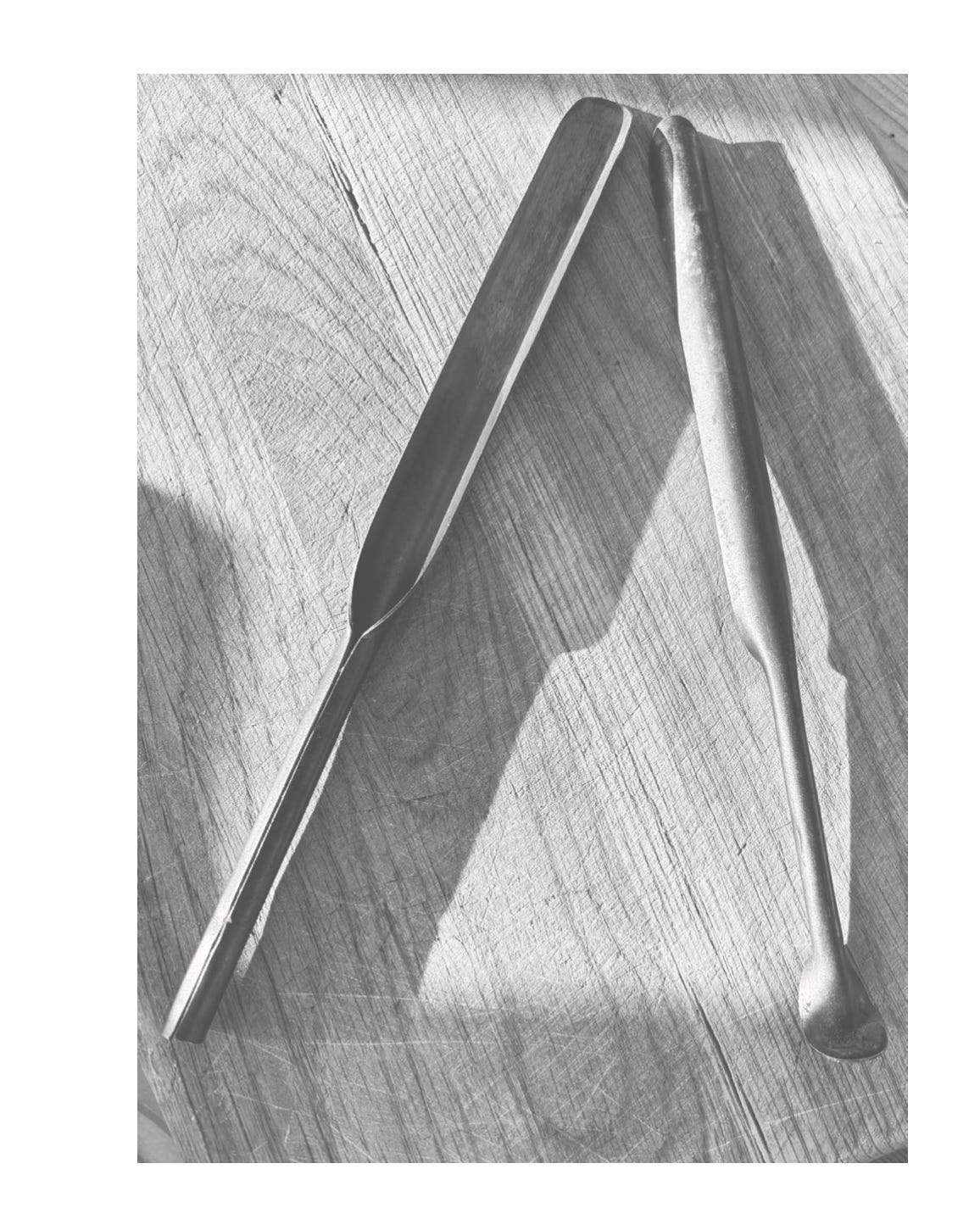
I have also had fresh conversations with some of the people I interviewed for the book. One of my favourite chapters to write was the one called ‘The Vegetable Corers’ about my friend Faraj Alnasser, a young Syrian chef who came to Britain as a refugee. He spoke to me of his love for two plain metal vegetable corers, given to him by his mother. These corers have become a symbol of home for Faraj because they take him back to a place he can never truly return to: a peaceful Aleppo, before his family was forced by the civil war to flee their home. When he holds these corers, he is transported to a totally different way of life when his mother and grandmother and aunts would all sit chatting, coring kilo after kilo of aubergines and courgettes (eggplants and zucchini) for making stuffed vegetables. Nothing can ever replace these corers for Faraj.
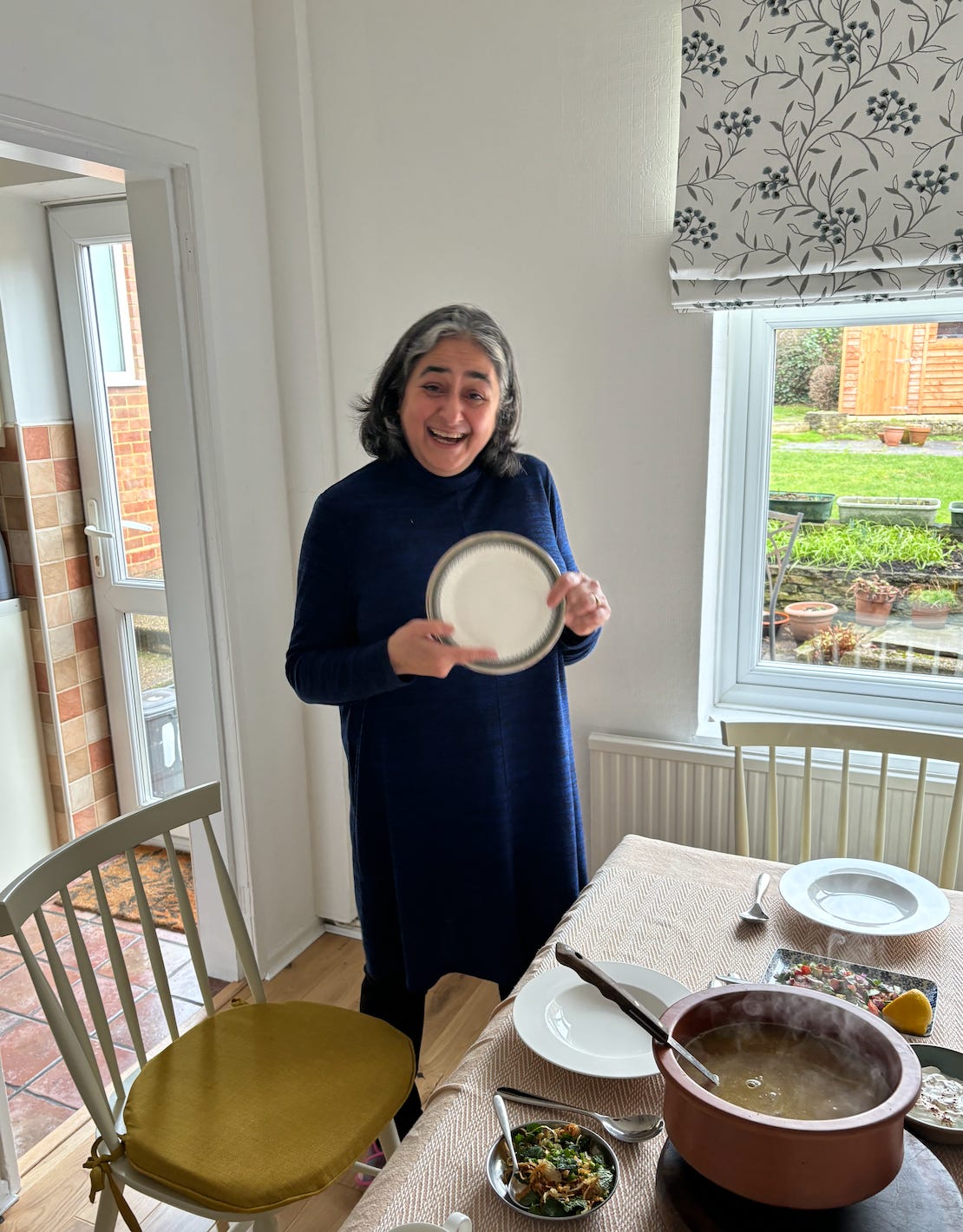
Last summer, Faraj showed me another object with an equally deep set of meanings. It’s a story which intersects perfectly with the one in the book about Roopa Gulati and her family’s dinner service which was too special to use in case it smashed; until her husband Dan was diagnosed with a brain tumour and she realised that life was too short and too precious not to use these beautiful plates, while she could.
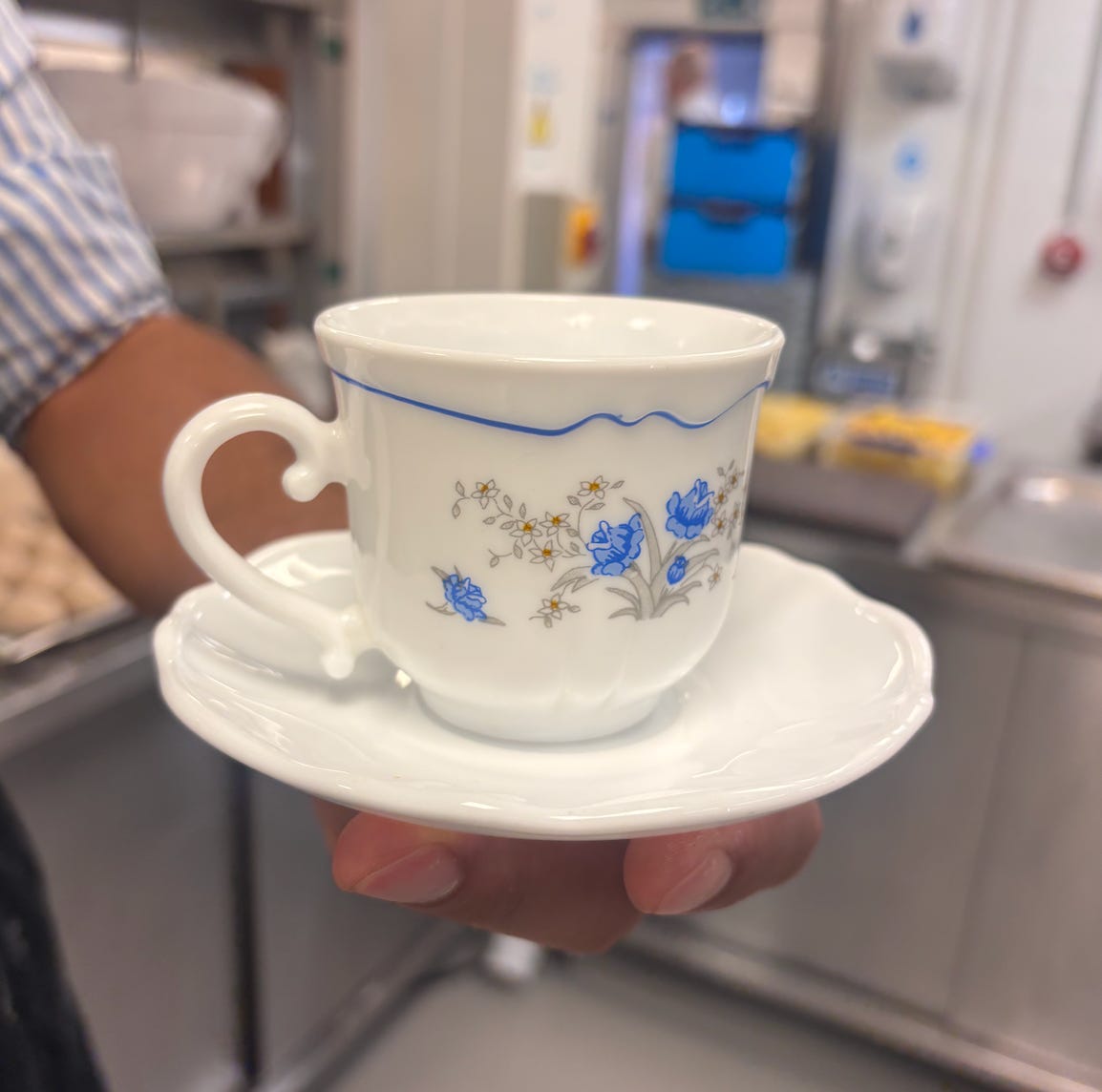
Faraj’s teacup, which he talks about in a video below, was also once too precious and fragile to touch. Back in Aleppo, before the war, it belonged to his mother. Growing up, he told me that he and his siblings ‘were forbidden to touch it and it was just behind the glass. We were allowed to look at it but we were not allowed to touch it’.
This teacup was bought by Faraj’s dad for his mum when they got married in 1992. After they left Syria for Egypt, the family lost most of their possessions. But when Faraj finally returned to their home after the fall of Assad, in 2025, more than a decade after they had left, he saw that the cup was faithfully waiting still ‘in the closet’! Most of the things in the house were smashed or gone yet the cup miraculously hadn’t broken.
Faraj told me that this cup not only reminded him of home but it even seemed to have traces of his mum’s touch still on it because she was the one who always held it. So he brought it back with him to the U.K. ‘to talk about it’. To hold it takes him back to being in the old house and seeing his mum ‘happy and smiling’, to remember her marriage day’.
When Faraj told me this story of the teacup, I was so moved. I hope he will collect all of his own stories one day. What a book that will be. And in the meantime, I hope you enjoy the video below as much as I did.
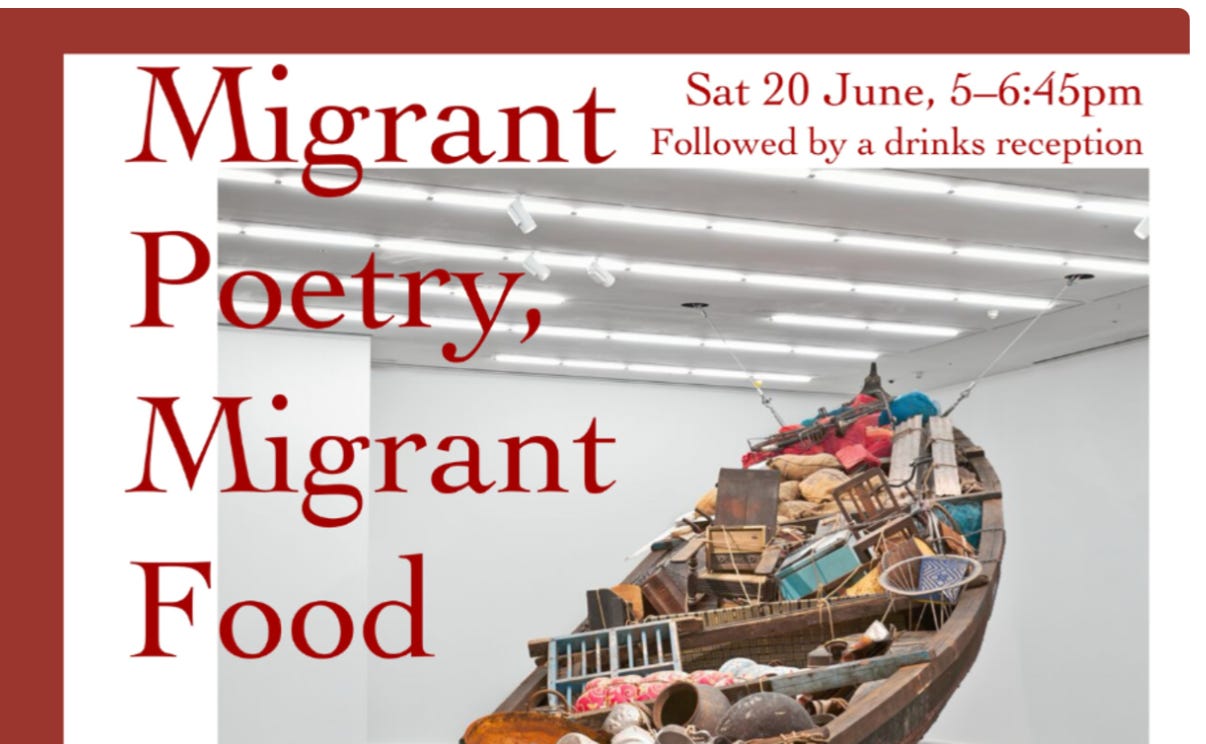
P.S. A few weeks ago, I had the great honour of interviewing Faraj as part of an event about Migrant Poetry and Migrant Food at Fitzwilliam College in Cambridge organised by my friend Subha Mukherji, who features in another chapter of my book (telling the story of her rice pan).
He spoke of how food was the only thing which seemed to heal him when he first arrived in England after a long and perilous journey during which he nearly died. Food and cooking took him back to Aleppo and his mother as nothing else could.
One of the stories Faraj told was of the rose petal jam he made one summer after he arrived in Cambridge. He smelled some damask rose petals in a man’s garden and suddenly felt that he was back in Syria in the spring time. He knocked on the man’s door and asked if he could have some petals to make his grandmother’s recipe for jam. At first the man who owned the garden was very grumpy and reluctant for anyone to take any of his petals but when Faraj handed him the jar of jam in return, he was delighted. Faraj phoned his grandmother to tell her how much the man had enjoyed her recipe and she was thrilled to think that the recipe had travelled all the way from Aleppo to Cambridge.
If you are interested in reading a full conversation about food between Faraj and Subha, there is one in a chapter about migrant food in Subha’s book CROSSINGS, which also features a wonderful interview between Subha and Claudia Roden (although the book as a whole is only partly about food).
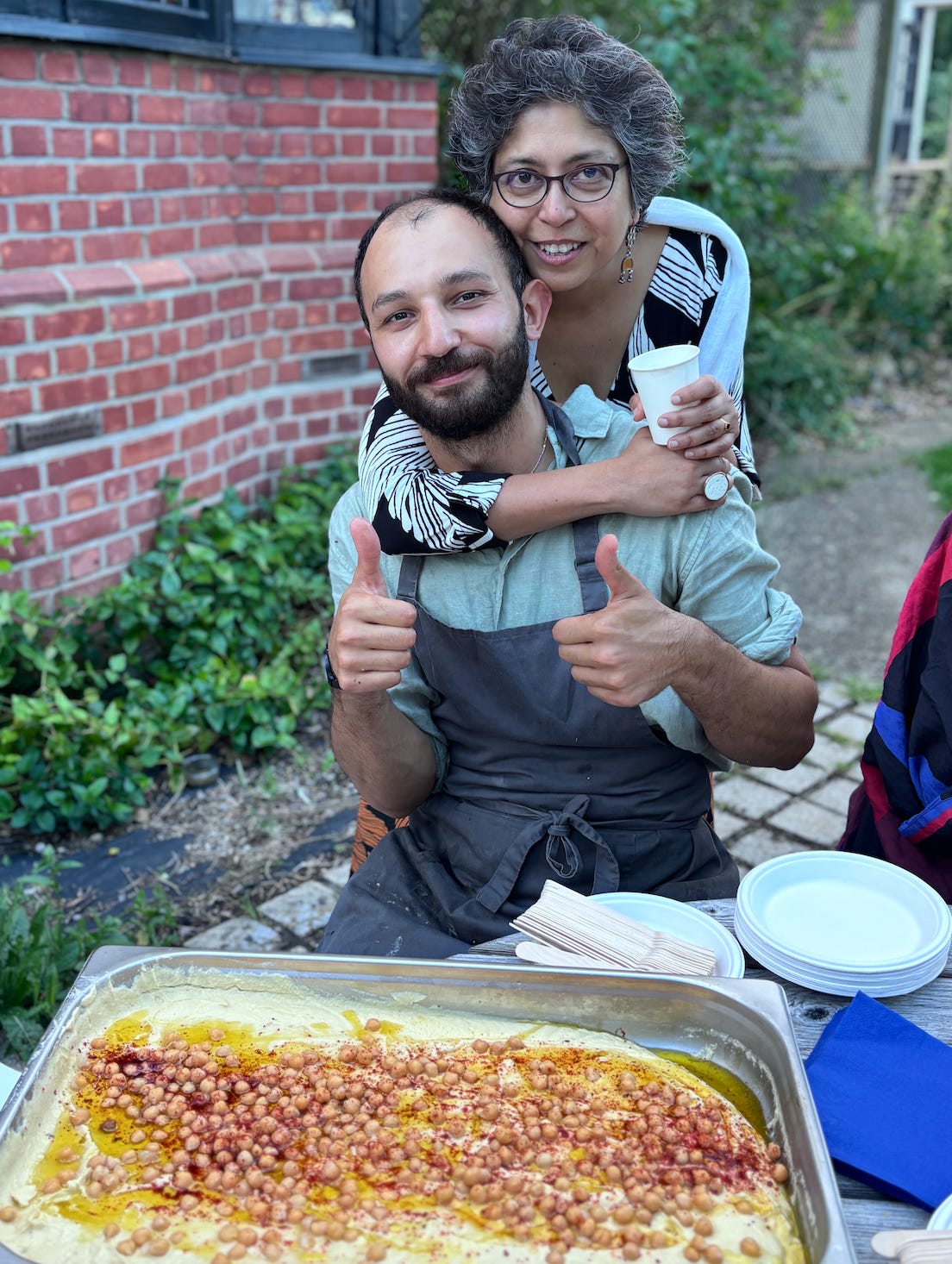
At the event, Faraj not only spoke beautifully about his experiences but he had also done the catering for sixty people. As well as the most glorious bread and salads and falafel and a rice dish flavoured with vine leaves and muhammara, there was hummus. Faraj’s hummus is the best I’ve ever tasted. It is lighter, smoother and more ethereal than other hummus. He actually uses a much higher percentage of the cooking water for the chickpeas than most recipes advise and he soaks and cooks the chickpeas for such a long time that they come out silky without any need to remove the skins.
The thing that fascinates me is that Faraj didn’t grow up watching his mother make it - the family always went out to buy their hummus from a 200 year-old hummus shop. But through his senses, he was eventually able to recreate it with the chickpeas he found in England.
Here are Faraj and Subha and the hummus at the June event! If you think that’s a lot of hummus, you should know that it vanished in minutes!
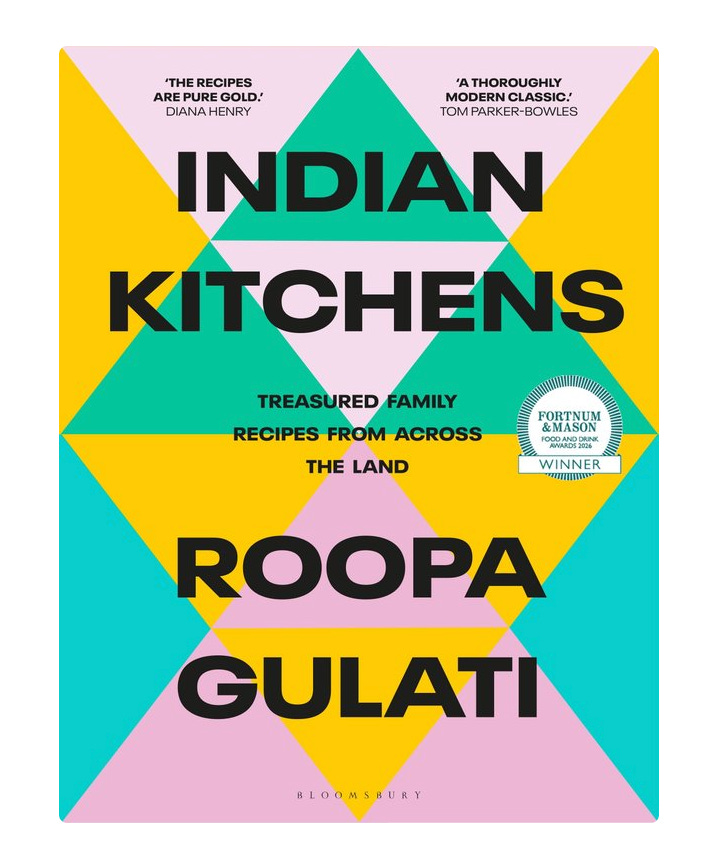
P.P.S. On the subject of Roopa Gulati, so many congratulations to her because her wonderful book INDIAN KITCHENS has triumphed at both the Fortnums Food and Drink Awards and the Guild of Food Writers Awards. It’s a book that deserves every success'; and a place on your kitchen bookshelves. It works on multiple levels, both as a collection of 100 joyous and doable recipes and an extraordinary behind the scenes look at ordinary domestic kitchens and cooks in multiple regions of India.
No posts
Comments
Nothing yet. Say the first thing.
Sign in to join the conversation.