
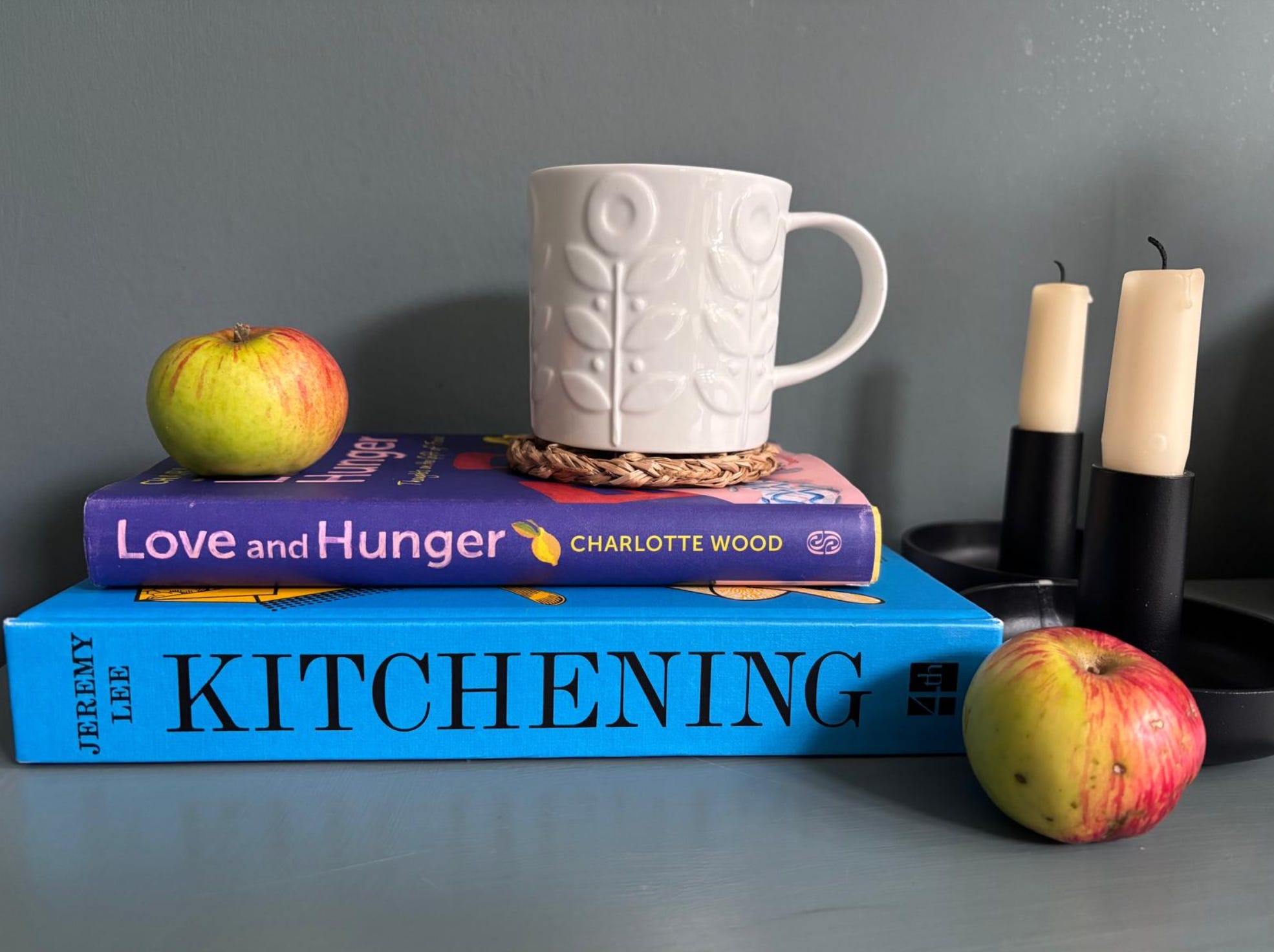
Can a soufflé recipe simultaneously make you cry and make you very hungry for melty cheesiness? Yes, if it is written by the excellent Jeremy Lee, chef at Quo Vadis in Soho and king of the kind of British cooking that most delights.
This is a quick one because I wanted to recommend two new food books which feel especially welcome now autumn is nearly here and nights darken. Both of them, as it happens, have deep things to say about food and loss but this is not to say that either of them are in any way depressing. To the contrary, these uplifting books make the case for cooking as a way to keep those we love at the table ‘come rain or shine’ ; and to celebrate being alive for another tomato salad or summer pudding or winter bean soup; to watch another soufflé emerge risen and burnished from the oven.
The first book is the glorious KITCHENING by Jeremy Lee.
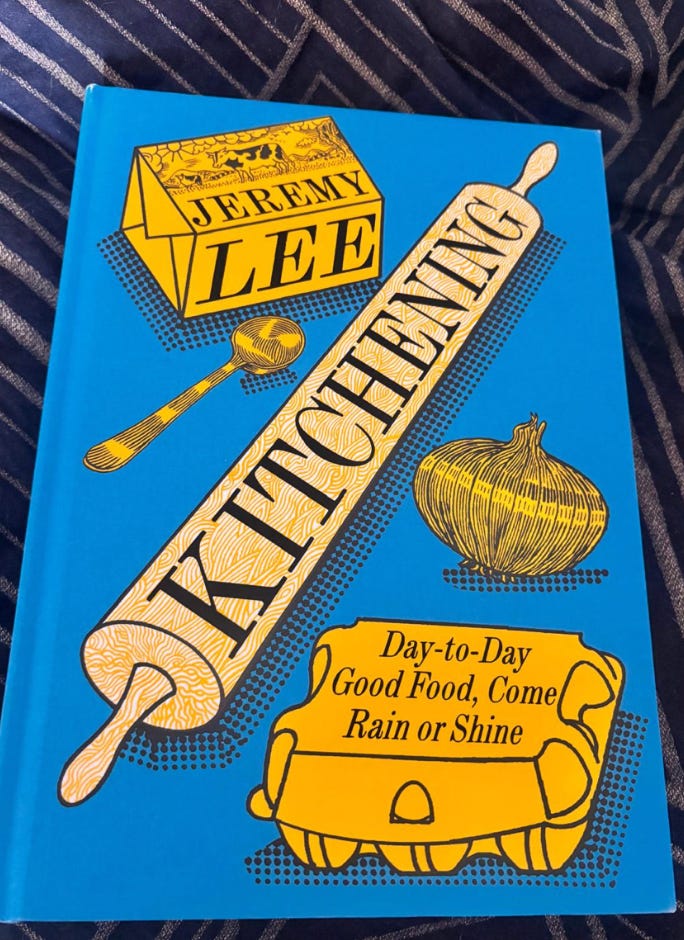
If you know Jeremy’s first book COOKING with its vibrant green cover, you will already have a sense of what a joy this one is likely to be. And it is! The recipes are arranged seasonally, from the puntarelle, fennel and orange salad of March to corn chowder with clams in September. Jeremy’s words make me so hungry - for pies, for puddings, for salads galore. But there is also something in his sensibility and voice that never fails to make me smile. Who but Jeremy would describe Staffordshire oatcakes as ‘estimable pancakes’? Or write of a melon sorbet that it not just eagerly awaited every summer but ‘pleases mightily’? He measures almonds in ‘smatterings’, ginger in ‘thumbs’ and olive oil in soup spoons. It feels like the perfect book to give you food market inspiration as summer slides into autumn.
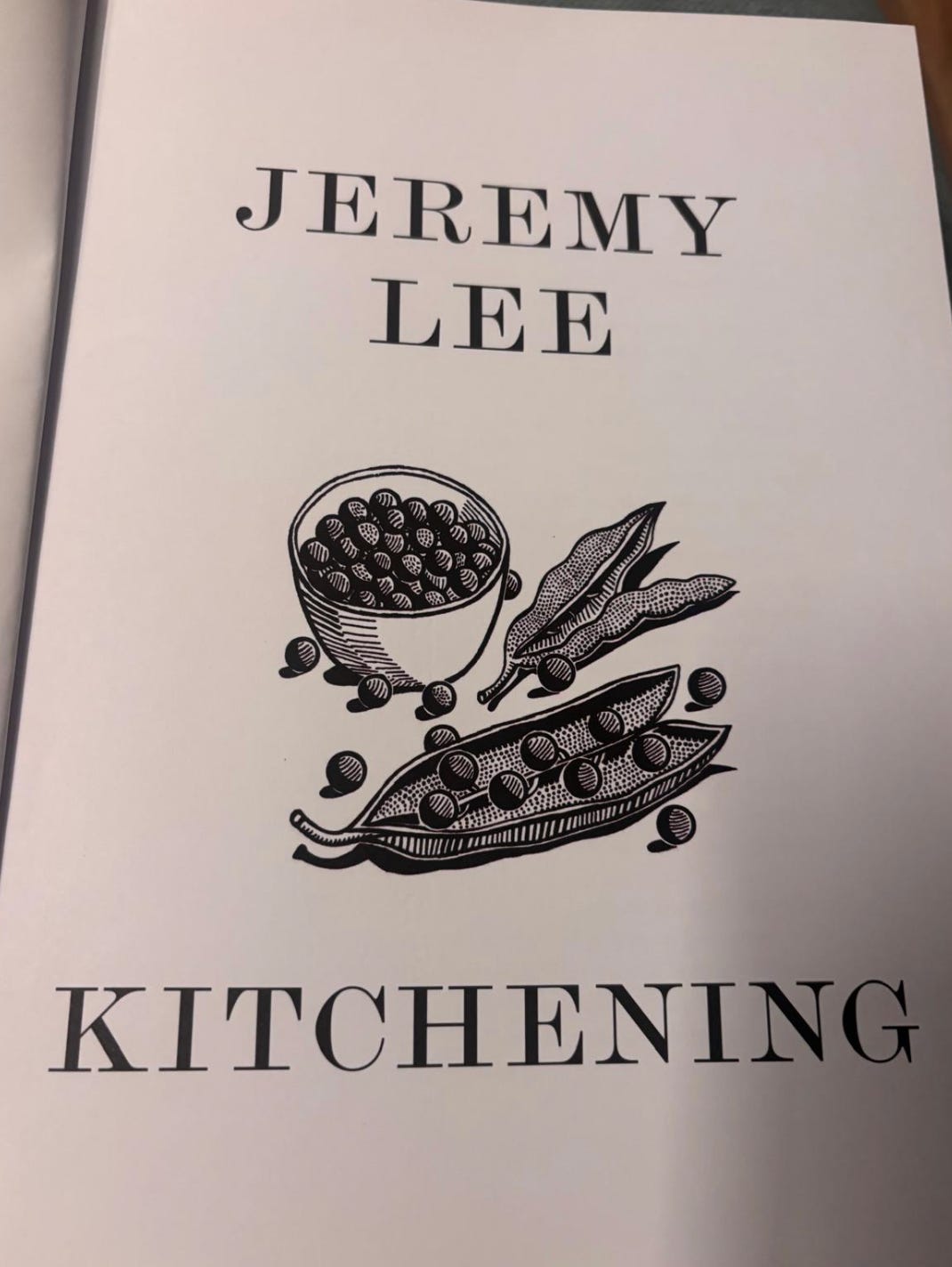
As with Jeremy’s first book, it would be worth buying as a gift just for the deeply distinctive ‘decorations’ by John Broadley. I mean, look at these peas!
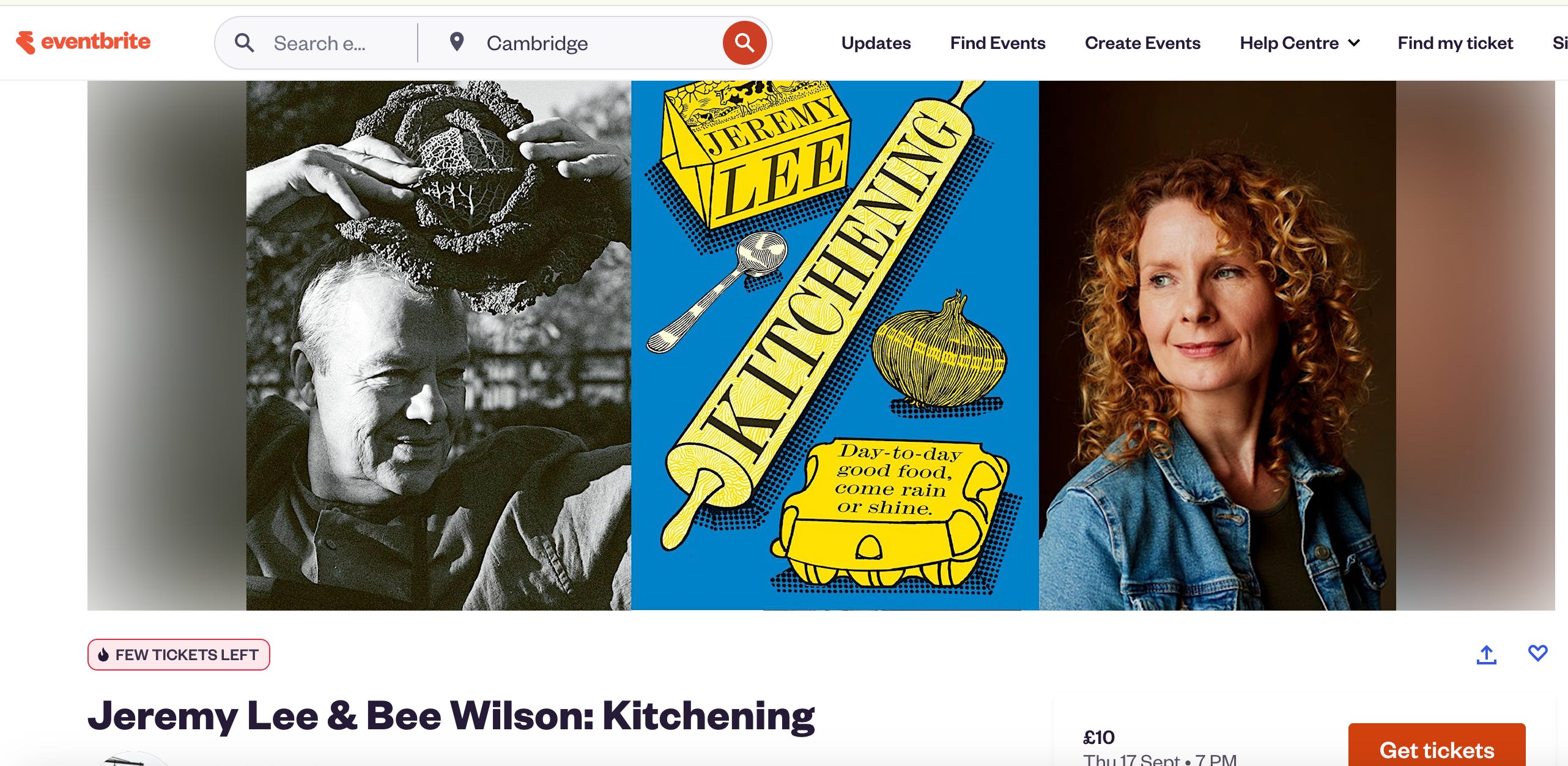
I am delighted to say that on 17th September I will be in conversation with Jeremy about his book at the London Review of Books Bookshop. Tickets here. It would be lovely to see you there.
Jeremy’s book is dedicated to the memory of his sister Annabel ‘gone from us too soon’ and one of the sections I most loved reading - though it made me cry - was a recipe for cheese soufflé inspired by Annabel. (As some of you know, I love a cheese soufflé too).
Jeremy recounts a moment when Annabel asked if he had a soufflé dish she could have and he gave her a white Le Creuset mould he found at the back of his cupboard on the condition that she made and shared a cheese soufflé with him from time to time using the recipe their late mum loved to make (Julia Child’s). So Annabel became the ‘keeper’ of the soufflé dish.
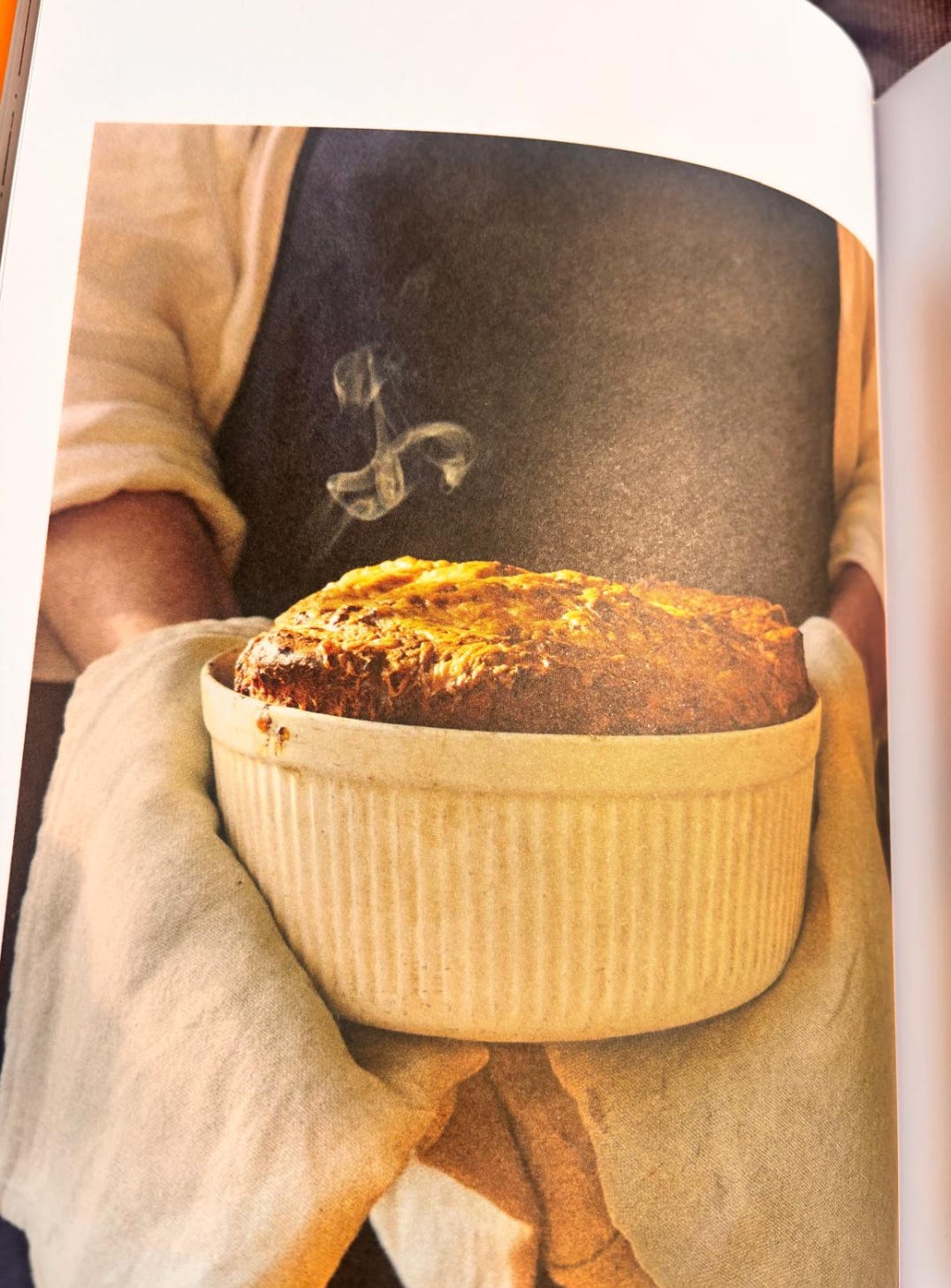
When Annabel asked to have Jeremy’s soufflé dish, it actually assuaged a ‘lingering guilt’ he had felt about borrowing it from ‘Alastair Little’s kitchen on Frith Street in Soho’ where he had cooked many years earlier. ‘Then came the unhappy truth that there was no restaurant, or indeed Alastair, to return the mould to, and as with so any such associations, it was tucked away’. So when Annabel, ‘being a good sort and a very good cook, ever partial to a cheese soufflé’, became the keeper of the soufflé dish, it gave the dish a new life which took some of his guilt away.
But now Annabel is gone and Jeremy has taken the torch of being the soufflé maker :the one who stirs the roux until ‘the scent of biscuit rises’ and folds the whites ‘deftly but thoroughly’ into the cheese sauce. And he can smile at the memories of Annabel ‘lifting a golden-domed dish infused with cheese from the oven as she placed a cloud-like spoonful of quivering soufflé on to a plate, laughing all the while’. I’m sure you can see why I was crying.
The other new food book I urge you to read is LOVE AND HUNGER by Charlotte Wood, an Australian novelist. It’s a collection of essays which - as Nigella Lawson observes in her excellent foreword - offer ‘comfort, calm, common sense’ and ‘sharp wit’. Whether she is writing about the solace of soup or how to be a host, Wood is an extremely funny companion; but also a wise one (Don’t carve at the table, do keep frozen peas in your freezer and when you have lost your ‘kitchen mojo’, make stock ). She writes about food as a lens on life; and as life as a lens on food. And she is a truth teller. She writes that ‘Occasionally, I detect in the very late serving of food an unconscious, rather depressing need to hold people captive, as if once the food has been eaten the dinner guests will all bolt for the hills’.
It’s a book you pick up intending to have a quick dip but find that you are still sitting on the sofa lost to the world an hour later. It’s practical too. There are thoughts, for example, on how to chop onions without crying - chill them first and sharpen your knife (‘A clean cut means less vapour’). And some lovely recipes of the kind I like best - i.e. ones that are actually cooked at home for comfort rather than for show: simple braised lentils, cheat’s cassoulet, soup for as cold (‘Pharmacy in a bowl’).
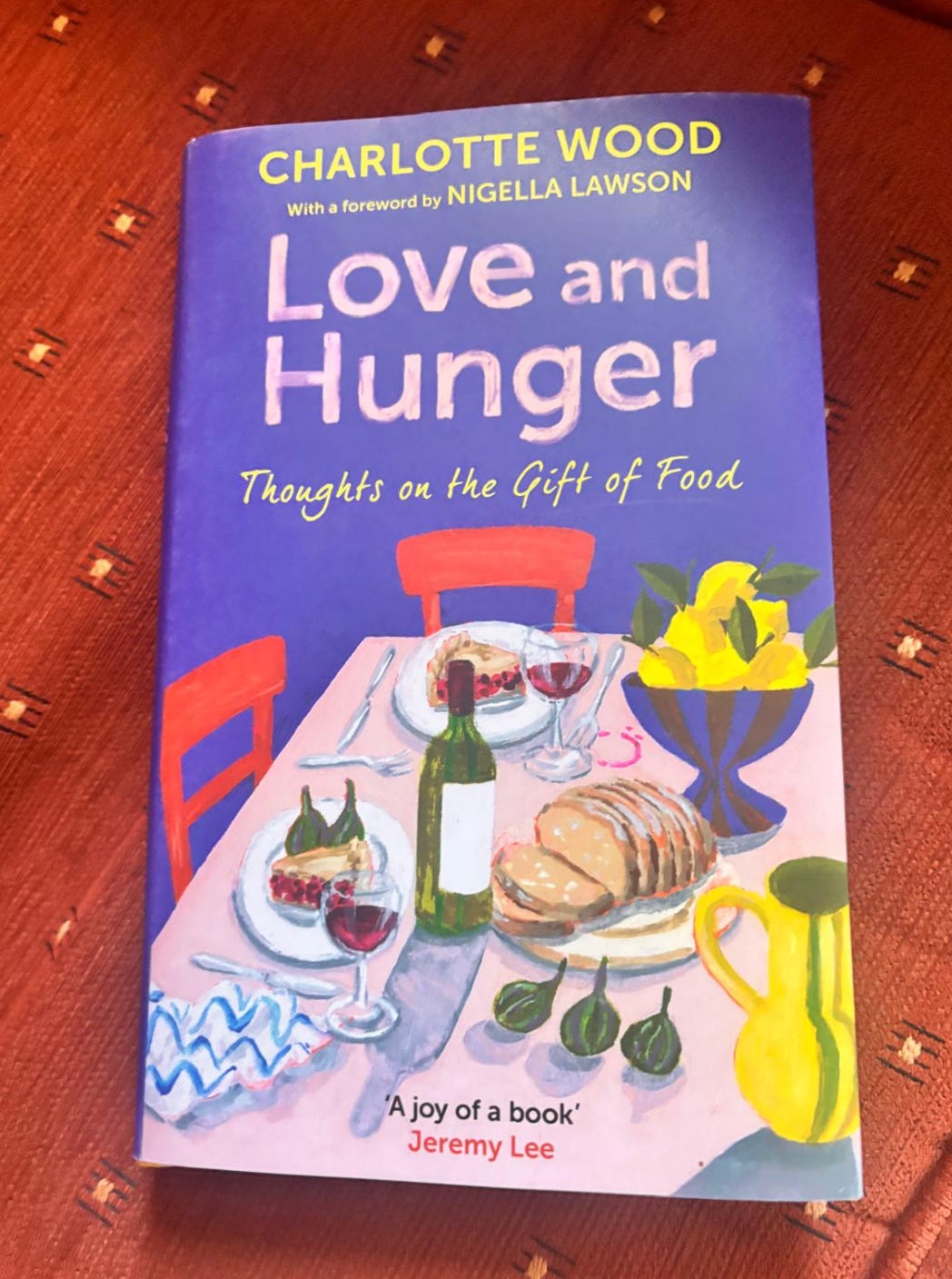
Another of the many chapters I know I’ll be thinking about for a long time is called ‘You still have to eat’. It is about one of her mother’s friends in small-town Australia, a woman called Ruby, faithfully bringing round a series of bizarre concoctions twice a week when her mother was very sick, such as a few sardines wrapped in luncheon meat. Wood writes that ‘when things are too terrible to talk about, an offering of home-cooked food is a silent, loving letter telling your broken-hearted friend or ailing aunt that they are not alone’.
Oh, and I loved her slightly unexpected chapter on Elizabeth David, an extraordinary food writer who feels undervalued these days in food writing circles, maybe because the more you read of David, the more you detect something not altogether friendly in her spirit. Wood says she loves David not despite her occasional tone of disdain but because of it - she has always liked ‘prickly, opinionated people’. She reads through some of the margin notes David made in her huge collection of food and recipe books and notes that ‘it is a relief to read such simple, cranky declarations as ‘This is NOT a tian’, and ‘This is a useless book’ and even ‘Waverley Root is a pitiful phoney’.
To Wood, as to so many of us, Elizabeth David’s remarkable books and recipes were a gift which arrived in her life just when she needed them. When she was a young university student, Wood was invited to lunch at her painting teacher’s house and still remembers the ‘incredible smell’ of ‘something rich and garlicky’. It was Elizabeth David pork cooked in milk. She remembers thinking that this way of eating was ‘a portal into an entirely new life for me, a simpler but richer mode of eating than I had ever known existed’.
You’ll need to read the book to get a full sense of what Elizabeth David means to Wood but I don’t think I have ever seen a better description of the way that certain cookbooks can become talismans in our life if we encounter them at the right time; and how we are changed by them.
No posts
Comments
Nothing yet. Say the first thing.
Sign in to join the conversation.