
What a conversation about writing with Kevin Tumlinson reminded me about creativity, getting stuck, and finding the way as you go. Watch or listen, if you want, on the podcast.
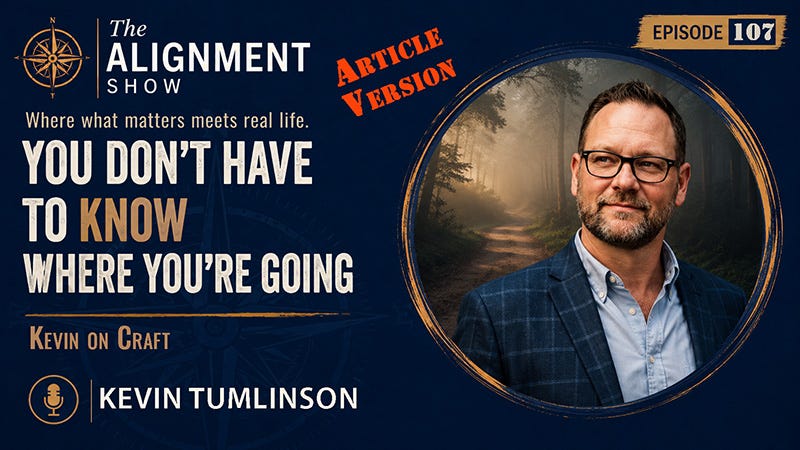
I have a friend who has written more than 70 books and says he doesn’t know exactly how many anymore. That seems like somebody worth asking about the craft of writing.
Kevin Tumlinson and I have known each other for years. He’s been a professional writer in journalism, marketing, television and radio. He’s worked in traditional publishing and indie publishing. He spent seven years as director of marketing and PR for Draft2Digital. He hosts the long-running Wordslinger podcast and co-hosts Writers Ink. And somewhere in there, he has managed to write those 70-plus books.
Recently I heard Kevin make an almost throwaway comment on Wordslinger. Despite all the talking he does about writing and publishing, he said he doesn’t get to talk about the actual craft of writing all that much.
Maybe, he suggested, he just needed somebody to ask him questions.
Well. Asking questions is something I can do.
So I sent him an email, made a truly terrible pun involving “Kevin on Kraft” and macaroni and cheese, and we decided to get together without much of an agenda and see where the conversation went. Which, as it turns out, was remarkably appropriate. Because much of our conversation wound up being about creating when you don’t know where you’re going, which you would expect from a couple of pantsers, um, I mean, Discovery Writers.
Kevin told me that, with very few exceptions, every book he has written began with a title.
Detailed outline? Character biography. Carefully constructed plot.
Nah. A title.
He may think of one while taking a shower or walking, or pick up a phrase from a passing conversation. Then he starts playing with it. What could those words mean? What else could they mean? Is there some irony hiding in them?
During our conversation, he made up a title on the spot: A Field of Dragons.
Then he started playing. What kind of field? A grassy field? A magnetic field? An energy field?
What if “dragons” were metaphorical? What if there were an energy field in space that reached out and destroyed every ship that approached it? Why would it do that? What was on the other side?
Within a couple of minutes, we had the beginnings of a science-fiction story neither of us had thought about before.
Once we had the situation, we needed somebody who cared about it. Now we were talking about character.
Who was being sent to investigate this thing? Why did it matter to that person? What did they want? What was at stake?
Kevin and I had started by talking about whether a writer begins with plot or character, and we quickly demonstrated why the distinction is artificial. Pull one thread and the rest of the sweater comes with it.
That led us to a simple definition of story we both use: there is a focal character facing a challenge. Something is at stake. And through facing that challenge, the character changes.
Plot and character aren’t really separate machines. They work together.
Kevin and I both lean toward what writers usually call “pantsing,” although our friend Joanna Penn has good reason to dislike that term. In British English, “pants” means underwear.
“Discovery writing” is perhaps safer for international relations.
Whatever we call it, Kevin rides it. He starts writing.
That’s pretty much it.
He may have a premise or an intriguing title. He may know that somewhere out there is an energy field destroying spaceships. But he usually doesn’t know exactly what is going to happen when he starts writing.
His characters aren’t necessarily fully formed when he starts, either. He described them as more like hangers at first. He throws things at them and watches how they react. Through those reactions, he discovers who they are.

Because he’s writing on paper or electrons rather than carving the story into stone tablets, he can always go back and change things later.
That sounds obvious when I say that, but it doesn’t always feel obvious when we’re staring at a blank page. There’s a powerful temptation to believe we need to know what we’re doing before we begin doing it. We need the character figured out. We need the plot figured out. We need to know where the story is going.
Or, on the other hand, if we’ve written it down, then we’re stuck with it.
Kevin’s process turns that around. Sometimes you find out where the story is going by writing the story. That’s not a failure to plan, but a way of discovering. I’ve even heard him say in the past that if he outlines a book and thus knows how the story develops and ends, he loses interest in writing it.
This may be the most practical advice in our whole conversation.
If you don’t know what to write, Kevin said, write whatever comes to mind. Even gibberish. You can fix it later. You can cut it. You can move it. You can discover that the apparently useless paragraph you wrote belongs three chapters later.
But you have to have something on the page before you can work with it.
Kevin was particularly emphatic about trying to perfect the book while you’re still writing it. For a new writer especially, he said, trying to produce a perfect draft the first time dramatically increases the odds that you won’t finish the book.
That struck me because the principle goes well beyond writing. We often want the first attempt at anything to justify itself. We want to know that we’re headed in the right direction before set foot on the road. But creativity rarely gives us that guarantee.
Sometimes the first version exists simply so that there can be a second version.
Of course, writing without a detailed map creates another problem. Eventually you get stuck.
I asked Kevin whether he ever reaches a point in a book where he has absolutely no idea what his character should do next. He said, in essence, only every single time he writes a book.
I found that reassuring.
His first “fix” is something he calls looping. He rereads and revises earlier parts of the manuscript, sometimes going all the way back to the beginning. As he works his way forward again, he regains the momentum of the story. Often, by the time he reaches the place where he was stuck, he knows what comes next.
I like that because it challenges the assumption that progress always means moving forward. In looping, he’s not backtracking. He’s just still moving. Then he can pick up the thread that brought him to the “stuck” point and keep following it.
And if that doesn’t work? Well, there’s always the nuclear option.
I told Kevin about a science-fiction story I wrote when I was in junior high school.
I had written myself into a corner. My characters faced a situation I couldn’t solve. I had absolutely no idea how to get them out of it.
So I wrote: “And then the ship blew up. The end.” I thought I was telling Kevin about my weakness as a young writer, but he said I had accidentally discovered a legitimate writing technique.
If looping doesn’t get him unstuck, Kevin sometimes throws something completely ridiculous at the characters.
Blow up the spaceship. Now what?
Are they dead? Presumably not, if you’re on page 60 of a 350-page novel. (In my case, it turned out to be a bad short story instead of a good novel.)
So what actually happened? Was the explosion an illusion? Is this a time loop? Is the mysterious energy field affecting their minds? Did something happen that changes everything the characters thought they understood?
The absurd event forces new questions. And new questions create new possibilities.
I love that.
Not because every novel needs an exploding spaceship. That could get tedious, especially if it’s a historical 18th century romance. But because sometimes when we’re stuck, we keep trying increasingly sensible variations of the same solution when what we need is something unreasonable, something that disrupts the assumptions that got us stuck in the first place.
There’s another advantage writers have that the rest of us could occasionally wish for. Writers can time travel.
During our conversation, I used the example of Joseph’s coat in Genesis. Early in the story, Jacob gives Joseph the distinctive garment. Much later, Joseph’s brothers use that same garment to convince Jacob that Joseph has been killed.
If you were writing a fictional story and reached that later scene only to realize, I need a distinctive coat here, you could simply go backward and put the coat into Chapter One.
As Kevin put it, the laws of physics don’t apply to writers. We can create something in the present and then travel backward to create the past that makes it possible. That’s editing.
It also means discovery writers don’t need to predict everything correctly. You can discover what the story needs and then revise what came before.
There’s freedom in that. We didn’t say it this way in the conversation, but you could almost think of it this way: plotters make an outline ahead of writing. Pantsers make an outline (i.e., a structure) by writing. Either way, in the end it all hangs together.
Somewhere in all this talk about craft, the conversation became about something larger.
Kevin talked about the years when he kept writing without money or recognition. His career today doesn’t look like the career he once imagined. But when he steps back from what he thought it was supposed to look like, he realizes something:
“I have exactly the career I prayed for and exactly the life I prayed for. It’s just got a different paint job.”
That line stayed with me. I joked that maybe I expected a sports car and wound up with a minivan. Kevin’s answer was essentially: fine. It still gets you from A to B.
That’s why a conversation ostensibly about the craft of writing belongs on The Alignment Show. We talk to a lot of writers on the show, but it’s not a show about writing. It’s about figuring out what makes people tick, figuring out what matters most to you and how to manage a life that supports that.
Kevin and I didn’t discuss something that is just a writing problem.
We want to know where we’re going. We want a map. We want reassurance that the work we’re doing will lead where we expect. We want to recognize success when it arrives because it looks like the picture we had in our heads.
Life is considerably less cooperative than that.
Sometimes we begin with little more than an interesting possibility. Sometimes we discover who we are by seeing how we respond to what happens. Sometimes we get stuck and need to loop backward before we can move forward.
Sometimes something blows up.
And sometimes we finally arrive somewhere worth being, only to discover that it looks nothing like the destination we had imagined. Different paint job, maybe a different vehicle. Same journey.
Maybe we don’t always have to know where we’re going.
Maybe we just need enough to write the next scene.
This article grew out of my conversation with Kevin Tumlinson on The Alignment Show. Watch or listen to the full conversation here, including links of interest.
No posts
Comments
Nothing yet. Say the first thing.
Sign in to join the conversation.