
[Note: if you would rather read an article instead of watching or listening, you can read such here.]
Sometimes the best conversations start because somebody says something almost in passing.
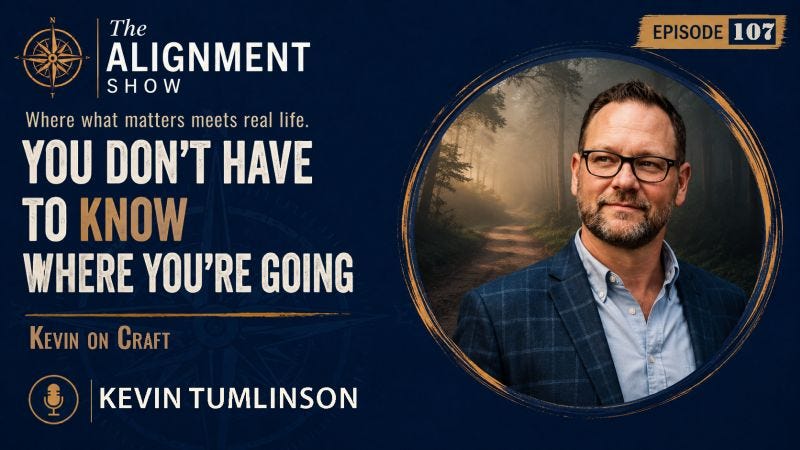
I was listening to Kevin Tumlinson on The Word Slinger Podcast when he mentioned that, for all the talking he does about writing and publishing, he doesn’t get to talk about the actual craft of writing as often as you might expect. Maybe, he suggested, he just needed somebody to ask him questions.
Well, I can ask questions.
That led to an email, a bad pun about “Kevin on Kraft” (yes, we know it’s cheesy—maybe we’ll make it “Kevin on Craft”), and eventually this conversation.
Kevin and I decided to borrow an idea from Rachael Herron and Sacha Black, who periodically record a conversation together and then each use it on their respective podcasts. So you may encounter this conversation here on The Alignment Show, over on The Word Slinger Podcast, or, knowing Kevin, possibly on the back of a cereal box.
What started as a conversation about writing craft quickly became something broader: creativity, discovery, getting unstuck, allowing imperfect work to exist, and recognizing that the creative process rarely follows the neat categories we use when we talk about it.
One idea kept resurfacing for me: you don’t have to know everything before you begin.
Kevin often starts a novel with little more than a title and an interesting possibility. The characters emerge as he writes. The plot develops alongside them. And when he gets stuck, he doesn’t necessarily take that as evidence that something has gone wrong. Sometimes he loops back through what he has already written. Sometimes he throws something ridiculous into the story just to see what happens.
As Kevin put it, writing gives us an advantage real life doesn’t:
“The laws of physics do not apply. So you can, in fact, travel through time and alter the past.”
You can discover in chapter six that you needed something in chapter three, then go back and put it there.
That sounds obvious once you say it. But it’s remarkably easy to forget when you’re staring at a draft and trying to get everything right the first time.
Kevin and I talk about:
Why this experiment in shared podcasting started in the first place, and where “Kevin on Kraft (not cheese)” might go from here.
Kevin’s unusual habit of beginning many of his books with the title, then asking what interesting or ironic idea might be hiding inside it.
Why separating “plot” from “character” can be useful for studying craft even though they’re deeply intertwined when we actually write.
Discovery writing versus outlining, and why most writers probably fall somewhere along a spectrum rather than neatly into one camp.
Why trying to produce a perfect first draft can make finishing the book much harder.
Kevin’s “looping” technique for getting unstuck: going back through earlier material, reading and revising until he regains momentum.
What happens when looping doesn’t work, including the surprisingly useful strategy of throwing something absurd into the story and seeing what it reveals.
Kevin’s “ash bin,” where deleted scenes and discarded material can live instead of disappearing forever.
Why originality usually doesn’t mean inventing something nobody has ever seen before. As Kevin says, the goal is often “the same, but different.”
Why creativity isn’t limited to people who call themselves writers, artists, or creators. Problem solving itself is creative work.
If you’re working on something creative and you’re stuck, Kevin offers two approaches worth trying.
First, loop back. Read what you already have. Make small adjustments as you go. See whether returning to the material gives you enough momentum to move through the place where you stopped.
If that doesn’t work, try something unreasonable.
Blow up the spaceship.
You don’t have to keep it. The point is to break whatever assumptions have trapped you and force yourself to ask new questions. The absurd choice may disappear in revision, or it may reveal the direction the story needed all along.
And remember: nothing you’ve already written is sacred simply because you wrote it. You can add something earlier, remove something that no longer belongs, or save good material for another day.
“All the notes are the same. You’re not inventing new notes. It’s all in how you arrange them. And that’s what makes the music.” — Kevin Tumlinson
That applies to considerably more than writing.
Kevin Tumlinson is an author with more than 70 published books, a longtime independent publishing advocate, and the host of The Word Slinger Podcast. He previously served as Director of Marketing and PR at Draft2Digital and is also one of the co-hosts of Writers, Ink. Kevin Tumlinson website The Word Slinger Podcast Kevin’s YouTube channel
Kevin’s YouTube channel
Rachael Herron / Ink in Your Veins
Sacha Black / The Rebel Author Podcast
Joanna Penn / The Creative Penn Podcast
On Writing by Stephen King — Amazon or Bookshop.org
20 Master Plots: And How to Build Them — Amazon or Bookshop.org
This is something of an experiment for Kevin and me, and we’d genuinely like to know how it lands.
Would you like to hear more conversations like this? Are there aspects of writing craft you’d particularly like me to ask Kevin about? And even if you’re not a writer, did you find something in the conversation that applies to your own creative work?
Leave a comment here on Substack, or join the conversation on Kevin’s YouTube channel.
We already have more things we could talk about. Whether “Kevin on Kraft” becomes a regular thing remains to be seen.
But I suspect we’re not finished talking.
If you get value from the show, consider supporting us in one of the following ways.
You can make a one-time contribution or sign up for regular support through Buy Me a Coffee.

You can also subscribe on Substack for free OR upgrade to a paid subscription. Your support helps me continue helping you and others, and thank you in advance! All subscribers now receive the following:
The “Big Takeaway”
A bulleted summary of the episode
Practical tips from the episode
A quote to ponder
Prefer text? We turn each podcast into an article.
Plus, Founding Members receive ebook copies of all my books as well as a sponsorship message on the podcast at least once a month.
That’s our way for saying “thanks for the support!”
Comments
Nothing yet. Say the first thing.
Sign in to join the conversation.