
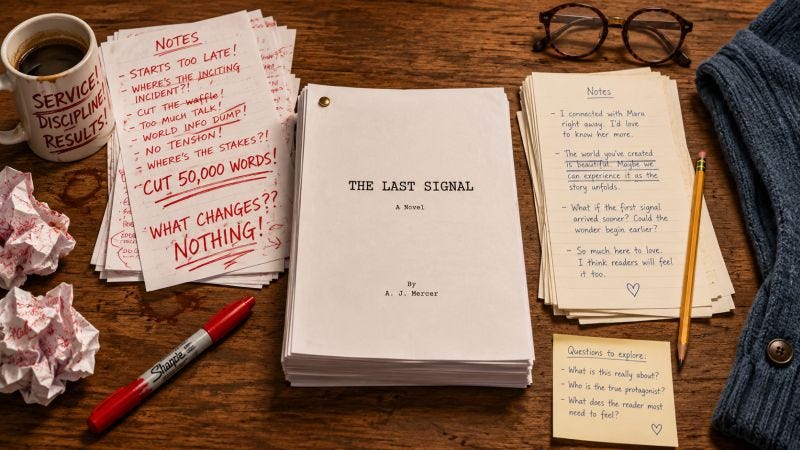
Every author eventually discovers that developmental editing goes beyond manuscripts to personalities.
Some editors wield a scalpel. Others use a flashlight. (And some use various other instruments.) Some challenge you by turning up the pressure, while others quietly help you discover what your story has been trying to become all along.
That led me to a ridiculous question.
What if two of television’s most recognizable personalities had abandoned their careers and become developmental editors instead?
At first, I just thought it was a fun (and maybe funny) idea. The more I thought about it, though, the more I realized we could have fun with it and still learn something useful.
To make the experiment fair, I imagined them reading exactly the same manuscript.
The hypothetical novel is The Last Signal, a science-fiction story about the lone operator of a centuries-old communications station orbiting a dying star. One day the station begins receiving messages from civilizations that no longer exist, including what appears to be humanity’s own future. It’s an ambitious novel with memorable characters, beautiful prose, and fascinating ideas. It also spends its first 120 pages taking the scenic route before the story finally arrives.
In other words, it’s exactly the sort of manuscript that would make an experienced developmental editor either reach for a red pen or an emesis bag (if you don’t know, look it up; I’m not explaining further).
So imagine, if you will, that Gordon Ramsay and Fred Rogers each left their original professions, hung out identical shingles reading Developmental Editor, and were handed the same manuscript.
These are the conversations I suspect might follow.
Author: So... thanks for agreeing to look at my novel.
Gordon Ramsay: Right. I read the whole ^%$#*!@ thing.
Author: You... finished it?
Ramsay: Of course I finished it! You think I walk out halfway through dinner because the appetizer’s disappointing?
(throws manuscript onto the desk)
Now... Who the #^&@ told you this was finished?
Author: My critique group loved it.
Ramsay: Your critique group should be arrested.
(flips pages)
Page one... Beautiful. Page two... Lovely. Page three... Still beautiful.
Page forty-seven... We’re still admiring the wallpaper! When does something actually happen?
Author: It’s literary science fiction.
Ramsay: Literary? LITERARY? Don’t hide behind the &&@$*! adjective! A Ferrari with no engine is still not @*$#!& going anywhere.
Author: I wanted to establish atmosphere.
Ramsay: Atmosphere? You’ve got enough atmosphere to terraform #@*&%!$ Mars! I’m drowning in atmosphere! Give me a story!
Author: But readers need to understand—
Ramsay: No, they don’t. Readers need a reason to TURN THE BLOODY PAGE. Understanding comes later. Curiosity comes first.
Author: The station is symbolic—
Ramsay: Everything’s %*$#@!&$ symbolic! Do you know what’s also symbolic? A restaurant with no customers. It symbolizes bankruptcy. Same thing for your pitiful excuse for a book!
Author: I spent three years building the world.
Ramsay: I can tell. You built the world. You built another world. Then you built a museum explaining both worlds. Meanwhile, your plot’s standing outside in the rain wondering if anyone’s coming to let it in.
(points to a paragraph)
Read this aloud.
Author: “The ancient relay station contemplated the entropy of civilizations in the silent mathematics of stellar decay...”
Ramsay: Beautiful sentence. Absolutely gorgeous. Now tell me—
What actually happened?
Author: Well... Nothing exactly.
Ramsay: Exactly! It’s like serving me a plate decorated with edible flowers... and forgetting the #@*&%!$ steak!
Author: You didn’t like the prose?
Ramsay: Don’t put words in my mouth! The prose is fantastic. Half the time I wanted to frame it. The other half I wanted to scream, “Would somebody PLEASE OPEN THE DAMN DOOR SO SOMETHING CAN HAPPEN?”
Those are two different problems. One is talent. The other is discipline. You’ve got the first one.
You desperately need the second.
(turns to another page)
This character. Mara. Fantastic. Sharp. Funny. Memorable.
Why is she only in four scenes?
Author: I wasn’t sure she fit.
Ramsay: SHE’S THE BEST THING IN THE %*$#@ #@*&%!$#@ (takes a breath) #*&% BOOK! It’s like inventing chocolate and then serving boiled cabbage!
Author: I liked the philosophical conversations.
Ramsay: I liked them too! Not twenty-three of them.
Look... Conversation should be seasoning. You’ve emptied the entire salt cellar. Now nobody can taste the %*$#@!&$ meal.
Author: So you’d cut them?
Ramsay: I’d cut HALF. Maybe more. Not because they’re bad. Because the good ones deserve room to breathe.
Author: That’s painful.
Ramsay: Developmental editing IS painful.
You know what else is painful?
Reading a brilliant novel that refuses to become brilliant because the author won’t kill their favorite paragraphs.
(leans forward)
Let me ask you something. When does the first message from the future arrive?
Author: Chapter nine.
Ramsay: Chapter—
NINE?
That’s your premise! That’s what’s on the back cover! That’s what readers paid for! Why am I waiting a hundred and twenty pages? Did FedEx lose the manuscript?
Author: I wanted readers to know the protagonist first.
Ramsay: They’ll know the protagonist BETTER if he’s actually doing something. People reveal themselves under pressure. Not while making coffee and reflecting on the cosmic loneliness of existence for six chapters.
Author: I suppose that’s fair.
Ramsay: It’s more than fair. It’s fixable. That’s the important part.
(picks up the manuscript again)
Listen carefully. This is NOT a bad novel. Bad novels don’t make me angry. Bad novels make me stop reading.
This...
This infuriates me because I can see the book hiding underneath, but just barely. It’s sitting in there screaming, “Cut fifty thousand @*$#!&% words and let me out!”
Author: Fifty thousand?
Ramsay: Don’t faint. You won’t lose the story. You’ll discover it. But if you waste talent like this, then you’re not writing a bad novel—you’re wasting a %*$#@!& good writer, and you should sell your computer and go back to asking, “Do you want fries with that?”
Author: That’s hard to hear.
Ramsay: Of course it is. Writing’s hard. Editing’s harder.
You know what the biggest lie writers tell themselves is? “If I wrote it, readers need it.”
No, they don’t. They need what serves the story. Everything else is furniture.
Author: So where would you start?
Ramsay: Easy. Open with the @*$#!& signal. Immediately.
Now I’ve got a question. Now I’m invested. Now I’ll happily read about your beautiful world because you’ve given me a reason to care.
See the difference?
Author: I think so.
Ramsay: Good.
Second— Promote Mara.
Third— Every scene answers one question. “What changes?”
If the answer is “nothing”... OUT.
Author: Even if it’s well written?
Ramsay: ESPECIALLY if it’s well written. Those are the &!*@#% dangerous ones. Beautiful writing seduces authors into keeping scenes that murder pacing.
Readers don’t remember pretty paragraphs. They remember moments.
Author: You know... I was expecting you to tell me it was garbage.
Ramsay: If it were %*$#@!& garbage, I’d say it’s %*$#@!& garbage.
This isn’t garbage. It’s a bloody magnificent stew that’s been simmering for three years when it only needed three hours.
You’ve cooked every ingredient into paste. Now scrape away everything that isn’t absolutely essential.
The flavor’s already there. Trust it.
(He stands and shoves the manuscript back across the table.)
Now get out. Go rewrite it. And next time...
Bring me the novel you were trying to write instead of the one you were %*$#@!& afraid to finish.
Author: Mr. Rogers... thank you for agreeing to read my novel.
Fred Rogers: Thank you for trusting me with it. That’s a generous thing to do.
Author: I wasn’t sure you’d like it.
Fred Rogers: Those are different questions, aren’t they?
Whether I like it... and whether it’s becoming the book you hoped it would become.
I’d rather talk about the second one.
(He gently smooths a slightly dog-eared page.)
I enjoyed spending time with these people. They’ve stayed with me. That’s a gift.
Author: Really?
Rogers: Oh, yes. Especially Mara. I missed her when she wasn’t on the page.
Author: I wasn’t sure she belonged in the story.
Rogers: May I tell you something I’ve learned?
Sometimes the people who surprise us are the ones readers need most. You don’t have to make that decision today. But I wonder if she’s trying to tell you something.
Author: That’s... interesting.
Rogers: May I ask you a question?
Author: Of course.
Rogers: What is your story about? Not the setting. Not the technology. If someone closed the book and said, “I think that story was really about...” What would you hope came next?
(A long pause.)
Author: I...don’t know.
Rogers: That’s all right. Most of us don’t, at first. Sometimes we discover what our story is about by writing it. Sometimes by rewriting it.
Author: Gordon Ramsay would probably have yelled at me for not knowing.
Rogers: Perhaps.
And perhaps he would have just been trying to help you know. People have different ways of helping.
(He smiles.)
Gordon’s heart is in the right place. I find questions more useful than shouting.
Author: Fair enough.
Rogers: May I ask another? When does the first message from the future arrive?
Author: Chapter nine.
(Another gentle pause. Rogers sits back, steeples his fingers, and purses his lips with a slight smile.)
Rogers: Were you excited to write that chapter?
Author: Oh, very much. It was the moment I had imagined from the beginning.
Rogers: I wondered if that might be true. Would it be all right if I wondered aloud whether your readers might enjoy sharing that excitement sooner?
Not because the earlier chapters are unimportant. But because that moment seems to contain a promise. And promises are lovely things to make early.
Author: I guess I was afraid readers wouldn’t understand enough.
Rogers: That’s a very familiar fear. Teachers have it. Parents have it. Pastors have it. Writers certainly have it.
We become so concerned that people understand... that we sometimes forget to let them become curious.
Curiosity is a wonderful teacher.
Author: So you’d move it?
Rogers: I would certainly try. Trying isn’t failing. It’s simply learning something new about your story.
Author: There are whole chapters I love.
Rogers: Oh, I know. I could feel that. You cared for them very deeply.
May I tell you something that has helped me over the years?
Loving something doesn’t always mean it belongs where we first put it.
Sometimes love means finding a better home for it. Perhaps a notebook. Perhaps another novel. Perhaps nowhere at all.
That doesn’t mean the writing was wasted. It means it helped you become the writer who could write this book.
Author: I’ve never thought about it that way.
Rogers: Most creative work leaves footprints that readers never see. That doesn’t mean the footprints weren’t necessary.
Author: Can I ask you something?
Rogers: Certainly.
Author: Did you think it was... boring?
(Mr. Rogers is quiet for several moments.)
Rogers: I think... there were places where I wished the story trusted itself a little more.
Your ideas are beautiful. Your language is beautiful. Sometimes you explain them so carefully that they don’t have room to surprise us.
Children taught me something about that. If you leave a little space, people often do remarkable things with it.
Readers can too.
Author: That’s hard to hear.
Rogers: It is. And I appreciate your willingness to hear it.
You know... people sometimes imagine that kindness means telling someone they’re already finished.
I don’t believe that.
I think kindness means believing they’re capable of becoming more than they are today.
I believe that about people. And I believe it about books.
Author: So you think this can become a good novel?
Rogers: I think... it’s already a good beginning. And I suspect there’s an even finer novel waiting patiently inside it.
May I tell you what excites me?
Author: Please.
Rogers: I never once felt that you were pretending. You were reaching for something true.
Sometimes you reached with too many words. Sometimes you wandered a little. But you never struck me as dishonest.
I can help someone trim a manuscript. I don’t know how to help someone become sincere.
You have already done the harder thing.
Author: I don’t know what to say.
Rogers: You don’t have to say anything today.
Go home. Read your own story as though someone you love had written it. Be honest with it. Be patient with it.
And be as kind to the writer as I hope the writer will be to the book.
I have a feeling the two of you are going to help each other very much.
Of course, neither conversation ever happened. But I suspect each contains a truth. Gordon Ramsay’s gift isn’t simply being loud; it’s refusing to let talent settle for mediocrity. Fred Rogers’ gift isn’t simply being kind; it’s helping people become brave enough to do difficult work. The best developmental editors, in one way or another, do both. They tell us what our manuscript needs to hear, and they tell it in a way that gives us the best chance of actually hearing it.
King’s Chronicles is a place for thoughtful readers, writers, caregivers, and curious people trying to live meaningful lives in a noisy world.
If this post resonated with you, you can subscribe below, leave a comment, or share it with someone who might need it. I’m glad you’re here.
Join the conversation! I’d love to know what you’re thinking. Just be respectful. 😊
No posts
Comments
Nothing yet. Say the first thing.
Sign in to join the conversation.