
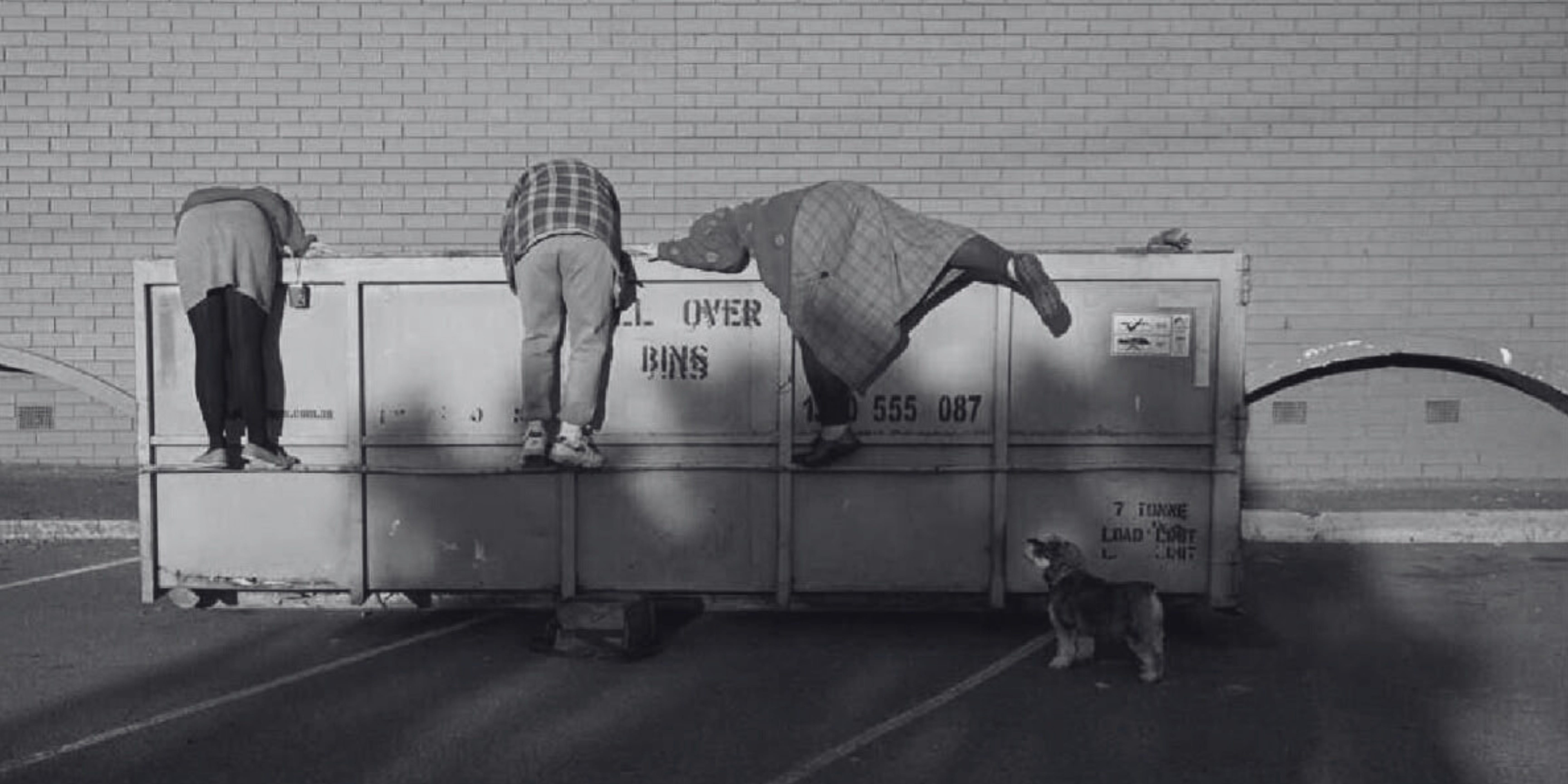
I admit that for most of my life I have been afraid of rats. The conditions in which they lived filled me with disgust. I thought of them more often as carriers of germs than as companions in misfortune. Recently, however, I have been paying more and more attention to the analogies between their existence and mine. Don’t get me wrong, I know that comparing humans to rats may sound like an exaggeration, but I find something painfully familiar in it: existence in spaces that were never designed with our well-being in mind, only for us to function somehow.
And that ‘somehow’ is where the whole problem lies. We live in a system that, on the one hand, expects us to be constantly resilient, and on the other, designs environments full of overload - too fast, too expensive, too dense, too uncertain. In such conditions, survival ceases to be a metaphor and becomes an everyday task, almost a biological response to chaos. I am beginning to think that the issue was not the fear of rats itself, but the belief that our existence is based on more favorable conditions than theirs - as if we really lived in a reality designed for humans, and not just to sustain the system.
Rats have learned to endure more than should be necessary - not because they are inherently tough, but because their world has never given them another option. They exist in the cracks of infrastructure, in spaces forgotten by urban planners and politicians, in environments that constantly expose them to danger and at the same time do not allow them to retreat. It is a life on the edge of survival and overload, on boundaries that are constantly shifting. And it was here that I began to see something disturbingly familiar - the logic of adaptation, which is not a choice but a requirement.
Here, perhaps, is where the issue of boundaries comes in - those invisible thresholds that each of us quietly crosses, often without even noticing. We talk about resilience as if it were a given, as if it were infinite, but in reality we function in a constant tension between what we can still “bear” and what is already breaking us. Late capitalism has taught us to ignore these thresholds, to push them back, to grit our teeth until we lose track of where adaptation ends and self-destruction begins.
In psychology, there is a concept known as the threshold - a point beyond which a stimulus ceases to be neutral and starts to elicit a response. I think that despite the clinical dimension of this concept, it is a useful metaphor for everyday life in late capitalism. Because our thresholds are not stable, they are not measurable, they are not objective. They shift along with the conditions in which we function: with the pace of work, with the uncertainty of tomorrow, with the chaos of the city, with an economy that forces us to adapt faster than we are able to regulate our own emotions.
And perhaps that is why today, it is the urban underground - those layers of infrastructure that only those who have nowhere else to go can see- that tells me the most about our thresholds. Like rats, people living in the lowest segments of the system are forced to function in spaces that were never meant to be inhabited, only serviced. In this sense, the threshold ceases to be an abstract psychological construct and becomes a real dividing line: who lives above ground and who lives in its crevices. And this line never runs randomly. In fact, these thresholds have their own class geography. For some, the threshold means discomfort, for others -a daily survival strategy. The system does not so much test our resilience as distribute it.
Thresholds are not neutral. They are produced, managed, and hierarchized. What psychology describes as an individual limit of endurance turns out, in practice, to be an indicator of where the system allows us to live and where we can only drift. Some balance on the edge of comfort, others on the edge of infrastructure. Because if you look closely, thresholds aren’t just a response to overload. They’re a selection tool that determines who gets pushed to the surface and who gets pushed beneath it. In this sense, thresholds don’t measure our resilience; they configure it. They distribute it so that some can function in a world designed for them, while others function in places that exist only because someone has to work or suffer invisibly. This is why the rat becomes here not a metaphor for disgust, but a figure of class visibility: an organism that will survive anything because it has to. The underground topography of the city begins to function like an X-ray-it reveals who lives on the edge of survival and who can afford the luxury of “enduring less.”
So perhaps the most important question is no longer: how much can a rat take? But rather: who sets the rat’s endurance threshold? Because if thresholds are distributed rather than innate, then there is no such thing as “natural resistance.” There is only resilience produced - by living conditions, by position in the workplace hierarchy, by chronic tension, by lack of room for error. In this sense, threshold ceases to be a psychological indicator of endurance and becomes a political map of who is allowed to be fragile and who is not. And maybe that’s why it’s worth looking where the eye usually doesn’t reach - into tunnels, back rooms, technical corridors. They reveal the architecture of our thresholds most clearly. They show that society is not divided into the strong and the weak, but into those who can stop and those who must go on, regardless of the cost. And if there is any boundary that tells us something true about ourselves, it runs not between individuals, but between living conditions. Between light and twilight. Between surface and crevice. Between what is considered livable and what is pushed underground. There - in this hidden cartography - the answer to a question that had long seemed biological to me, but turned out to be class-based, is revealed: it is not a question of how much a rat can endure, but of who is the rat for whom in this system.
No posts
Comments
Nothing yet. Say the first thing.
Sign in to join the conversation.