

You finish the game. A hundred hours. The graphics are stunning. Every pore on every face rendered with a fidelity that would have seemed supernatural a decade ago. The voice cast is stacked. The budget was somewhere north of $200 million. The combat was fine. The world was large.
And you feel nothing.
Not disappointment. Not anger. Nothing. The kind of nothing that takes you a minute to name because you were expecting something at the end of a hundred hours, and the absence has a shape but no weight.
That sensation is real. It’s also a diagnostic. What you felt at the end of that game was not content fatigue or nostalgia bias. You were reading the difference between something built by a person and something built by a committee to pass a review.
The culture war account of what happened goes like this: activists infiltrated the industry, hired their friends into key positions, and used gaming to push an ideological agenda. Games got “woke.” Studios hired consultants to sanitize dialogue. Strong female protagonists replaced male power fantasies. Players with normal preferences were dismissed as bigots. The culture war is the story.
This is an emotional misdiagnosis. It’s not entirely wrong about the symptoms, but it names the wrong cause, which means every treatment derived from it misses the wound entirely.
The industry didn’t go progressive. It went bureaucratic.
When a single game costs $200 million to produce, artistic risk is no longer a creative choice. It’s a financial exposure. Dark storytelling, morally complex villains, provocative design decisions. Each of those is a variable. Variables create headlines. Headlines create risk. And when the C-suite is staring down a nine-figure production cost, their response to existential risk is always the same: send a committee to remove the variables.
The result is what you played. A game that has been reviewed, audited, iterated, and sanitized by fifteen people with fifteen different veto powers over anything that might generate a negative news cycle. The committee doesn’t hate your taste. It’s allergic to your attention. The kind of attention that comes from provoking something real in you.
This is the first thing to understand. The safety is not ideological at its root. It is financial. The ideology is the texture of the compliance, not the engine underneath it. Get that backwards and you spend your energy fighting the wrong war while the actual extraction continues uninterrupted.
Call it what it is: the Safety Virus. A psychological softening of the creative medium through institutional selection pressure, that replaced dangerous art with compliance theater.
Gaming’s creative peak was built by individuals with conviction. Hideki Kamiya building Devil May Cry. Fumito Ueda stripping Shadow of the Colossus to its essential wound and refusing to add more. Ken Levine constructing Rapture in his head for years before anyone gave him money to build it. David Cage writing for hours about things most publishers would have rejected in the pitch.
Those creators shared one quality: they had something they needed to say, and the games were the instruments they built to say it. The vision preceded the committee. The committee, when it existed at all, served the vision.
What replaced that is a different sequence. Today, the committee precedes the vision. The creative director is hired to execute within a risk-assessed envelope. The writers produce content inside parameters set by people who have never written anything. The characters speak in the careful, measured cadences of a human resources department because someone with veto power reviewed every line of dialogue and removed anything that felt like it had a weight.
The player is not challenged. They are managed.

When you spend hundreds of hours inside a world that never asks you to wrestle with real moral friction, something in your imagination softens. Games that once forced genuine decisions, real losses, actual consequences. Games that asked something of you. Those calibrated your moral intuition against resistance. A diet of compliance theater does the opposite. It trains you to expect resolution without cost, conflict without consequence, villains without genuine menace.
You finish the game and feel nothing because you were never actually in it. You were always just a visitor in a space designed to be inoffensive to all possible visitors simultaneously.
Here is where the culture war crowd is not entirely wrong, just imprecise.
There is a documented institutional ecosystem that created real pressure on AAA studios. It did not operate as a conspiracy with a master plan and coordinated direction. It operated as convergent incentives. Multiple institutions with their own internal logic arriving at similar destinations through separate roads. The road still leads somewhere, and the destination is still the sanitized product in your hands. You are entitled to know what built that road.
For roughly a four-year window centered on 2020 through 2024, the largest institutional asset managers in the world held explicit board-level diversity requirements for every company in their portfolios. BlackRock maintained a 30% gender diversity threshold for boards and voted against directors at companies that didn’t meet it. State Street’s “Fearless Girl” campaign required at minimum one racial or ethnic minority director in addition to gender parity. Vanguard required companies to disclose individual directors personal characteristics including race and ethnicity.
Every major publicly traded publisher sat in those portfolios. EA, Activision Blizzard, Take-Two, Ubisoft, Sony, Microsoft. These companies held explicit ESG conversations with shareholders holding 61% of outstanding shares, per EA’s own SEC filings. Activision Blizzard had a non-binding shareholder proposal on workforce diversity disclosures receive majority support at a 2022 annual meeting, which is rare enough to be significant. ESG objectives were tied to executive incentive compensation.
To be precise: the documented pressure ran at the corporate governance level, not the creative content level. No ESG rating agency scores studios based on whether their protagonists reflect approved demographic compositions. The pressure shaped board composition, workforce hiring, and diversity reporting. Not, formally, game narratives. But when you tie executive compensation to diversity metrics and put diversity-oriented talent into leadership pipelines, the creative output eventually reflects the institutional culture being built. That is how institutions work.
All of this has now largely collapsed. BlackRock dropped its 30% gender diversity threshold in December 2024. Vanguard followed in January 2025. State Street completed its withdrawal in March 2025. BlackRock’s support for environmental and social shareholder proposals fell from over 40% in 2021 to under 2% in 2025.
Microsoft eliminated its D&I report and removed DEI as a performance review component. S&P 500 companies reduced DEI language in their securities filings by 68% in a single year. The apparatus that enforced this was more fragile than either its architects or its critics assumed. It was contingent on a specific political and institutional moment, and that moment is over.
This one is more durable because it is embedded in funding law rather than investor preference. The UK’s BFI Diversity Standards tie access to British film and television funding to mandatory inclusion requirements.
Canada’s Canada Media Fund conditions access to gaming grants on diversity criteria. The EU’s Creative Europe program has explicit requirements tied to underrepresented groups. New York State requires a mandatory Diversity Plan for access to its state film tax credit program.
These are not investor sentiment. They are conditions for accessing public subsidy. A studio seeking government funding to offset production costs does not debate whether to comply. Compliance is the price of the money. This funding apparatus is still standing.
Sweet Baby Inc is a Montreal-based narrative consultancy with 16 employees. Silverstring Media is a micro-studio in Vancouver. These are small operations with legitimate business models and documented client lists including major AAA titles. Sweet Baby Inc has confirmed credits on God of War Ragnarök, Spider-Man 2, Alan Wake 2, and Suicide Squad: Kill the Justice League.
Their services include narrative design, cultural consultation, and what their materials describe as “risk assessment.”
An ecosystem of independently motivated institutions. Investors managing risk. Governments enforcing cultural policy. Professional associations running speaker quotas. Academics teaching representation criteria. Small consultancies offering risk auditing services. All of them aligned. Each node followed its own institutional logic. The overlap was real and the pressure was real. Convergent incentives do not require coordination to produce consistent outcomes.
Now here is what the culture war discourse almost never names, because naming it would require going after the business model rather than the ideology.
The Safety Virus is not just a symptom of ideological pressure from funders and consultants. It is the required operating condition for the dominant AAA business model.
The Live Service game is an extraction engine. Its design goal is to keep you inside a variable-ratio reinforcement loop for one thousand hours, purchasing the solution to friction the game manufactured for you. This is documented. The patents are filed. The mechanics were presented at GDC. It’s not a secret.

An extraction engine with a one-thousand-hour mandate cannot afford to make you feel things you didn’t consent to feeling. It cannot afford to disturb you. Disturbance causes churn. Moral friction causes churn. Genuine tragedy causes churn. Players do not stay inside a treadmill that costs them something real every session. They stay inside a treadmill that is comfortable, inoffensive, and just rewarding enough to justify another week.
Safety is the lubricant for the extraction funnel. The sanitized, committee-approved, diversity-audited, risk-assessed product is not incidentally inoffensive. It is necessarily inoffensive, because a genuinely provocative work would damage retention metrics and threaten a business model worth hundreds of millions of dollars in recurring revenue.
This is the alliance that nobody on either side of the culture war wants to name because it inconveniently implicates everyone.
The ideological compliance enforced by institutional investors runs the same play as the economic extraction enforced by battle pass designers. Both demand a lobotomized product. Both benefit from a player who is conditioned rather than challenged. The consultant auditing your dialogue for representational risk and the monetization designer scheduling your daily login bonus are not working together. They do not need to work together. They want the same thing.
A safe player is a retained player.
This is why the culture war argument is not just imprecise. It is functionally useful to the extraction model. As long as you are arguing about character demographics and representation consulting, you are not examining the battle pass, the daily login requirement, the FOMO timer, the seasonal content that erases your progress, the matchmaking algorithm designed to induce purchasing decisions. The ideology is the visible surface. The extraction is the engine underneath. Spend your outrage on the surface and the engine runs unexamined.
Stop defending the cage. The cage is not your culture. The cage is a revenue model that uses your cultural loyalty as a retention mechanism.
Here is what you actually do.
Become an auditor. You already have the instinct. You felt the nothing at the end of the hundred-hour game. That sensation is the Nail Test returning a result. Sharpen it.
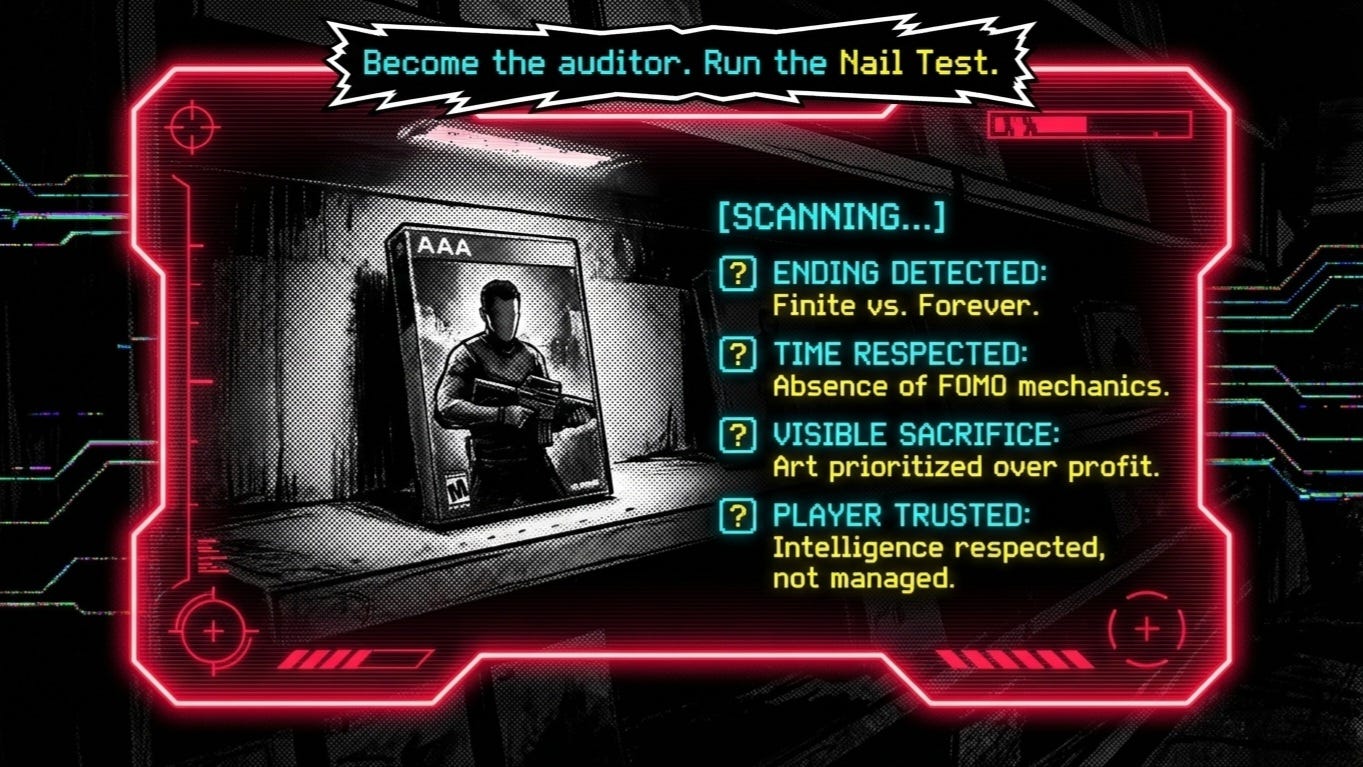
When you look at a game, before you spend sixty dollars and two hundred hours, ask five questions.
Does this game have an ending? Not a season. An ending. A designed destination where the thing the developer wanted to say has been said and the game knows it is finished. That is the Completion Principle. If the game is designed to last forever, that is not generosity. That is the vessel being sold empty.
Does this game respect your time or demand it? Is there content that expires tomorrow? A daily login bonus? A season that takes your progress with it when it ends? That is demanded time. Demanded time is extraction. Offered time is a game that lets you pick it up when you choose, set it down when you choose, and trusts you to manage your own engagement.
What did the developers give up? Did someone extend a development cycle to finish something properly? Did someone refuse a monetization model that would have made more money? Did someone hold an artistic choice at the strength the work required even though it cost them audience? That sacrifice is visible in the finished product. You can feel it. Absence of sacrifice is also visible. You can feel that too.
Does this game trust you? Does it explain the climbable cliff with a yellow smear of paint because someone decided you cannot be trusted to read a surface? Does the dialogue tell you what to feel three seconds before the cutscene shows you? Intelligence respected produces a different game than intelligence managed. You know the difference.
Will you remember it? Not the total hours. A specific moment. A choice, a scene, a thing you built, a match you won or lost in a way you will describe to someone later. If you cannot name it, nothing was planted.
The auteurs did not disappear. They left the AAA machine. FromSoftware refuses to explain Elden Ring to you and declines to justify that decision to investors. Larian spent seven years on Baldur’s Gate 3 and shipped something that asks you to make real choices with real consequences and does not apologize when those choices cost you something. Team Cherry spent years on a game that has no interest in whether you find it accessible. ConcernedApe spent four years alone building a world that remembers what season it is and changes accordingly.
These studios are not struggling experiments. They are commercially successful precisely because they honor the patterns the Safety Virus violates. Baldur’s Gate 3 sold ten million copies. Elden Ring sold over twenty-five million. Hollow Knight has over fifteen million players. Stardew Valley has over thirty million. The remnant is not a niche. It is what the market produces when a maker decides to care about the nails.
The extraction loop runs on your hours. The battle pass times its pressure to your psychology. The daily login bonus is not a reward. It is a collar. Every hour you spend inside the loop is an hour of data that tells the publisher the model works and the next one should be built the same way.
You are not obligated to stay inside a system designed to deplete you. Deletion is not defeat. Walking away from a live service game that costs you more than it returns is not losing. It is refusing to be ungovernable by their metrics.
The Safety Virus is not invincible. It is fragile. The entire ESG enforcement apparatus collapsed in six months when the institutional pressure shifted. Studios that built the safety apparatus as a cultural identity rather than a compliance response are now exposed, still shipping the same sanitized product but without the institutional cover that justified it. The market is reading this in real time.
The remnant knows how to build complete things. Finite things. Things with endings and weight and the human signature of someone who cared enough to risk something.
Play those. Support those. Fund those with your sixty dollars and your two hundred hours.
The machine runs on your depletion. Become ungovernable by its metrics.
Welcome to the autopsy.
Subscribe to KCG for the the Nail Test applied in real time.
Comments
Nothing yet. Say the first thing.
Sign in to join the conversation.