
Gaming is moving from ownership to permission. Retro players are quietly moving the other way.
There was a time when buying a game meant acquiring something that could outlive the transaction. You walked into a store, paid for it, took it home, and the publisher eventually had to let go. You could lend it, resell it, preserve it, put it on a shelf for twenty years, or dig it back out long after the company that made it had moved on.
That relationship is disappearing.
The modern gaming industry is moving steadily from possession toward permission. Physical games become digital licenses. Digital licenses become subscription libraries. Games become dependent on authentication systems and remote servers. Cloud gaming pushes the process further by moving the hardware itself into infrastructure controlled by somebody else. The customer still pays, but the seller increasingly remains present after the sale.
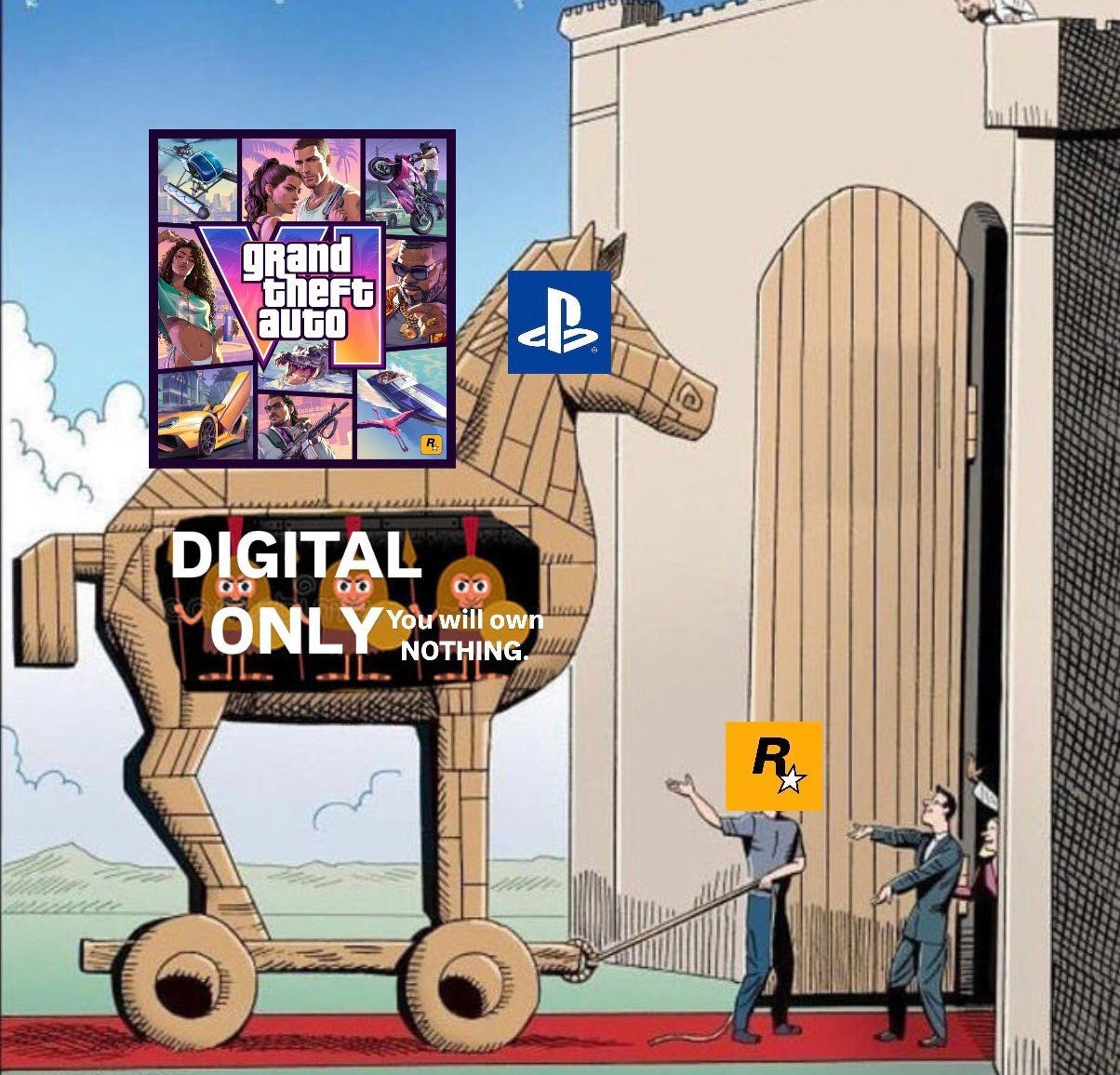
That is why the shift around Grand Theft Auto VI matters. A retail box containing a download code instead of a disc is more than an odd packaging decision. It is an almost perfect symbol of the new arrangement. The physical language of ownership remains: the box, the cover, the shrink-wrap, the shelf presence, the trip to the store. But when you open it, the product itself still lives somewhere else.
The box survives. The game does not.
GTA VI matters here because Rockstar operates near the center of gaming culture, not at its edges. When a release of this scale adopts a model, it helps normalize that model far beyond one game. A premium physical package with no physical game inside tells the player that the shell of ownership can remain even after ownership itself has been hollowed out.
Sony’s direction makes the same point at platform level. Physical media is being treated less as a permanent part of the ecosystem and more as a temporary accommodation for a shrinking minority of customers. Publishers regularly report that the overwhelming majority of sales are now digital, and corporate messaging presents the move away from discs as a natural response to consumer behavior.
That framing is not entirely false. Consumers really have moved heavily toward digital purchases. But it hides a distinction that matters.
A market trend means fewer people choose an option. A platform decision removes the option entirely.
If nine out of ten customers prefer digital, the tenth customer still exists. When the platform eliminates physical production, that customer did not suddenly change his mind. His choice disappeared.
That is why the language of inevitability deserves attention.
Corporate decisions are easier to accept when they are presented as weather rather than decisions. “The market moved. Consumers changed. Technology evolved. The future arrived.”
But futures do not arrive by themselves. Companies build them through hardware design, pricing, distribution, platform rules, licensing, server architecture, and storefront control.
Power is most effective when its preferences are presented as inevitable trends.
The economic logic behind this shift is straightforward. Ownership gives the player powers the publisher cannot fully control. A physical game can be lent, resold, bought used, preserved, or played long after the publisher has stopped monetizing it. A player can decide that the commercial relationship is over.
Access changes that.
When the game remains tied to an account, storefront, authentication system, subscription, or server, the transaction does not really end at the cash register. The platform stays between the player and the product.
That gives publishers more control over pricing, distribution, updates, access, and the continuing customer relationship. Used copies become less relevant. Resale disappears. Old products can be folded into subscription libraries. The player becomes easier to keep inside the ecosystem.
Convenience is the sales pitch. Control is the business advantage.
The endpoint of that model is already visible.
When Ubisoft shut down the servers for The Crew, the game became inaccessible. Players who had paid for it were left with account histories, receipts, boxes, and memories of something they could no longer use. That case matters because it strips away the abstraction of the word digital. The real issue is dependency.
If your ability to use a product depends on infrastructure controlled by another company, then that company retains power over the product after you have paid for it. A cartridge can survive Nintendo losing interest in the cartridge. A server-dependent game cannot survive the server losing interest in you.
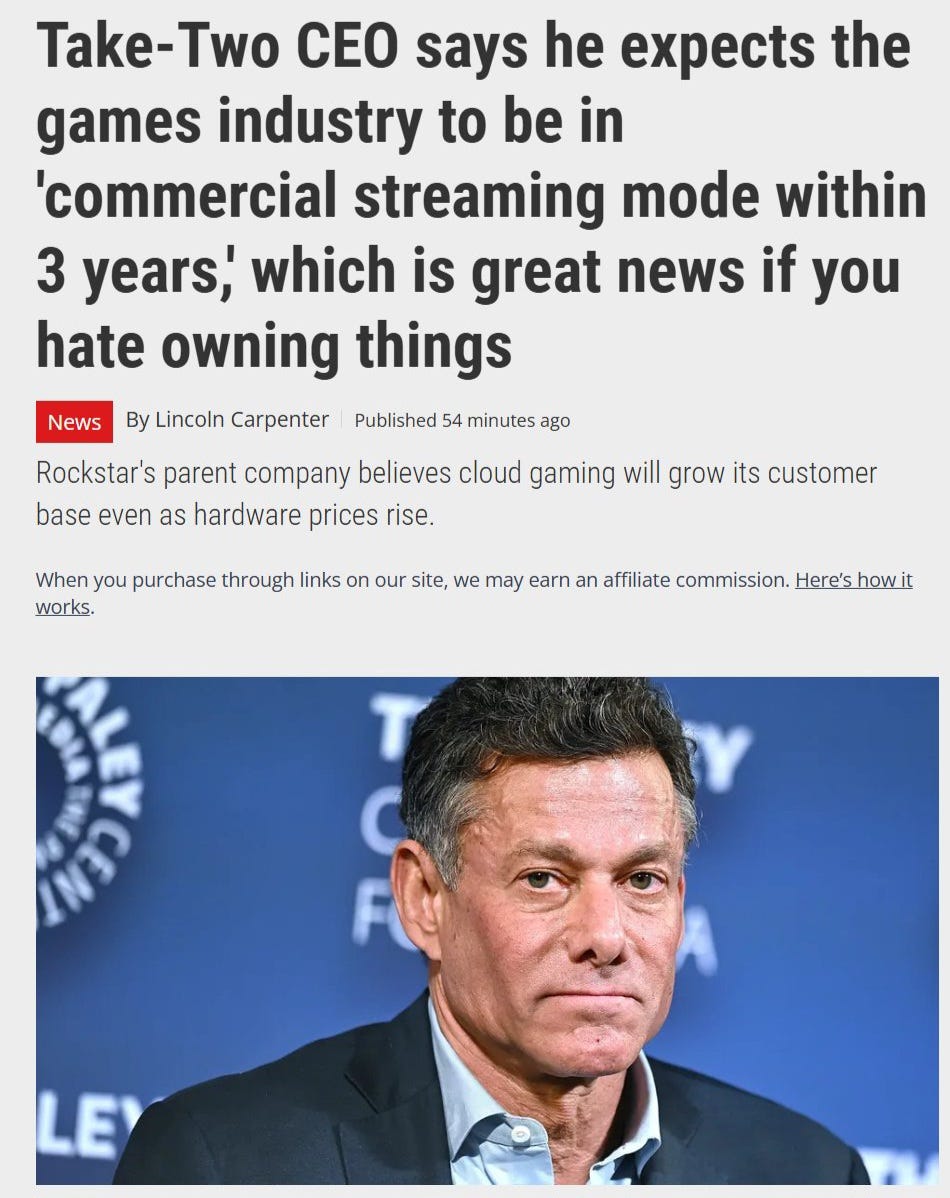
That difference becomes even more important as the industry moves beyond digital storefronts toward streaming. The logical endpoint of access-based gaming is not merely a console with fewer discs. It is a system in which the local machine matters less because the game itself runs somewhere else.
Your television becomes a window into infrastructure you do not control. Your save exists somewhere else. Your library exists somewhere else. Your access rights are verified somewhere else. You own less of the system required to play.
At that point, buying a game starts to look less like buying a book and more like renting space inside an amusement park. You can enjoy everything while the gates are open, but the gates are not yours.
This is also where the current fascination with retro gaming becomes much more interesting than simple nostalgia.
While the largest publishers move toward permission, millions of players are moving in the opposite direction. Old consoles are being restored. Physical collections are growing. Emulation handhelds have become a serious market. ROM hacks, fan translations, FPGA hardware, preservation projects, and communities like RetroAchievements have built new infrastructure around games whose commercial lives supposedly ended decades ago.
Some of that is obviously nostalgia. But nostalgia alone does not explain why the movement keeps growing.
Retro games offer something that has become strangely scarce in modern gaming: finality.
The game shipped. The game exists. There is no seasonal roadmap waiting to reorganize it. There is no battle pass sitting beside the main menu. There is no rotating cosmetic store, no engagement strategy, no promise that the product will become complete later. You turn it on and the game is there.
If the developer closed twenty years ago, the cartridge does not care.
That is a form of functional autonomy.
It also explains why the contrast between retro gaming and the modern industry feels increasingly sharp. The modern industry wants games to become continuing relationships. Retro hardware reminds players that games can simply be products.
The distinction is not old technology versus new technology. Retro communities are not anti-technology. Emulation is technological. RetroAchievements depends on networking and software. FPGA hardware is technological. Preservation projects use modern tools to keep old games alive.
The deeper difference is what the technology is being used for.
One model uses technology to increase dependence on the platform. The other uses technology to preserve independence from it.
That is the real divide.
The gaming industry does not need every player to celebrate the loss of ownership. It only needs the old expectation to disappear. Once people stop expecting a purchase to end with possession, the transition is effectively complete.
You can already hear the replacement vocabulary everywhere. “Physical is dead.
“Everything is digital now.”
“You never really owned games anyway.”
“Just subscribe.”
“Who even uses discs?”
Eventually the publisher no longer has to defend the arrangement because consumers do it for them.
That is when the engineered reset becomes durable.
Not when the last disc factory closes.
When the player himself stops expecting the seller to surrender control after taking his money.
That is why the code-in-box era matters beyond one Rockstar release. It does not end ownership by itself. It shows how far the baseline has already moved.
Twenty years ago, paying full price for a physical game box and finding no game inside would have looked ridiculous.
Today, millions of players barely notice.
And somewhere else, somebody will put a cartridge made decades ago into a machine that has not contacted its publisher in thirty years.
It will simply boot.
The industry keeps building more sophisticated ways to grant us permission.
Retro gaming keeps reminding us that we once did not need to ask.
Comments
Nothing yet. Say the first thing.
Sign in to join the conversation.