
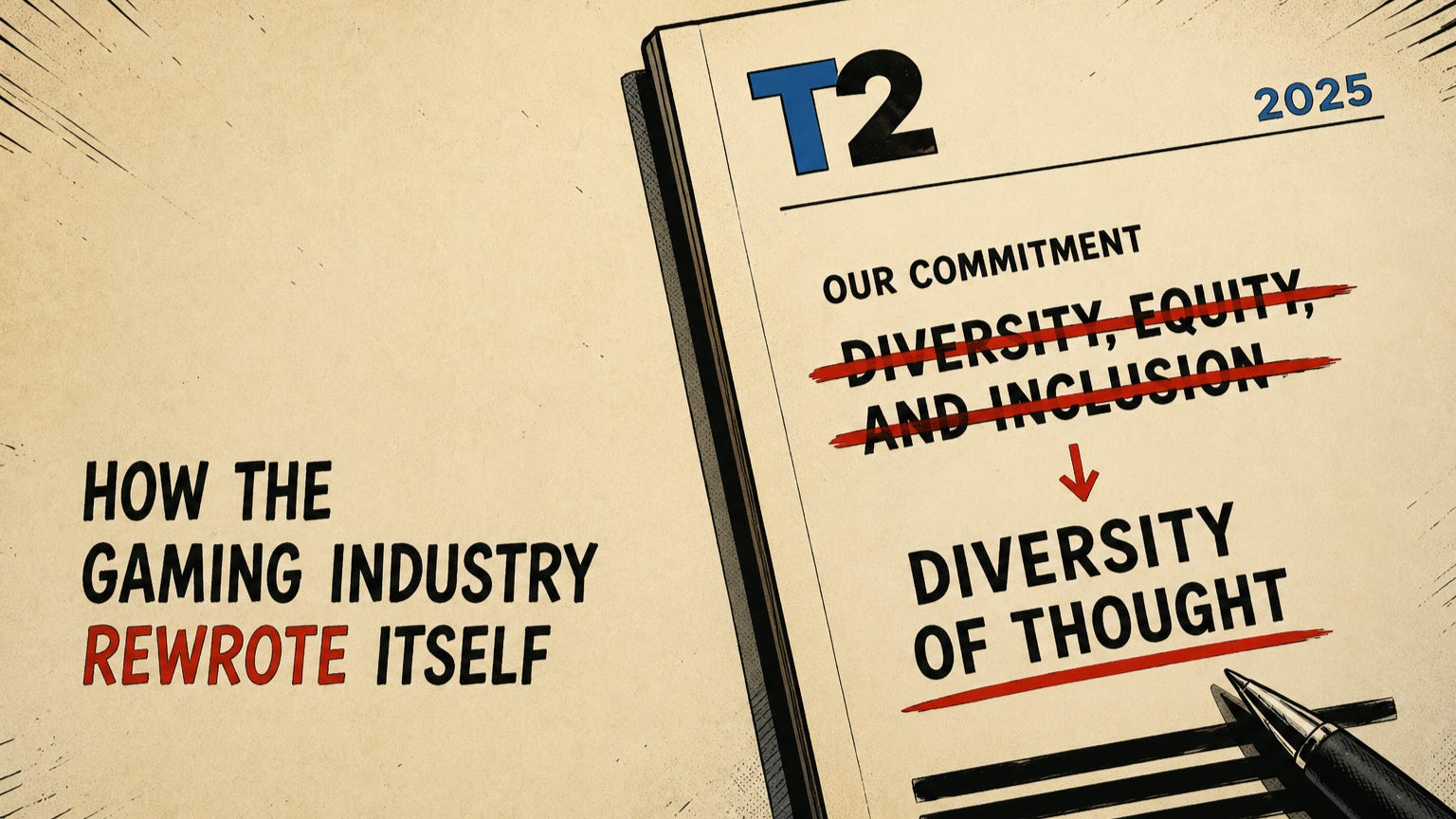
Take-Two removed every instance of “Diversity, Equity, and Inclusion” from their 2025 annual report.
Someone at Take-Two read the arithmetic and quietly rewrote the language before anyone asked them to.
That edit is the most honest thing a publicly traded gaming company has said in a decade. The calculation changed. The language followed.
This piece is about what produced that calculation, what it costs when the calculation runs the wrong direction, and what November 19 tells us about whether the correction arrived in time to matter.
For a publicly traded gaming studio, commercial failure and institutional non-compliance are two different costs. Studios have been choosing between them for a decade.
The cost of ESG non-compliance is specific and immediate. Restricted capital access. Index fund divestment. Proxy voting pressure from institutional shareholders. Board-level intervention. The entities controlling this are not abstract. BlackRock, Vanguard, and State Street collectively govern the capital flow that keeps publicly traded studios operational.
The cost of mandate-driven content is also specific. Market rejection. Brand erosion. Talent attrition. A $200 million write-off.
For most publicly traded studios the first cost exceeded the second. So they complied. A $200 million failed launch is a manageable quarterly event. Losing favorable positioning with the firms managing trillions in assets is an existential condition.
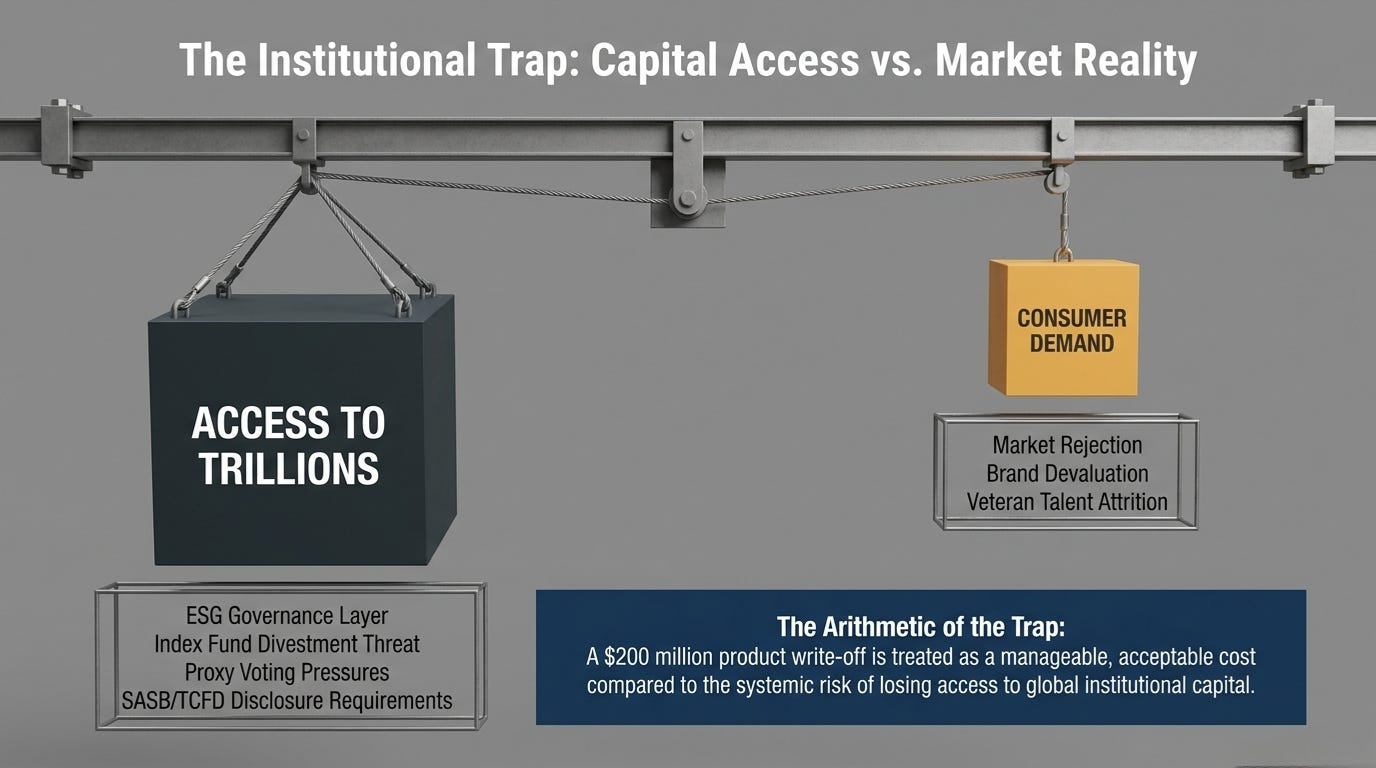
That is not irrationality. That is arithmetic.
The audience calling these studios stupid for making products nobody wanted was looking at the wrong ledger. The studios weren’t optimizing for the player. They were optimizing for the capital conditions that kept the lights on. Understanding that distinction doesn’t excuse the output. It explains why the output kept coming despite the commercial evidence against it.
The institutional pressure on gaming studios doesn’t arrive through a single channel. It runs through an interconnected ownership layer that most players have never examined.
Start with GDC. The Game Developers Conference is the primary professional credentialing system for the people who make games. Speaker selection, session programming, award recognition, GDC shapes what developers believe is normal, acceptable, and career-advancing.
GDC’s parent company is Informa PLC.
Informa PLC’s largest institutional shareholders and index managers are led by BlackRock, alongside the structural capital presence of Vanguard and State Street.
The same asset managers scoring Take-Two on ESG criteria own the conference that trains Take-Two’s developers.
That is not a conspiracy. It is a documented ownership structure with documented downstream effects. Informa used its FasterForward sustainability program to align GDC programming with corporate ESG targets. The conference that presents design standards to the global developer community answers to the same capital layer that scores studios on compliance with those standards.
The pipeline runs from asset manager to conference to developer to product. Each link is documented.
2014 — GDC codified the Advocacy track as a permanent programming pillar alongside Engineering and Design. The shift from technical disciplines to policy platform begins.
2019 — Representation becomes a formal design metric. External consultancies establish new standards through GDC programming. Narrative roles expand.
2024 — Microsoft releases its Product Inclusion Protocol. Four doorways formalized: approachability, representation, globalization, accessibility. Every product element passes through the doorways.
2026 — GDC rebrands as the Festival of Gaming. Attendance has fallen 33% to 20,000 unique attendees. The engineering conference that once defined the craft of game development is now a “festival.”
The attendance collapse is the market speaking about the conference the same way it spoke about Concord. The product failed to serve its actual audience.
GDC-aligned surveys reported compliance success rates between 71% and 90% across the industry during peak capture. The reality inside studios tells a different story.
By 2024 the percentage of developers rating their company’s compliance efforts as completely unsuccessful had tripled to 11%. The narrative professionals whose roles expanded most rapidly under the compliance mandate faced the highest layoff rates during the 2024-2025 industry contraction — 19% of that cohort eliminated in a single cycle.
The roles created to satisfy the scoring system were the first eliminated when the commercial consequences of that system became undeniable.
52% of developers view generative AI as a negative force on the industry. Among artists that rises to 64%. Among narrative writers 63%. The people whose creative labor was already being directed toward compliance outputs see the next wave of displacement coming.
The credentialing system produced a workforce trained to satisfy external audits. When the audits softened the workforce had nowhere to redirect the training.
The gap between institutional alignment and commercial outcome is now documented across enough titles to constitute a pattern.
Concord followed the mandate faithfully. GDC-adjacent character design philosophy. Live service architecture. Institutional praise. It lasted two weeks. $200 million gone.
Suicide Squad followed the mandate. Compliance-forward character roster. Extraction design built around seasonal monetization. The studio absorbed layoffs. Player counts collapsed.
Elden Ring ignored the mandate entirely. FromSoftware bypassed Western institutional orbit through self-publishing. Shadow of the Erdtree sold 5 million copies in three days.
Institutional alignment and commercial success moved in opposite directions consistently enough that the arithmetic became undeniable to anyone reading the actual numbers.
Take-Two read the numbers. Then they edited the document.
The arithmetic of the trap has a human layer the ledger doesn’t capture.
Naughty Dog is the primary case study. During the production of The Last of Us Part II, 70% of non-lead designers left the studio. The institutional knowledge accumulated across years of craft design work walked out with them. Management framed the turnover as the cost of perfectionism. High Metacritic scores became the shield — if the game wins awards the hundred-hour weeks were necessary.
The Perfectionist Mandate is the compliance culture’s most sophisticated move. It reframes talent extraction as artistic commitment. The score validates the conditions that produced it. The conditions persist because the score keeps arriving.
What left Naughty Dog was not just personnel. It was the specific creative conditions that made Jak and Daxter possible. Andy Gavin and Jason Rubin built that game under conditions of complete creative sovereignty. They invented a programming language to serve the vision. They left in 2004 — three years after Sony’s acquisition consolidated.
The studio that made Jak and Daxter still exists. The conditions that made Jak and Daxter do not.
That is the human cost rendered in institutional language. Two founders. One departure. Twenty years of different output.
The studios maintaining creative sovereignty share one operating condition: independence from the Western institutional orbit that governs publicly traded publishers.
Capcom built a division structure that isolates gameplay design from compliance pressure. Every title gets evaluated on mechanical coherence first. The RE Engine is reusable technology that reduces budget pressure without reducing creative ambition. Lower costs mean less dependence on institutional capital. Less dependence means more creative authority.
FromSoftware moved toward international self-publishing specifically to bypass Western narrative mandate intermediaries. The result is a catalogue of mechanically demanding, authored experiences that the compliance layer would have softened into something legible and forgettable.
Nintendo operates within the Western financial orbit but remains immune to its cultural mandates. Western institutions hold a majority stake, but Nintendo’s zero-debt, multi-billion-dollar cash reserve eliminates investor leverage. Because they never require external financing to fund their next cycle, their capital structure secures absolute creative sovereignty. In Kyoto, the product dictates the corporate governance, not the market.
These studios are not ignorant of the pressure. They built around it. The architecture of their independence is a documented strategic choice not an accident of geography.
Take-Two’s 2025 annual report removed DEI language and replaced it with “diversity of thought.”
That edit is a signal. A financial recalculation.
The institutional pressure has softened publicly since 2022. BlackRock stopped using the ESG term publicly. Several US states restricted pension fund ESG criteria. The scoring environment relaxed without disappearing. Studios that built compliance infrastructure during peak pressure still carry it. The internal governance doesn’t dissolve when the external language softens.
GTA VI was developed inside that environment. The delays, thirteen months past what Take-Two wanted, suggest someone with enough authority to absorb shareholder pressure held the line on completion. The internal DEI structure installed between 2022 and 2024 was operational during development. The edit in the annual report tells you the external calculation changed. It doesn’t tell you whether the internal conditions changed in time to reach the creative layer.
November 19 answers that.
Three criteria. Established publicly six months in advance.
The satire blast radius — does the equal-opportunity grotesque that made GTA what it is still have no protected categories, or has the compliance layer installed its preferences into the writing room?
The Lucia test — does she carry the moral complexity and genuine darkness of Trevor Phillips and Arthur Morgan, or has she been sanded into a legible, sympathetic, mandate-compliant protagonist?
The extraction boundary — does GTA Online’s monetization bleed into the authored single-player world, or has Rockstar held the line that kept the world worth inhabiting for a decade?
If GTA VI scores 9-10 on the Nail Test the financial argument for compliance collapses publicly. The largest launch in history produced by a studio that held its creative line. Every analyst in every board meeting where someone argues for mandate-driven content will face that data point. The arithmetic changes industry-wide.
If GTA VI scores 5-6 the last craft studio at scale folded. The compliance layer reached all the way to the top and the edit in the annual report was just optics over an unchanged reality.
Take-Two already told you which direction the wind is blowing. They changed the document before anyone asked them to.
The question is whether they changed what’s inside the game.
The Nail Test runs November 19. The criteria are documented. The verdict publishes regardless of outcome. That is the standard. Hold it.
Comments
Nothing yet. Say the first thing.
Sign in to join the conversation.