
Perhaps we are never entirely free, but we have choices, as contradictory as that may sound.

I am nearing the end of the Ignatian Spiritual Exercises, commonly known as the 19th Annotation when you do them in daily life. I’ve been working with an Ignatian guide since September or October last year, meeting every week for about an hour to discuss the daily meditations on the passages she provides. We will finish early to mid-June. The scriptural passages follow the life of Jesus and are primarily imaginative. There’s also a period when you’re asked to journey with Jesus through his child years, which are not written about in the Bible. The idea is to get to know who Jesus is in order to figure out who is this person who is both fully human and fully divine.
It is incredible, but my guide tells me it happens all the time; there are so many coincidences and synchronicities between the passages I am asked to pray with and what is happening in daily life.
Praying the last couple of weeks with the resurrection story, I wondered in my journal whether suffering is inevitable. What might have happened to the Jesus story if Jesus never suffered? Must we suffer to be believed? If you don’t suffer, are you credible?
I had written a few days earlier a substack on trauma and quoted something from James Hillman about the ways in which western psychology encourages us to search out traumatic memory in our past. And when meditating on the resurrection passages I started to wonder whether this notion that we ‘must’ suffer might stem from our Christian heritage.
Certainly if you look at how the concept of trauma has been stretched to include any and all potentially offensive and disrupting events in our daily lives, I see a link to the idea that credibility is achieved through having experienced ‘major’ suffering. It accompanies another tendency which is to disregard academic theory and research, in favour of the opinions and experiences of ordinary people.
It may sound like I disregard or disrespect what ordinary people might have to say about a particular subject. I don’t. It’s essential to be informed on different perspectives. Nevertheless, opinion grounded in rigorous research is not the same as personal grievance or emotional reaction.
Some skip the suffering bit during Easter and jump straight from Good Friday to Easter Sunday and the resurrection. Silent or Holy Saturday when Jesus supposedly descended to the realm of the dead is not given much regard either. And yet somewhere along the line, popular culture took on the idea that work must be difficult, suffering equals courage, trauma whilst not good somehow means you know what you’re talking about. Add to this the modern psychological notion that endless talking about feelings is necessary for healing to take place and the idea that older generations, like my mother, were hardened and probably incredibly traumatised but afraid to express vulnerability and look around at the mental health crises we see everywhere, and tell me what you think.

Young and old are persuaded that they must have a label. Neuro-diverse, ADHD, autistic, ADD, gender fluid, non-binary. There seems to be cultural pressure to locate ourselves within some category of woundedness or exceptionality. You daren’t say you have never experienced ‘real’ trauma. Nor that you consider yourself relatively ‘normal’. It’s not done. Especially not in spiritual and religious circles. If you haven’t been traumatised, had a John of the Cross dark night of the soul, if you don’t own up all your vulnerabilities but instead seem strong and grounded most of the time, something must be wrong. Right? Wrong.
With the stretching of trauma and the opening up of our minds to the reality of diversity, we may also have weakened our cultural language of resilience. If you don’t have a therapist or have never been to a psychologist, you must be repressing something. Right? Wrong.
What we talk about; the words we use; the concepts we know – all affect the way we perceive the world. And the way we experience it. There are cultures which conceptualise the future as being behind us rather than in front of us, because the future cannot yet be seen whilst the past is visible and known. Metaphors matter. Narratives shape consciousness. Talk about trauma all day long and suddenly you realise you must be traumatised. Keep talking about autism and you will recognise some of the symptoms in yourself and others. Add to this the psychological language of projection. And all of a sudden all kinds of bad behaviour hide behind a veil of some syndrome or another. “I can’t help it because I’ve got…….”.
It hurts to know we’ve probably all got something. You’re not so ‘special’ after all.
We’re all non-binary. Human beings have always contained ambiguity, contradiction and fluidity. We do not necessarily need a label to acknowledge that complexity. We don’t need a label to prove it.

Now you might want to read this as a denial that some people have problematic mental health issues. It’s not a denial. In fact it’s the opposite. Trauma is trivialised and turned into a meaningless concept when every tiny offence can become traumatising. Look at the explosion of trans youth in the west. Trans experience in the UK or in the Netherlands is in no way comparable to being trans in Brazil, for example. Perhaps the cultural context should always be taken into account when examining the spread of these conditions, ailments, syndromes and diagnoses. Could part of this phenomenon also reflect the modern search for identity and significance?
It is important to make a distinction here that I do not want to collapse. There is a difference between trauma as it has expanded in cultural language, and the kinds of traumatic experiences I have encountered over two decades of hosting and working with refugees, where suffering is often immediate, concrete, and tied to survival itself. Nothing I am saying is intended to diminish that.
What I am questioning is the huge expansion of the language of trauma in ways that displace older ways of speaking about the human experience of finitude itself — ways in which death and dying, grief and mortality were not primarily framed through the lens of trauma, but were integrated into broader cultural, spiritual and communal understandings of what it means to be human. Yet paradoxically, we still struggle to speak directly about death except in the language of battle or survival – as something to be “fought”, “beaten”, or “won”. The metaphors we inherit are often military, even when the reality is not a war at all. This creates a strange cultural tension: on the one hand, an expansion of psychological language into nearly every domain of discomfort; on the other, a shrinking of our capacity to speak simply and openly about mortality, fragility, and the ordinary human condition. It is this shift in language, rather than the reality of suffering itself, that raises questions for me.
Is there suffering? Of course there is. There is individual, collective and cultural suffering. The context is just as important as the biology. Acceptance is other than embrace. Embrace can welcome diversity just as much as it can encourage and condition it. Not wrong. Not right. Just something to watch. Be aware of.
Resurrection means rising again, again to rise or straightening up. Is straightening up possible in a culture that idealises trauma and romanticises suffering? How to straighten up when our culture demands specialness through suffering?
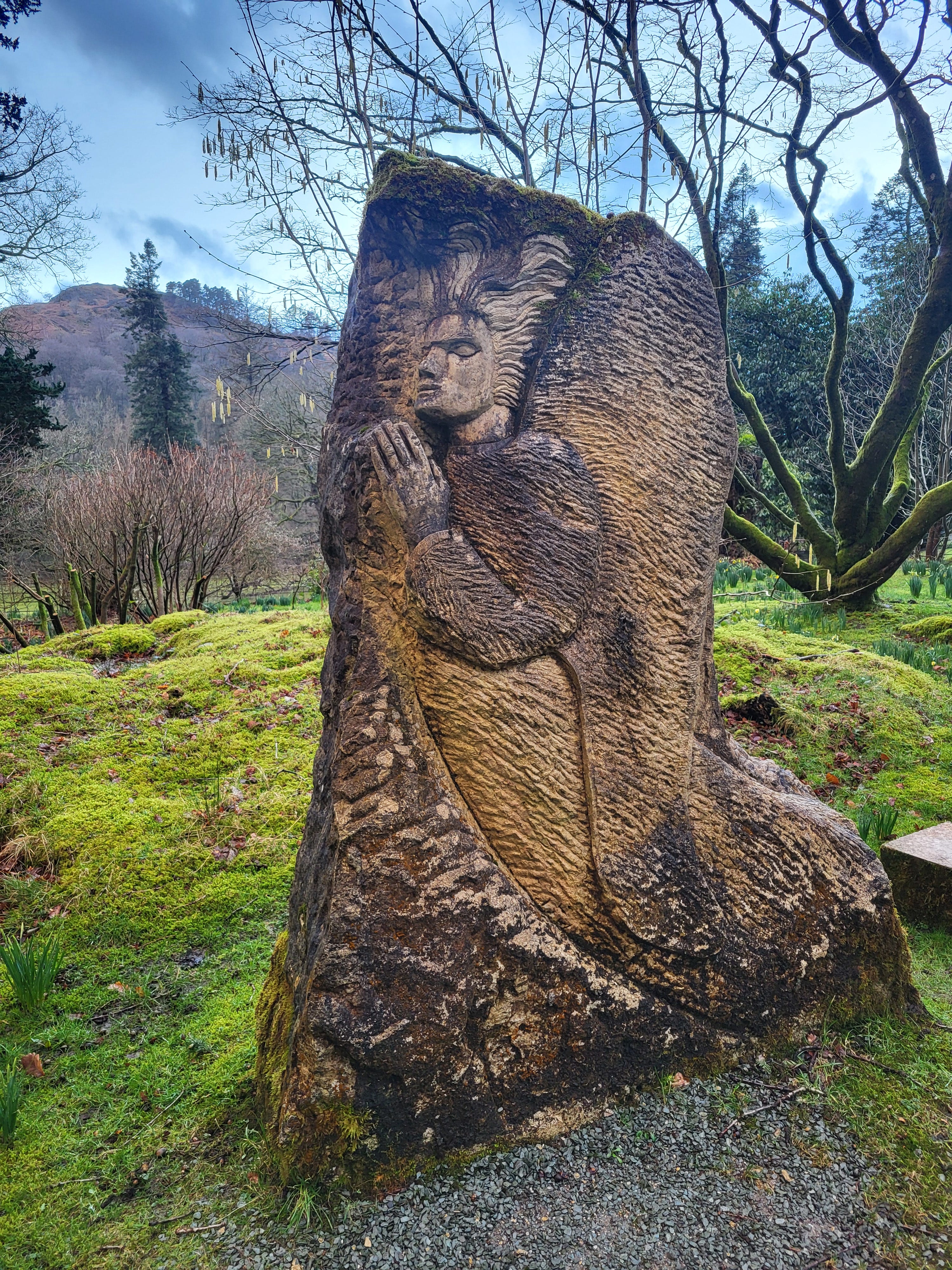
No answers. Just questions. Things to ponder. Seek balance. Be receptive.
Comments
Nothing yet. Say the first thing.
Sign in to join the conversation.