
Lately, impermanence has been sitting with me: Friends reaching milestone birthdays; a beloved teacher passing; democracy unraveling before our eyes; and an unexpected health scare.
In Buddhism, this is the first mark of existence — impermanence. Nothing lasts. And if we look closely enough, most of our fears are rooted in the greatest fear of all: The fear of death.
It is often said in Buddhism that the only constant is impermanence (Pali: anicca; Sanskrit: anitya).
“All compounded things are subject to vanish.” Whether it’s the last cookie in the jar, the first gray hair on your head, or the coral reefs bleaching in a warming ocean, all conditioned things — big or small, brief or long-lived — eventually pass away.
Perhaps this is why this teaching is the foundation for all other teachings in our canon — that much of our suffering, arguably, is because we cannot accept impermanence. Instead we grasp at things, want things to last longer — relationships, money, that delicious sticky bun.
Our natural instinct as humans is to desire, and in the contemporary capitalist society we live in, it is often ad infinitum. It is never enough. We are never enough.
That’s why the art of letting go is so vital in our practice, both in our everyday life and on our cushion. It is the art of letting go that allows the gentle embracing of the truth that nothing is constant.
So where does that leave us?
Thanks for reading Just One Breath.! This post is public so feel free to share it.
We live in a culture that, in many ways, is grief-phobic. We rush people to “move on,” praise each other for being strong, and treat mourning as something to get over quickly rather than tend to; it has become a private burden instead of a shared experience — a far cry from the communal mourning our ancestors practiced for centuries.
Even our systems mirror this avoidance. A 2023 federal report found major barriers to bereavement support across the U.S., showing how little infrastructure we have to help people navigate loss. And because we lack a federal right to bereavement leave, most companies offer only a few days off — if even that — before expecting employees to return to work like “normal.”
The pandemic, of course, only deepened this collective avoidance. Studies show that prolonged grief increased during COVID because isolation and disrupted rituals left so many without the space or support to process loss. It has gotten to the point that psychologists are saying that unprocessed collective sorrow is “eating away at us,” showing up in burnout, anxiety, rage, and despair.
It’s become abundantly clear to me how important it is for us to grieve, and yet, I recognize my aversion to it as well. One of my dear teachers Dr. Larry Ward shared once that he grieved every morning and then read the Five Remembrances before even getting out of bed.
Larry didn’t know me well, but his way of sharing the dharma, loudly, fiercely, changed my life. He made my suffering feel seen during the height of anti-Asian hate crimes; he spoke openly about white supremacy as a call to compassion; and he helped me understand the wisdom of my body. He embodied the dharma name that Zen Master Thích Nhất Hạnh gave him — True Great Sound — and made an indelible mark on my soul.
I will be forever grateful to him and remain in deep reverence for his wife and fellow dharma teacher Peggy Ward who is moving through her grief with such vulnerability, openness and courage and somehow still teaching through all of it. Please go soak in her humanness at The Lotus Institute and be a part of Larry’s collective vision for the world.
When the edges of grief singe the borders of my heart, I often think about how he shared that he would grieve every morning as a Black man in America. And I then often think about how much I carry and don’t release.
But release often shows up differently for everyone. For me, it’s through writing, play, deep breaths, my mindful steps. This past week I found myself furiously writing about how I am mourning America as a first-gen kid of refugees; it came pouring out of me, like a tub overflowing. I also am a fan of a rage room; it can be cathartic to let that energy out of your body in a destructive but safe way. Whether it’s smashing an old computer monitor or writing stream of consciousness on the page, these acts of release remind me that grasping only prolongs suffering — and that letting go is its own practice of impermanence.
Just as Larry’s grieving practice grounded him, I too found myself forced to reckon with impermanence when I spent the night at the ER after a freak viral infection. After two days, as my body recalibrated, my heart would not stop racing. When chest pains arose, my wife asked: Are you having a heart attack? In the fleeting moments between pains, I felt how quickly life can change — and can end.
And after that week of recovering — both physically and emotionally — I remembered that we also always have a choice. We can take the nihilist viewpoint and feel powerless, or we can lean in and reclaim our lives. Impermanence can feel like a void, but it can also be a doorway. One friend reminded me recently: The point is not despair, but to remember that life is precious.
For me, that’s what impermanence invites us to do every minute, second, breath we take. We can take the opportunity to live life to the fullest — that means stopping the never-ending scrolling and brain rot and finding ways to be present in the here and now.
That means hugging your loved ones, being there for them, truly being present for them in a way that makes them feel seen and cared for. That means doing the thing you’ve been wanting to do for years and taking the leap. That means taking good care of your body, listening to your nervous system in a way so you know when to rest, when to grieve, when to just stop and let yourself be. That means looking deeply enough to understand that though nothing is permanent, understanding that we are all still here because we are interconnected, because we inter-are to help us ignite our deep well of compassion within all of us.
Because otherwise, one way or another, it will all go away eventually and transform into something else. And no one wants to look back on a life not lived.
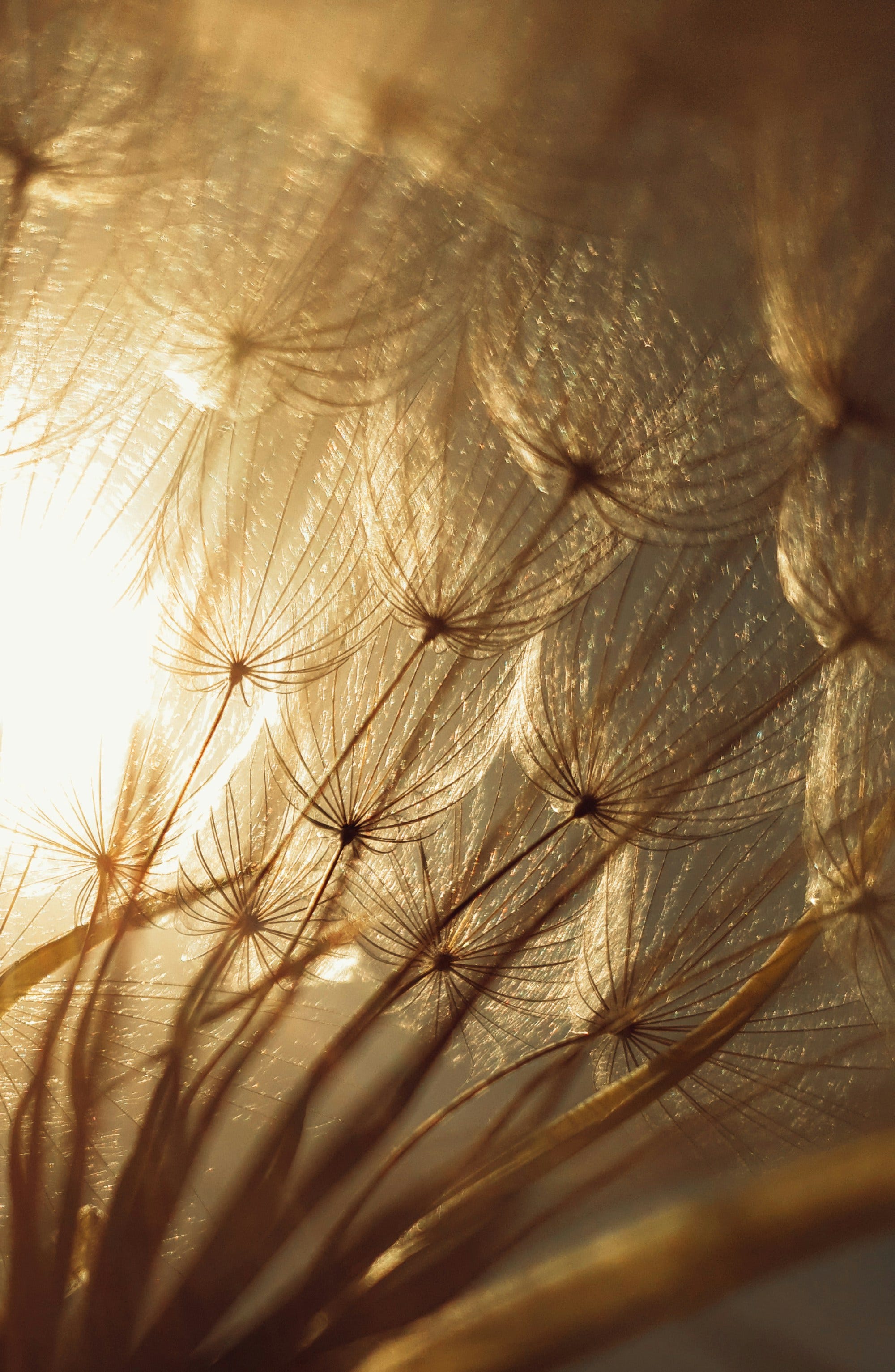
At the recent BIPOC retreat at Blue Cliff Monastery, Sister True Vow gave a dharma talk on how the dandelion is such a wonderful teacher to us — how some people can view it as beautiful, while others view it as a weed. And that with a gust of wind, it suddenly is no more.
Gone.
Whatever feelings you may have about the dandelion, it is such an invitation for us to practice mindfulness, to witness it before it is gone. And in this way, it is a beautiful teacher.
She asked us: What is your dandelion? What can be your dandelion? What is something that helps you stop and witness what is right in front of you before it is gone?
So I’ll extend that same invitation to you: What can be your dandelion? What can help you wake up to see your life and be present for it?
Practicing with impermanence is a new practice for me. Though I think about it in the abstract often, it is not something I have built space to deeply contemplate before. So below are some ways I will be practicing with it in the coming months and invite you to do the same. Send me a message and let me know how it’s going. Let’s be on this journey together so we can make the most out of life.
Create a grief ritual for yourself. Take inspiration from dear Larry. Maybe it’s every day, maybe it’s once a month. But try to do it with some regularity, and I will too. Allow yourself the space to pour out what you are carrying — whether it’s a loved one who died, a missed opportunity, the state of the world (jump down for more), a relationship. Don’t judge it, just be with it. Tend to it like a child. Be gentle with yourself. Cry. Dance. Write it down, burn the paper. Do whatever you need to do to get it out of your body. You deserve not to be weighed down. You deserve to feel the lightness of being.
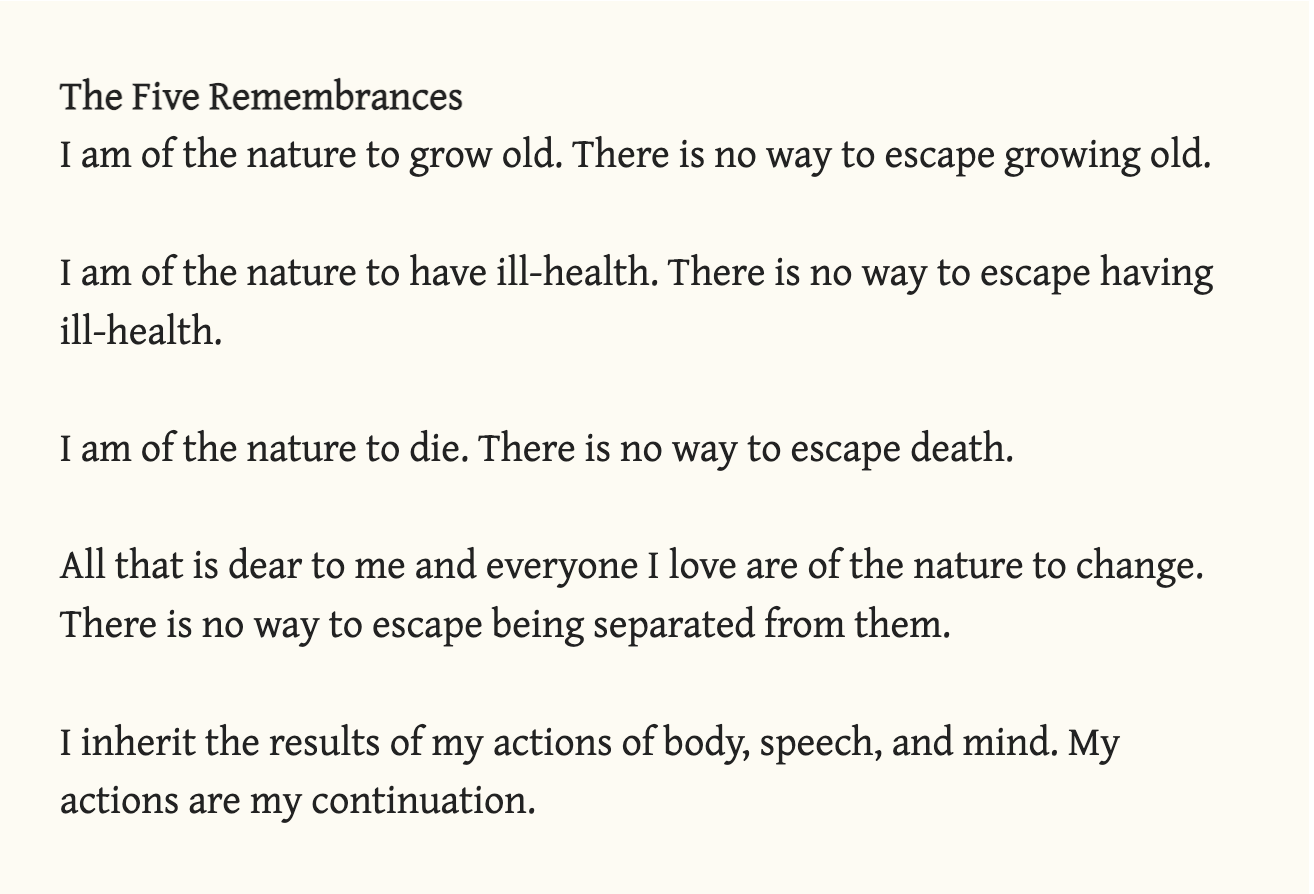
Recite the Five Remembrances as a way to remind you of the inevitable, as a way to help you work with your fear, so that you cam sit with it, transform it and let it go — to make room and space in your body and mind consciousness for joy, light, laughter.
Read Ann Tashi Slater’s new book Traveling in Bardo: The Art of Living in an Impermanent World — a luminous guide to impermanence. I’ve had the pleasure to get to know Ann a bit through my Narrative Healing community and have always found her profoundly wise and grounded. Her latest book is getting rave reviews from Elizabeth Gilbert, Dani Shapiro, Malcolm Gladwell, Melissa Febos and the like. Even without all those endorsements, I would have supported Ann knowing how brilliant she is but this is just confirming that this is the must-read book of the Fall. If you’re interested in reading it with me, send me a message!
Mourn for clarity. And if you are like me, you need a place to process what’s happening in the world some more. I invite you to read this beautiful letter-prayer from ARISE sangha, a community of mindfulness practitioners and monastics who come together to heal the wounds of racial injustice and social inequity, beginning with looking deeply within ourselves and using the energy of compassion, understanding, and love in action. Below is the just the beginning of this call-to-clarity letter. It has brought me much healing in a time of the world where I often feel lost. Do yourself a favor and the next time an injustice happens, read this and be with it and allow whatever feelings may arise and be with them. Don’t push them away. This too is a practice of mindfulness — of our feelings, our grief, and our shared humanity.
We are suffering. We are grieving. We are raging. And, we are taking care with much tenderness and the patience of our individual and collective hearts, bodies, and minds. We seek to lift up our voices in a hope that’s grounded in love-in-action and offer this love letter as an expression of our call to clarity in a time of chaos. We acknowledge that we are experiencing global crises and that the message below is focused primarily on the US and its impact around the world.
There is much to mourn. And, there is much more care and compassion to offer so as not to lose oneself in despair.
Full call-to-clarity here.
No posts
Comments
Nothing yet. Say the first thing.
Sign in to join the conversation.