
Like I did with Chiltrude, the heroine of my new novel, Duchess of the New Dawn, I had to invent quite a bit about her love interest, Odilo, Duke of the Bavarians, but I wove in the history where I could.
One certainty in his background: he belonged to Bavaria’s ruling family, the Agilolfings. The rest of it is educated guesses and invention. We don’t know when Odilo was born or exactly who his parents were.
His connection to the Agilolfings likely came from his mother, who might have been a sister or daughter of Bavarian Duke Theodo (died c. 717), and Odilo might have been the youngest son of Alaman Duke Gottfried.
In my version of events, Odilo’s mother is her husband’s much younger wife in the duke’s second marriage, and Odilo was born a month after his father’s death in 709. That allowed me to narrow the age gap between him and Chiltrude to 9 years. It also put young Odilo in a vulnerable position, with his much older brother Theudebald questioning his paternity. This has ramifications later on in the backstory and the novel.
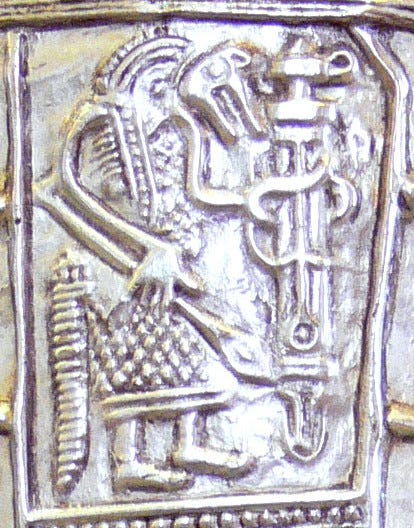
Historically, after Gottfried’s death, two of his sons, Lantfrid and Willeharius, fought each other to rule the duchy. The Frankish mayor of the palace, Pippin of Herstal, allied himself with Lantfrid and attacked Willeharius for four years in a row. Willeharius vanishes from the record in 712—this is not the first or last time an early medieval person inexplicably disappears.
The alliance between the Franks and the Alamans continued after Pippin died and Charles Martel assumed control of Francia after his own years-long fight with his stepmother and another rival.
We don’t know where Odilo spent his childhood—I assume it was somewhere in Alamannia. One invention is for Odilo to visit Charles’s court in 724 at age 15. As the youngest son, he does not have hopes for ruling the Alamans, where his brother Lantfrid reigns, or the Bavarians, where his relatives have been fighting over who gets to succeed Theodo. But Odilo does aspire to be a high-ranking officer. He meets Chiltrude for the first time, when she is 6, but neither attaches any significance to it.
And while I’m inventing, why not have Odilo accompany Charles, now a widower, on a real-life invasion of Bavaria in 725, when the Frankish ruler teamed up with Lombard King Luitprand to support Luitprand’s brother-in-law, Bavarian Duke Hugbert? Lantfrid allowed Charles to march through his territory. Charles returned to Francia with a highborn Bavarian bride, Swanahild, solidifying the Bavarian-Frankish alliance.
No one knows what the historic Odilo looked like, so why not make him handsome? It helps with the love story.
When Chiltrude returns from Chelles in 729 before she turns 12 (my version of events), she is old enough to notice the good looks of a man in his early 20s but roll her eyes at the court ladies fawning over him. Odilo and Chiltrude are not in each other’s orbit for long. A few months later, Charles send Odilo to Bavaria to serve as an officer in Hugbert’s court. It’s not too much of a stretch for Charles and Swanahild to notice Hugbert hasn’t sired an heir, even though he’s been duke for four years, and want someone familiar as a backup.
In 730, the historic Charles attacked Lantfrid. The apparent reason is that Lantfrid tried to change the law governing the Alamans, a responsibility reserved for the king only. Lantfrid died, and his and Odilo’s brother Theudebald became Duke of the Alamans. In 734, Charles Martel drove Theudebald out of power, except for part of the Black Forest.

We don’t know why, so the novelist must come up with a reason. In his late 40s, Theudebald decided it was high time to get married to a young woman and beget a son. Luckily, he didn’t have to wait long. To ensure loyalty from his brother’s former subjects, he named the child Lantfrid. An Alaman aristocrat named Lantfrid appears a few years later in the records, but we don’t know the historic Lantfrid’s relationship with the real Theudebald.
In the novel, Charles saw Theudebald’s choice of baby name as betrayal. Odilo did not come to his brother’s aid. His cover story is that he was not the Duke of Bavaria and did not have the authority. His real reason: payback for Theudebald’s questioning of his paternity.
In early fall 736, Hugbert died. A few months later, Charles allowed Odilo to become Duke of the Bavarians.
In my version of events, Swanahild notices that a duke need a wife, and she writes to Odilo a year after he assumes power over the duchy, proposing marriage between him and her stepdaughter, Chiltrude. It’s plausible. Odilo and Chiltrude were in the same social class, and the marriage could have solidified the political alliance. The historic Swanahild would later encourage her stepdaughter to flee Francia and marry Odilo, even if her full brothers didn’t approve. The elopement gave them a grievance against their brother-in-law.
By this time, Bavarians counts probably resented Charles’s years of meddling in their affairs. In 740, Swidger, Count of the Nordgau, and his allies in Linden Grove (Lindenhart) drove Odilo from power, and he fled to Charles’s court in Quierzy.
Here is how Chiltrude reacts to seeing him, in Duchess of the New Dawn.
*
I counted ten men in the Bavarian party—six of them armed and armored, a churchman, and three servants—and three packhorses, five mules, and five horses. The leader, tall and muscular, wore a red-plumed helmet, and was surrendering his sword to the villa’s guards, as all guests did. Even if Odilo was Swanahild’s kinsman, my father would never allow weapons anywhere near him or our family.
“Count Swidger must have moved quickly for them to travel so lightly,” I said in a low voice.
Grifo snickered. Swanahild frowned. Did she think I would marry a half-Alaman, half-Bavarian driven out by the nobles he was supposed to rule, even if he was an Agilolfing like her?
“Never you mind Swidger,” Swanahild muttered. “You are both to be gracious to our guest.”
Odilo removed his helmet and handed it to a manservant. Grooms from our house led his servants with their horses and carts, toward the stables to our left and behind us at the back of the property.
As he approached us, I noticed his light brown hair was wet with sweat. Even though it was midmorning, Quierzy’s warm air was as moist as dew, and armor and its padding would make anyone hot. Oh Mary, Mother of God, he was handsome, better looking than I had remembered. I had last seen him eleven years ago, and women in the court had fawned over him. Although he was past thirty now, they would still seek his attention. I resolved not to be one of them, despite those chiseled features and striking sapphire eyes. Yet I found myself wishing I had followed Swanahild’s advice to wear my rings, necklaces, and garnet girdle with my embroidered midnight-blue dress over a vermillion underskirt. Beside Swanahild, I must have looked dull.
*
For more, read the book. You can get Duchess of the New Dawn now from Amazon, Bookshop.org, Barnes & Noble, Walmart, Kobo, and many other booksellers. For more buy links, visit kimrendfeld.com.
On the blog, I discuss how Charles Martel’s failing health and the looming succession crisis in 741 poses a dilemma for Archbishop Boniface. Check out part 1 of 2.
My thanks to author and editor Erin Al-Mehairi for her lovely review of Duchess of the New Dawn. She says Chiltrude is “a formidable force, defying odds and pioneering new paths for her life and to protect those she loves, which makes her a very inspiring character.” Read Erin’s full review on her blog, Hook of a Book!
No posts
Comments
Nothing yet. Say the first thing.
Sign in to join the conversation.