
Anything you read in Duchess of the New Dawn about my heroine’s childhood is my invention. Although the primary sources say nothing about how the real-life Chiltrude grew up, a novelist needs to know what shaped her main characters, even if she has to make educated guesses.
Chiltrude was the daughter of Charles Martel and Chrodtrude. My first task was figuring out Chiltrude’s and her brothers’ ages. All we know with certainty is that Chiltrude and her two full brothers were born before their mother died in 725, and Karlomann was the older of the brothers. After consulting genealogy sites (which I suspect are also making best guesses), I settled on birth years of 708 for Karlomann, 714 for Pippin, and 717 for Chiltrude.
Next step: her upbringing. That responsibility fell to her mother, especially the teaching of morals. Aristocratic medieval moms were their children’s first teachers and could use psalters and other books. When a child, especially a boy, was about age 7 or 8, their parents might send them to an abbey or another noble house for a few years. That reinforced loyalty.
Pippin spent his childhood at Saint-Denis abbey, which would have provided him a solid education. So it is not too much of a stretch for pious Karlomann to be sent there as well and for Chiltrude have a similar experience at the royal Abbey of Chelles, where her niece, Gisela, would later become abbess. It was also a great way for Chiltrude to be one of the few people taught to read and write. In this fictitious version of events, this happens shortly after she had met a teenage Odilo, the youngest son of the Gottfried, the late Duke of the Alamans. With their invented age difference of about 9 years, neither takes much notice of the other.
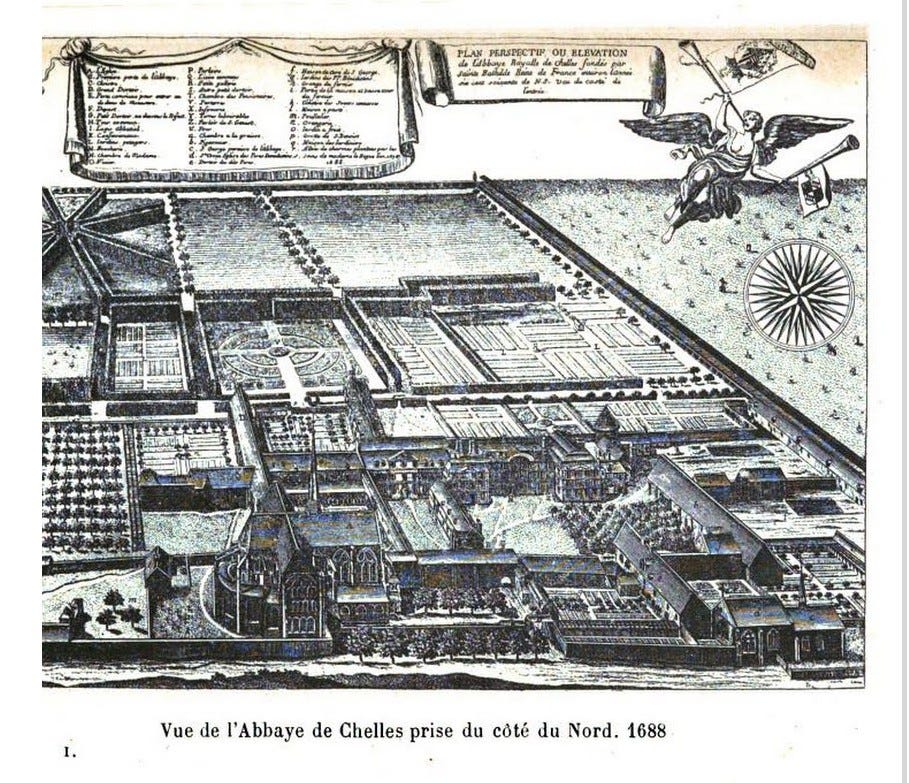
Along the way, Chiltrude would have heard stories such as the origin myth of the Franks being descendants of Trojans, a long-ago Merovingian ancestor being sired by a sea monster (or maybe that anecdote was a joke), and the evil and ruthless Queen Fredegund (d. 597) and virtuous Queen Bathilde (c. 626-680). In her father’s court, she might have heard whispers about the struggle for power after her paternal grandfather, Pippin of Herstal, died. All of those tales would have shaped her outlook.
If a girl was not destined for the Church, she would need to know the ways of the aristocracy. So I have Chiltrude coming home in 729 when she was 11 or 12, a few years after her father married a high-ranking Bavarian, who bore him another son. In my version of events, she encounters Odilo. She’s now old enough to notice his good looks and young enough to roll her eyes at the ladies who fawn over him.
Then there are Chiltrude’s three siblings born outside wedlock. To simplify this already complex family, they are all sons of the concubine Ruodhaid in my novel. This dynamic raised interesting questions. How does Chiltrude feel about her father’s infidelity? How does she feel about Ruodhaid and her half-brothers?
Although the author of the Continuation of Fredegar is scandalized that Bavarian Duke Odilo wed Chiltrude without the permission of Karlomann and Pippin, we don’t know what her father or eldest brother had in mind for her. To seek favor with God, parents could commit a little one to the Church, or to build political alliances, they could betroth their tender-aged children. Girls as young as 12 or 13 could become wives. (Read my blog for more about how the Franks defined traditional marriage.)
Even if the historic Chiltrude’s mother died giving birth to her, she would have been 15 when Odilo visited Charles’s court—definitely old enough to marry. Those of you who are mathematically inclined will notice my heroine is older.
Another thing I needed to fabricate: Chiltrude’s appearance. Primary sources rarely describe what anyone looked like—it was not important to most authors. Occasionally, they will say a woman was “beautiful.” We don’t even get that with Chiltrude. I made her tall because her nephew Charlemagne was tall, according to Einhard. Her full brothers are tall too. I decided “the Short” in Pippin the Short described the length of his locks in contrast to the long-haired Merovingians.
And that gets us to the beginning of Duchess of the New Dawn, which opens in Quierzy (in today’s France) in August 740.
*
Everyone had plans for me. My older brothers Karlomann and Pippin intended to imprison me in an abbey. My late mother’s brother urged my father to betroth me to the aged Count of Provence. Swanahild, my father’s Bavarian wife, wanted my father to negotiate a marriage with her kinsman Odilo.
No one had asked me what I thought best for our family.
For the moment, nothing would change. My ailing father said he couldn’t bear to part with me. That didn’t stop my suitors, even though I was almost twenty-three, when most women were wives or nuns. One of those wooers had arrived across the paved courtyard, just inside the southern gate to the villa—Odilo, Duke of the Bavarians.
*
For more, read the book. You can get Duchess of the New Dawn now from Amazon, Bookshop.org, Barnes & Noble, Walmart, Kobo, and many other booksellers. For additional buy links, visit kimrendfeld.com.
If you enjoy Duchess, you would be doing me a tremendous favor by leaving an honest review at Amazon, Goodreads, BookBub, or wherever you would like. Reviews let potential readers know the book is something they might appreciate, and those mysterious algorithms might show the book to more people.
On the blog, check out my post about a church called Saint Discord, the result of a dispute between Odilo and the high-ranking Irish churchman Virgil. (Be aware this true story has some spoilers for Duchess.)
Almost a month after its release, Duchess of the New Dawn has also gotten attention elsewhere. My thanks to:
The Historical Novel Society and Jessica Knauss (who writes as J. K. Knauss) for the wonderful interview about Duchess, which you can read on the HNS website. Jessica’s is a great author whether she is writing about betrayal and revenge in early medieval Spain or an alternate reality where select individuals have extraordinary, and dangerous, talents, or other stories.
My friend and fellow author Susan Keogh, who writes as S.K. Keogh, for her lovely review of Duchess and for hosting my article about a fight among Chiltrude’s brothers over who gets the inheritance after Charles Martel died escalating into civil war. You should check out Susan’s work, especially if you’re interested in pirates, plantation life, or the American Civil War.
My friend and fellow author Charlene Newcomb for spotlighting Duchess and for her wonderful review. If you like stories of soldiers in the Crusades and a unique take on the Robin Hood legend, check out her work.
My friend Erin Al-Mehairi, an author, poet, editor, PR professional, and journalist, for hosting an interview with me on her Hook of a Book blog. While you’re there, check out the other posts, which include cover reveals, reviews, and a discussion on body horror.
In celebration of Duchess of the New Dawn, Confluence Books, 705 W. Main St., Carbondale, Illinois, will host an event on Sunday, July 26, at 2 p.m. Central. I will read from my new book and answer questions. Paperbacks will be available for purchase, along with used books by many, many other authors. If you’re within driving distance of Carbondale, feel free to stop by.
For those of you who buy books online, there are only a few days left in the Summertime Reading online book fair, which features 30+ historical fiction novels, including two of mine, Duchess of the New Dawn and Queen of the Darkest Hour. Tales take place in Ancient Egypt, the Byzantine Empire, the Middle Ages, and 18th, 19th and 20th century America, Europe and Asia. They showcase everything from court intrigue to challenges faced by everyday people. Visit the book fair now and find that perfect read for the beach, the mountains, or whenever you will be.
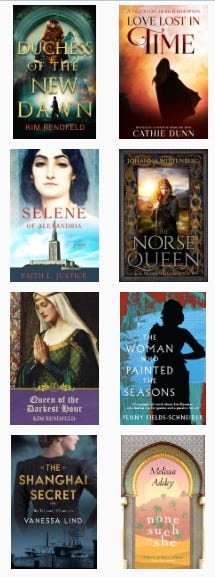
In addition, the Smashwords Summer/Winter sale is underway. There is quite a selection of discounted historical fiction, including my first two novels, The Cross and the Dragon and The Ashes of Heaven’s Pillar at $1.49 (75% off).
No posts
Comments
Nothing yet. Say the first thing.
Sign in to join the conversation.