
I was in a PhD program at NYU in the 90’s. The program wasn’t entirely the right fit for me, and I ultimately got offered a dramaturgy job on a Broadway show, and left academia, which was the right move.
Some of the work there felt ridiculous, elitist, and vapid, every theory was encased in such turgid, complicated language, that even a good concept that had lots of applications in the real world, had no chance of ever being heard outside the Tisch building or being integrated into a community or individual life in any meaningful way. I left feeling the academy was full of itself.
I still had the blue collar chip on my shoulder. I wanted to write for and be read by real people, not just the six people who would read my dissertation. And honestly would they even read it? My advisor for my Masters thesis left for Mexico without even looking at it, while giving me an A for my troubles. Why do all that writing for no one? As prolific writer, Sam Kriss of Numb at the Lodge wrote about academic writing, it is “a genre that is, in most cases, read by literally no one.”
Most of the schools of academic writing are notoriously passive and there is built in distance. The expert is separate from the reader. It’s long-winded, prone to plot-killing foot notes, and dense as hell in unnecessary ways. It infected my writing in the 90’s, this failure to connect to the emotional heart of humanness, this lack of connective tissue to the actual world. I constantly struggled against its rigidity.
What saved the experience for me were two professors whose work felt rooted in the real. I learned a lot from Jewish folklorist Barbara Kirscheblatt-Gimblet, known as BKG to everyone at NYU, she helped me re-think how I see very ordinary things, and that changed my writing.
The other was my advisor, Marcia Siegel, renowned dance critic. I didn’t want to write about dance specifically, and honestly, my imagination is so text-based - I “see” the world through a ticker of words, not images - that deciphering the physicality of dance required all kinds of mental gymnastics.
But turns out, dance writing is itself a writing bootcamp. If I’m good at all at this writing thing, it might be largely do to struggling through dance writing.
“Dance goes away,” Siegel liked to say.
It exists on the stage and is then gone. Our job is to capture it on the page. Our job it to be a witness. To observe and describe the movement, is what mattered to Siegel, it’s the point before analysis or expressing our opinions. Observation and testimony are the most important jobs of the writer.
For Siegel, the writing asked: Where are the dancers in the space? Why are they moving in this way? What are the larger structures of the choreography? What is the dance trying to tell us? How might a classic piece shift in its identity across time? Or through the lens of historical events that might change the very meaning of what we are seeing? How does the age, physicality and characteristics of the dancers themselves shift the work? Everything is up for elaboration for Siegel. On the stage and all around it.
Siegel got me to abandon over-used descriptors, like “sad, angry, longing, joyful, manic,” which she saw as lazy, in the same way food writers shouldn’t defer to “delicious” or “yummy” as descriptors of their meal. She got me to not lead with my opinions, but to build a case for them. The idea is to have a more connected and satisfying relationship to what we are observing, that could translate to readers, and help them to develop similar connections. It is writing not to elevate the expertise of the writer herself, but to elevate the readers connection to the art. Writers aren’t the celebrities, they are the monks scribbling in a tablet in an old dusty room. The idea of criticism is not to say it’s good / it’s bad, but to translate for the reader, the experience on the stage and the environment around its creation and construction.
By forcing us to do this before giving out our opinions, like cheap candy, she wants us to look more deeply at the dance itself. Opinions can be wrong. They are subjective and they often require more analysis, deeper thought. We are inundated by people’s often stupid, uninformed opinions all the time on socials. It’s a barage of opinion and judgment, often either wrong or misguided. But Siegel wants us to slow down, take in the scene, roll it around between our fingers, taste it in our mouths, languish in its soft textures and be thrown backwards by its razor edges. The idea is to examine the work’s microscopic pores before expounding on it.
This is something I try to take with me now on the internet.
I’m writing it here almost as a reminder to myself. The algorithms want us to spew silly, slim opinions at each other, when what we need to do is stand in testimony to a deeper, slower truth about our humanity and its deep complexities. We need to be writing and speaking this way, with depth and complication that are simply bigger than a 140-character slap dash judgment.
I thought, for this piece, it might be fun to see if you would like to try your hand at dance writing as a way to inform your own personal or professional writing. I chose, for this exercise, one of my favorites, Pina Bausch’s, Kontakthof – Echoes of ’78.
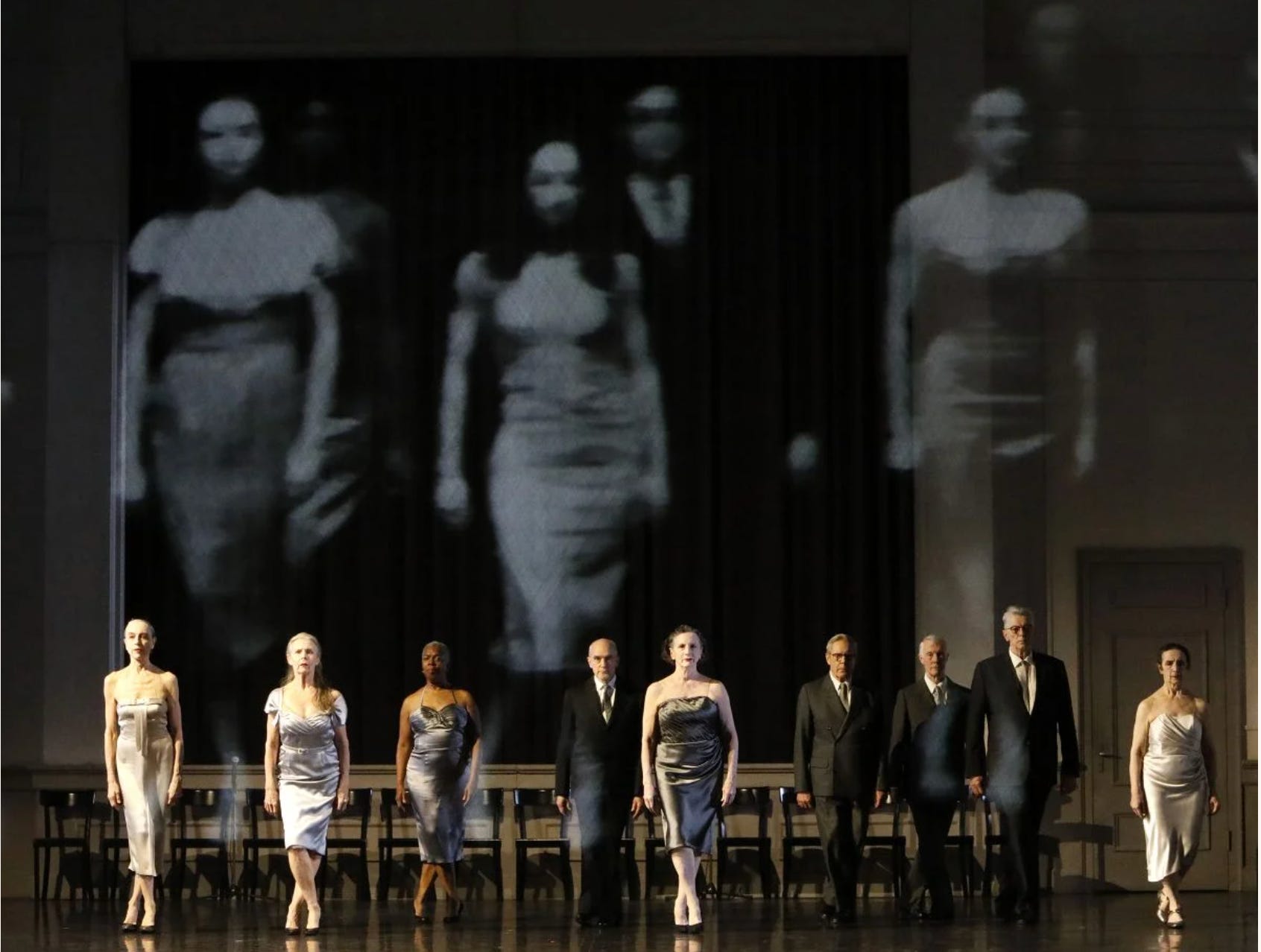
The piece is a revival of the original Kontakthof, which debuted some 50-ish years before. It is set in a dance hall, to music popular in the 1930s. This makes the piece feel like it stretches back into time infinitely. This production, staged in Germany in 2024, features the same cast as the original, only now everyone is significantly older.
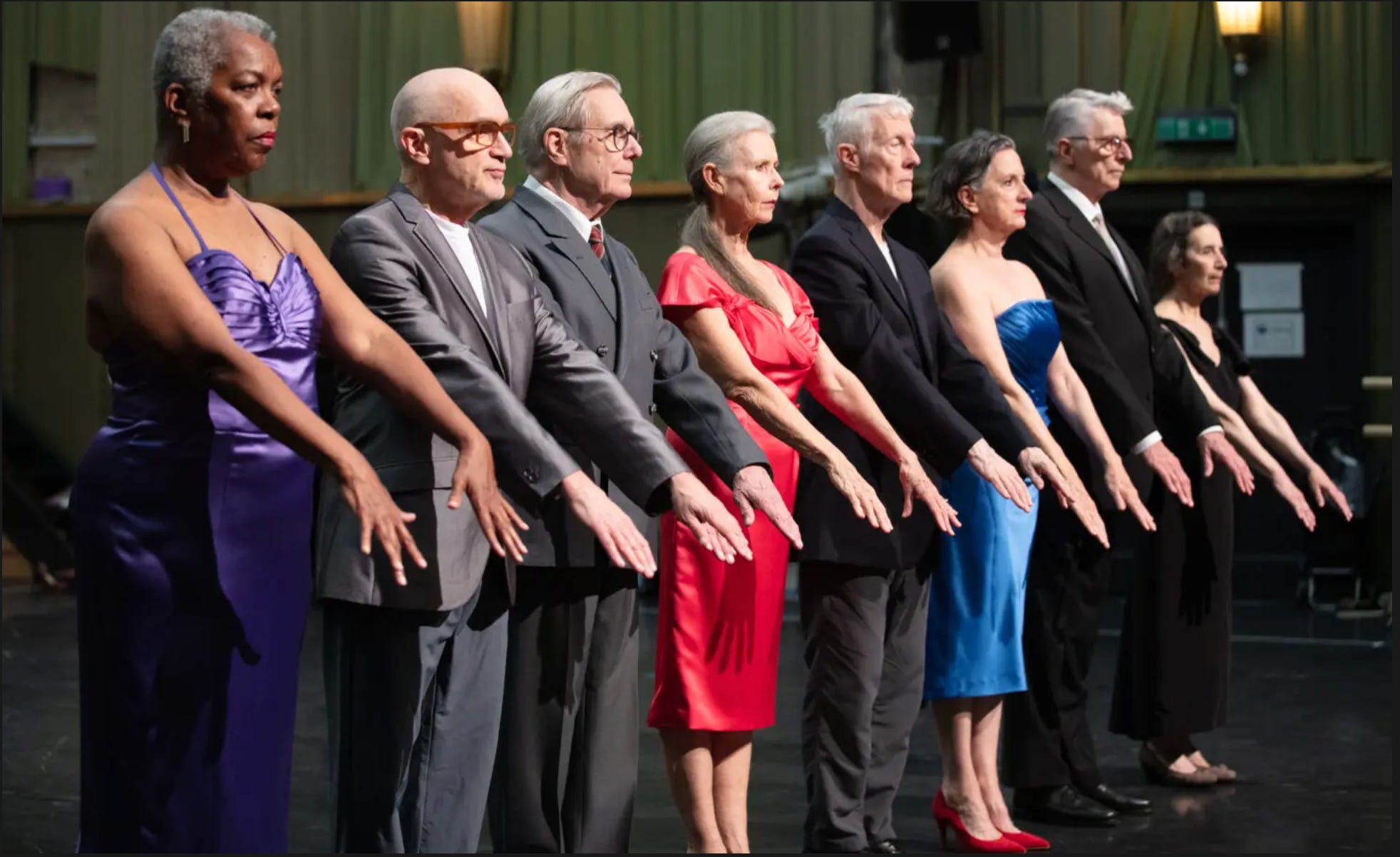
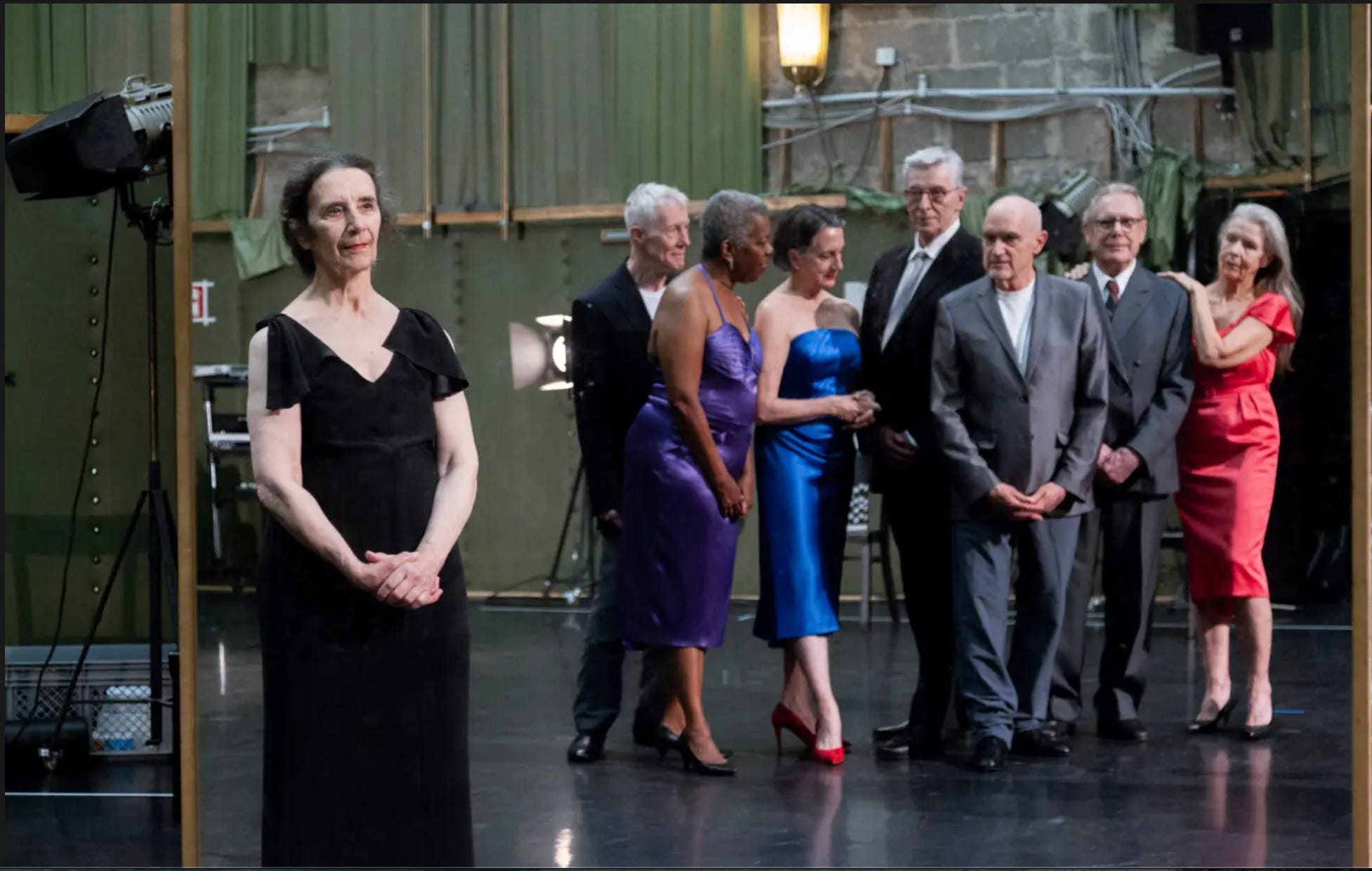
Of the 20 original dancers in the piece, nine returned. Empty chairs signify the cast members who could not come back to perform. Directed by Australian choreographer, Meryl Tankard, also an original cast member, the dancers performing the choregraphy are older now, in their 70s and 80s. While they dance, the original choreography, archival video images of their younger selves doing the same moves, plays behind them, referencing the original.
The contrast is extraordinary.
Reviewers of Kontakthof – Echoes of ’78 tend to want to talk about older, more “frail bodies” being compared to the dancer’s younger, more agile, bodies on the film, but I don’t see it. This feels like a kind of mythology created by arrogant young writers, that oldness must be frail, it must be “less than” youth.
Age is almost always protrayed with loss.
Life is loss and long lives have a lot of loss in them, but there is also tremendous gains and satisfactions.
What we are watching in this dance is a certainty, of small, in-unison repetitive movements, little steps performed over and over, quotidian anxieties like smothing a dress, adjusting a hat, tics, get performed over and over, in a kind of OCD fever dream of compulsion. There are bodies smashing up against bodies even as they seek out tenderness, which feels so real to me. How many people do we clobber while trying to seek out affection, attention or love? Who better to understand this than someone who has lived an entire life? Someone who has done it and had it done to them, over and over?
I see nothing frail in these older dancers. And if you check out some of the clips I’ve linked below, you will see no frailty. The women, wear body-forming slip dresses and dance heels, have twiney, muscled arms. The men are dapper and handsome, poised. The muscle memory has survived time. Their feet, legs and arms remember the steps. They are at times molasses-slow, and then seem to almost pilot through the air. Their bodies fall in line. The music, the experience of doing the dance as a young dancer gives way to a lifetime of movement. A lifetime of living through all things hellish and wonderful, and these experiences inform the dance.
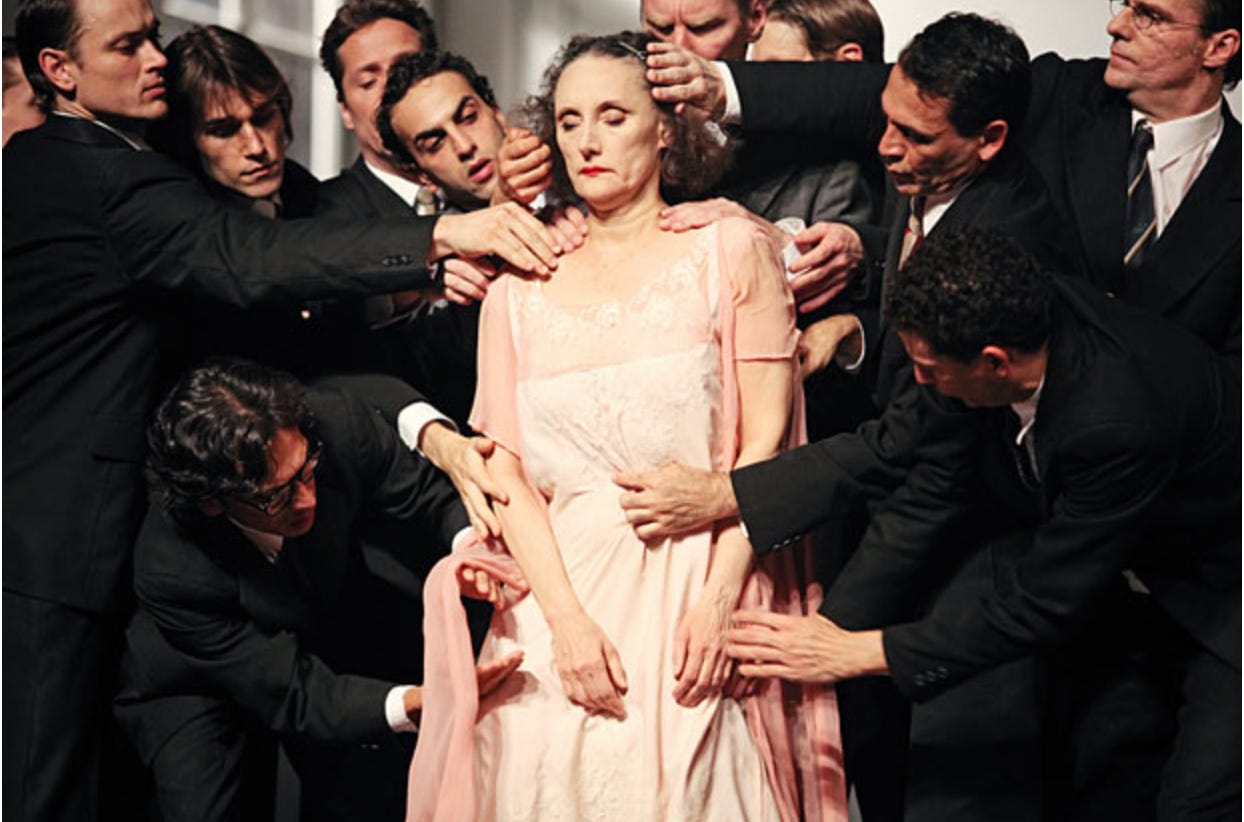
There is a scene where a woman is “bothered” by a group of men. They surround her, invade her space, touch her nose, her ears, her body. It is bothersome, too close. Later tender and sweet. Patriarchal and condescending. Claustrophobic again. It escalates and their touch is more violent, menacing, terrifying, even as the woman stands there as a passive platform enduring it. I watch it and wonder how the experience for the dancer, and the character she plays, experiences this, then and now? Do you experience violence the same way at 20 that you do at 80? No. And so I look for those cues and explanations in her body.
What does it mean to be alone and un-chosen at the dance as a young woman of 20, versus being alone and unchosen at the dance as an 80-year old? What is loneliness at those different ages? What does it mean to be “courted” at 20, or at 80? What are the stakes at those ages? What about the petty cruelties that Bausch amplifies in her choreography, the rejection by a suitor, the uninvited hands across your stomach? What does it mean to be 20 and pick a dancer, draw them out and humiliate them in front of their peers? What does this mean at 80? Is cruelty at 20 the same as at 80?
This is the kind of thinking that this dance invokes, and it’s such perfect fodder for your writing and for things to contemplate in the shower.
Okay. A dance writing exercise for you, if you are up for it:
This is a simple exercise to improve your own writing, whether you are writing a book, a newsletter or a personal journal. And it’s fun.
Set-Up: Clear some space in your mind. Relax. Watch the dance at the links below. One of them, all of them, your choice. It’s okay to watch the dance without understanding dance with any complexity. It’s okay to not understand it, and need to replay it over and over. It’s okay to feel uncomfortable at first, or to hate it. You will, if you let yourself, slide into the work a little. It’s okay to get it wrong and be totally off base, if this is even possible. It’s okay to make your writing about the dance personal and completely about you. In fact, I’d love to read that! It’s okay to get nothing on the page. What you write doesn’t have to be publication-ready, it can be a few lines on a pub napkin. But write.
The Assignment, Part 1: Watch the clips of the dance. Set your phone for seven minutes and write non-stop about whatever comes to mind, the steps, the physical movments, the impressions, your raw unfiltered feelings. What does it stir in you? What else did it remind you of? Are you finding your own life popping up inside the choreography? What are the connections you can make? Did it fill you with rage or boredom or joy?
The Assignment, Part 2: Let that quick draft sit for a bit. The exercise can stop right here, or you can let the dance sit with you for a bit. Do other things. Shower. Cook dinner. Make love. Walk the dog. Come back to your draft and add to it. Add musings, connections you make while washing dishes. Try to flesh out the initial writing and see what happens! It can be short or long-winded. No rules.
Publish, if you want: I’d love to read these and would love to see what you think in comments, or on Notes. You can send me video of you reading your piece. You can just observe in comments without doing the exercise. Feel free to share, so we can all read. Or keep them for private use only. No pressure.
Here are the links to get started:
A 15 minute doc about the dancers coming back to work on the piece they originated in 1978. It’s such a lovely watch and excellent context for writing. Even if you don’t do the exercise, watch this!
Short clips from the dance and cast.
The trailer: Kontakthof – Echoes of ’78
Here are links to small segments of the choreo. Choose one, or a couple, to use as inspiration for your writing:
Number One: Four dance sequences. Echoes of ‘78.
Number Two: A quick piece from Echoes of ‘78.
Number Three: Selected Scenes from Echoes of ‘78.
Number Four. A short from a peformance in 2022 with the National Opera of Paris (One cast, no age disparities)
Number Five: A short from a performance in 2022 with the National Opera of Paris. (One cast, no age disparities)
Number Six. A short from a performance in 2022 with the National Opera of Paris. (One cast, no age disparities)
Try not to use AI, because the idea is to perform the mental gymnastics to get your thoughts together. To be comfortable in the discomfort of not knowing what you think or how to write it. This is our little revolution against the Tech Overlords.
Thank you, as always for reading + playing along. Looking forward to seeing what you might create. Kim xo

Comments
Nothing yet. Say the first thing.
Sign in to join the conversation.