
Gen Alpha gets a lot of bad PR.
Kids born roughly between 2013 and 2025 are often described as distracted, lazy, disrespectful, socially behind, overly sensitive, addicted to screens, or suffering from the now extremely scientific condition known as “brain rot.”
To be clear, as a teacher, I understand where some of the concern comes from.
I have heard the words “skibidi,” “67” and “tuff” used in sentences that, despite technically being in English, I could not confidently translate. I have watched children act personally victimized by a blank piece of paper. I have seen a student insist he could not possibly write a three-sentence response in his morning journal, only to later create a 142-slide interactive, choose-your-own-adventure slide deck complete with transitions, sound effects, branching storylines, and more narrative commitment than most streaming platforms are currently offering.
So yes…I see the short attention spans, the big reactions, the social friction, the resistance to hard things, and the way some kids can negotiate a simple direction like tiny courtroom attorneys with goldfish crumbs on their shirts. But I do not see broken kids.
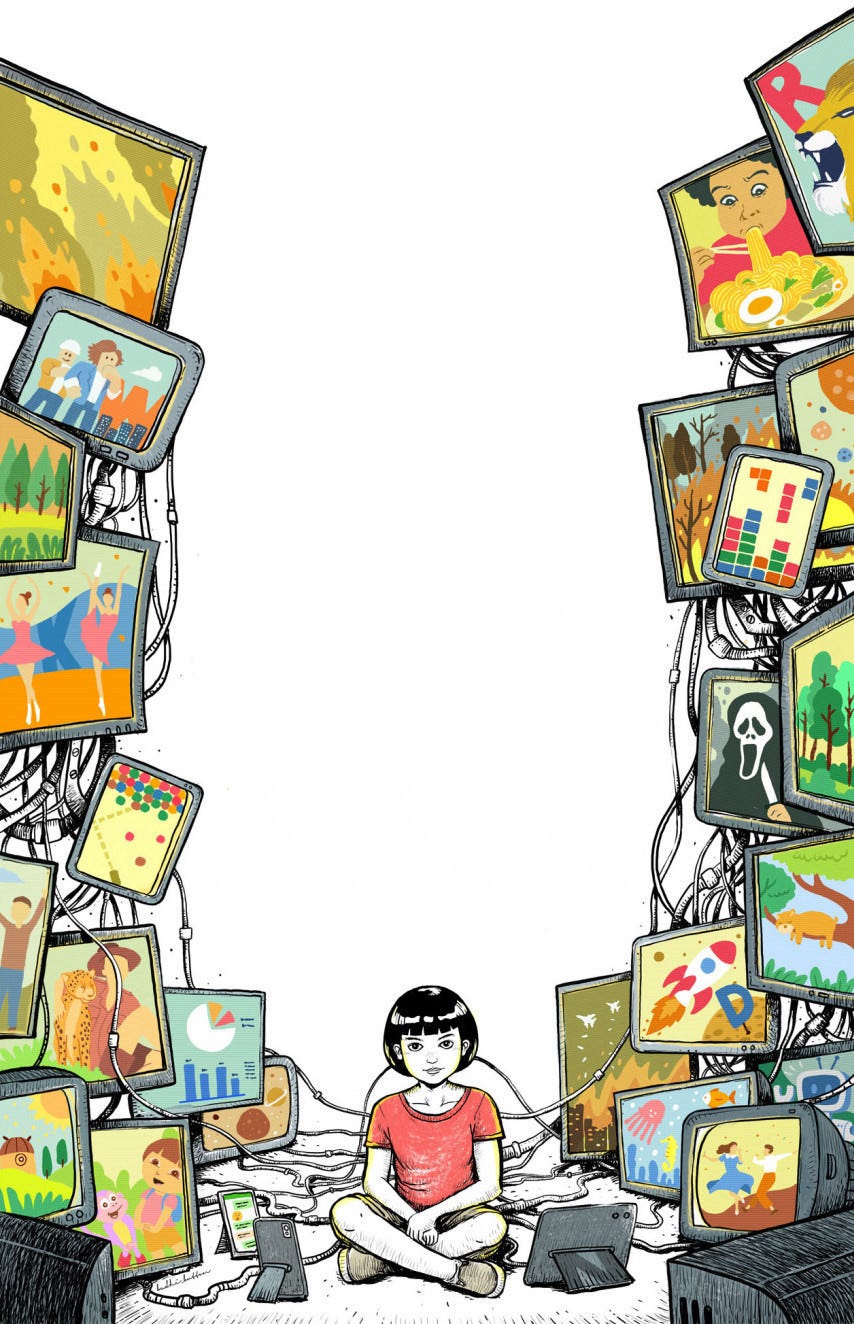
I see kids growing up in a world childhood was never designed for.
Before we panic too hard, it is worth remembering that adults have always been very confident that the next generation is doomed.
Our grandparents worried about rock and roll. Our parents worried about television, video games, texting, MySpace, and the fact that millennials were apparently going to destroy society because we liked participation trophies and avocado toast. Before that, people panicked about hippies, comic books, jazz, novels, dancing, radios, and probably whatever Athenian teenagers were doing in the agora instead of listening to their elders.
The moral panic is not new, but the specific conditions of today are.
Gen Alpha is growing up in the most stimulating environment children have ever had to develop inside. Think about it: constant novelty, instant feedback, 7-second videos, notifications, screens in every room, online comparison, adult worries, global problems, academic pressure, less unstructured time, less neighborhood freedom, more adult-managed play, more noise, more speed, more content.
Then we look at them and wonder why they struggle to slow down.
I say this as a Waldorf teacher, which means my classroom and lessons are intentionally structured to slow childhood down. Our days include movement, storytelling, painting, drawing, handwork, gardening, music, rhythm, ritual, and making things with our hands..
And still, the wider world is in the room.
The pace of the culture shows up in their stamina. The noise of the world shows up in their nervous systems. The speed of their digital lives shows up when I ask them to sit with a blank page, listen to a long story, wait their turn, revise a sentence, or handle the devastating injustice of not being first in line.
Kids do not need another round of “kids these days.” They need adults who are willing to ask a better question: What conditions are shaping these kids?
Because when we understand the conditions, we can respond with more precision. Not with permissiveness, panic, shame, or nostalgia, but with leadership.
One of the most common complaints I hear about Gen Alpha is that they cannot focus.
And yes, sustained attention can be hard for many kids right now. But attention does not develop in a vacuum. It develops inside an environment.
Today’s children are surrounded by constant novelty, instant feedback, short videos, games, notifications, advertising, background noise, and devices designed to keep them engaged. The American Academy of Pediatrics has increasingly moved away from treating children’s media use as a simple question of “screen time” and toward looking at the broader digital ecosystem children are growing up inside: algorithms, advertising, content, privacy, sleep disruption, family habits, and the design of platforms themselves.
That matters. Because a child’s attention is being trained all day long.
If most of a child’s world is fast, bright, responsive, and instantly rewarding, then of course slow work feels harder. A blank page asks them to generate something from nothing. A long story requires patience before the payoff. A multi-step math problem demands planning, memory, and frustration tolerance. Even quiet can feel unfamiliar when their world is usually full of input.
Yet that does not mean focus is gone. It means focus is competing with a world that is very, very good at stealing it.
It is a skill we have to protect and practice.
Executive function — the ability to plan, focus, manage impulses, and move between tasks — develops over time. It is not something children simply have or do not have. It is built through practice, structure, modeling, repetition, and support.
Teachers see this constantly. A child who “can’t focus” is likely not refusing to pay attention, but may be overwhelmed by the number of steps or need a quieter room, a clearer beginning, a movement break before they sit, or an adult nearby long enough to help them get started.
Intentionally slowing down and practicing executive functioning skills doesn’t need to be dull. Children still need beauty, humor, curiosity, story, movement, and delight.
Focus grows when children are given real chances to stay with something: drawing carefully, revising a sentence, listening to a story, sewing a small stitch, painting a page, building something that falls apart and trying again, solving a problem, tending a garden, or sitting with a task long enough to feel the quiet satisfaction of finishing it.
They don’t need constant entertainment disguised as learning.
They need adults willing to protect the slower conditions where attention can grow.
Another common assumption is that Gen Alpha is lazy, but I think that is probably the least useful word we can use for children.
When a child avoids work, gives up quickly, refuses to try, or seems uninterested, there is almost always more going on underneath.
Many kids are overwhelmed, distracted, under-slept, over-scheduled, anxious, discouraged, or used to fast rewards. Hard work requires stamina and stamina is built slowly.
Sleep is part of this conversation, too. Children and adolescents need A LOT of sleep. More than many of them are getting. Sleep affects attention, memory, emotional regulation, learning, frustration tolerance, and behavior.
A tired child may look unmotivated, a dysregulated child may look defiant, and an overwhelmed child may look lazy.
There is a big difference between “This child does not care” and “This child does not yet have the stamina, confidence, sleep, structure, or support to do this independently.” Those two interpretations lead to very different adult responses.
A child who avoids effort probably doesn’t need another lecture about work ethic. They may need a smaller starting point, a reason to care, and enough support to begin without being rescued from the entire experience.
This is one of the tricky parts of parenting and teaching: we want children to become capable, but we often step in right before capability has a chance to grow. We smooth the path, finish the task, lower the demand, or rush to make the discomfort go away.
But children build stamina by doing hard things in manageable doses. They need real responsibilities, chances to contribute, practice finishing what they start, and adults who notice effort before perfection.
Confidence does not come from being told, “You can do hard things.” It comes from doing hard things and realizing it was true.
A lot of kids have had fewer chances to practice messy, ordinary, face-to-face social problem solving.
More play is adult-managed, more communication happens through screens, and many children have less neighborhood freedom, less unstructured time, and less of the everyday “village” where they would have learned how to be part of a group by actually being part of one.
Then the pandemic added another layer. For many children, important years of social development were interrupted or reshaped, and those skills did not magically snap back the moment life became “normal” again.
This is where the research on play matters. The American Academy of Pediatrics describes play as essential to children’s cognitive, physical, social, and emotional development. Play is not a break from learning. It is one of the main ways children learn how to negotiate, take turns, handle disappointment, solve problems, regulate emotions, and work through conflict.
So when children have less real play, we should expect some social skills to need more direct teaching.
That does not mean they are mean, doomed, or incapable of friendship. It means many of them are under-practiced.
In my classroom, I have seen children make tremendous growth when adults stop assuming they “should already know better” and start teaching the missing skill: how to apologize without performing, how to disagree without humiliating someone, how to notice when someone is being left out, how to repair after harm, how to lose a game without collapsing into complete spiritual ruin.
These are not extras, but the building blocks of community.
This one comes up a lot, too.
Gen Alpha asks why. A lot.
Why do I have to do this? Why does that rule matter? Why is that fair? Why can’t I? Why should I? Why not?
And I will be honest: it can be exhausting.
Sometimes the “why” is genuine curiosity or an attempt to gain control. Sometimes it actually is avoidance, a negotiation tactic, or it comes out with a tone that needs to be addressed.
But questioning adults is not automatically the same as disrespecting them.
I once had students push back on losing group free play minutes because the behavior had come from only two people. Was it annoying to have a room full of children suddenly transform into a constitutional law seminar? Yes. Absolutely.
Were they also kind of right? Also yes.
That is the tricky thing about this generation. Sometimes their pushback is inconvenient, poorly timed, or perhaps needs a lot of coaching around tone, respect, and timing. But sometimes they are noticing something real.
Gen Alpha is growing up in a culture where they are exposed to adult conversations, big world problems, social commentary, online criticism, and public distrust of institutions earlier than many previous generations were. They often have strong opinions, big questions, and a very low tolerance for hypocrisy.
That can be challenging, but it can also be healthy.
The answer is not to turn every boundary into a courtroom debate. Kids still need to hear “no,” respect limits, and learn that disagreement does not always change the outcome.
Gen Alpha often responds better to adults who can be clear without being dismissive: adults who explain the reason, hold the line, and do not take every question as a personal challenge.
That might sound like:
“I hear you. The answer is still no.”
“You can ask about the rule. You may not argue with me about it.”
“That is a fair question. Here is why this matters.”
“I’m going to think about what you said. For now, this is the decision.”
Kind and firm are not opposites. Children need adults who can be both.
“Too sensitive” is another label I hear a lot.
I understand why. Many kids do have big reactions. Correction can feel like humiliation. Disappointment can feel enormous. A small conflict can become a dramatic full-body slide down the chair.
I don’t think sensitivity is the problem, though. I think many children have more language for feelings than they have capacity to carry them.
They are growing up with constant social comparison, adult information, global worries, public commentary, and pressure to perform. At the same time, youth mental health data continues to show high levels of sadness, stress, and emotional distress among adolescents.
So no, children do not need us to mock their sensitivity, but they also do not need us to remove every uncomfortable feeling from their path. They need help building capacity. They need to learn that feedback is survivable and disappointment will not destroy them.
Feelings are allowed, and limits can still stand — a child can be upset and still repair; a child can feel embarrassed and still try again; child can be disappointed and still respect the answer.
The goal is not to make children less feeling, but to help them become more capable of carrying what they feel.
None of this means every behavior is acceptable. Children still need limits, expectations, responsibility, and repair. They still need to learn how to apologize, wait, contribute, listen, disagree respectfully, finish hard things, and survive the unspeakable tragedy of someone else choosing the read-aloud first.
But we need to stop confusing symptoms with character.
A distracted child ≠ lazy
A questioning child ≠ disrespectful
A socially clumsy child ≠ mean
A sensitive child ≠ fragile
A child who struggles with boredom ≠ broken
They are showing us what childhood looks like when the world gets too loud.
And if we want different outcomes, we have to build different conditions.
That does not mean rejecting technology entirely or pretending children can be raised outside the modern world. It means remembering that children need more than efficiency, stimulation, convenience, and constant access.
They need a childhood with texture.
Time to move their bodies.
Stories that unfold slowly.
Work that asks something of them.
Adults who mean what they say.
Rituals that help them feel held.
Relationships that can survive conflict.
Responsibilities that make them feel useful.
Spaces where awkwardness is not recorded, measured, or turned into content.
They need to paint, draw, build, dig, sew, cook, clean, climb, pretend, argue, repair, wait, wonder, and try again.
Boredom matters because imagination often needs a little quiet before it speaks up.
Challenge matters too, especially when it is small enough to try and meaningful enough to care about.
And adults matter most of all: adults who can slow the pace without lowering the bar, explain without turning every limit into a negotiation, hold boundaries without making everything a power struggle, and let children do hard things without leaving them to do hard things alone.
Gen Alpha is not broken. They are growing up inside a childhood that has become louder, faster, more public, more stimulating, and less forgiving than the one many of us knew.
So no, they do not need another moral panic.
What they need is protection from the pace, more practice with being human, and adults brave enough to lead them through the world as it is while still making space for the childhood they deserve.
American Academy of Pediatrics. “Digital Ecosystems, Children, and Adolescents: Policy Statement.” Pediatrics, 2026.
A helpful framework for thinking beyond simple “screen time” limits and looking at the larger digital environment shaping children’s attention, sleep, privacy, relationships, and well-being.
American Academy of Pediatrics. “The Power of Play: A Pediatric Role in Enhancing Development in Young Children.” Pediatrics, 2018.
This report explains why play is essential for cognitive, physical, social, and emotional development, including executive function, language, social skills, and stress regulation.
Center on the Developing Child at Harvard University. “A Guide to Executive Function.”
A clear overview of executive function and self-regulation as skills children develop over time through practice, support, and experience.
Paruthi, Shalini, et al. “Recommended Amount of Sleep for Pediatric Populations: A Consensus Statement of the American Academy of Sleep Medicine.” Journal of Clinical Sleep Medicine, 2016.
Includes sleep recommendations for children and teens and connects adequate sleep with attention, behavior, learning, memory, emotional regulation, and overall health.
American Psychological Association. “Health Advisory on Social Media Use in Adolescence.” 2023.
A nuanced guide emphasizing that social media’s effects depend on the child, content, context, vulnerabilities, sleep, relationships, and adult guidance.
Centers for Disease Control and Prevention. “2023 Youth Risk Behavior Survey Results.” 2024.
Provides recent data on adolescent mental health, including persistent sadness or hopelessness, poor mental health, safety concerns, and related youth well-being trends.
No posts
Comments
Nothing yet. Say the first thing.
Sign in to join the conversation.