
The affordability crisis isn’t really a pricing problem. It’s a government problem.
Every politician in America now claims to care about “affordability.” Housing is unaffordable. Healthcare is unaffordable. College is unaffordable. Insurance is unaffordable. Groceries are unaffordable. Raising a family increasingly feels like running a leveraged buyout with no exit strategy.
And Washington’s answer is almost always the same: spend more money. Another subsidy, another tax credit, another government loan program, another agency, another guarantee, another trillion dollars pumped into an economy already distorted by decades of intervention. Then everybody acts shocked when prices rise again.
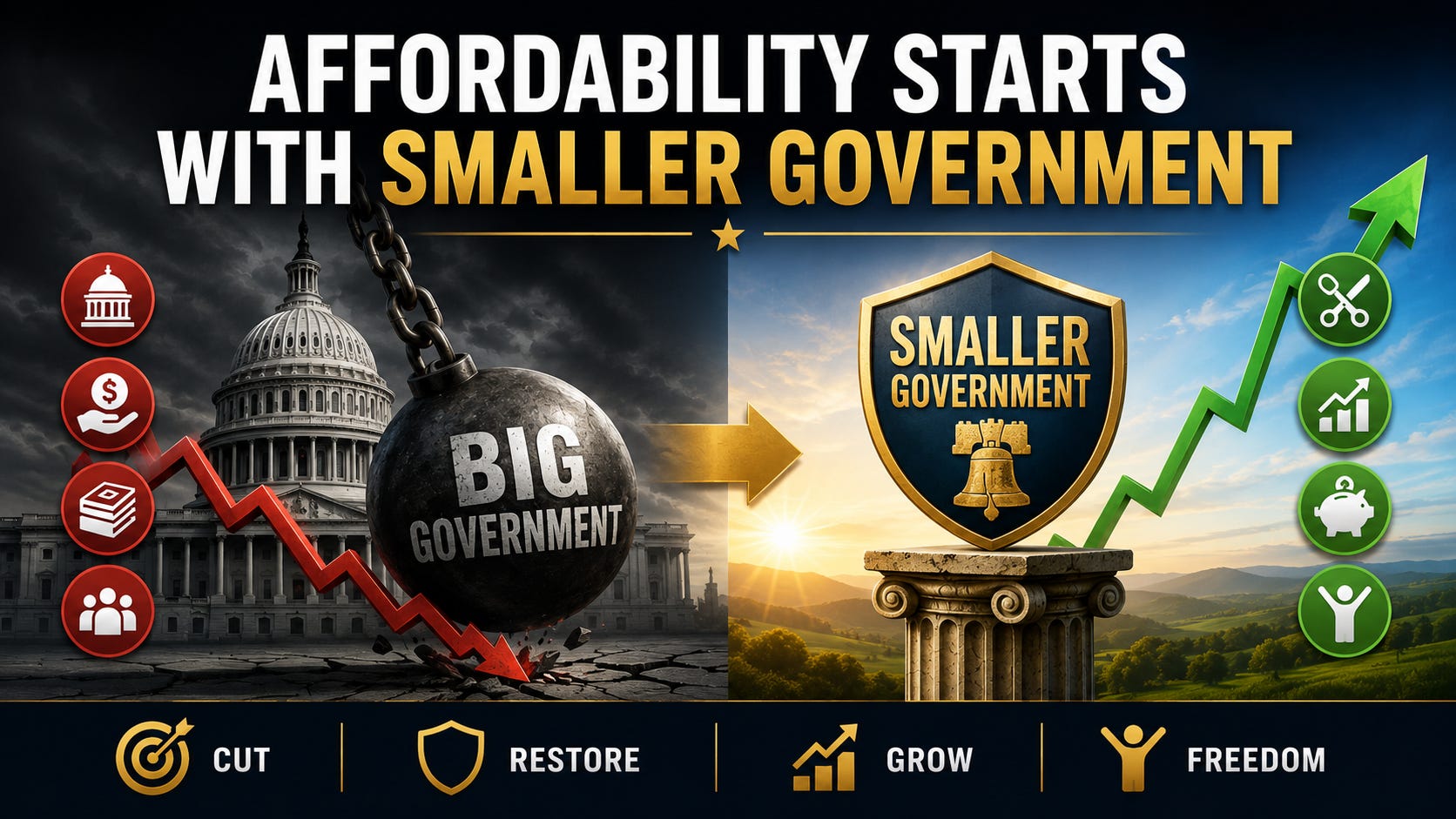
If Washington were genuinely serious about affordability, it would do something far more radical than handing out another rebate check. It would cut government back toward its core functions, slash the deficit, restore genuine markets and stop subsidizing the very things politicians complain are too expensive.
That may not make for a great campaign commercial. But it would attack the disease instead of subsidizing the symptoms.
💰 A Quick Note for Insider Advantage Readers
This is exactly what The Insider Advantage is about. We’re not here to repeat the daily financial headlines or tell you what CNBC already told you three hours ago. We look at the incentives underneath government policy, markets and money—and what those incentives mean for your wealth before the consequences become obvious.
If you’re reading the free edition, you’ll continue getting plenty of analysis. But Insider Advantage members get the deeper market calls, investment themes, interviews and financial intelligence that I simply can’t put into every public article. If you want to understand what happens next rather than merely read about what already happened, that’s where the real work takes place.
💰 Start With the Deficit
You cannot have an honest conversation about affordability while pretending federal deficits don’t matter. Government doesn’t manufacture wealth. Every dollar Washington spends ultimately comes from taxation, borrowing or monetary expansion, and all three eventually land on somebody’s balance sheet.
Taxes remove purchasing power directly. Borrowing consumes capital today and creates future claims on taxpayers. Monetary expansion dilutes purchasing power more subtly, which is why politicians usually prefer it: you don’t receive an invoice telling you exactly how much inflation just cost you.
For decades Washington has attempted to make things affordable primarily by subsidizing demand. But when you give consumers more money to purchase something without significantly increasing its supply, much of the subsidy eventually gets capitalized into the price. The buyer receives a bigger check, the seller discovers the buyer has more purchasing power, and the market adjusts accordingly.
Then Washington points to the resulting higher price as evidence that an even larger subsidy is necessary. That’s not an affordability policy. That’s a perpetual-motion machine for government spending.
A serious affordability agenda would therefore begin with bringing federal spending much closer to federal revenues. Not after another bipartisan commission studies it for five years, and not through imaginary future reductions in projected spending. Every department should be forced to answer the question that every family and business eventually has to answer: What do we actually need?
⚔️ The Pentagon Doesn’t Get a Hall Pass
Fiscal conservatives love talking about shrinking government until somebody mentions the Pentagon. Then suddenly every dollar becomes essential to civilization. If we’re serious about reducing government, that exemption has to end.
National defense is unquestionably a core federal responsibility. But defending the United States and maintaining every weapons system, foreign deployment, headquarters, contractor and procurement program accumulated over the past 80 years are not necessarily the same thing. A serious audit would distinguish national security from institutional inertia.
Go through procurement. Go through overseas bases. Go through consulting contracts, duplicate commands, administrative layers and programs that survive because a contractor employs 2,000 people in somebody’s congressional district. If something is essential to defending the country, fund it aggressively; if it exists primarily because the political system cannot kill it, kill it.
Government waste doesn’t become productive because someone paints it camouflage. And if Washington wants ordinary Americans to accept spending cuts, the political class has to demonstrate that its favorite sacred cows are getting examined too.
🏛️ Then Go Through Every Agency
The same test should apply everywhere else. What functions are constitutionally and practically necessary for the federal government to perform? Keep them, fund them properly and demand that they work.
What can states do better? Send those responsibilities back to the states. What can private companies, nonprofits or individuals do better? Let them do it without Washington standing between the provider and the customer.
And what functions accomplish almost nothing except employing administrators, consultants, contractors and lawyers? Eliminate them. Not “cut their growth rate,” not “streamline” them, and not merge three offices into one larger office with a new acronym.
Washington has mastered the linguistic trick of calling slower spending growth a cut. If I planned to spend $100, decided to spend $105 and somebody stopped me from spending $110, I haven’t suffered a $5 cut. I’ve increased spending by $5.
Only in Washington could that be described as austerity.
👴 Social Security Needs a Different Model
Social Security illustrates the larger problem perfectly. Americans have been taught to think of their payroll taxes as retirement contributions sitting somewhere on their behalf. That isn’t really how the system operates.
Today’s workers largely finance today’s retirees, while today’s workers receive a political promise that tomorrow’s workers will someday do the same for them. That’s a transfer system dependent upon demographics, wage growth and congressional willingness to tax future workers sufficiently to honor previous promises. When the ratio between workers and beneficiaries deteriorates, arithmetic begins overpowering political rhetoric.
The answer isn’t to suddenly abandon existing retirees or people who built retirement plans around the current system. Those promises need to be honored. But younger workers should gradually gain the ability to direct part of their retirement contributions into diversified accounts that they actually own.
That money could compound over decades, belong to the worker and potentially pass to heirs. More importantly, Washington could no longer casually treat retirement contributions as another stream of government cash. The transition would take years, perhaps decades, but serious structural reforms usually do.
The alternative is pretending indefinitely that demographic mathematics can be repealed by Congress.
🏥 Want Cheaper Healthcare? Restore a Market
American healthcare may be the strangest “market” ever created. The patient frequently doesn’t know the price. The doctor frequently doesn’t know the price. The insurance company has negotiated one price, Medicare pays another price and the hospital maintains a list price that almost nobody actually pays.
Then six weeks or six months later, a statement arrives that requires the skills of a forensic accountant to decipher. Somehow we’ve convinced ourselves this is capitalism. It isn’t.
Imagine buying groceries this way. You fill your cart without seeing prices, leave the store, and three months later receive a statement explaining that your chicken officially cost $83 but your grocery insurer negotiated it down to $14.72. You’d reasonably conclude the entire system had lost its mind.
A functioning market requires meaningful price information, competition and some connection between the person consuming a service and the price being paid. The goal shouldn’t be another thousand pages of federal regulations establishing yet another layer of artificial prices. It should be restoring the conditions under which providers actually have to compete.
More transparent cash pricing, more portable coverage, more catastrophic insurance, more consumer-controlled healthcare dollars and fewer artificial barriers to supply would be a start. Markets lower prices when producers compete for customers. Healthcare increasingly operates in the opposite direction: customers navigate bureaucracies while providers compete for reimbursement systems.
That’s how you get $14 aspirin.
📈 This Is Where the Investment Story Starts
Policy debates are interesting. Capital flows are profitable.
When Washington subsidizes an industry, regulates an industry, withdraws from an industry or redirects trillions of dollars through the tax code, somebody wins and somebody loses. The investment opportunity is often hiding inside that second-order effect, long before the political debate is settled.
That’s one of the reasons I created The Insider Advantage. The public articles explain what I think is happening; Insider Advantage is where we spend more time on what to do with that information—the market implications, investment opportunities, risks and trades worth watching.
If your financial information isn’t giving you an advantage, it’s entertainment.
🎓 Washington Made College “Affordable” Too
Higher education may be the cleanest demonstration of what happens when government attempts to make something affordable by making credit easier. Washington poured enormous amounts of subsidized lending power into the college market under the theory that everybody should have access to a degree. Universities quickly discovered that their customers could borrow increasingly large amounts of money.
Tuition rose. Administrative bureaucracies exploded. Campuses added amenities that would have looked extravagant at country clubs a generation earlier, because there was relatively little pressure to lower prices while federal credit remained readily available.
Students then graduated carrying debts that could follow them for decades, sometimes attached to degrees producing earnings nowhere near sufficient to justify their cost. And Washington’s proposed solution has repeatedly been some variation of additional lending, forgiveness or subsidy. We’re treating the consequences of the distortion by increasing the distortion.
Get Washington progressively out of the student-loan business and lenders would immediately begin asking questions that federal policy has helped suppress. How much does this program cost? What percentage of students graduate? What does somebody with this degree actually earn, and what’s the probability this loan gets repaid?
Suddenly a $180,000 degree generating $42,000 salaries becomes difficult to finance. That wouldn’t destroy higher education. It would force higher education to price itself rationally.
And universities would discover with astonishing speed that they can operate more cheaply when customers can no longer borrow virtually unlimited quantities of government-backed money.
🏠 Housing Has the Same Disease
Housing has a similar problem from both directions. Government subsidizes demand through mortgage guarantees, tax preferences, grants and buyer assistance while state and local governments simultaneously restrict supply through zoning, permitting delays, density rules and endless regulatory hurdles. Then everyone wonders why home prices remain stubbornly high.
Give a buyer another $25,000 in a market where five people are bidding for the same house and you haven’t necessarily created $25,000 of affordability. You’ve created another $25,000 of bidding power. In a constrained market, some meaningful portion of that money is likely to migrate into the selling price.
Real affordability requires supply. Make housing easier to build, make redevelopment easier, allow density where the market wants density and shorten permitting processes that turn ordinary projects into multi-year legal exercises. Then let builders compete to deliver what buyers actually want.
Government doesn’t need to determine the correct price of a house. It needs to stop preventing the market from producing enough houses. Let builders, lenders, buyers and sellers respond to actual price signals instead of constantly layering one political intervention over another.
You want cheaper housing?
Build more housing.
🔥 The Great Affordability Paradox
There’s an unmistakable pattern running through all of this. Government subsidizes healthcare because healthcare is expensive, and healthcare gets more expensive. Government subsidizes college because college is expensive, and college gets more expensive.
Government subsidizes housing because housing is expensive, while restricting housing construction at the same time. Then housing gets more expensive. Finally, Washington spends trillions helping Americans cope with inflation, and Americans discover that the dollars being handed to them buy progressively less.
At some point you’re allowed to question the treatment.
The political incentives explain why this happens. Creating a program produces an identifiable group of beneficiaries who know exactly what they’re receiving. Eliminating a program produces angry beneficiaries, contractors, government employees and lobbyists who know exactly what they’re losing.
The costs, meanwhile, are dispersed among hundreds of millions of taxpayers and frequently pushed years into the future. Politicians therefore receive tremendous rewards for creating programs and almost no immediate reward for eliminating them. Incentives matter more than intentions.
And that is how you eventually build a government that promises to make everything affordable while becoming progressively less affordable itself.
🇺🇸 Affordability Requires Saying No
There is no painless version of fixing this. You cannot meaningfully reduce federal spending while declaring every large program politically untouchable. You cannot slash the deficit while exempting defense, entitlements and every constituency capable of hiring a lobbyist.
You also cannot restore markets while retaining every subsidy created to protect consumers from markets. At some point, somebody has to hear the word no. Washington has spent generations avoiding that word.
But the upside from genuine reform could be enormous. Smaller deficits mean less pressure for future taxation, borrowing and monetary accommodation. Reduced federal borrowing leaves more private capital available for productive investment rather than government consumption.
Competitive markets also create relentless incentives to reduce costs. Businesses that can’t provide value eventually lose customers and capital. Government programs can fail for 40 years and receive larger budgets because their failure is cited as evidence that they need more money.
Most importantly, prices would begin functioning as prices again. They would communicate scarcity, demand and opportunity rather than constantly being distorted by subsidies, guarantees, mandates and political decisions.
The Choice Is Pretty Simple
If our political class really believes America has an affordability crisis, let’s take them at their word. Cut federal spending dramatically, force the Pentagon to justify its budget like everybody else, eliminate agencies and programs that no longer serve essential functions, and start bringing the deficit under control.
Begin a long-term transition toward genuine personal ownership in retirement. Restore actual competition to healthcare. Get Washington progressively out of student lending and stop manipulating housing demand while local governments choke off housing supply.
Then see what happens when millions of businesses and hundreds of millions of Americans are permitted to allocate resources without Washington constantly standing in the middle of the transaction. It won’t produce perfection, because nothing does. But it would restore the most powerful price-reduction mechanism ever invented: competition.
There are ultimately two ways to attempt to make life affordable. You can keep giving people more government money to chase things whose prices government policy helped inflate, or you can begin dismantling the policies that helped make those things expensive in the first place.
We’ve spent half a century aggressively experimenting with the first approach.
Maybe it’s time to try the second.
🚨 Want the Advantage Before Everyone Else Sees It?
Markets rarely wait for Washington to officially admit that a policy has failed. Capital moves first. Interest rates move first. Commodities move first. Stocks move first.
That’s why The Insider Advantage exists.
I’ve spent decades looking for the gap between the official story and what’s actually happening underneath it. Today I use that same approach across metals, currencies, energy, inflation, government policy and the investment opportunities created when conventional wisdom gets something badly wrong.
Insider Advantage members get the analysis that goes beyond the public newsletter—the deeper market work, actionable ideas, investment themes and intelligence designed to help you position before the crowd catches up.
If you’re already getting value from the free articles, that’s the strongest argument I can make for upgrading.
Become an Insider Advantage member and turn information into an actual advantage.
No posts
Comments
Nothing yet. Say the first thing.
Sign in to join the conversation.