
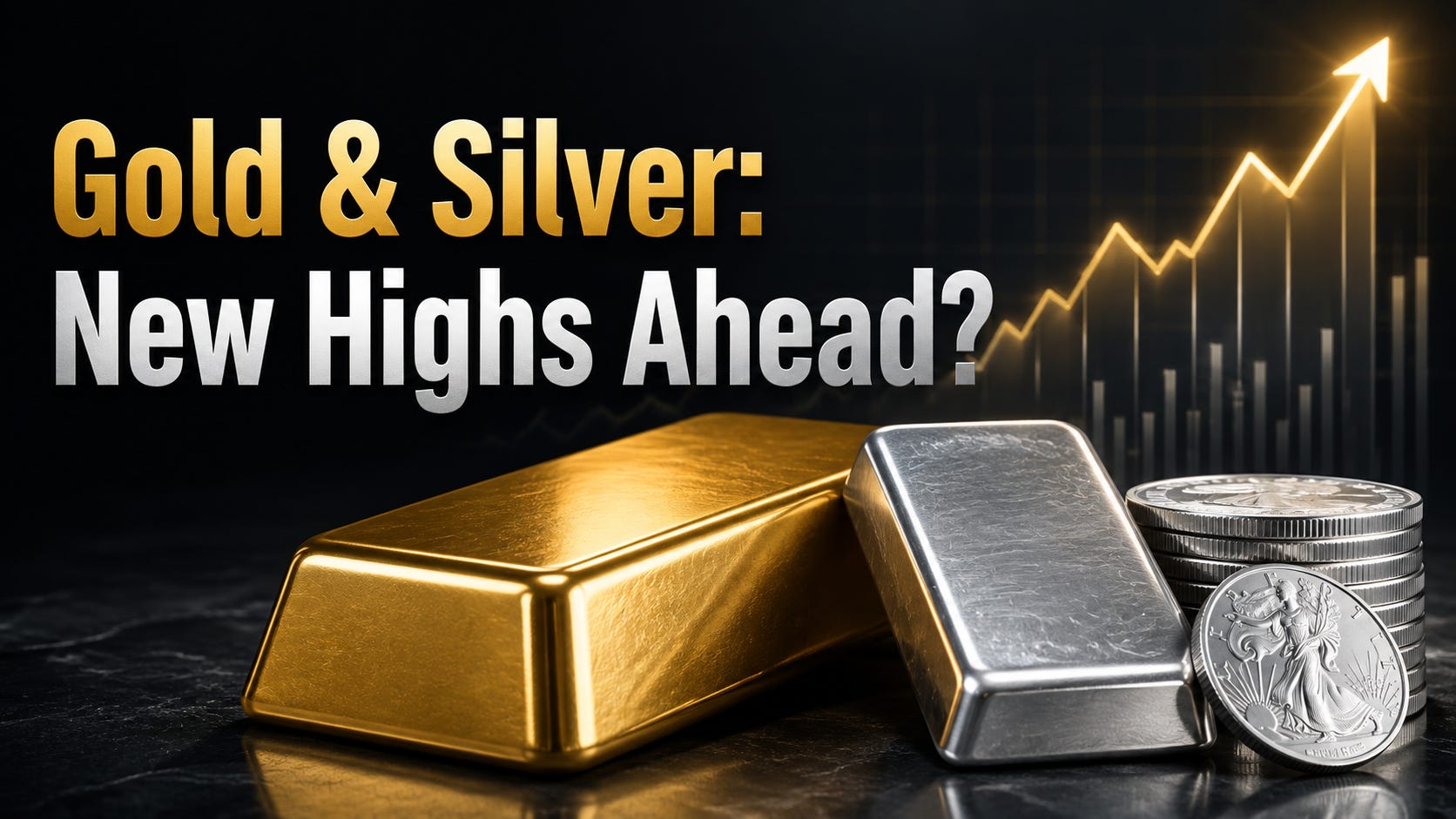
Gold and silver have already shown us what they are capable of. In January, gold exploded to an all-time high near $5,595, while silver went completely berserk, touching roughly $121.64 before both metals were brutally repriced lower. Today gold is back around $4,400 and silver near $65, which means gold needs roughly another 27% to break its record while silver needs something closer to 85%. That sounds enormous until you remember what these markets have already done. My working assumption is that gold gets back to record territory first, probably within four to nine months, while silver takes nine to eighteen months—but when silver finally moves, it could make gold look downright civilized.
Gold’s recovery is already telling us something. It has been climbing even with long-term interest rates elevated, the dollar has weakened, and expectations for additional Federal Reserve tightening have faded. Normally high real rates are supposed to suffocate gold because bullion pays no interest, but the metal isn’t behaving as though that textbook relationship matters as much as it once did. That’s a tell. The market increasingly appears to be looking past today’s rates toward a much larger problem: enormous government deficits, relentless Treasury issuance, currency risk and the uncomfortable question of who ultimately absorbs all the debt being created. Even J.P. Morgan has maintained a highly bullish longer-term view, with research pointing toward gold around $6,000 if the monetary and fiscal pressures continue.
One of the biggest differences between this bull market and previous speculative runs is who’s buying. Central banks remain major accumulators of gold because gold has no counterparty. A Treasury bond is somebody’s liability. A bank deposit is somebody’s liability. A currency is ultimately the liability of a sovereign monetary system. Gold is simply an asset sitting outside that chain of promises, and that distinction becomes much more important when governments are running massive deficits, geopolitical alliances are shifting and investors start questioning how much purchasing power their currencies will retain over time. Sovereign buying doesn’t guarantee that gold goes straight up, but it gives the market a structural bid that simply wasn’t present to the same degree in many earlier cycles.
Silver is a completely different animal. Central banks aren’t sitting around filling vaults with silver, so it doesn’t have the same persistent sovereign bid underneath it. That’s one reason silver can go from $50 to $120 and then get cut nearly in half while both moves somehow seem perfectly rational at the time. But that volatility works in both directions. From roughly $65, $80 silver is a 23% gain, $90 is 38%, and $100 is more than 50%. Once silver is back above $100, the January record suddenly isn’t very far away anymore. That’s how silver works: nothing happens, nothing happens, everybody gets bored, the shorts get comfortable, and then six months of price movement gets compressed into six weeks.
My rough roadmap isn’t complicated. Gold has to reclaim and hold the mid-$4,000s, then push through $5,000 and start forcing investors who sold the January collapse to reconsider whether the cycle really ended. Above $5,000, the prior record becomes the obvious magnet, and if $5,595 goes decisively, $6,000 isn’t much of a stretch. Silver probably follows a messier path: $65 to $75, then $85–90, a sharp correction or consolidation, then $100 and eventually another attack on $120. Somewhere in that sequence there will almost certainly be another violent downdraft that convinces people the whole bull market is dead. That’s almost a requirement in silver.
The larger issue is that gold isn’t really trading like a commodity anymore. It’s increasingly trading like an alternative monetary asset. The underlying question isn’t whether jewelry demand rises a few percent or whether another mine opens in Nevada. It’s confidence—confidence in currencies, sovereign debt, central banks and the ability of governments to finance ever-larger promises without steadily depreciating the units in which those promises are denominated. That kind of confidence rarely collapses overnight. It erodes slowly, then suddenly. And once investors begin treating gold not as a trade but as monetary insurance, traditional valuation models start becoming much less useful.
I also wouldn’t be surprised if we get one more ugly liquidity event before the next major metals leg begins. Private credit, commercial real estate, sovereign debt, war, a large financial institution—pick your poison. When genuine financial stress hits, investors don’t initially sell what they want to sell; they sell what they can sell. Gold can fall. Silver can get massacred. Stocks can fall. Bitcoin can fall. Everything gets converted into liquidity. Then the authorities respond with emergency facilities, lower rates, fiscal spending, guarantees or whatever new acronym they invent this time. That’s when the second act begins. The sequence is remarkably consistent: liquidation, intervention, monetary expansion, metals repricing.
If that sequence repeats, January’s records may eventually look less like the top of the precious-metals bull market and more like its opening act. Gold showed us where global capital begins moving when monetary confidence deteriorates. Silver showed us what happens when that monetary trade turns into speculation. The collapse that followed removed leverage, destroyed enthusiasm and reset expectations—which is exactly what a major bull-market correction is supposed to do. That’s why I’m watching gold first. If gold starts moving decisively toward $5,000, silver probably follows. If gold takes out $5,595, the whole conversation changes. And if silver eventually gets back above $100, I won’t be wondering whether it can revisit $121. I’ll be wondering how far beyond it this cycle ultimately goes.
My base case: gold makes a new record sometime between late 2026 and the first half of 2027. Silver probably follows later in 2027, although a serious monetary or liquidity shock could compress that timetable dramatically. Gold tells us the monetary system is under stress. Silver tells us the crowd has finally figured it out.
🔒 Insider Advantage
The specific price levels, breakout signals and warning signs I’m watching from here are reserved for Insider Advantage subscribers. If you want the roadmap before the crowd notices the move, that’s what the Insider Advantage is for.
Comments
Nothing yet. Say the first thing.
Sign in to join the conversation.