
When people hear the phrase Industrial Revolution, they usually imagine Britain: smoking factory chimneys, steam engines, railroads, and unprecedented economic growth. It is remembered as the event that transformed Europe and later America into the dominant powers of the modern world. Far less discussed is what the Industrial Revolution did to the Muslim world.
For Britain, France, and other European powers, industrialization created wealth, military superiority, and global influence. For much of the Muslim world, represented by the Ottoman Empire, Egypt, Qajar Iran, and Mughal India, the same revolution produced almost the opposite outcome. Rather than becoming centers of industrial production, many Muslim lands experienced de-industrialization, foreign economic dependence, mounting debt, and eventually colonial domination.
The Industrial Revolution was not simply a European story. It became one of the turning points that reshaped Islamic civilization.
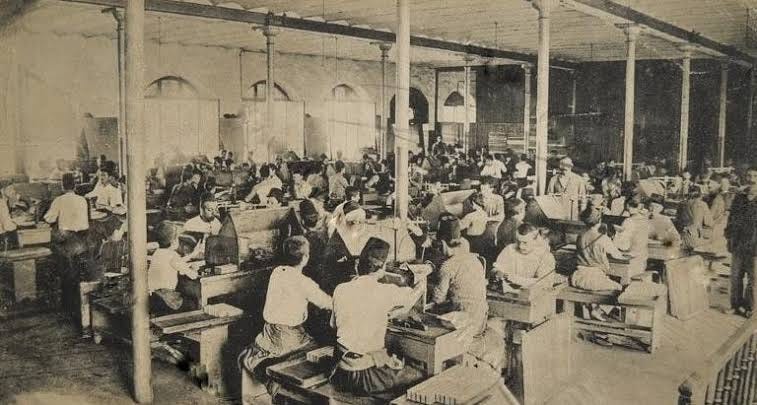
Before the late eighteenth century, many regions of the Muslim world were renowned for manufacturing. Damascus produced steel blades that became legendary. Cairo was known for textiles, paper, and glass. Anatolia produced silk and carpets. Persia exported fine rugs and luxury goods. India, under the Mughals, was among the world’s greatest textile producers. Cotton fabrics from Bengal and other regions were sought across Europe, Africa, and Asia.
These were not primitive economies. They were sophisticated networks of guilds, artisans, merchants, and long-distance trade routes that had developed over centuries. Most production was done by skilled craftsmen rather than machines. While slower than factories, their goods were often of extraordinary quality. That balance would not last.
The invention of steam-powered machinery transformed manufacturing. British factories could now produce cloth in hours instead of days and at a fraction of the cost. For consumers, this meant cheaper products. For traditional Muslim manufacturers, it was catastrophic.
European-made textiles flooded markets throughout the Ottoman Empire, North Africa, and South Asia. Local weavers and craftsmen simply could not compete with factories producing thousands of identical goods every day. Entire industries that had supported families for generations began disappearing. Unlike European governments, many Muslim states could not adequately protect their own industries.
One reason was a series of trade agreements known as the Capitulations. Originally negotiated centuries earlier when the Ottoman Empire was still powerful, these agreements granted European merchants special privileges. They paid reduced taxes, enjoyed legal protections, and often operated outside local jurisdiction.
As European industrial production exploded, these agreements became increasingly one-sided. Ottoman officials found themselves unable to raise tariffs high enough to protect domestic industries without provoking diplomatic crises. The result was predictable. Cheap European goods entered Muslim markets in enormous quantities. Local workshops closed. Guilds declined. Traditional manufacturing shrank year after year. The Industrial Revolution had not merely introduced competition. It had fundamentally changed the rules of global trade.
As Europe industrialized, it needed enormous quantities of raw materials. Rather than encouraging industrial development within Muslim lands, European economic policy increasingly transformed them into suppliers. Egypt became heavily dependent on cotton cultivation to feed the textile mills of Manchester. The Ottoman Empire exported wool, silk, tobacco, and agricultural products. Iran expanded exports of raw materials and opium.
Instead of producing finished goods, many Muslim economies increasingly exported inexpensive raw resources while importing expensive manufactured products. This created a cycle of dependency that became difficult to escape. The value, technology, and profits remained in Europe. The raw materials came from elsewhere.
Not every Muslim ruler accepted this transformation. Among the most ambitious reformers was Muhammad Ali Pasha of Egypt. He recognized that military strength depended upon industrial strength. Beginning in the early nineteenth century, he launched one of the most ambitious industrial programs outside Europe. He established state-owned textile mills. He built foundries capable of producing modern weapons. He opened paper factories and shipyards. Students were sent to Europe to study engineering, medicine, and military science. Foreign experts were invited to train Egyptian workers. Protective tariffs shielded Egyptian industries from British imports.
His goal was not merely economic growth. He wanted Egypt to become an independent industrial power capable of competing with Europe. For a time, it appeared possible.
Egypt’s experiment faced enormous obstacles. Unlike Britain, Egypt lacked abundant coal, the fuel that powered Europe’s factories. Transportation infrastructure remained limited. Technical expertise had to be imported.
But perhaps the greatest obstacle was political rather than economic. A powerful, industrialized Egypt threatened the balance of power in the eastern Mediterranean.
After Muhammad Ali defeated Ottoman armies and expanded his rule across Syria, Palestine, the Hijaz, Sudan, and much of the eastern Arab world, Britain, Austria, Russia, and Prussia intervened militarily and diplomatically.
The Convention of London in 1840 forced Muhammad Ali to withdraw from most of his conquered territories. Just as importantly, Egypt was compelled to dismantle many of its monopolies and abandon the protectionist policies that had nurtured its industries. Its markets were opened to British manufactured goods. The industrial project never fully recovered. Many historians view this as one of the greatest lost opportunities in modern Middle Eastern history.
The Ottoman Empire also recognized the challenge. Beginning with the Tanzimat reforms in 1839, Ottoman leaders attempted to modernize the empire. Railroads were built. Telegraph lines connected distant provinces. Modern military academies were established. Government factories were created. Administrative institutions were reorganized. These reforms achieved important successes. Yet they also faced overwhelming structural problems.
European industries had already gained decades of technological advantage. Foreign loans financed much of the modernization, leading to enormous debt. European creditors eventually gained direct influence over Ottoman finances through institutions like the Ottoman Public Debt Administration. Modernization continued. Economic independence diminished.
Industrialization changed more than factories. It changed how people experienced daily life. For centuries, much of the Muslim world organized time according to the movement of the sun. Prayer times naturally structured the day. Markets often paused during the hottest hours. Many communities practiced biphasic sleep, sleeping shortly after sunset, waking during part of the night for worship, conversation, or study, then sleeping again before dawn. (This is called Namat (نَمَط), and will share an article soon regarding Islamic systems and its impact on spirituality.
Industrialization introduced something different. Factory whistles replaced the sun. Railway timetables demanded standardized clocks. Government offices adopted rigid working hours. Gas lighting extended activity late into the evening. Urban workers increasingly adapted to uninterrupted workdays and consolidated nighttime sleep. The mechanical clock slowly replaced the rhythms that had shaped life for centuries. The transformation was not immediate, nor universal, but over generations it altered how millions organized work, rest, and even their relationship with time itself.
The Industrial Revolution did more than invent new machines. It transformed the economics of empire.
Factories consumed staggering quantities of cotton, coal, rubber, metals, timber, and other raw materials. They also produced more goods than domestic markets could absorb. To keep the machines running, industrial powers needed reliable sources of raw materials, guaranteed buyers for manufactured products, and secure shipping routes linking the two.
In many ways, the Industrial Revolution became the engine of European expansion, while colonialism became its fuel supply.
Factories created the demand.
Empires secured the resources.
Steamships carried the goods.
Navies protected the trade.
This helps explain why the nineteenth century witnessed not only unprecedented industrial growth, but also the largest wave of European colonial expansion in history.
For much of the Muslim world, industrialization and colonization were not separate historical events. They were two sides of the same process.
Few places demonstrate this relationship more clearly than Egypt.
Under Muhammad Ali Pasha and his successors, Egypt pursued an ambitious modernization program. Railways were built, irrigation projects expanded, factories established, and eventually one of the greatest engineering achievements of the nineteenth century took shape: the Suez Canal.
Completed in 1869, the canal dramatically shortened the journey between Europe and Asia. Steamships no longer needed to sail around the Cape of Good Hope at the southern tip of Africa. Instead, European factories could move manufactured goods to Asian markets and transport Asian and African raw materials back to Europe in a fraction of the time.
The canal quickly became one of the most valuable industrial arteries on earth.
But modernization came at an enormous financial cost.
To finance the canal and other infrastructure projects, Egypt borrowed heavily from European banks. The mounting interest payments eventually overwhelmed the Egyptian government.
Financial dependence soon became political dependence.
In 1875, Britain’s Prime Minister Benjamin Disraeli purchased Egypt’s shares in the Suez Canal, giving Britain enormous influence over one of the world’s most strategic waterways.
When nationalist unrest threatened British interests and Egypt’s financial obligations, Britain intervened militarily.
In 1882, the Royal Navy bombarded Alexandria before British forces occupied Egypt.
Officially, the occupation was presented as restoring order.
In reality, Britain secured control over the Suez Canal, protected the route to India, ensured repayment of European creditors, and safeguarded one of the most important lifelines of its industrial empire.
The story of Egypt illustrates a broader pattern seen across much of the Muslim world.
Industrialization created strategic assets.
Debt created leverage.
Leverage invited intervention.
Intervention became occupation.
The Industrial Revolution was not only about factories and steam engines. It reshaped global politics, turning economic dependence into imperial control.
Industrial superiority translated directly into military superiority. European nations produced steam-powered warships, modern artillery, repeating firearms, and advanced logistics on a scale few Muslim states could match. Economic dependence often became political dependence. Political dependence frequently became military occupation. Within a century, much of the Muslim world found itself under direct or indirect European rule.
Algeria was occupied by France. India fell under British control after the collapse of Mughal authority. Tunisia became a French protectorate. Egypt came under British occupation. Libya was invaded by Italy. Large portions of the Ottoman Empire were partitioned after the First World War.
Industrialization alone did not cause colonization. Internal political struggles, military defeats, administrative weaknesses, and global rivalries all played important roles. But industrialization fundamentally shifted the balance of power. It gave Europe economic resources and military capabilities on a scale the world had never seen.
It is tempting to tell this story as one of inevitable Western progress or inevitable Muslim decline. History is more complicated. The Muslim world was not passive. Its rulers debated reform.Its scholars discussed modernization. Its engineers built factories. Its states attempted industrial programs. Some succeeded for a time. Others were constrained by geography, finances, internal politics, or foreign intervention.
The lesson is not that industrialization itself was harmful. Rather, it is that technological revolutions rarely occur in isolation. They reshape economics, politics, culture, education, warfare, and even everyday habits. The Industrial Revolution did not simply produce better machines. It reordered the global balance of power.
For Europe, it became the engine of empire. For much of the Muslim world, it became the beginning of a long struggle to preserve economic independence, political sovereignty, and cultural identity in a rapidly industrializing world.
Understanding that history helps explain why the nineteenth century became one of the most consequential turning points in the history of Islamic civilization.
Thanks for reading The Muslim Observer! This post is public so feel free to share it.
No posts
Comments
Nothing yet. Say the first thing.
Sign in to join the conversation.