
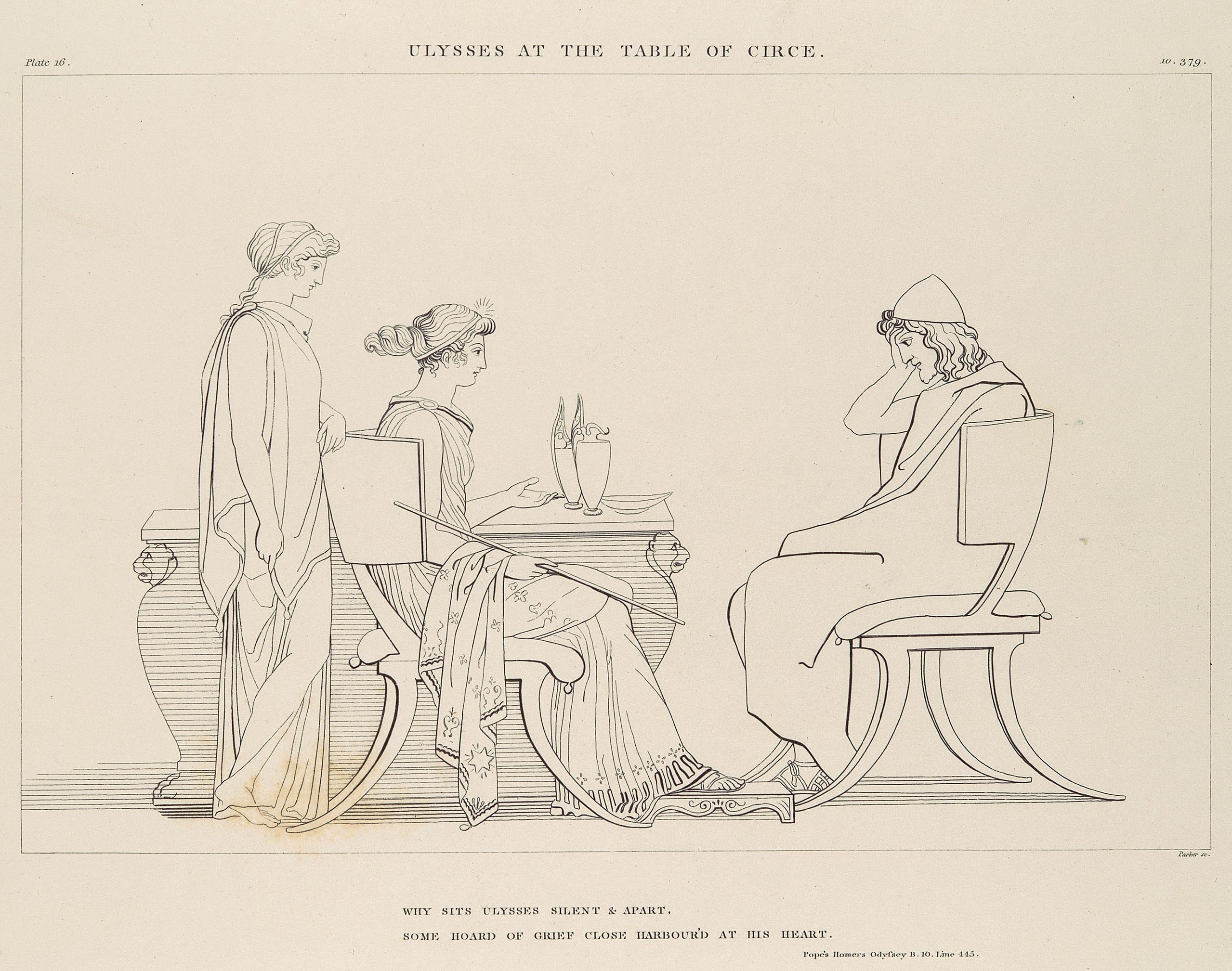
Happy Bloomsday—June 16, the date on which James Joyce set Ulysses—to all who celebrate. This spring I read the novel for the first time and, not being hyperbolic, it changed me.
I’d encountered Ulysses before, having gone through a few sections in a college class on the Odyssey1 that looked at texts inspired by Homer’s work; Ulysses, published in 1922, maps Odysseus’ ten year journey back to Ithaca onto a single day in Dublin. Aside from that Odyssey course, a couple short stories, and an abortive teenage attempt at Finnegan’s Wake, I hadn’t read Joyce and didn’t know any biographical information about him outside of some smutty letters to his wife, Nora Barnacle. I knew the book starred two men, the younger Stephen Dedalus and older Leopold Bloom.
I expected formal invention. Truthfully, I expected a slog. Somehow I did not expect language so beautiful it would make me actually breathless, did not expect some of the funniest scenes I’ve read in years, and periodic emotional gutting that left me lying in bed, the book butterflied on my stomach as I stared into a middle distance, or cried. I didn’t expect that the book would be so much about grief and loneliness, and that reading it would prove such a balm.
A poor soul gone to heaven: and on a heath beneath winking stars a fox, red reek of rapine in his fur, with merciless bright eyes scraped in the earth, listened, scraped up the earth, listened, scraped and scraped.
Much has been written about Ulysses, so instead, here’s a bid for the way I read it, which was with The Catherine Project. The Project takes a symposium-style form, with small groups led by a fellow reader rather than an “expert,” and eschews references to secondary texts. (We bent this rule a little to bring in the Odyssey.) For eighteen weeks, from January through May, twelve of us met on Zoom for an hour and a half.
I was in a complicated mental space at the commencement of the reading group. I’d left my job of eight years a couple months earlier and had difficulty adjusting from constant daily contact with longtime colleagues and strangers to mostly being alone at my desk. The morning of the first scheduled meeting I had a miscarriage, acutely isolating in its attendant grief. I thought about skipping Ulysses. I’m glad I didn’t. For ninety minutes that evening I left myself behind and thought only about Stephen, and Bloom, and stately, plump Buck Mulligan, and the ashplant and milk and the snotgreen sea.
Behind him he heard Buck Mulligan club with his heavy bathtowel the leader shoots of ferns or grasses.
—Down, sir! How dare you, sir!
Each week we read one episode2 (except for two particularly lengthy ones that we split in half) and then gathered to discuss. The group members lived in six or seven different states and spanned a few decades in age. Over nearly half a year I came to know them purely through their lens on Ulysses. Someone clocked details that seemed small but cast long shadows. Someone pointed out the poetry. Someone underscored the humor. Someone had an eye for the book’s finances and debts. Someone pulled at the political threads. Together we grappled with the characters’ misogyny and racism, sifted through the streams of consciousness, mourned Stephen and Bloom’s losses alongside them, debated which way the earth turned. “What exactly is happening here?” someone would ask, and often someone else had an answer. Everyone was generous and thoughtful and I cannot more highly recommend reading a Big Book in this way. I felt religious while participating, a zealot not only for the novel but for these other brains with which I got to commune. By the final weeks I was preparing to terribly miss our weekly meetings. Now that they’re over, I do.
Alone, what did Bloom feel?
The cold of interstellar space, thousands of degrees below freezing point or the absolute zero of Fahrenheit, Centigrade or Réamur: the incipient intimations of proximate dawn.
Each episode of Ulysses takes a different narrative form—standard close third, “pure thought,” the script of a play—and as I read I frequently thought, This is the least comprehensible episode, how could it get more difficult than this? Inevitably a later episode would prove even more challenging in a new and inventive way. But the book also became increasingly gratifying. We more deeply understood the people. The jokes and connections landed harder. This is how life works, I think, under ideal circumstances. Rising demands and complications in general proportion to fulfillment.
In a stroke of pathetic fallacy, the days were short and dark when we started reading Ulysses. When we ended they were long and bright.3
Colm Toibin’s custom Charvet shirt is collateral damage amid the turmoil at Grasset, the Paris-based publishing imprint of Hachette Livre from which more than two hundred authors departed in response to the far-right billionaire owner Vincent Bolloré firing beloved editor and chief executive Olivier Nora earlier this year. Toibin, one of Grasset’s team-Nora authors, has had a Charvet shirt nearly ready for pickup in Paris. “I was going to go [to Paris] in the autumn,” he told Bella Freud, but “I wouldn’t sign a contract with Grasset now because of their appalling behavior […] I’m going to have to keep postponing this Charvet fitting.”
“To shit-talk is human.” Read this horror story of our new golden age of hacking in New York; forget Obsession, this is the stuff of which nightmares are made.
The Big Bear eaglets are getting ready to fledge.
I read each episode straight through, first, letting it wash over me rather than trying to understand it. Then I read it again, making underlines and notes in the margins, realizing that passages I’d felt lost in before were suddenly clear. RTE has a great podcast, the 1982 dramatic reading of the text, which I sometimes listened to while walking.
All of the pull quotes are from the Gabler edition of Ulysses.
Comments
Nothing yet. Say the first thing.
Sign in to join the conversation.