
I have been some form of Baptist for most of my life. Independent Baptist (eek), GARBC, Southern Baptist, Cooperative Baptist, Alliance of Baptists, and probably others if I thought long enough about it.
I know Baptist life well, what it should and shouldn’t be when it is healthy.
I want to say something plainly, without qualification or equivocation:
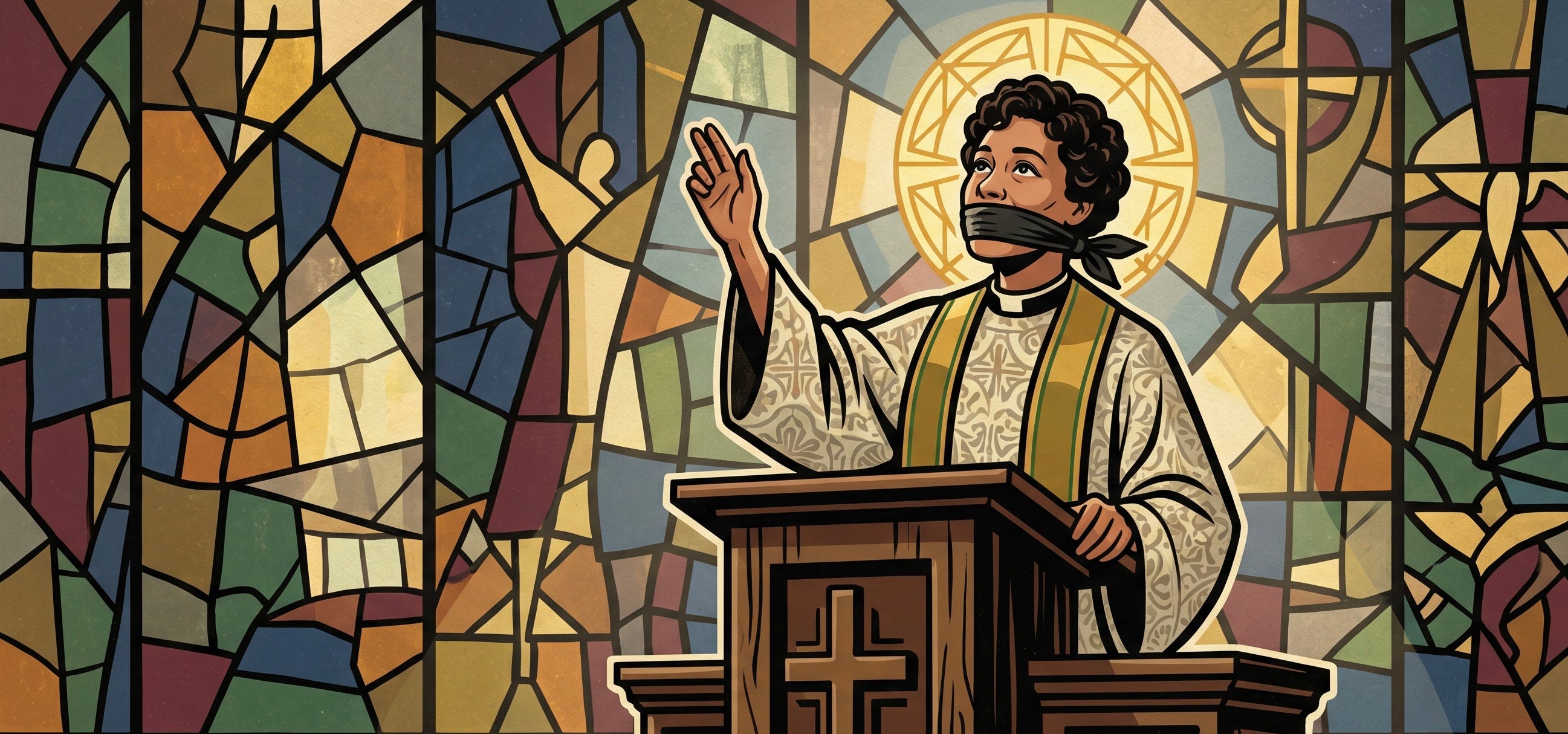
If you are a woman in a Southern Baptist church, the institution you are sitting in has just told you—boldly, in writing, with a landslide vote—that you are less than the men around you. And the research overwhelmingly says that’s not just a theological problem, it’s a warning sign.
History tells us that victims often remain in increasingly toxic and abusive relationships rather than run. Don’t make that same mistake.
This week in Orlando, the Southern Baptist Convention passed the “Truth and Unity Amendment” (gaslighting language proposed by Albert Mohler, president of Southern Baptist Theological Seminary) to formally enshrine in the SBC’s governing constitution that no cooperating church may “affirm, appoint, or endorse a woman serving in the office or function of a pastor/elder/overseer, specifically preaching to the assembled congregation.” In the same breath, Mohler framed this as the natural continuation of the SBC’s earlier constitutional exclusion of LGBTQ-affirming churches.
Women in pulpits.
Gay people in pews.
Same constitutional remedy.
Same category of threat.
And on that same convention floor, Southern Baptists elected as their new president Willy Rice, a Florida pastor who has publicly suggested the SBC’s documented, independently-investigated, two-decade sexual abuse crisis is more hoax than history. His primary opponent used the phrase “snipe hunt” to describe it. Both men, apparently, are more troubled by a woman preaching than by the documented reality that, for almost twenty years, the SBC Executive Committee systematically stonewalled, dismissed, and denigrated survivors of sexual abuse while protecting the institutions and the men who ran them.
As such, the topic of female pastors isn’t a theological conversation, not at its core.
If it were, the SBC would be equally as concerned about removing the men in their ranks who abuse and harm the office of pastor.
But an organization run by men doesn’t see men as a problem (and they believe God agrees with them). Go figure.
The first thing outsiders notice about the SBC’s current posture is the irony. You can’t miss it. The same institution that spent twenty years dismissing, belittling, and burying the testimonies of women who were sexually abused in Southern Baptist churches just voted to constitutionally limit what women can do and say in those same churches. Ironic, yes.
But let’s be honest: calling it irony lets them off the hook.
Irony implies accident. It implies that if the SBC leadership could just see the contradiction, they’d correct it.
But would they?
What if this isn’t a contradiction at all? What if the suppression of women’s authority and the suppression of women’s abuse testimony are not two separate, ironic policies running on parallel tracks but, instead, the same policy, expressing itself in two different ways?
Because that’s exactly what the research says is happening as the SBC devolves.
Dr. Kristin Kobes Du Mez—professor of history and gender studies at Calvin University and author of Jesus and John Wayne—has made this case with scholarly precision. The white evangelical complementarian worldview (the idea that women have God-ordained roles/submission in marriage, church, and the world), she argues, does not merely correlate with sexual abuse cover-ups… it enables them.
The same ideological machinery that says a woman cannot preach to a congregation also says that a woman’s testimony about a man in authority is inherently suspect, even and especially when she is calling out abuse.
It gets worse: A peer-reviewed study found that purity culture beliefs predicted domestic violence myth acceptance above and beyond hostile sexism, benevolent sexism, and traditional sex-role beliefs as independent variables. That means people formed in SBC-style evangelical culture (i.e., people who are taught that women are responsible for male sexual behavior, that female bodies are the source of male temptation, and that a woman’s value is bound to her purity and her submission) are measurably, empirically more likely to rationalize, minimize, and dismiss sexual violence against women.
In short, the doctrine of gender hierarchy itself is the sin that leads to the evil of violence and abuse against women.
The SBC is, therefore, an unavoidable theological breeding ground for abusers.
Across 44 countries, the data is consistent: the more gender equality, the less violence against women. The less gender equality, the more violence against women.
This is not a correlation found in one study. It is an inverse relationship that replicates across regional, cultural, and religious contexts. The Lancet published it. The World Health Organization documented it across 161 countries. ResearchGate’s academic review concurred: “the more gender equality, the less domestic violence against women.” The National Academies of Sciences found that organizations with large power differentials (places where men hold more power than women) are more likely to be associated with high rates of sexual harassment than organizations without them.
Every time.
Everywhere.
So when the SBC constitutionally codifies the subordination of women, they are not just making a theological statement; they are building the precise conditions that the research most consistently identifies as predictors of abuse. Not to mention, when they write into their governing document that women cannot lead, cannot preach, cannot hold authority over men in any pastoral capacity, that in and of itself is a form of abuse.
Abusive theology leads to abusers perpetrating abuse.
This shouldn’t be a radical idea.
The SBC is not protecting women from bad theology, it is creating the environment in which the abuse of women becomes, as I’ve come to think of it, largely inevitable.
Not every man in every SBC church will abuse a woman. Not every complementarian pastor is a predator. Academic honesty requires that caveat. But the research supports something more troubling than individual bad actors: the systemic, institutionally-protected, repeatedly-enabled abuse of women at scale cannot exist without gender subjugation as its structural foundation.
The subjugation is what makes the abuse scalable, deniable, and sustainable across decades.
Which is exactly what the Guidepost Solutions report documented in 288 pages: twenty years of survivors coming forward, twenty years of institutional dismissal, a private list of accused ministers that was never shared with law enforcement, and organized, active resistance to reform.
Not one or two bad decisions. A system. An abusive one. Functioning exactly as it was designed.
While the conversation about abuse in the SBC tends to center on sexual abuse, and for good reason, we need to push further.
The documented cases are devastating, but if we only talk about sexual abuse, we miss the broader architecture of harm that complementarianism builds into a woman’s daily life.
Telling a woman she cannot lead is not a neutral theological position. It is a psychological event… one that happens every week, in every SBC church, in every sermon, every deacon meeting, every moment a gifted woman with something to say is quietly pointed back to the children’s ministry.
Research from Christians for Biblical Equality found that attendance at sexist religious congregations correlates with measurably worse health outcomes for women—psychologically, emotionally, spiritually. This is not speculative. This is measured.
When you tell a woman, repeatedly, with the weight of divine mandate behind you, that she is structurally “less than,” you are doing harm. When you tell her that her voice carries less authority, that her calling is conditional on male approval, and that her body is a liability and her testimony is suspect then you are abusing her, long before anyone touches her or before any abuse report gets buried.
The true harm is the hierarchy itself.
Abuse is what grows in the hierarchy’s soil.
Purity culture (especially the SBC’s specific brand of it) does something even more insidious than restrict women’s leadership. It constructs women as morally responsible for male sexual behavior, making them psychologically pre-loaded to doubt themselves when abuse occurs, and institutionally pre-loaded to be doubted by others. As The Conversation’s academic analysis put it: patriarchy and purity culture don’t just silence women after abuse happens, they build the silence in advance. Patriarchy and purity culture manufacture the conditions in which a woman questions whether what happened to her was real, whether she bears responsibility for it, and whether anyone in her church community will believe her if she speaks.
The SBC didn’t just fail to protect women from abuses, the SBC has spent decades building, doctrine by doctrine, a structure in which women were primed to absorb abuse because it was called ‘biblical.’
I cannot leave the biblical argument entirely on the table, because the SBC insists this is about Scripture. Albert Mohler says this is about what Christ has the authority to determine.
Fine. Let’s talk about what the historical Jesus actually did.
The historical Jesus—the one documented across all four gospels, the one whose revolutionary social behavior is among the most academically consistent findings in New Testament scholarship—operated in a first-century Palestinian context where women were legally classified closer to property than to persons. And into that context, Jesus did something that his contemporaries found scandalous enough to write about, argue about, and, in some cases, try to silence: he treated women as full, equal human beings with full spiritual authority in all matters.
He appeared first to women after the resurrection—not to Peter, not to the twelve, but to Mary Magdalene. The early church Fathers called her Apostola Apostolorum: “The Apostle to the Apostles.” She was the first preacher of the resurrection, the first witness, and the first one commissioned to carry the most important message in Christian history to the men (who had run away).
Figures.
Biblical scholars Joan Taylor and Helen Bond, both professors of Christian origins, have documented extensively that Jesus had women disciples (not just supporters, not just donors, but active participants in the movement, entrusted with teaching and witness). Junia, named in Romans 16:7, is—by a consensus of New Testament scholars including N.T. Wright—identified as an apostle. Not a helper. An apostle.
Women were Apostles.
Period.
The SBC’s “Truth and Unity Amendment” is not a reflection of the historical Jesus. It is a reflection of the Roman household codes that the early church was in the process of dismantling before later interpreters froze them back into doctrine. Full stop.
The Jesus of the Gospels didn’t come to reinforce the patriarchy of Greco-Roman culture. He detonated it, quietly and consistently, in every conversation he had with a woman who wasn’t supposed to be there.
Complementarianism is not Christology. It is cultural conservatism wearing the Bible as a costume.
I know some of you reading this are still sitting in those pews. Some of you were there in Orlando this week. Some of you are wrestling with what this means for your faith, your community, your family, your sense of call.
I am not here to tell you what to do. But I am here to offer you a framework, because sometimes the hardest thing about leaving a harmful system is finding language for what you already know in your body is true.
Here are five things you are permitted to say.
Five things the research (not just theology, but peer-reviewed science) fully supports:
“The way this institution treats women is not just theologically questionable—it is extraordinarily harmful.”Complementarianism does not merely limit your role. It places your well-being structurally below the institutional interests of men in authority. It shouldn’t be called a church, because it is a known abusive power structure hiding under a steeple.
“When my voice is silenced in leadership, I am placed in measurably greater danger.” This is not rhetoric. This is the World Health Organization and the National Academies of Sciences. The inverse relationship between gender equality and violence against women is one of the most consistent findings in global public health research. A church that bars your voice is a church that dramatically increases your risk of harm.
“I am not responsible for what men do with their desire. That doctrine was designed to protect them, not me.” Purity culture is not holiness. Purity culture is a liability-shifting mechanism that transfers male behavior onto female bodies. Any theology that makes you responsible for male lust is a theology that has already decided whose safety matters more.
“My call does not require male permission to be legitimate.” The historical Jesus commissioned women before he commissioned the assembled disciples. Mary Magdalene did not check with Peter before she went to tell the story of the resurrection. Your gifting precedes their approval. Always has.
“Leaving is not a loss of faith. It may be the first fully faithful thing you do.” The SBC has been in a two-decade membership decline—losing over 259,000 members in 2024 alone, down to its lowest membership in 50 years. You are not abandoning the church, you are joining a growing, quiet exodus of people who decided that their integrity and their safety were worth more than the institutional brand.
The Southern Baptist Convention has just declared, before God and everybody in Orlando, that women in their pulpits are a greater threat to denominational integrity than two decades of documented, independently-verified, survivor-testified sexual abuse.
They’ve elected a president who called that crisis a hoax. They’ve written women’s subordination into their governing document. And they’ve placed this squarely in the tradition of a Jesus who—I promise you—looked nothing like Albert Mohler.
The research is clear.
The history is documented.
The direction is unmistakable.
Women: you deserve a faith community where your voice is not a constitutional problem. Where your body is not a theological liability. Where the person most likely to protect you from harm is not also the person most likely to bury a report.
That community exists. It’s being built right now, by people who have already done what you’re considering.
It’s okay to run.
Run.
Kevin Young is a pastor, public theologian, published author, and advocate writing at kevinyoung.substack.com. He is a member of the LGBTQIA+ community and an unapologetic voice for progressive faith, human dignity, and the deconstruction of systems that harm people in God’s name.
Bond, Helen K., and Joan E. Taylor. Women Remembered: Jesus’ Female Disciples. London: Hodder & Stoughton, 2022.
Christians for Biblical Equality International. “When Religion Hurts: How Complementarian Churches Harm Women.” CBE International, 2022. https://www.cbeinternational.org/resource/when-religion-hurts-how-complementarian-churches-hurt.
Du Mez, Kristin Kobes. Jesus and John Wayne: How White Evangelicals Corrupted a Faith and Fractured a Nation.New York: Liveright Publishing, 2020.
Guidepost Solutions LLC. Report of the Independent Investigation: The Southern Baptist Convention Executive Committee’s Response to Sexual Abuse Allegations and an Audit of the Procedures and Actions of the Credentials Committee. May 15, 2022. https://guidepostsolutions.com/insights/media-mentions/guidepost-solutions-report-of-the-independent-investigation-of-the-southern-baptist-convention.
Lifeway Research. 2025 Annual Church Profile. Nashville: Southern Baptist Convention, 2026. https://research.lifeway.com/2026/05/05/southern-baptists-see-attendance-and-baptism-gains-amid-membership-declines.
Mohler, R. Albert, Jr. “Truth and Unity Amendment.” AlbertMohler.com, May 18, 2026. https://albertmohler.com/2026/05/18/truth-and-unity-amendment.
National Academies of Sciences, Engineering, and Medicine. Sexual Harassment of Women: Climate, Culture, and Consequences in Academic Sciences, Engineering, and Medicine. Washington, DC: National Academies Press, 2018. https://www.nationalacademies.org/publications/26631.
“Purity Culture: Measurement and Relationship to Domestic Violence Myth Acceptance.” Journal of Psychology and Theology, 2023. ResearchGate. https://www.researchgate.net/publication/371890421_Purity_Culture_Measurement_and_Relationship_to_Domestic_Violence_Myth_Acceptance.
Religion News Service. “Willy Rice, Florida Pastor and Abuse Crisis Skeptic, Elected SBC President.” Religion News Service, June 9, 2026. https://religionnews.com/2026/06/09/willy-rice-florida-pastor-and-abuse-crisis-skeptic-wins-sbc-presidential-election.
ResearchGate. “The More Gender Equality, the Less Violence (Domestic, Against Women).” ResearchGate, 2021. https://www.researchgate.net/post/The-more-gender-equality-the-less-violence-domestic-against-women.
Sardinha, Lynnmarie, et al. “Achieving Gender Equality to Reduce Intimate Partner Violence Against Women.” The Lancet Global Health 3, no. 6 (2015). https://www.thelancet.com/journals/langlo/article/PIIS2214-109X(15)00006-6/fulltext.
The Conversation. “Patriarchy and Purity Culture Combine to Silence Women in the Southern Baptist Convention — and Are Blocking Efforts to Address the Sexual Abuse Scandal.” The Conversation, 2022. https://theconversation.com/patriarchy-and-purity-culture-combine-to-silence-women-in-the-southern-baptist-convention-and-are-blocking-efforts-to-address-the-sexual-abuse-scandal-183799.
World Health Organization. “Violence Against Women.” WHO Fact Sheet, March 2024. https://www.who.int/news-room/fact-sheets/detail/violence-against-women.
Comments
Nothing yet. Say the first thing.
Sign in to join the conversation.