
Confession:
For years … years … I tried to have the Bible argument with bigots. I believed that if I could just get the exegesis right, unpack the Greco-Roman context of arsenokoitai, demonstrate that Sodom’s sin was inhospitality and not homosexuality, I could change minds. I thought the problem was an information deficit. I thought that if I could better educate people about the Bible, then I could change them.
I was wrong.
Not about the exegesis (the scholarship is overwhelmingly on the side of LGBTQ+ inclusion, and I’ll fight that battle any day of the week). No. I was wrong about where the hostility actually comes from. Behavioral science, psychology, sociology, and political science have been quietly, rigorously telling us for decades what drives bigotry:
The Bible isn’t the engine for hate; neither is morality.
It isn’t even really about faith.
The engine that drives hate is something far more primal, far more irrational, and far more interesting than a hermeneutics dispute. And if we’re going to stop being traumatized every June and start building something that actually changes the terrain, we need to understand what we’re actually dealing with.
Religion is a convenient cover for the true root issue.
According to a large and robust body of peer-reviewed research, disgust is the single most powerful psychological predictor of negative attitudes toward gay and lesbian people. More than religious attendance, political affiliation, or any demographic factor, disgust predicts the level of gay-hate present in a person.
Not the Bible.
Not morality.
Not God.
Disgust.
Psychologist Jonathan Haidt’s Moral Foundations Theory identified six innate psychological systems that function like moral “taste buds.” Liberals weight their moral lives primarily around Care and Fairness, even above loyalty, liberty, or authority. Liberals will sacrifice (even break the rules) to care or be fair. Conservatives, on the other hand, tend to weight their moral lives around Sanctity. The sanctity foundation is the moral taste bud most directly wired to disgust. It produces the intuitive sense that something is unclean, disordered, profane … i.e., a violation of some sacred order.
Which means that when a deeply conservative person sees two men kiss at a Pride parade, what they experience is not primarily a theological objection they’ve consciously reasoned to. They are having a visceral, embodied moral-emotional response that their entire psychological architecture has primed them to experience as the voice of moral truth.
Their disgust BECOMES their morality, rather than their morality shaping their disgust.
Disgust shapes moral judgment. Moral judgment amplifies disgust. The feedback loop is remarkably resistant to rational argument.
Evangelical purity culture didn’t get their LGBTQ-disgust from God. They took a pre-existing internal psychological disgust response and handed it a Bible verse and a theology.
Evangelicals told a generation of people: your gut reaction to gays is not an irrational instinct—it is the voice of God.
But it wasn’t God’s voice, it was their own disgust, wrapped up in Bible drag.
They gave psychological disgust divine authorization, transforming normal (and yes, manageable) personal discomfort into a sacred, communal, non-negotiable moral obligation.
It wasn’t the Holy Spirit their hate was hearing from, it was their amygdala wearing a fake clerical collar.
Disgust doesn’t operate alone, though. It has a partner.
Decades of cross-cultural research have identified two personality constructs that, together, predict homophobic prejudice with striking consistency. Right-Wing Authoritarianism (RWA), which is a deep psychological need for social order, deference to authority, and aggressive rejection of perceived deviants. And Social Dominance Orientation (SDO), which is a fundamental preference for hierarchy and resistance to movements that challenge who sits at the top of it.
Together, RWA and SDO account for a substantial portion of anti-gay prejudice even after controlling for religion, politics, and demographics.
Meaning: for a significant population, opposition to LGBTQ+ dignity is not primarily a moral position, it is an expression of one’s personality flaws.
I.e., you don’t need fewer gays in your life, you just need therapy.
The gay couple next door isn’t so much of a theological problem for a high Right Wing Authoritarian person as they are a destabilizing symbol of a world not behaving the way that your personality needs it to behave.
And then there’s this, the finding I keep coming back to:
A well-documented body of research shows that some of the most intense public hostility toward gay people comes from people privately navigating unresolved same-sex attraction! The more likely you are to be publicly hostile toward the LGBTQ+, the more likely you are to be a closeted member of that community.
When the message you’ve absorbed your entire life is “what you feel inside is an abomination,” that pressure doesn’t disappear. It externalizes. For a notable subset of the loudest anti-gay voices, what you’re watching is wounded people hurting others with the wound they cannot name.
In my personal and public conversations with vocal anti-LGBTQ+ individuals, I have begun pointing out they are simply in the closet and dealing with internalized homophobia. And surprisingly, they rarely ever push back against my assertion, choosing instead to pivot away rather than lie about their same-sex attraction or correct me.
Now layer on the sociology, because this is where Pride Month specifically comes into focus.
There is a research theory that brings all of this into focus. Social Identity Theory tells us that human beings derive a significant portion of their self-concept from group membership. When the perceived status of an outgroup rises (an “outgroup” is a group made up of outsiders), members of the dominant ingroup (insiders) experience it as a relative diminishment of their own worth. So in effect, the more that people accept the existence of the LGBTQ+ community, the more that white, Christian heterosexuals will feel their existence is threatened.
When a conservative, evangelical American sees rainbow flags on government buildings and corporations changing their logos every June, their social psychology isn’t asking “is this logically a threat to my hetero marriage?” It is saying: “Your group is losing ground. Their group is winning. This is zero-sum and you are on the losing side.”
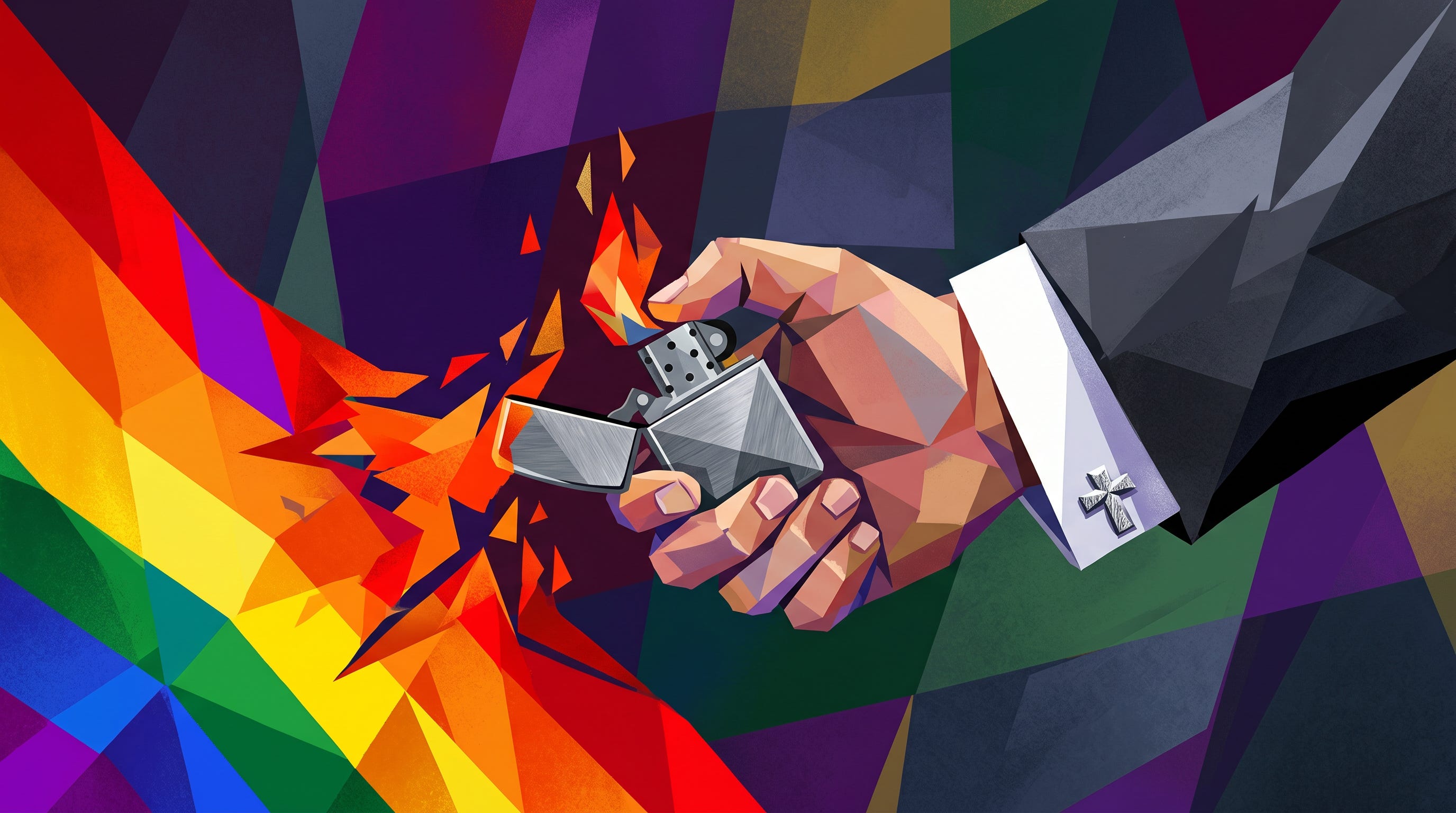
This is exactly why the MAGA and Evangelical responses are both performative and public. Burning a pride flag… saying things like the “Stars and Stripes is my Pride Flag”… state resolutions designating June as “Nuclear Family Month”…. These are not rational arguments directed at LGBTQ+ people. They are solidarity signals directed at the ingroup—saying to their own community: we are still here, our values still matter, we will not be erased.
In effect, let’s erase THEM before they erase US.
Research calls this a symbolic threat—the sense that LGBTQ+ visibility undermines the moral fabric and threatens the cultural architecture that gives a community its identity.
You cannot argue someone out of a symbolic threat. You cannot defeat it with better exegesis. Because it was never about the argument. It was always about the identity.
ACLED documented that anti-LGBTQ+ incidents in the United States more than tripled from 64 events in 2021 to 193 in 2022. For three consecutive years, more than 20% of all hate crimes reported to the FBI have been motivated by anti-LGBTQ+ bias. This is not accidental.
Research using millions of tweets found that positive social feedback for expressions of moral outrage conditions people to produce more outrage—identical to slot machine conditioning. A Pride flag burning that goes viral becomes a template. A governor who signs a Nuclear Family Month resolution gets national coverage and donor checks. The escalation is manufactured, rewarded, and quite profitable.
When Tennessee’s Bill Lee signed a resolution declaring June “Nuclear Family Month”—explicitly describing the heterosexual nuclear family as “God’s design”—he wasn’t doing theology. He was deploying a precise political instrument to affirm his ingroup, delegitimize LGBTQ+ symbolic claims on public space, and perform cultural survival for a base that rewards bigotry.
Everything above could, in certain lights, feel deeply discouraging. But here’s what years of serious training in the gym have taught me:
The most seemingly immovable things are often the most responsive to consistent, intelligent pressure.
The research on what actually changes attitudes is more compelling to me than the research on what creates them. Because change is not only possible, it is happening, it has happened, and we know with increasing precision what produces it.
Public shaming feels good, but it is strategically counterproductive. Public shaming of bigotry only hardens opposition and energizes the ingroup you’re trying to reach past. Winning the Bible argument matters for the church, but doesn’t move the dial for people whose opposition is emotional and identity-based rather than intellectual. And framing every Pride action as a battle in a zero-sum war deepens the very polarization that feeds the backlash.
We have to stop fighting on terrain our opponents designed.
A meta-analysis of 515 studies involving more than 250,000 participants across 38 nations confirmed that intergroup contact (i.e., actually knowing someone from the outgroup) consistently reduces prejudice. The mechanism is empathy through perspective-taking. People who personally know a gay, lesbian, or bisexual person are dramatically less likely to hold hostile attitudes toward LGBTQ+ people as a whole.
The practical implication is staggering in its simplicity: you, being you, in proximity to people, IS the strategy. Every out LGBTQ+ person living openly and in genuine relationship with their community is doing something no legislative campaign or social media strategy can replicate.
EVERY “out” person moves the needle, because it gives their community and connections a living, breathing face and story from someone they know and love… which makes it far more difficult to hate.
Companion research from UC Berkeley and Stanford found that a ten-minute, empathy-focused conversation (not argument, not data, but genuine human presence) produces lasting reductions in anti-trans prejudice that persist for months. Not arguing at people, but inviting them to connect the issue to their own experience of exclusion or invisibility and building bridges on similar topics. For those of us in ministry: this is not a political strategy. This is incarnational theology with empirical validation. This is what Jesus did at every well, every table, every threshold.
And the research on persuasion is unambiguous: personal narrative shifts moral attitudes more durably than statistics or argument. Less time winning debates; more time telling human stories with radical honesty.
Less time proving our right to exist.
More time existing so fully and humanly that the question dissolves.
Because symbolic threat drives so much of this hostility, our communication needs to address it directly. Messaging that affirms diverse families without requiring the abandonment of traditional ones consistently outperforms messaging that frames equality as cultural replacement.
The frame that works is not “your values are wrong.” It is: “My family being celebrated does not uncelebrate yours. My dignity does not diminish yours. This is not a competition.”
Rather than being capitulation, that is strategic empathy deployed in service of justice. There is a difference.
Individual attitude change is necessary but not sufficient. The legislative assault on LGBTQ+ lives is driven by electoral incentives because political entrepreneurs have discovered that anti-LGBTQ+ performance generates donors and drives base turnout.
Nuclear Family Month didn’t come from the pews. It came from the playbook.
Removing the electoral profitability of anti-LGBTQ+ signaling is as urgent as changing individual hearts. Pursuing ballot outcomes, corporate accountability, and cross-partisan coalition building with libertarian conservatives who oppose government intrusion into private life are structural interventions that complement, but cannot be replaced by, personal and relational work.
We need both.
The long arc and the immediate leverage point. We need both the deep relational conversations and the voting booth.
From where I stand, I see people who were handed a psychological disgust response and told it was divine revelation. I see people whose sense of identity feels genuinely threatened by a world changing faster than their nervous systems can process. I see wounded people, some of whom are fighting hardest against the very thing they secretly are.
And I see, on the other side, a community—our community—that has survived everything. That has outlasted every empire that tried to erase us. That has produced, out of the crucible of marginalization, extraordinary beauty, resilience, love, and spiritual depth.
The path forward is NOT louder outrage.
The path forward is deeper humanity. Showing up … in relationship, in story, in unflinching presence … so fully and irrevocably human that the narrative of threat has nowhere left to stand.
The research says contact changes minds.
The Gospel says love changes hearts.
I’ve decided to trust both.
Kevin M. Young is a pastor, author, public theologian, and proud member of the LGBTQ+ community. His writing explores the intersection of ancient spiritual disciplines, progressive faith, and embodied liberation. Subscribe to kevinyoung.substack.com for weekly essays at the edge of faith and culture.
If this landed for you, share it. The algorithm rewards engagement. For once, let’s make it work for us.
SOURCES:
Haidt, J. (2012). The Righteous Mind: Why Good People Are Divided by Politics and Religion. Pantheon.
Pettigrew, T. F., & Tropp, L. R. (2006). A meta-analytic test of intergroup contact theory. Journal of Personality and Social Psychology, 90(5), 751–783.
Stephan, W. G., & Renfro, C. L. (2002). The role of threat in intergroup relations. In D. M. Mackie & E. R. Smith (Eds.), From prejudice to intergroup emotions.Psychology Press.
Mancini et al. (2025). Bidirectional interplay of disgust and morality: Meta-analytic review. Personality and Individual Differences.
Broockman, D., & Kalla, J. (2016). Durably reducing transphobia: A field experiment on door-to-door canvassing. Science, 352(6282), 220–224. (The deep canvassing study)
ACLED (2022). Fact Sheet: Anti-LGBT+ Mobilization on the Rise in the United States.
ISD Global (2025). Five-year overview of the online and offline anti-LGBTQ+ landscape.
Comments
Nothing yet. Say the first thing.
Sign in to join the conversation.