
There are multiple flavors of Christianity these days, but not all of them are healthy or driven by Christ.
One of the most concerning is the one that allows federal ICE agents to profile congregants, interrogate on church property, and make arrests within sanctuaries.
Have we forgotten the meaning of “sanctuary?”
Lutheran synods, an entire UCC convention, and a slew of Baptist churches are in federal court this month fighting the Trump administration over the reversal of the “sensitive locations” policy that used to keep ICE and federal agents out of churches, schools, and hospitals. Now the sanctuary is little more than another parking lot to stake out.
While a federal injunction has already blocked enforcement of the practice once (which tells you how shaky the government’s legal ground is here), the fight is still very much alive.
Shockingly, many Christians are siding with the government and ICE.
Their rationale? The rule of law.
It’s as if they never stopped to think about how that phrase has been used as justification for some of history’s worst atrocities.
Pharaoh had the rule of law.
Segregation and slavery had the rule of law.
1930s Germany had the rule of law.
But somehow that is conveniently avoided.
The rule of law isn’t a trump card that we get to play against Jesus whenever we want to follow a tyrannical regime or a political party rather than his teachings. We don’t get to use the rule of law to bring harm to others.
But, of course, it isn’t that clear at times, is it?
We have to keep asking the question: Whose law, protecting what, at whose expense?
At the center of this tension sits the Bible.
Not cable news.
Not the election.
And more specifically, the Bible verse that is always used to shut down the whole conversation before it even begins: Romans 13, “submit yourselves to the governing authorities.”
Before we get to Paul and Romans, we need to start in Exodus. You don’t just get to leapfrog the Hebrew texts and Jesus just because it fits your preferred political position.
“You shall not wrong a stranger or oppress him, for you were strangers in the land of Egypt.” (Exodus 22:21)
Notice what God does not say.
God doesn’t say “be nice to foreigners because it’s the nice thing to do.” God doesn’t appeal to feelings at all.
God appeals to memory.
You were the undocumented ones, once.
You were the ones without papers,
You were the ones without land,
You were the ones under the rule of law, without a legal leg to stand on,
You were the ones entirely at the mercy of somebody else’s border policy.
Don’t you dare forget it! — God
Later, in Leviticus, he says it again:
“The stranger who dwells among you shall be to you as one born among you, and you shall love him as yourself... for you were strangers in the land of Egypt” (19:33-34).
And again in Deuteronomy:
God himself “loves the stranger, giving him food and clothing, and therefore…” (not however, not but only if they came through the right channel, but THEREFORE) Israel must do the same (10:18-19).
This is not a suggestion buried in the footnotes of OT Law.
In Hebrew, the word for “stranger” is ger, and it has a specific group of people that it means. The ger (stranger) is the nonnative person living in your land, contributing to your economy, raising their kids in your neighborhood, but who has no legal standing.
The ger is completely dependent on the mercy of people who could turn on them, and turn them in, at any moment.
The closest modern equivalent to a biblical ger/stranger is the eleven million undocumented people in America.
Jesus does not soften any of this:
“I was a stranger and you welcomed me... as you did it to the least of these, you did it to me.” (Matthew 25:35, 40)
Jesus is not being poetic or metaphorical, he is telling us, point blank, that he has attached himself to the “illegal,” the refugee, and the person your people are telling you to hate and send home.
If you refuse the stranger, you are not just bending a policy, you are refusing Christ.
Jesus’ own origin story is essentially one of an undocumented refugee. Herod wanted Jesus dead, so Joseph and Mary became asylum seekers, fleeing through the night into Egypt with a baby who has no papers and no protection except the mercy of a foreign land (Matthew 2:13-15).
The God of the universe entered the story of human history as an undocumented child.
I failed to grasp the importance of these texts until I began to interact with undocumented immigrants while living in South Florida. I was shocked by what I learned. The stories I had been told about them were all lies. These gers were good people. They worked hard. They paid their taxes and gave more to the system than they took. They desperately wanted to become legal, but the process was designed to keep them from it, with many spending untold years trying.
In America, the ger has become too useful as a political football (to rally white conservatives) for anyone in power to want the problem solved. So the “just follow the law” and “just do it the right way” lines are lies.
In America, the ger has become too useful as a political football — a wedge to rally voters — for anyone in power to actually want the problem solved. So the 'just follow the law' line is a lie.
So with all that in mind, let’s now face Paul and Romans 13:
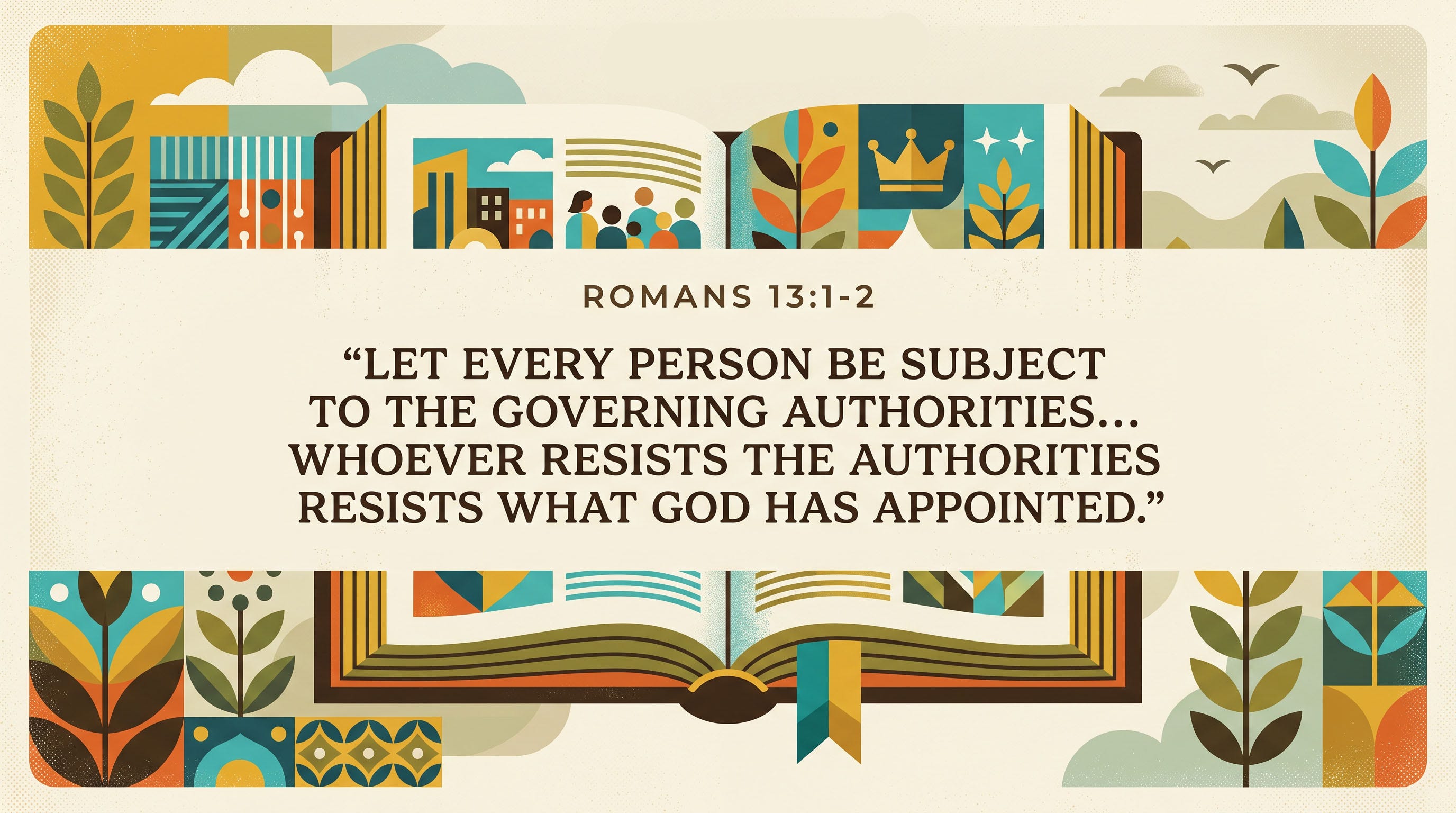
“Let every person be subject to the governing authorities... whoever resists the authorities resists what God has appointed.” (Romans 13:1-2)
This verse is easy to misunderstand if you don’t read everything around it, know the people whom Paul is writing it to, or the situation that his readers find themselves in.
And that is an important point to remember: It was written to them, not to us.
WHO IS PAUL TALKING TO, AND WHAT’S THEIR DEAL?
Paul is writing to a vulnerable, struggling, and quite small group of Jewish-Christians living in Rome, a city that could crush the new Christian community without anyone taking notice. In fact, it had just happened to the Jews in Rome. To make it worse, Rome was in open unrest over unfair taxation, with ongoing riots, which is why Paul’s encouragement to pay your taxes and obey without questions isn’t a once-and-forever decree about every government ever. It’s pastoral triage. Paul is a battered leader telling his fragile, minority community, “Don’t give the government an excuse to notice you and kill you.”
THE VERSE DOESN’T STAND ALONE
This verse is a continuation of a sentence that began at the end of chapter 12: “Repay no one evil for evil... never avenge yourselves... leave it to the wrath of God” (12:17-19). Paul’s concern here is Christian vigilantism, i.e. that Christians were looking increasingly as though they might take justice into their own hands. He’s saying: Don’t become the mob. There is a huge difference between that and “whatever the government does to the vulnerable is fine with God.”
VERBS MATTER.
Paul uses the word hypotassō for “obey.” It means: to be rightly ordered under, or situated in right relationship to.
He does not use hypakouō, which is the word for direct, unconditional obedience (the same word Luke used in Acts 5:29 when the apostles tell the Sanhedrin, “We must obey God rather than human authority.”) Paul could have used either word, but he used the first, and there is an enormous difference between the two.
PAUL PUTS IN A CONDITION, BUT EVERYONE IGNORES IT.
In verses 3-4, the very next lines say: rulers are legitimate only if they are “not a terror to good conduct, but to bad” since they exist to be “God’s servant for your good” and to act against wrongdoing.
So let’s ask the question: When armed ICE agents stake out sanctuaries to terrorize people who are worshiping, feeding their kids, and doing nothing but existing without the correct paperwork, is that a government being “God’s servant for good,” or is that the exact thing that Paul says disqualifies authority from being followed and obeyed?
WHAT PAUL DOES HIMSELF.
When city magistrates try to release Paul quietly after an illegal beating, he refuses to slip away, demanding public accountability for the injustice done to him (Acts 16:35-37). Later, Paul appeals directly to Caesar, using the empire’s own legal machinery against corrupt local authorities (Acts 25:11).
The man who allegedly told everyone to just fall in line, didn’t fall in line himself. He spent his entire ministry life in and out of prison for refusing to fall in line. If Romans 13 meant what the rule of law people say it means, then Paul constantly broke his own rule.
PAUL DIDN’T WRITE IN A VACUUM.
The Hebrew midwives lie to Pharaoh’s face and let the babies live (Exodus 1). Daniel keeps praying toward Jerusalem, even with the death decree already signed (Daniel 6). Shadrach, Meshach, and Abednego stand in front of a furnace and tell the king, we’re not bowing, do what you’re going to do (Daniel 3).The same New Testament that contains Romans 13 also contains Revelation 13, a vision of empire so given over to blasphemy and bloodshed that the faithful response is resistance, not submission.
And history confirms Paul’s argument, and we should be ashamed for continually forgetting.
The “German Christians” in 1930s Nazi Germany quoted Romans 13, demanding submission to Hitler. But the minority Confessing Church insisted the church’s ultimate allegiance could never be absorbed into the state’s. Dietrich Bonhoeffer went to the gallows because he believed in the very reading of Romans 13 that I just gave you.
American slaveholders and, a century later, segregationists reached again for Romans 13 against abolitionists and against Martin Luther King Jr., trying to squelch the resistance by hitting hard with an authoritarian reading of Romans 13. King answered from a Birmingham jail cell, borrowing from Augustine: “An unjust law is no law at all.”
So when someone quotes Romans 13 to defend the government and tries to press Christians into obedience, gently ask them: Which side of history has that understanding of Romans 13 always ended up defending?
In Les Misérables, there is a man who is an ex-convict, a parole violator, and a guy that the rule of law had already judged disposable. His name is Jean Valjean, and wherever he walks in town, every single door shuts in his face.
Every door, but one.
The Bishop’s.
Myriel, the Bishop, takes him in, gives him food and a bed, asking no questions about his papers.
Valjean repays the kindness by stealing some silver from the church and running.
When the police catch him and drag him back to the Bishop’s house to confirm the theft, the Bishop lies to the police.
He tells the authorities that he gave Valjean the silver as a gift. Then, in front of the officers, he hands Valjean two silver candlesticks, saying he had “forgotten” them when he left…
“Jean Valjean, my brother, you belong no longer to evil, but to good. It is your soul I am buying for you.”
The Bishop broke the law that night. He lied to armed government authorities to protect a man who was a criminal. But no one has ever thought the Bishop was the villain.
There is another character, who is worth noting.
Javert.
Javert is as important to the story as the Bishop. Javert genuinely believes the law is righteous and to follow it is to be a righteous person, full stop, no exceptions. But Valjean’s transformation and the mercy shown by the Bishop break Javert’s world. Unable to reconcile the Bishop’s mercy with his rule of law worldview, Javert commits suicide.
Right now, right here in America, there are Javerts standing at the back of sanctuaries, sitting in pews, and waiting in parking lots. We have to decide which character in the story we are going to be.
The rule of law, today, is trying to say that the stranger at the door doesn’t count. But the Bible has told us that we aren’t supposed to slam it in the face of anyone, even criminals, but instead, throw it open wide.
It is your soul I am buying for you.
That line was never just about a Bishop or a convict.
We only welcome Jesus when we welcome the stranger unconditionally. Not before. Not with conditions. Only then.
Kevin Young writes at the intersection of faith and culture, tackling the tough topics from a progressive-leaning perspective… thoughtfully, pastorally, but boldly.
Comments
Nothing yet. Say the first thing.
Sign in to join the conversation.