

It was 2019, and I found myself in one of the most magnificent (and admittedly weirdest) places on earth… its lowest point, the Dead Sea, located in Israel’s Jordan Valley.
I stayed at the most magnificent seaside resort, experiencing luxuries most people only ever dream of. But the true opportunity of a lifetime wasn’t the resort but the seawater and the chance to float in water so dense with salt that I couldn’t make myself sink no matter how hard I tried (which is pretty cool for a guy who doesn’t swim well).
While in the water, I remember a guide reaching down to the bottom of the sea, scooping up a bit of sea floor, and handing me a fistful of thick, gray Dead Sea mud, telling me to cake it on… “good for the skin,” he said, “minerals found nowhere else on earth.”
What a memory, floating effortlessly in the lowest place on the planet, covered in mud, baking in the sun, laughing with strangers.
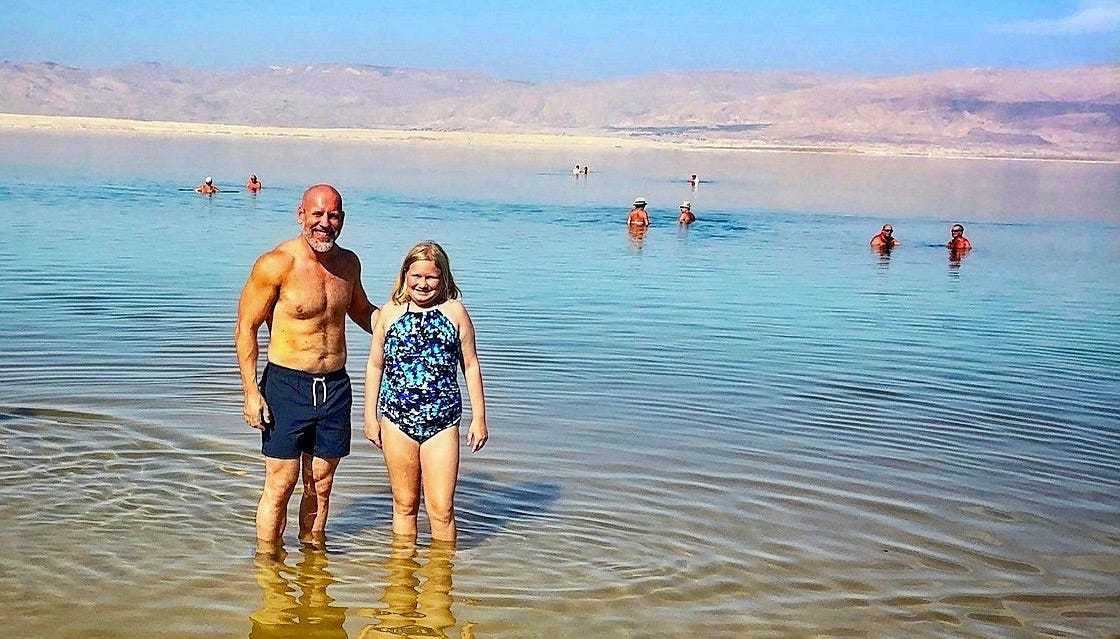
I didn’t think much of it at the time, beyond how absurd I looked. It wasn’t until later, flipping back through John’s Gospel, that the image caught up with me. When Jesus heals the man born blind, he doesn’t just speak a word, but he makes mud from dirt and his own saliva and puts it on the man’s eyes.
“Go,” he says, “wash.”
And the man came back seeing.
While I don’t want to overwork that image, I haven’t been able to shake it either, because that’s more or less what happened to me.
For many years, I had a tidy, inherited theology about what “God’s covenant nation” (Israel) meant and what it obligated me to. I had mud over my eyes. It wasn’t until I washed off the muddy theology about Israel, so to speak, that I was able to see the place, and the theology, more clearly.
Seven years later, apparently I’m not the only one that needs a mud bath.
For most of my life, white evangelical support for Israel has been treated as settled fact. “Christians are required to support Israel… no matter what,” they say.
But fewer and fewer Christians are buying into that theology anymore, and it is causing a great deal of distress.
Pew Research’s most recent survey, released this summer, found that favorable views of the Israeli people among white evangelicals have dropped ten points since 2024, down to 74 percent. That is an enormous, steep drop.
But the sharper drop is toward Israel’s government: favorability there has fallen from 71 percent to 57 percent in the same window, among white evangelicals. Among Americans under 30 (the future of every church that’s paying attention), only 32 percent hold a positive view of Israel at all!
Having been to Israel, this caught me off guard. It is a lovely country with truly lovely people.
But it gets worse for Israel…
Brookings was blunter than Pew: Israel now relies more heavily than ever on American evangelical support precisely because younger evangelicals are the ones walking away from it.
And it’s not a coincidence. Reports indicate that this bottoming-out of pro-Israel sentiment among young evangelicals is part of the reason why the Israeli government earmarked nearly $750 million for public relations aimed, in no small part, directly at Christian audiences. One of their primary methods? Flying more than a thousand American pastors to Israel at the government’s expense to be trained, in effect, as ambassadors back home.
Pastors like me are being bought as ad space. Walking billboards.
So what gives? Why the change??
I don’t think this shift is mainly about people reading their Bibles more carefully, though I wish it were.
It’s Gaza.
It’s smartphones putting images in front of eighteen-year-olds that their grandparents’ pastors never had to reckon with.
It’s a slow, accumulating disillusionment with the entire political package evangelicalism sold alongside unconditional Zionism… a package which increasingly asks evangelicals to look away from things Scripture never asked them to look away from, like genocide.
Which raises the actual question underneath all of it: What was the theological justification for the unconditional support that Israel has enjoyed from evangelicals for generations?
And when I go looking for that answer, I keep finding one verse, and one verse only, doing all of the work.
The proof text for all unconditional evangelical Israeli support is Genesis 12:3, and only Genesis 12:3, where God’s word to Abram is: “I will bless those who bless you, and whoever curses you I will curse.”
In several corners of American Christianity, this single verse has been stretched into something like a standing threat against any nation, including our own, that doesn’t sufficiently fund or defend the modern State of Israel.
But if we set the verse back into its actual context, the lay of the land becomes obvious fairly quickly.
In this verse, God is addressing one man, ONE MAN, using ancient covenant language about God’s relationship to him, and him alone. This is not a foreign-policy directive to Gentile nations three thousand years later regarding a 20th-century parliamentary democracy in Israel. The Torah itself is relentlessly conditional about blessing and land (Deuteronomy 28–30), and the prophets spend entire books pronouncing curses on Israel itself for covenant unfaithfulness.
IF Genesis 12:3 were an unconditional blank check, as evangelicals treat it, then the prophets wasted a great deal of ink.
And even IF it were true that God intended that blessing/curse promise to extend to a people or nation, then we have to admit that Abraham is the father of more than Israel. He is the father of Islam, Bahá’í, Druze, and Christianity.
So, when was the last time you heard an evangelical say that we must bless an Islamic country as much as Israel or suffer the wrath of God?
The New Testament doesn’t leave this alone either, though.
Paul insists that “those who have faith are children of Abraham” (Galatians 3:7) and that “not all who are descended from Israel are Israel” (Romans 9:6). In short, the New Testament redefines everything around Christ… not bloodlines or borders. And THAT gets conveniently skipped whenever Genesis 12:3 gets quoted with total confidence.
But let me pause here and say: I don’t believe that everyone who holds this view about supporting Israel is being cynical. Most of the people who taught it to me were sincere. They were heirs of a specific, but terrible, 19th- and 20th-century theological tradition called dispensational premillennialism. It was popularized through the Scofield Reference Bible, and later, by people like Hal Lindsey and John Hagee.
Sadly, much of what Christians believe today is inherited from terrible theologians of the recent past rather than the Bible itself.
But the real unsettling problem with the “bless Israel or else God will smite you” theology is how it isn’t really about blessing Israel at all, because it is rarely about extending charity, humility, patience or generosity to Israelis. instead, it shows up the moment someone raises a hard question about things like civilian casualties in Gaza, in convos about settlement expansion, or oversight of a multi-billion-dollar aid package. And it shows up specifically to reclassify what is simply a policy disagreement as a spiritual crime.
“What? You want to stop funding Israeli genocide? … Then you must hate God.”
Insert eyeroll emoji.
A real theological conviction invites conversation.
A trump card ends it.
That’s the sleight of hand: a contested, cherry-picked reading of one patriarchal promise from Genesis, laundered into an unanswerable veto on debate, deployed by people who benefit politically from never letting any debate or dissent happen.
If the last few weeks in Congress proved anything, it’s that the veto is losing its power. The dissent over Israel funding was large and came from directions that would have been unthinkable a decade ago, and I don’t think that’s a sign of eroding faith.
I think it might be a sign of improving faith.
This is more than generational drift, though. As the call for unconditional allegiance to evangelical Zionism has weakened, it hasn’t simply been replaced by something more careful or more just. No, in some very loud corners, it’s been replaced by something much worse.
Case in point. Last fall, Tucker Carlson sat down for a two-hour interview with Nick Fuentes, who is a young white nationalist known for open racism and misogyny. During the interview, Tucker and Nick bonded over mutual contempt for “Christian Zionists” (people who support the return of the Jewish people to the Holy Land and the defense of the modern state of Israel), with Carlson naming figures like Ted Cruz, George W. Bush, and Mike Huckabee as people “seized” by what he called a “brain virus.”
The interview has been viewed more than 20 million times, and it sent shockwaves through the conservative movement. In fact, it fractured the movement badly enough that the Heritage Foundation’s president publicly defended Carlson and an antisemitism task force reportedly cut ties with Heritage over it. Many news outlets have covered the story as a rare but genuine schism inside the American right.
And let’s try and be honest AND precise here. Some of what got said in that critique of “Christian Zionism” (that it isn’t the whole of biblical faith, and that Christians can question a foreign government’s policies without heresy, even Israel’s) isn’t wrong on its face, and it echoes some of what I’ve argued above. But when a kernel of truth arrives wrapped in open racism and antisemitic conspiracy, not principled biblical correction, we have no choice but to denounce it.
That’s the trap: the good-faith theological critique of Genesis 12:3 and the bad-faith, hate-driven critique of “Zionists” can sound almost identical for about one sentence before they diverge completely. One ends in “read the whole Bible,” the other ends in “the Jews control everything.” Watching my own tribe struggle visibly to tell those two things apart in real time has been one of the more unsettling parts of this whole season.
This is the actual predicament, and it’s harder than “should we fund Israel?” The theology propping up unconditional support is shaky enough to be genuinely worth dismantling, but the loudest people currently dismantling it in public are not doing it for reasons I’d want anywhere near my faith.
Being against Christian Zionism CANNOT end in antisemitism. Period.
These days, I think a lot about my trip to the Holy Land, and I especially think about the people.
I think about that Palestinian Christian guide in Bethlehem more than almost anyone else from that trip. He wasn’t bitter, or at least he didn’t perform bitterness for a busload of Americans. He just told the truth about his life, plainly, and let us sit with it. I couldn’t believe how he was treated, but I saw it with my own eyes and heard how Israelis spoke of Palestinians and how miserably they treated them.
But I also think about the guy at the Dead Sea who caked mud on my back and laughed at how badly I sunburned two days later.
I think about how ordinary and human all of it was, underneath every layer of theology stacked on top of it by people—myself included—who’d never actually been to the Holy Land.
None of what I experienced there requires me to pretend that the modern State of Israel is beyond moral critique. I don’t have to pretend that Israel is perfect to have loved being there, and none of it requires me to launder my policy opinions through an ancient biblical curse formula that I’m not sure Genesis 12:3 was ever offering in the first place.
It also doesn’t give me permission to let disillusionment curdle into something that sounds a little too comfortable and ends in platforming actual bigots and antisemites, the way I’ve watched happen to some people I used to trust.
It’s been seven years since I dipped my toes in the Dead Sea, but all these years later, I still order bars of Dead Sea mud soap from an importer—a small, slightly ridiculous ritual that has nothing to do with minerals anymore and has everything to do with reminder.
I use the mud soap, and I think about the mud on a blind man’s eyes, and about scales, and about how the whole point of that story was never the mud itself. It was that he could suddenly see something he’d been told his whole life he never would.
That’s still the goal, for me and I suspect for a lot of us: Not louder certainty in either direction, but washing the mud off and actually looking at the whole text, the whole place, and the whole tangle of people, politics, and power we’ve let stand for far too long.
If this piece made you think, the most helpful thing you can do is share it with one person who needs to read it too.
Kevin Young writes at the intersection of faith, culture, and honest doubt. He visited Israel and the West Bank in 2019 and hasn’t stopped thinking about it since.
Have you watched people in your own church or family shift on this in the last few years? If so, toward what? I’d genuinely like to know in the comments.
Comments
Nothing yet. Say the first thing.
Sign in to join the conversation.