
For most of human history, “work” was defined by what you could do with your hands. Today, we define it by what we can do with a spreadsheet or a slide deck. But we are standing on the precipice of a shift so fundamental it will make the Industrial Revolution look like a software patch.
We are moving from a Service Economy to an Orchestration Economy. In this new era, the value isn’t in doing the service, but in managing the AI agents that deliver it.
To understand where we’re going, we have to look at the three great “migrations” of human labor.
In 1790, roughly 90% of the U.S. workforce was employed on farms. Survival was a direct result of physical output. If you didn’t plow, you didn’t eat. Work was decentralized, local, and grueling. We should be so happy we were not born in this era!
By the mid-1800s, the steam engine and the assembly line began pulling people into cities. Manufacturing employment peaked in 1944 at 38% of the workforce. We stopped managing our own survival and started managing machines that did the physical work.
As automation ate the factory floor, we migrated to the office. By 1999, the service sector accounted for 78% of jobs, and today it stands at over 80%. We became “knowledge workers,” selling our empathy, our logic, and our time to solve problems for others.
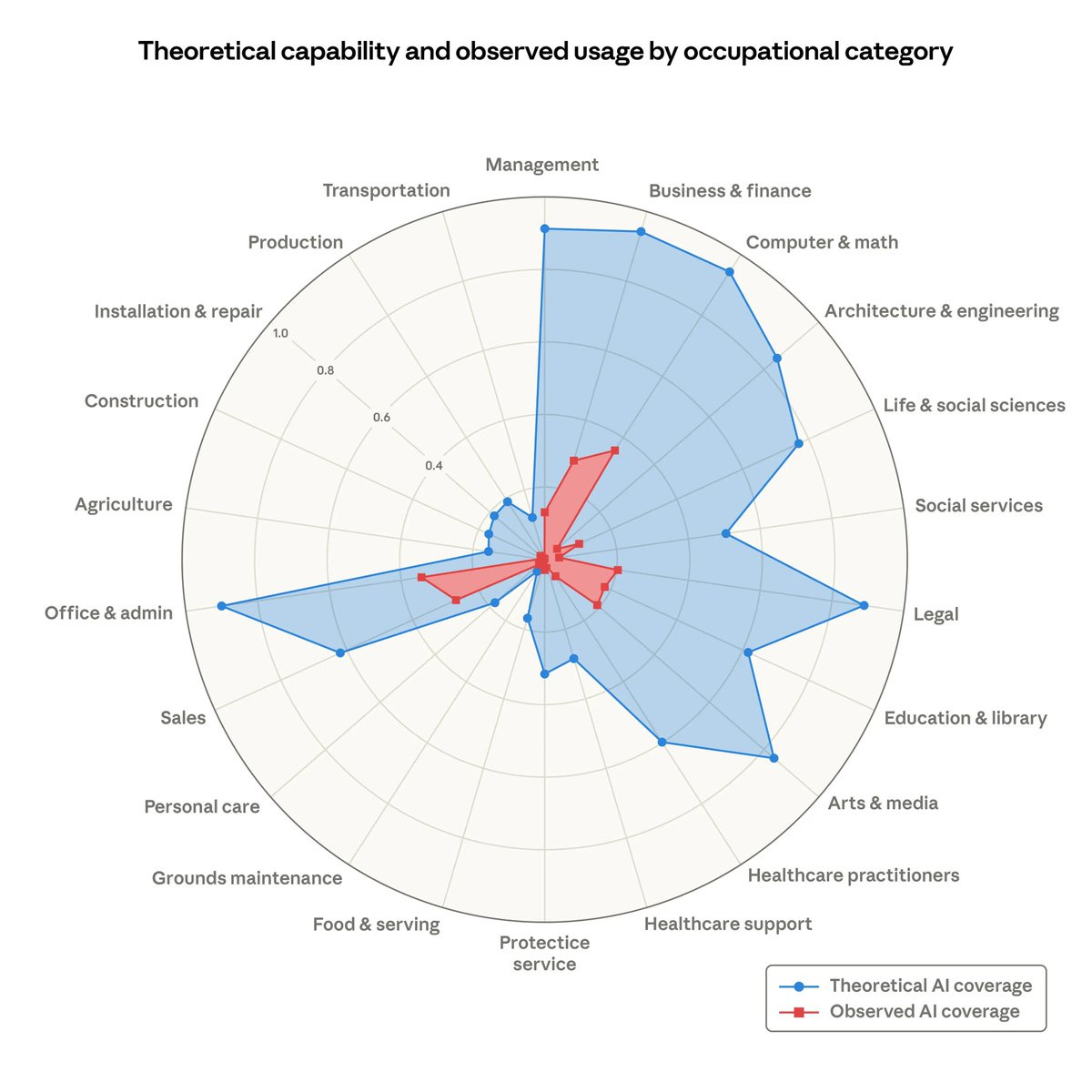
The Service Era is dying. Why? AI agents are becoming capable of executing the “doing” part of knowledge work—writing the code, scheduling the logistics, and even handling the initial customer “empathy” loops. Here is a great chart from Anthropic that shows their forecasted displacement of jobs by AI.
I believe we are entering the Orchestration Era. In this world, we don’t “provide a service” ourselves. Instead, we manage a fleet of specialized AI agents to deliver the product or service to the customer.
Everyone becomes a “Mini-Manager.”
Imagine a graphic designer. In the Service Era, they spent 8 hours in Photoshop. In the Orchestration Era, they act as a “Creative Director” for five different AI agents: one for layout, one for color theory, one for typography, and one for brand consistency. The human’s job is to orchestrate the inputs, critique the outputs, and ensure the final product meets the “human” standard of the client.
Let me be clear, I am very optimistic about the future of the US economy as we have never been able to compound intelligence as fast as we can today. The iteration of technology coming out of the Research Labs is astounding. The number of agentic tools and companies is rapidly growing on a weekly basis.
However the journey to this future is fraught with risk. History shows us that labor transitions are rarely smooth. They usually involve a “productivity-pay gap” or what economists call Engels’ Pause, where the benefits of new technology take decades to reach the average worker.
The biggest risk isn’t that the jobs won’t exist; it’s that the old skills will be obsolete before the new “orchestration” skills are learned.
Job Displacement: Goldman Sachs estimates that 300 million jobs globally are exposed to automation, with 6-7% of workers likely to be displaced in the next decade.
The Skill Mismatch: The World Economic Forum projects that 39% of key job skills will change by 2030. We are asking a generation of “doers” to suddenly become “managers,” a transition that requires a completely different cognitive toolkit (systems thinking, prompt engineering, and agentic oversight).
The “Apprenticeship” Problem: If AI agents handle all the entry-level tasks, how do new workers learn the ropes? We risk a “missing middle” where we have senior orchestrators but no way for the next generation to gain the foundational experience needed to manage.
One of the most profound shifts in the Orchestration Era is the democratization of expertise. Historically, “learning the ropes” required years of proximity to veterans who often guarded the traditional path of institutional knowledge.
Today, the younger generation has a unique opportunity to leapfrog this gatekeeping. By mastering AI, digital natives can skip legacy learning cycles and synthesize decades of industry experience in weeks. This allows them to effectively replace retiring, stubborn adopters who refuse to evolve, moving from “entry-level” to “Conductor” almost immediately. They aren’t just joining the workforce; they are out-pacing the legacy guard through sheer technical leverage.
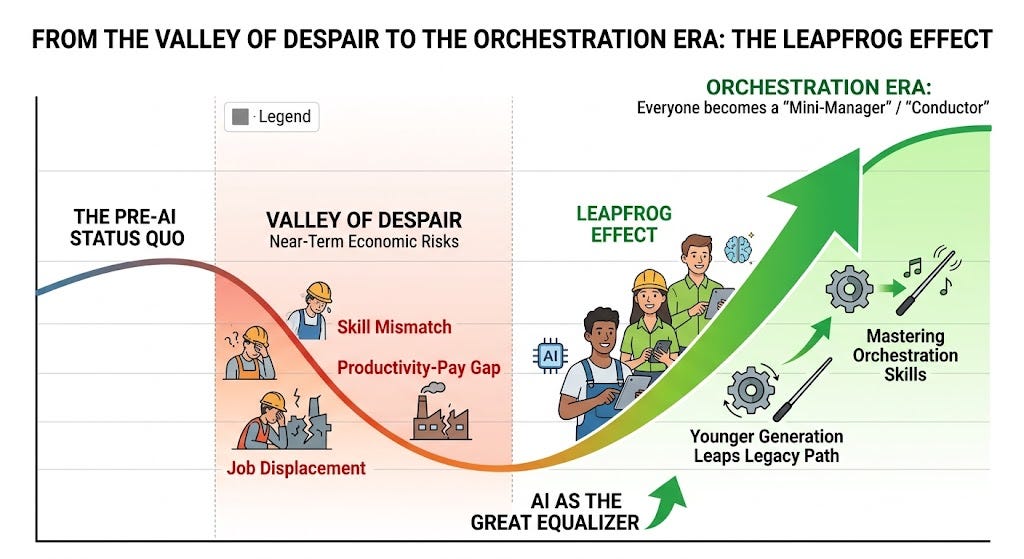
The transition to an Orchestration Industry is inevitable, but its success depends on how quickly we can turn a workforce of “service providers” into a workforce of “orchestrators.”
If we succeed, we unlock a level of human productivity that makes the Industrial Revolution look like a rounding error. If we fail to manage the transition, we face a period of deep economic friction as the “old” jobs vanish faster than the “new” knowledge can be transferred.
The future belongs to the Conductors, not the performers. While some argue that “the only way to keep up with AI is to be unemployed,” the reality is that the Orchestration Era demands a different kind of investment: The Curiosity Tax. This is the price of admission: the deliberate, often unstructured hours spent playing with, breaking, and building alongside these agents until you understand their rhythm. It’s worth it. I have spent several allnighters understanding Openclaw in January and how it can apply to my professional and personal life. Don’t wait for the tide to pull you under; ride the wave. Master the logic, refine the inputs, and claim your seat at the front of the room. In this new economy, the highest-paid skill isn’t doing the work, it’s knowing exactly how to lead it.
No posts
Comments
Nothing yet. Say the first thing.
Sign in to join the conversation.