
We used to read a map. (older people like me can relate!)
Remember when we’d unfold it on the passenger seat, trace the highway with our finger, rotate it so the road matched the windshield, and argue with whoever was driving. The map was the interface. Now we just punch in an address and follow a blue line. We don’t study the route. We don’t verify the turns. We trust the instruction the moment it’s given. This behavior change from operating a map to trusting a voice is the future of software. We just haven’t admitted it yet.
For fifty years, interfaces got richer because we didn’t trust computers to act without our hand on every control. In the agentic AI era, they start getting thinner and eventually, for most tasks, they disappear into surfaces that are generated on the fly, for one person, for one moment, and then thrown away. This is my prediction.
Humans are visual animals
Humans are overwhelmingly visual creatures. An enormous share of the brain is devoted to processing what we see, and we parse an image orders of magnitude faster than a page of text. Seeing isn’t a nice-to-have for us. Seeing is how we verify. Seeing is how we trust.
Buttons, dashboards, settings panels, “are you sure?” dialogs, the little progress bar that shows you the file is really uploading. None of that exists for the computer. The computer doesn’t need to see it. All of it exists so that you, the nervous human, can watch the machine work and feel like you’re in control.
The richer the interface, the lower the trust. The thinner the interface, the higher the trust.
But notice the sleight of hand in that sentence. The interface that helps you trust the machine is not the same thing as the interface the machine needs to do the work. Those have always been the same object. They’re about to come apart.
Take a look at your open tabs right now. Look at the software you use to get through a workday. We are surrounded by massive, permanent digital architecture that we take for granted, but it is entirely built for a nervous human operator.
Consider the ubiquitous left-hand search filter on sites like Amazon or Zillow. It is a graveyard of checkboxes, price sliders, square footage options, color variants, and shipping speeds. We manually click twelve boxes because the computer doesn’t understand context. We are doing the sorting work. Consider the labyrinth of the enterprise analytics dashboard, filled with dense, colorful bar graphs that companies hire entire teams just to interpret. Or look at the “Settings” and “Preferences” panels in macOS or Salesforce, a massive map of rules where humans must manually toggle behaviors.
None of this is permanent. It is all just a coping mechanism for a low-trust relationship with software. When an agent genuinely understands your context, the sidebar filter dies because you simply ask for what you want. The analytics dashboard rots away because the machine reads the data instantly and only generates a screen when there is an anomaly to approve. The settings panel vanishes because intent replaces manual configuration. We are building massive, beautiful dashboards for a pilot who doesn’t actually want to fly.
Follow the money: the interface is the most expensive thing you maintain
Here’s the dirty secret of the software industry: building a product is the cheap part. Maintaining it is where the money goes and it’s not close. The IEEE Computer Society puts maintenance at 60–80% of a software product’s total lifecycle cost. Gartner has found that organizations spend 55–80% of their IT budgets just keeping existing systems alive. Over a full lifecycle, maintenance routinely runs two to four times the original development bill.
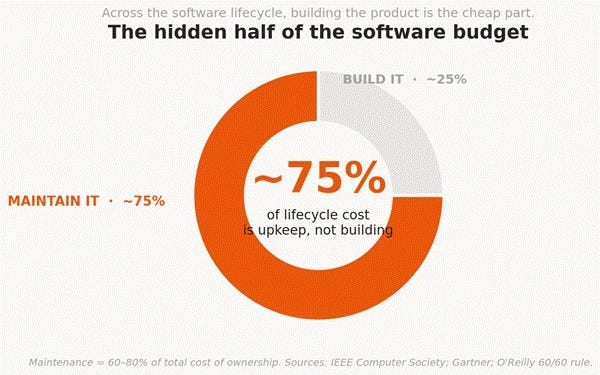
And the interface is the part that rots fastest. Backend logic, once it works, tends to keep working. Over a third of professional developers spend their days building and maintaining interfaces, before you even count designers and UX researchers. At U.S. market rates front-end engineers average somewhere around $90,000–$120,000, and senior design-system owners clear $175,000.
Now connect it to everything above. If the interface becomes something an agent generates on demand rather than something a team builds and maintains in advance, you don’t need a standing crew to keep that surface from cracking. That money doesn’t evaporate. It gets reallocated.
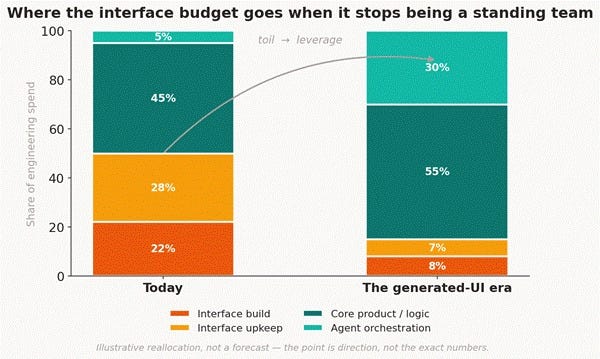
The reallocation isn’t headcount-to-zero. It’s toil-to-leverage: away from maintaining yesterday’s screens, toward directing the system that builds tomorrow’s. Which is, not coincidentally, the exact same move from doing to orchestrating that I keep arguing is the whole shape of the next economy. I am speaking to the younger audience!
The agentic turn: interfaces the machine doesn’t need
I wrote recently about The Orchestration Era; the argument that we’re moving from a service economy, where we do the work, to one where we manage fleets of AI agents that do it for us. Your next job title is “Conductor.” You shape the inputs, critique the outputs, and never touch the instruments.
Apply that to interfaces and the picture snaps into focus.
A UI exists for the human operator. The moment an agent becomes the operator, the agent doesn’t need buttons. It needs intent, an API, and judgment. Agents talking to other agents are already headless; there’s no screen in the loop, because no human is in the loop. That work layer is going invisible right now, this year, in production systems you’ll never see.
What’s left for you is a thin sliver: approve, verify, redirect. A conductor’s interface isn’t a control panel. It’s a baton and a score. You’re not pressing keys; you’re deciding whether what you heard was good.
The endpoint: temporary interfaces
So put it together.
Not “no UI.” A UI conjured on demand. This can be by the agent, for one task, for one person, in one moment and then discarded. The interface stops being a product you learn and navigate and return to. It becomes an output, the way a sentence is an output. You’ll get a screen built precisely for what you’re doing right now, with exactly the controls that moment requires and nothing else, and you will likely never see that exact arrangement again because you’ll never need it again.
This satisfies both masters at once. It gives the visual animal something to look at and verify. And it frees the machine from the dead weight of a generic, designed-in-advance, one-size-fits-nobody cockpit. I’m not the only one circling this; usability researchers like Jakob Nielsen have argued AI is the first genuinely new interaction paradigm in sixty years — a move from telling the computer how to do something to simply telling it what outcome you want. Generated UI is what that paradigm looks like when it grows up.
The shrinking interface is physical evidence of the larger shift I keep coming back to: the future belongs to people who can direct and judge, not people who operate. We stop touching the controls because, finally, we trust the orchestra to play. So here’s where I’ll land, and where I’ll happily take the disagreement in the comments: the best interface of the next decade is one you’ll never see regularly. It will be built for you, for one task, in one instant and then it’ll be gone.
No posts
Comments
Nothing yet. Say the first thing.
Sign in to join the conversation.