
In Post 6, I showed you how Claude Code connects to the rest of your stack; MCP, n8n, JSON, and the tools that turn a terminal into an automated system. If you haven’t read it yet, that’s the place to start.
This post is what comes next: once you’ve built something, what happens to it? How does it move from your laptop into your organization? And how do you bring your team into systems you’ve built without losing control of what you’ve created?
That’s what this post is about. And it’s where individual capability becomes organizational leverage.
Subscribe to get every post in this series delivered to your inbox: kevinkerner.substack.com
The Series: CMOs as Builders
1 -- Why CMOs Who Build Will Win -- The case for moving from AI user to AI builder, and why stepping out of the chat window changes everything.
2 -- Your First 30 Minutes with Claude Code -- How to install Claude Code, get oriented, and build your first real output.
3 -- How to Give Claude Code Its Orders -- The difference between a prompt and a directive, and how to communicate so Claude builds what you actually want.
4 -- Stop Losing Your Work: Sessions and Context -- Why Claude forgets everything when you close a session, and the simple habits that make your work carry forward.
5 -- Skills, Efficiency and Model Switching -- Haiku, Sonnet, Opus: what each model is for, when to use which one, and how the wrong choice cost me $75 in a single session.
6 -- Beyond the Terminal: MCP, APIs, and the Tools That Connect Everything -- The infrastructure layer that turns Claude from a smart assistant into the brain of an automated system.
7 -- From Terminal to Teammate (you are here) -- How to bring your team into the systems you’ve built without losing control of what you’ve created.
8 -- The CLAUDE.md Blueprint (coming next) -- The one document that ties everything together: your operating manual for building with AI at scale.
What you’re about to understand — why great AI work dies in a folder and how to stop that from happening:
You’ve built something useful. A competitive brief. A messaging framework. A workflow that turns raw research into a finished report. It’s sitting in a folder on your laptop, and nobody on your team knows it exists. This is where most CMOs stall, not because the tool failed, but because there’s no system connecting what you built to how your organization actually works.
By the end of this post you’ll know how to:
Understand what GitHub is and why it matters for CMOs who build — explained without a single line of code, using a framing that actually makes sense for how you work
Move from outputs to systems — the difference between a file Claude produced and a living asset your team can access, improve, and trust
Design a human-in-the-loop workflow — where you stay in control of every decision without becoming the bottleneck
Recognize the real difference between conversations and systems — and why that distinction determines whether your AI investment compounds or evaporates
Why this matters for you as a CMO:
The CMOs who get durable leverage from AI aren’t the ones with the best prompts. They’re the ones who connected their AI work to a system their team can use and build on. This post is about making that connection — and understanding why it’s the move that separates builders from users.
Time to read: 9 minutes What you need: Posts 2 through 6. A willingness to think about your team, not just your terminal.
You ran Claude Code. You got great output. It’s sitting in a folder on your laptop.
Nobody else can find it. Nobody else can improve it. If you leave the company tomorrow, it disappears with you.
This is the last mile problem. And it’s not a Claude problem. It’s a systems problem.
Most CMOs I talk to hit this wall around the third or fourth thing they build. The first build is exciting. The second confirms it works. By the fourth, the question shifts from “can I build this?” to “what happens to this after I build it?” That’s the right question. And it’s the one this post answers.
The answer starts with understanding why chat AI keeps you stuck in this loop - and why Claude Code is the way out.
Every conversation you’ve had in ChatGPT or Claude.ai is a dead end. Not because the output was bad. Because the output lives in a window that closes. There’s no version history. There’s no shared access. There’s no way for a teammate to pick up where you left off. Every session starts from zero.
Claude Code is different because it produces files. Real files that live on your computer, that can be organized, shared, and built on. But files on your computer are still just files. They’re only as powerful as the system you put around them.
That system is GitHub.
GitHub is not a developer tool. That’s how developers use it, but that’s not what it is.
Here’s what it actually is: a shared filing cabinet where every version of every file is saved, labeled, and traceable - and your whole team can access it without emailing attachments back and forth.
That’s it. That’s the frame that matters for you.
Think about how your team manages documents today. Someone creates a brief. Someone else edits it. A third person makes a final version. Now there are four copies floating around in email threads and shared drives, and nobody is sure which one is current. GitHub solves that problem. Not just for code - for any file. Prompts. Frameworks. Workflow instructions. Brand standards. Anything Claude Code produces that you want your team to be able to use.
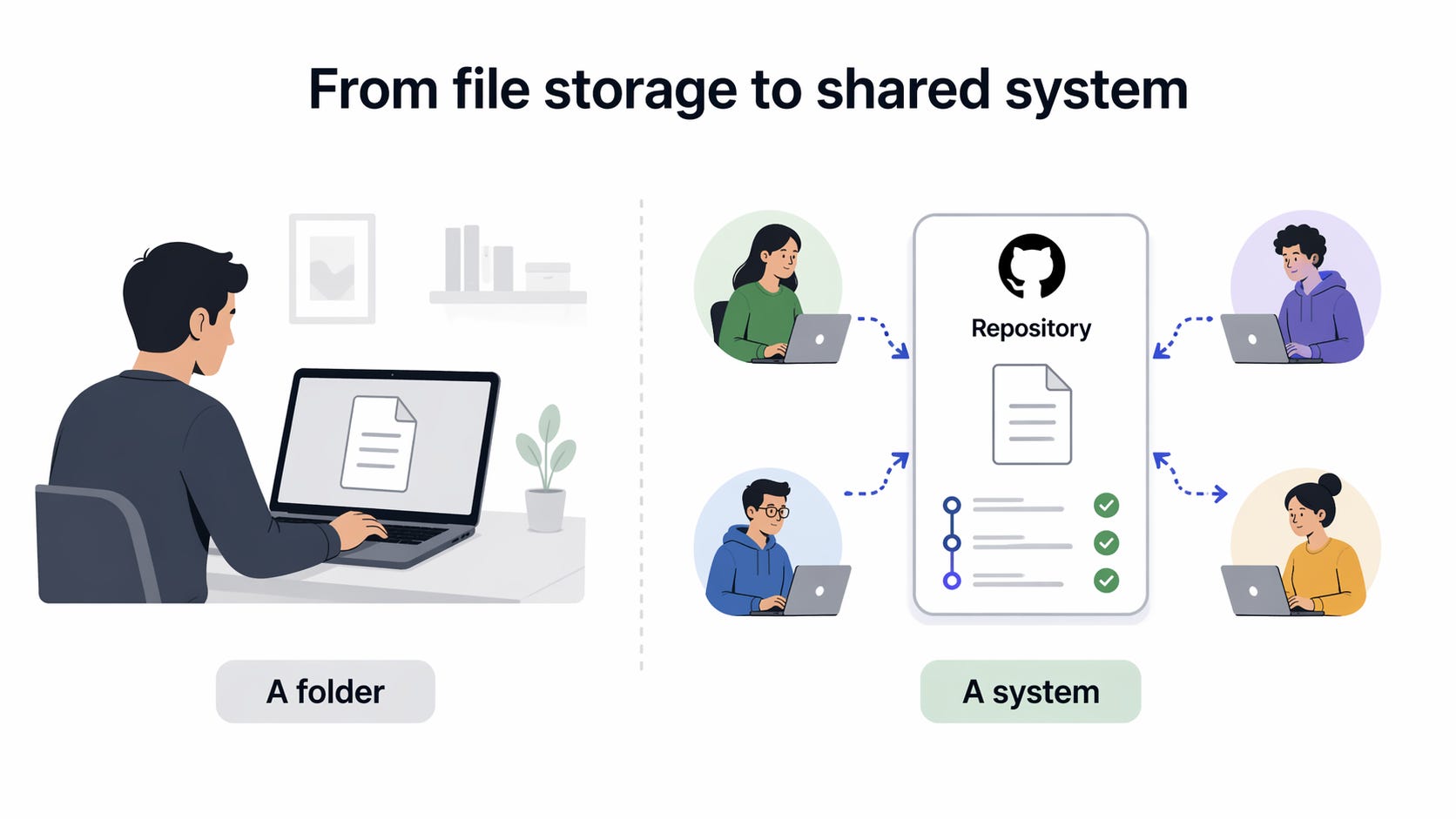
Here’s how the pieces work, in plain language:
A repository is a project folder with memory. Every file you’ve ever put in it, every version of every file, every change anyone has ever made - all of it is saved and labeled. Nothing disappears.
A branch is a draft. When you want to improve something without overwriting what’s already working, you create a branch. You make your changes there. When you’re happy with them, you bring them into the main version. It’s the difference between editing a live document and working on a copy first.
A commit is a labeled save. Every time you save your work, you attach a short note: “Updated the competitive brief template” or “Fixed the model selection logic.” That note becomes part of the permanent record. Six months later, you can see exactly who changed what and why.
A pull request is a review. When you’ve finished a change on a branch, you open a pull request to bring it into the main version. That’s where a teammate can look at what you did, ask questions, and approve it before it goes live. It’s the same review process your legal team uses for contracts - except it’s built into the tool.
In the Mighty & True engineering workflow, every piece of code, every standard, every set of instructions Claude uses - it all lives in GitHub. When something changes, it changes once and updates everywhere. New team members get access to everything from day one. Nothing lives in one person’s head or one person’s laptop.
That’s what you’re building toward.
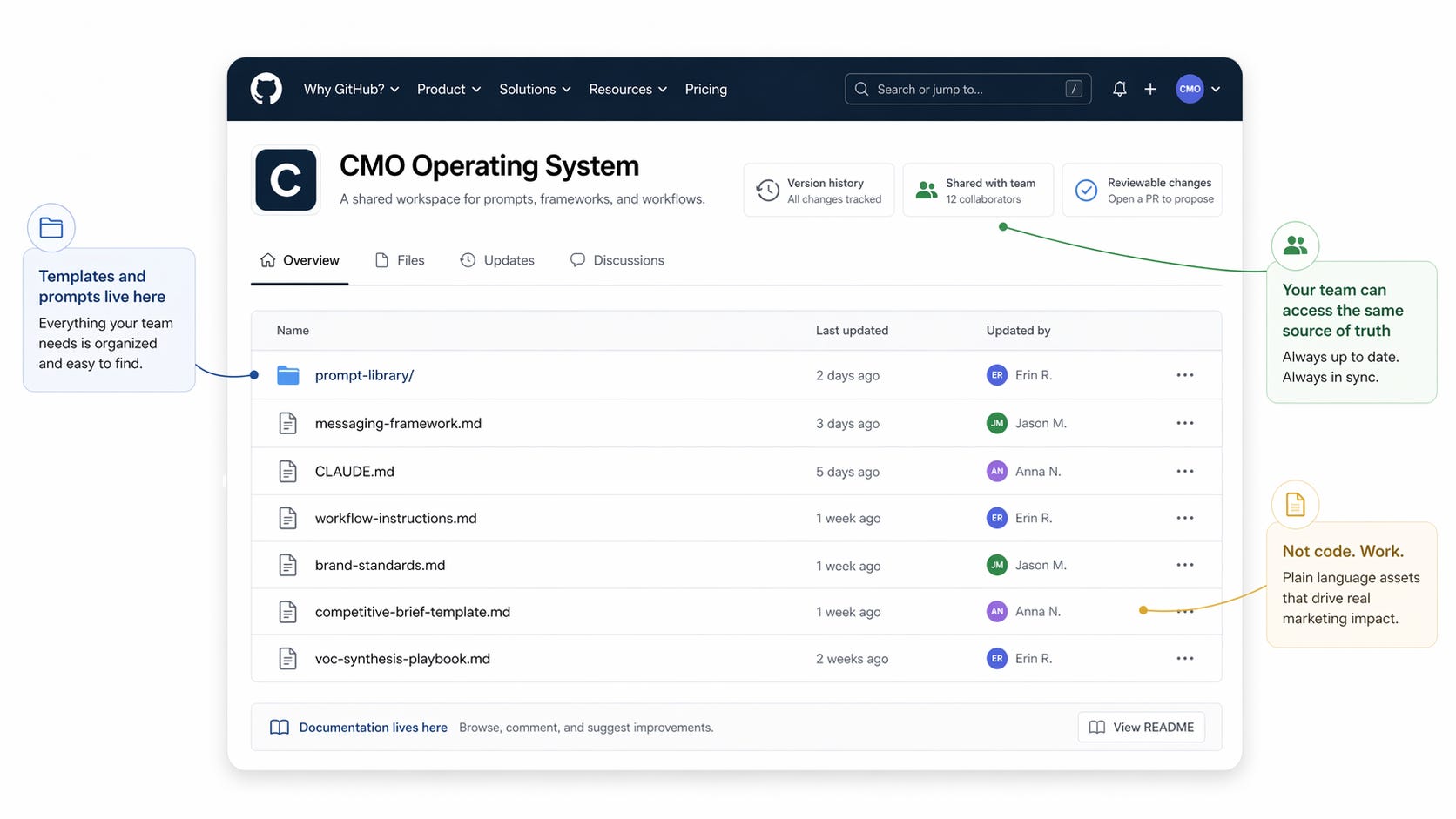
You don’t need to learn Git commands to benefit from this. Here’s how the workflow runs in Claude Code, using the /start and /ship commands introduced in Post 2:
You open Claude Code in your project folder. You type /start. Claude Code pulls the latest version of your work from GitHub, creates a branch for the session, and confirms you’re ready to go. You build whatever you’re building. When you’re done, you type /ship. Claude Code saves your work, writes a note describing what changed, pushes everything to GitHub, and opens a pull request for review.
That’s the cycle. Start, build, ship, review, merge.
The technical details run in the background. What you experience is: your work is saved, labeled, accessible, and ready for your team.
Here’s where most leaders get nervous. The moment you share your AI work with your team, you’re also sharing the risk that someone changes something they shouldn’t, or uses an output that wasn’t ready, or undermines the quality you’ve spent weeks building.
That nervousness is legitimate. And it’s exactly what a well-designed human-in-the-loop workflow addresses.
The principle is simple: Claude proposes. You decide. The system executes.
My LinkedIn Content Machine is the clearest example I have. It’s a three-workflow n8n system. The first workflow pulls meeting transcripts and calendar data, extracts one idea per day using Claude, and sends me a Slack DM with a suggested angle. That’s Claude proposing.
The second workflow runs when I reply to that Slack DM with my actual take. Claude takes my angle - my words, my voice - and writes the full post. That’s me deciding.
The third workflow sends me the draft for a final review. When I approve it, it goes to scheduling. That’s the system executing.
At no point does Claude publish anything without my sign-off. At no point am I doing the grunt work of pulling transcripts, drafting from scratch, or managing a content calendar. I’m in the loop at every decision point. I’m just not doing the parts that don’t require my judgment.
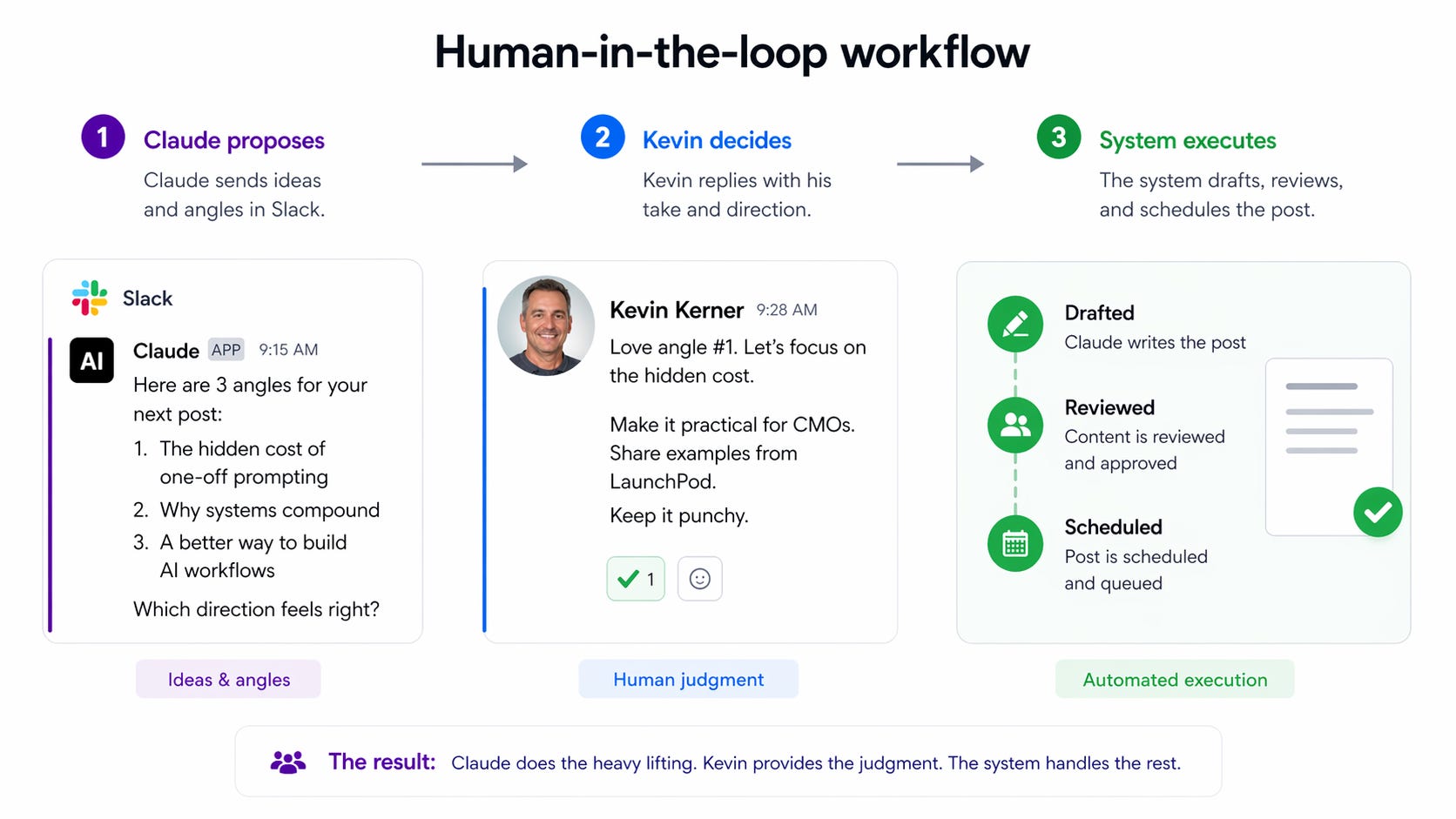
That’s the model to bring to your team. Define where human judgment is required. Protect those decision points. Automate everything around them.
For most marketing teams, the decision points look like this: strategy and positioning (always human), final approval on anything that goes external (always human), budget and vendor decisions (always human). Research aggregation, first-draft generation, formatting, scheduling, routing - all of that is automation territory.
When you set up a GitHub repository and give your team access to your Claude Code outputs, they don’t need to understand how the system works to use it. They need to understand their role in it. That’s a much simpler conversation than “here’s how AI works.” It’s: “Here’s what Claude produces. Here’s where your judgment comes in. Here’s how you approve and move it forward.”
A brief mention: one of the most useful applications of this is VoC synthesis - taking raw survey data and support tickets and having Claude Code produce a structured executive report. The output lands in GitHub, gets reviewed by a human, gets approved, and goes to leadership. The human-in-the-loop review is what makes it trustworthy. Claude does the aggregation. You do the judgment call on whether the story it tells is accurate.
This is the distinction that changes how you think about AI investment.
A conversation ends. A system persists.
Every GPT, every Claude.ai chat, every ChatGPT thread is a one-time interaction. You get an output. The window closes. The next person who needs that output starts over. There is no institutional memory. There is no improvement loop. Every session costs the same amount of effort regardless of how many times you’ve done it before.
A system built in Claude Code - connected to GitHub, running as a workflow, integrated with your team’s tools - is different. Every time you improve it, it gets better for everyone. Every standard you encode into it gets applied consistently across your whole team. Every new hire inherits the intelligence the system has accumulated. It compounds.
A great example is the new Mighty & True website system.
We didn’t just redesign a website. We built the beginnings of a marketing machine.
Someone fills out a Webflow form. That submission goes into Supabase. n8n picks it up, sends the right Slack notification, enriches the lead through Clay, runs Claude scoring against our ICP logic, stores the result, and routes the next action.
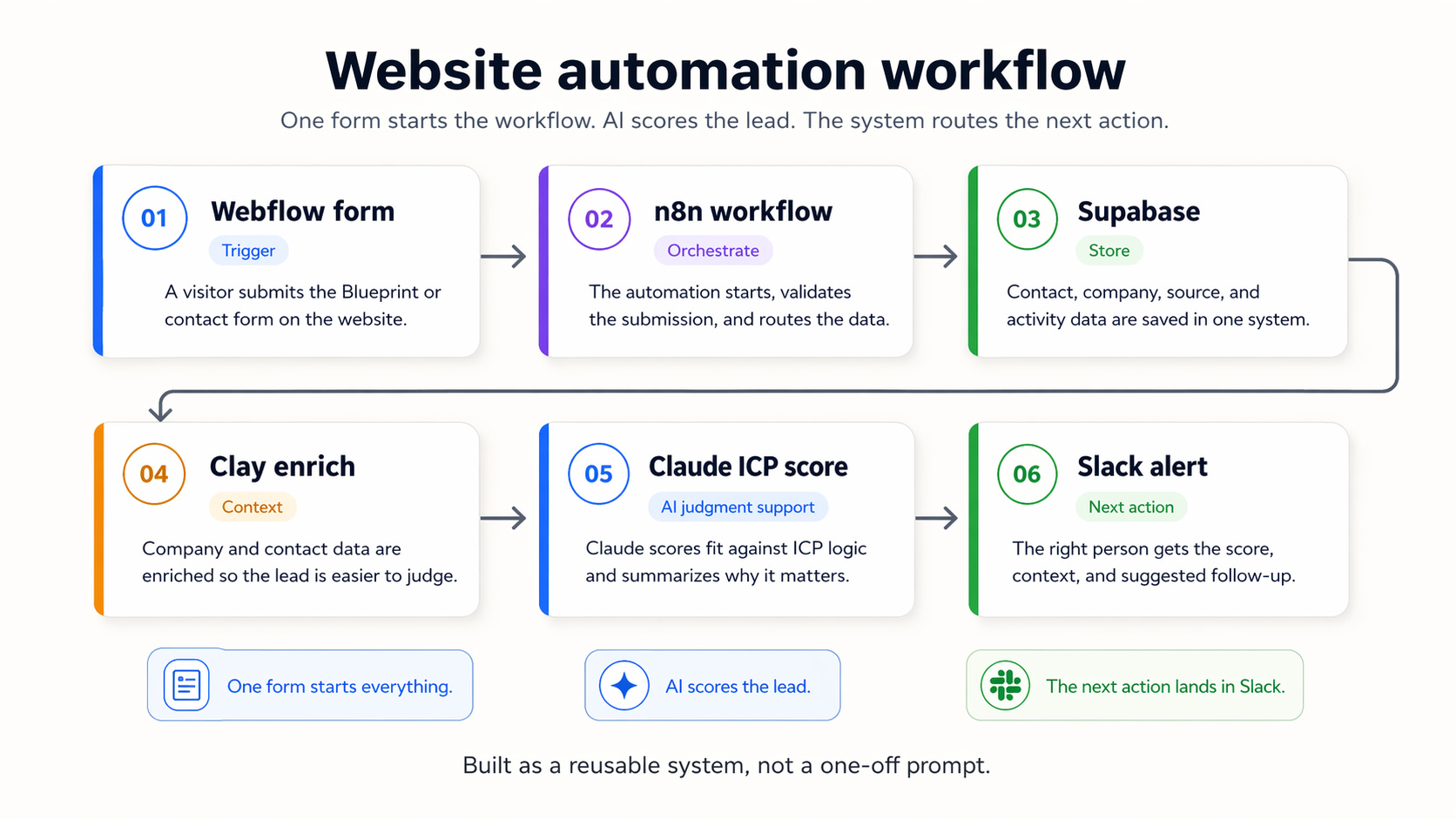
That means the website is no longer just a place where people read about us. It is connected to the operating system behind the business.
The old version of this would have been manual. Check the form. Copy the lead. Look up the company. Guess whether it is worth following up on. Send someone a Slack message. Maybe add it to a spreadsheet. Maybe remember to follow up.
The system version does all of that in the background.
It does not replace strategy. It removes the drag around strategy. A human still decides what the score means, how to follow up, and whether the opportunity is worth pursuing. But the system gets the signal, enriches the context, and puts the next decision in front of the right person.
That is the point.
The CMOs who build durable leverage from AI are not the ones collecting better prompts. They are the ones connecting the work. Website forms, enrichment, scoring, notifications, follow-up, reporting. All the boring middle steps that usually leak time and momentum.
That is not a prompting win. That is an architecture win.
The question changes from “what should I ask AI to write?” to “what system should exist so the work moves without me pushing it every step of the way?”
When your AI work lives in GitHub and your team has clear roles in the workflow, a few things change.
You stop being the only person who can use what you’ve built. Your frameworks, your prompt libraries, your workflow instructions - they’re accessible to anyone you give repository access to. A new strategist joins and inherits your entire system on day one. A contractor needs to produce a competitive brief and your template is right there, along with instructions for how Claude should use it.
Your standards get encoded, not just communicated. Right now, your quality bar exists in your head and in feedback you give on drafts. When you encode it into a CLAUDE.md file - which is exactly what the next post covers - it applies automatically, every time, for everyone on your team.
And when something needs to change, it changes once. Not in ten different documents and four different email threads. One place. One update. Everyone benefits.
That’s the organizational leverage that most CMOs are still leaving on the table.
Six posts ago, I made a claim: CMOs who build will win.
The posts since then have been about building the foundation for that - understanding the tool, learning to give it clear instructions, managing context and cost, choosing the right model for the task, and connecting Claude to the rest of your stack.
This post was about the final shift: from solo builder to team infrastructure. From files on a laptop to a system your organization can use.
The last post in this series - Post 8 - is about CLAUDE.md. The file that makes everything you’ve built this consistent, scalable, and teachable to everyone on your team. It’s the closest thing to a permanent AI operating system for your marketing function.
If you’ve followed this series from the beginning, you’re ready for it.
This is what we do at Mighty & True.
We’re a B2B tech marketing agency that builds AI-powered systems for growth-stage CMOs. Web systems, GTM play, media programs, you’ve read about in this series… those are our systems. We build the same thing for our clients. If you want to know what that looks like for your team, start with a Blueprint Session. Thirty minutes. No pitch deck.
No posts
Comments
Nothing yet. Say the first thing.
Sign in to join the conversation.