
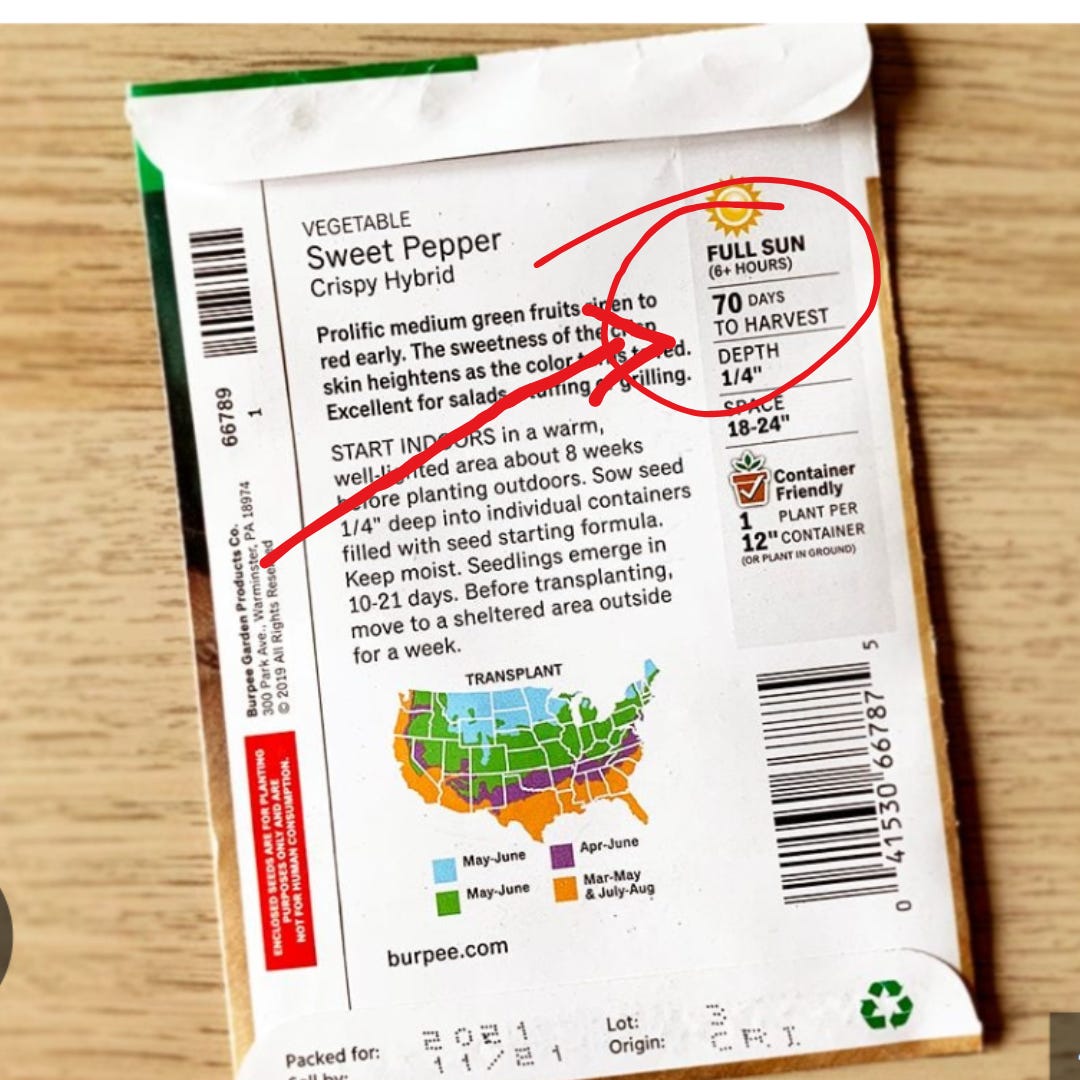
Even though Good Courage Farm is primarily a perennial fruit farm, my wife Jen lives to plant vegetables each year. She has stacks of seed packets on her bedside table in every season. On the back of any of those seed packets, one finds lots of helpful numbers about how deep to plant the seeds, and how far apart. Another number indicates how many days it is from planting to maturity: 52 days. 67. 85.
Plant your sweet corn in mid-May, and you’ll be roasting ears by early August, if you’ve kept the weeds and raccoons at bay. Everything’s on a schedule in the vegetable field. The rows fill in with their succession of crops with (more or less) clocklike precision.
I’m not big into planting seeds, which is why I was game to take on fruit farming in the second half of my life. I love that we don’t have to plant anything, really. Our orchards are mostly between 6 and 12 years old, and we only planted a few of those trees. They persist, year after year; I just show up in the same place and find them blooming and fruiting. Jen plants her vegetable seeds for extra joy and more nourishment.
From both the house garden and the established fruit plantings, I draw regular lessons about the nature of time. In particular, about the Greek notions of chronos and kairos, which have become Christian theological concepts.
Chronos is countable time, like the number on the seed packet.
Kairos is time as the seed itself knows it, time like berries ripening —
how and when they will.
Of course, the seed packet wants us to believe that its numbers will always be correct, but reality is different. Meteorological summer started June 1, but the unfolding of the season happens as it will. June gets hot, early, sometimes and the lettuce bolts. If rain comes for days and days and days, the tomatoes sometimes stay green in spite of their label.
That said, the “days until harvest” on a packet of pepper seeds is a pretty good place to start. Chronologically speaking.
Now, fruit is different.
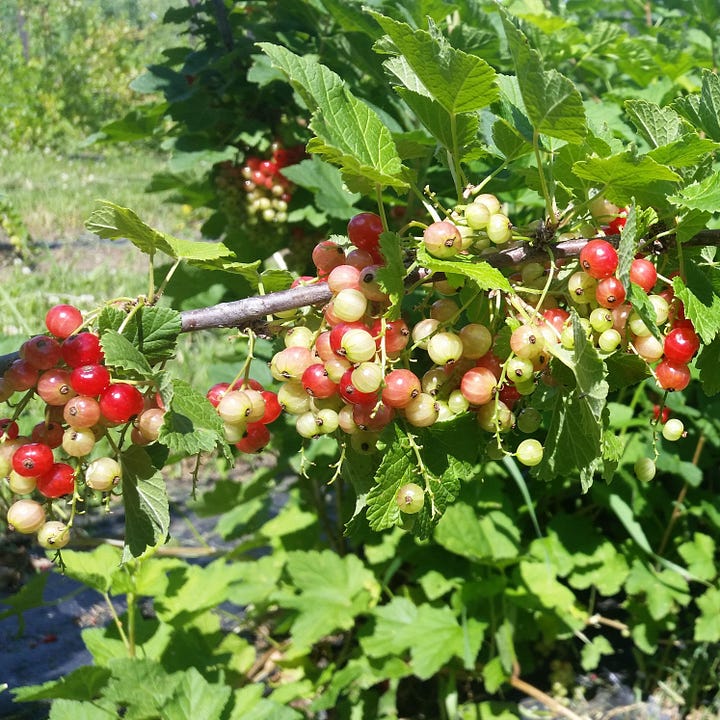
Currants—our next summer crop at Good Courage Farm—ripen when they’re good and ready. They carry no seed packet promise, no countdown clock. Berry harvest has been off by as much as two weeks across the six years we’ve been tending these fields of currants. One June may be flush and early; another may come slow and stormy. One week the bush is a tangle of green berries. The next, the sun has shifted something inside them, and you taste that the time is now. Kairos time.
Chronos is the time we measure.
Kairos is the time God meets us in.
Chronos is our weather app saying that rain is expected at 10:15. Chronos is the fifty-five minutes you need to bake your rhubarb pie. The feed truck that will come on June 30. The unchanging rhythm of weeks across which we see the moon filling and emptying herself of borrowedlight. The cadence of six days of work and one day of rest.
Kairos is the ripeness of a moment. The fullness of time, when God steps in. It defies numbering. Kairos is when your body tells you to stop even though there’s still work to do. When the barn swallows return and stitch the sky with their holy embroidery. When a child speaks a first word — so clear! — and you know that this changes every moment to come. Kairos is knowing time not by the date on the calendar, but by the depth of color in the cherries, or by the appearance of the blue darning needles in the tall pasture grass. “Oh, it’s that time…” Kairos is the kind of time that can’t be planned or forced, only received.
One is not more real than the other. Kairos isn’t ‘better’ time than chronos. They’re different experiences of the same reality. Kairos doesn’t always flow sweetly, like honey. I don’t think we could handle a lifetime of kairos. That’s God’s milieu.
Chronos and kairos contain one another. They only have meaning to our human hearts when we can dip in and out of each, feeling the difference —one a stream, the other an unfathomable pool.

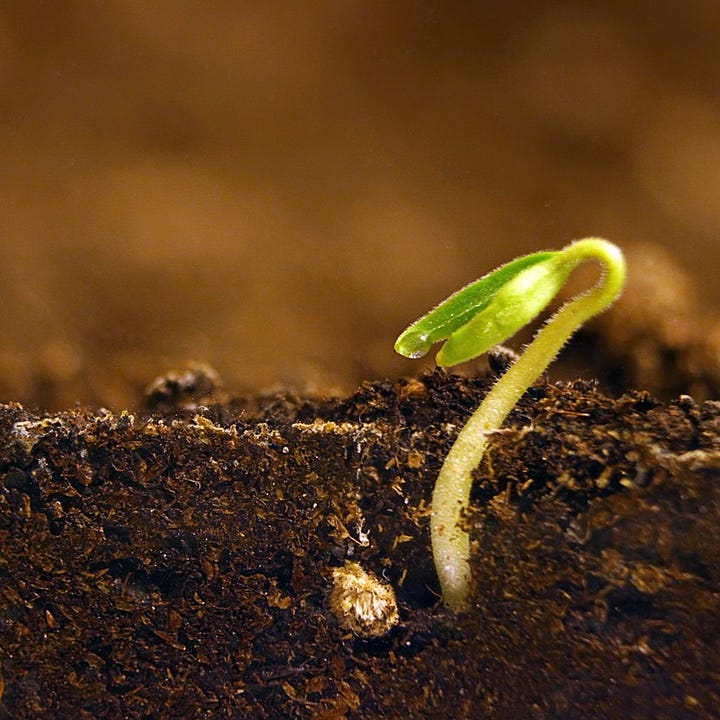

Chronos contains kairos. On a toddler’s birthday, the bright number 2 festooned from backyard trees and bouncing on every balloon – 2! 2! 2! – means something because it contains sleepless nights of tender care that we never tally. The smallness of “two” contains the hope of every day of that child’s life yet to come, kairos days beyond our sight.
Kairos contains chronos. At the bedside of our beloved, at the threshold of the next world, the space between breaths stretches to hold every one of the perhaps thirty-three thousand days that have been given as gifts. We want to remember, to count and name every day in those vigiling hours, yet the numbers we would need to count the days don’t come to visit us then. Still, every one of the days is there in the room, still there even after the breath stops.
Kairos and chronos are two ways to know one reality. That said, the lives of most Americans these days are spent indoors - 21 of every 24 hours away from the sun and soil, out of earshot of the beating hearts of other creatures or pounding rainstorms. Our lives are short on kairos.
It is so much easier for me to move in and out of chronos and kairos, to occasionally find myself at their astonishing confluence, when I’m standing in a berry field. At any hour of the day or night, time flows out of Creation, through my hands and feet, into my awareness. The less I’m outdoors, in contact with other creatures (meaning the more I am indoors, in a human-made environment), the more stuck I remain in one experience of time. Usually chronos.
Time feels different in these six years I’ve lived and worked on a farm.
I am learning to keep time from the plants and animals here. What surprises me is that other creatures know both chronos and kairos time. The hen who chooses a moment and will not be moved from the nest knows somehow that in exactly 21 days, eggs will suddenly be replaced by chicks. Knows that she can make it until then without food, without moving. Our ponies know when it’s 5:00 a.m., even as the solstice passes and my own morning chore alarm slips ahead of the sun by a couple minutes each day. They wait at the gate as if they had pocket watches. The sparkling metronome of fireflies is reliably precise, the different species pulsing in a slightly different rhythm from one another so that they can be found and known.
They can’t count time, non-human creatures, and yet they can.
Every creature is gifted with the capacity to slip into kairos time —
that includes you.
Outside the house is where I come to meet God outside of time. What if kairos is the best name we can give to God’s temple? God’s holy court, which we find is built not out of stones but out of time, consecrated not by human hands but in and through the goodness of Creation.
Psalm 84 sings it: “Better is one day in your courts than a thousand elsewhere.” The psalmist may have meant the courts of the Temple in Jerusalem, but I read the word ‘courts’ to mean that unbounded space in time so near to God that everywhere we’ve already been seems like elsewhere. I read ‘courts’ and I think of the slow-ripening currant field outside my window. There, I find that one day of God’s nearness outweighs a thousand of my busy-ness. One kairos moment outshines a year’s worth of well-planned agendas.
And yet, we can’t dwell there always, in that timeless temple of God’s nearness. Chronos has become our habitat, where we live with calendars, reminders, news feeds, end dates.
Peter, writing to the early church, had something to say about this tension. "With God," he wrote, "one day is like a thousand years, and a thousand years like one day" (2 Peter 3:8). He was trying to comfort a small group of people, living under Empire, who felt abandoned by God’s delay in coming to set the world right. I feel you, ancestors. For those of us braced against these four years, faced with 1,304 more days of struggle and rage, chronos is a timeline we’d rather not inhabit, days of past and future tragedy stitched together by lies. We pray and act every week, hoping that we can bend the moral arc of the universe bend a little more tightly. We need change, ASAP, and we wonder what in the world God is waiting for.
Why do the seeds of justice not come with a “days to harvest” label?
Yet the God of the ripening berry is never late. Also, God is never early.
God is on time—just not always on our time.
Our time is made of hours and days that we still give to the work of nurturing, tending, preparing, even though we may not see the harvest.
On the farm, we live in the both/and of chronos and kairos.
The daily and the divine.
The carrots and the currants.
You live there, too, neighbor in time.
We watch the weather, plan our pruning, get the irrigation system going in spring. Chronos matters—we need to show up, prepare, weed, wait. But we also need to watch for the shimmering edge of kairos, when the fruit is ready before we expected. Or when we’re stopped by a hawk circling, or a stranger bursts into tears at the taste of black currants, or we get news of a friend’s death while surrounded by elderflower that smells like heaven.
Those are the moments when time thins. When something eternal slips through.
Attending to these moments grounds us in this good world. Connects us to other beings. Even if we think we experience the moment alone, it connects us to the whole.
Perennial crops teach patience. They ripen on their own schedule. They carry memory in their roots. A bush remembers drought. A tree remembers pruning. And somehow—somehow—they still bear. Sometimes wildly. Sometimes stingily. But always according to a wisdom not our own.
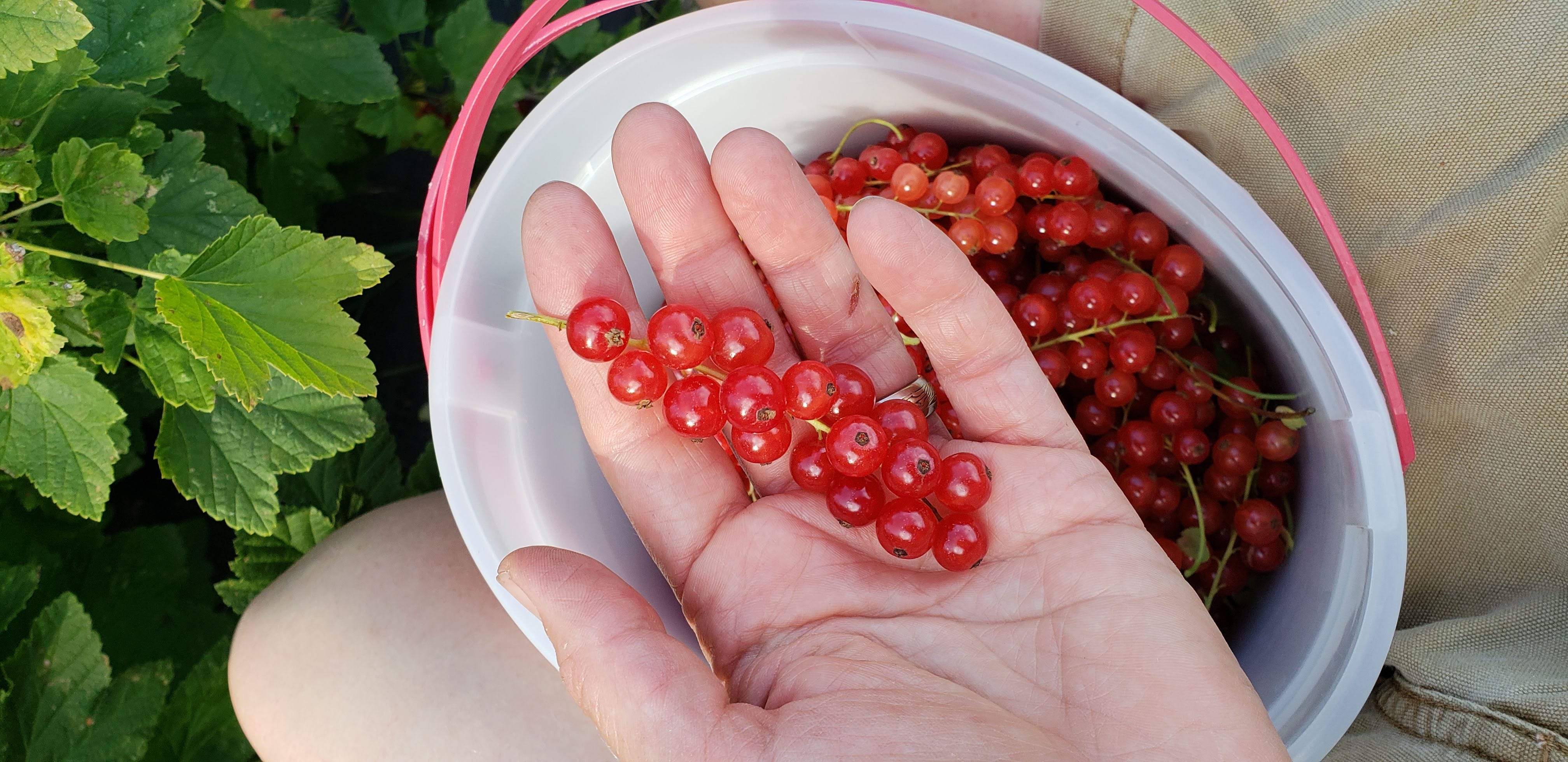
There’s no forcing a currant to ripen. But when the time is right, you’d better have your bucket ready.
Maybe that’s the invitation. To live with a little more kairos in our chronos. To let Creation teach us what kind of time we’re in. To remember that you are the seed, not the number on the paper envelope – let the measure of days between you and maturity be an invitation, not a stick.
Some seasons ask us to mark the days and keep the schedule. Others ask us to wait and watch and trust the slow ripening of God’s goodness. You may not know what kind of day it is until you taste it.
So bless the days that feel long and fruitless—God is not slow.
God is ripening something.
Bless the days that fly by with gladness—God is near.
And bless the days that break your schedule with beauty or grief or joy.
Those might be the days God is most at work.
You just might be standing in the courts of God, one moment at a time
.
No posts
Comments
Nothing yet. Say the first thing.
Sign in to join the conversation.