
This question is July’s mantra: Um…is this ripe?
We hear it asked in dozens of different voices, even different languages in our currant rows. We ask it in our own voices, Jen and I, standing under one of the 14 varieties of plum tree that live and grow here at Good Courage Farm. How can we know if this is ripe, without picking it too soon and ending any possibility of ripeness? How can we be sure not to miss what is ripe and ready?
I wish I could offer the ministry’s volunteers more than a couple rules of thumb, but it may be the case that berry picking is an art best learned in childhood, when every way of knowing is still open too us, every kind of learning equally valid. I can say, “The darkest purple berries should give a little under a gentle squeeze between your finger an thumb. Pick those.” Yet it’s not a hard-and-fast rule. Meeting and knowing the ripeness of fruit is a far more subtle and wholly sensory thing. There’s simply the unavoidable need for at least a dozen hours with a thousand individual fruit—and a farmer’s practiced attention. One day the berry is nearly there. The next, it's fragrant and heavy and about to drop. With currants, they lose their slight gloss, deepening to a matte violet-black. They soften slightly to the touch. It comes off the stem with the lightest tug. You can almost hear its readiness, if you’re quiet enough.
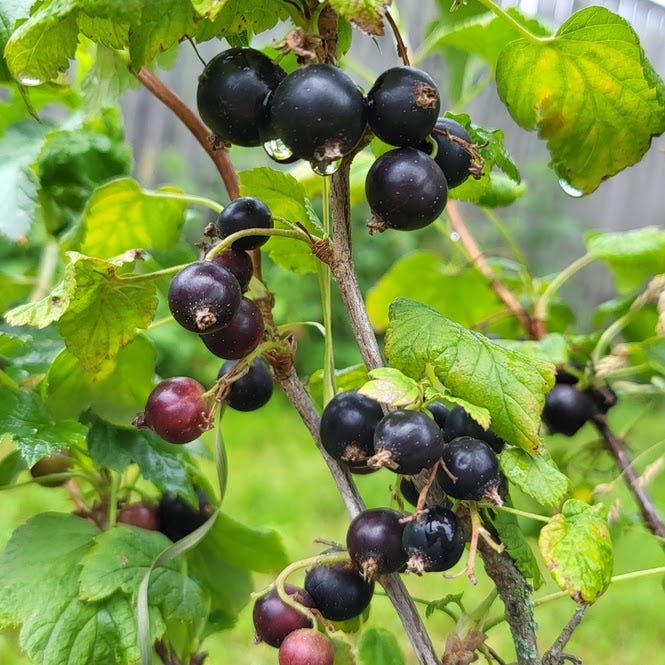
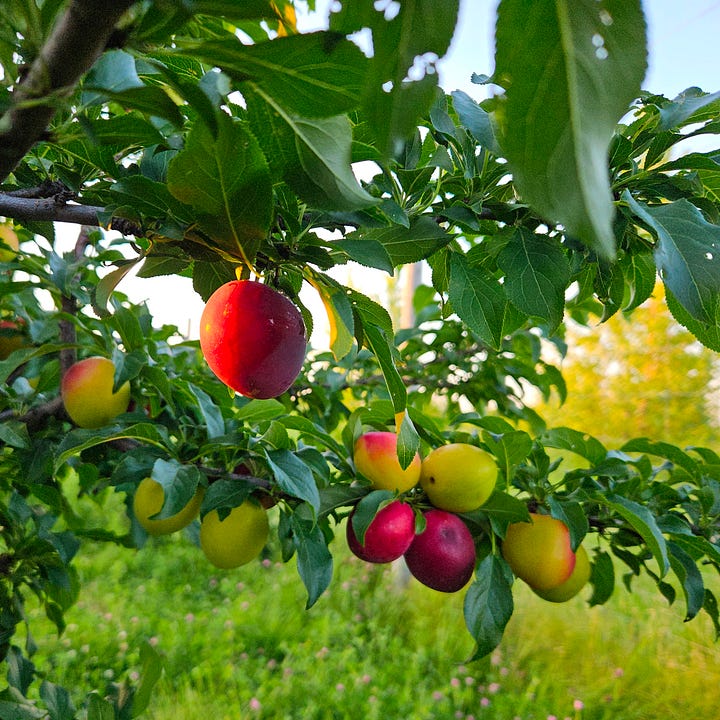
The same is true with plums. A green plum swells and flushes; then one day, its skin takes on a matte blue bloom, and it feels heavier in the hand. There’s a scent, too, that wasn’t there the day before—a fullness you can’t measure, only notice.
Side note: Okay, apparently it can be measured in some ways. Would it surprise you to know that in industrial agriculture, ripeness in berries – blueberries, for example – is identified and graded by machines? It is. Like writing poetry, this not work that I need to know can be done by a robot in this world. I don’t want the sweetest parts of living to be handled by soulless, disembodied intelligence. But it is: ripeness has become a data point on a robotic conveyor belt. The blueberries that you buy (and that I buy, too, because it would take a miracle to grow a blueberry in our ultra-alkaline soil, here) have all met the gaze of a massive optical sorter on their way to your breakfast bowl. Coupled with cameras that detect multiple wavelengths of light, there are algorithms and deep learning models out there in fruit-packing plants, doing the work of our human eyes and fingertips. Machines are busy even now, somewhere, analysing the size, color, shape, and weight of grocery-store berries and plums, selecting and rejecting accordingly.
But what joy — and what wisdom — can be had only in seeking and choosing sweetness out under the hot sun?
What is the difference between analysing acceptability and discerning ripeness?
Ripeness is a matter of attention—of deep sensory discernment. We don’t train our eyes to catch the difference between red and red-enough. That knowing comes through attention, day after day, berry season after berry season. Our fingers learn what “ready” feels like. The work is slow, patient, reverent. Wendell Berry (the cosmos gave him that name, yeah?) called this embodied learning, this attention — so utterly different from artificial intelligence —“material intelligence”.
It’s also a kind of spiritual knowing. In the berry field, material intelligence is intertwined with the life of the spirit. Some decisions can't be rushed. Some seasons require us to wait, to observe, to hold still until the fruit is fully formed. A soul’s knowing, like a berry, ripens in its own time.
What are you discerning these days?
Know that discernment is not analyzing or sorting, nor is it guessing or strategizing. It’s not forcing a choice. It’s standing in the orchard of your own life and learning to see what is quietly becoming ready. The writer of the book of James says, “The farmer waits for the precious crop from the earth, being patient with it until it receives the early and the late rains. You also must be patient. Strengthen your hearts, for the coming of the Lord is near” (James 5:7–8).
I love that: strengthen your hearts. That’s the discipline it takes to wait well. To watch with care. To trust what is unfolding. To discern ripeness.
So when I kneel in the currant rows, eyes scanning first for the darkest fruit, almost disappearing into the leafy shadows, I think of all the noticing, the wondering, the deciding that is ripening in me, too. I’ll be praying for the strength of heart it takes to choose this way of knowing.
Not yet, not yet... yes, now.
The harvest comes not with haste, but with holy attention.
No posts
Comments
Nothing yet. Say the first thing.
Sign in to join the conversation.