
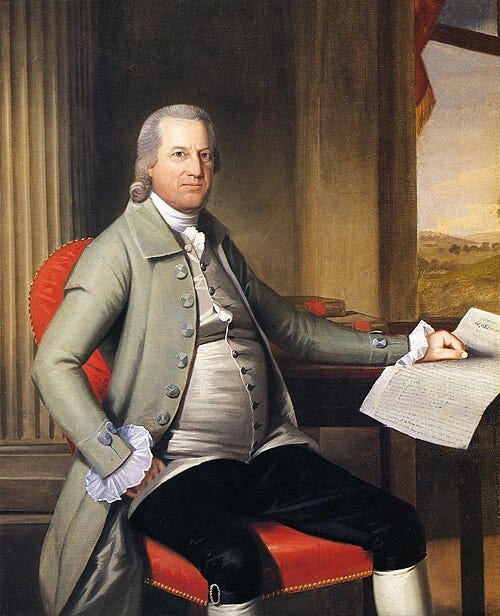
Portrait of Connecticut Founding Father Oliver Wolcott by the American painter Ralph Earl, oil on canvas. Courtesy of the Museum of Connecticut History.
This week’s Founding Father is the prestigious Connecticut politician, Oliver Wolcott, Sr. Wolcott was born on November 20, 1726 in Windsor, Connecticut, the fourteenth of fifteen children, in the family that governed the colony. His father was colonial Governor Roger Wolcott; his mother was Sarah Drake Wolcott. He attended Yale and graduated with top honors in 1747, having lead his class for four years. Upon graduating, he was granted a captain’s commission in the militia by Governor George Clinton of New York, and raised a regiment to fight the French in King George’s War, for the ill-fated Louisburg expedition to Canada. The war ended the following year. He dabbled in the study of medicine with his uncle, Dr. Alexander Wolcott, though eventually went on to try the merchant’s trade. He was made the first sheriff of Litchfield, Connecticut in 1751, a position in which he served for twenty years. During this time, he married Laura Collins and they would have five children, one of whom would tragically die in infancy.
Wolcott has been described as tall, erect, dark-complexioned, dignified, a man of integrity and deep Puritan faith. He was said to be “a man who spoke his own mind,”and was described by Thomas Rodney as “a man of integrity, is very candid in debate and open to conviction and does not want abilities, but does not appear to be possessed of much political knowledge.” Despite his duties as a sheriff, Wolcott stayed away from politics and his life was relatively peaceful as far was we know, though he was supportive of the cause of independence.
It wasn’t until 1774 that Wolcott’s political career began, when he was appointed to be an assistant to the state council of Connecticut. In 1776, he was elected to represent Connecticut in Continental Congress, where he voted for independence without hesitation. He became ill and left Philadelphia without signing; William Williams served as his substitute. On his way back to Litchfield that July, as he traveled from Philadelphia through New York, he transported the head of the lead equestrian statue of King George III to Litchfield, where it was melted into bullets at Wolcott’s home by his wife and daughter!
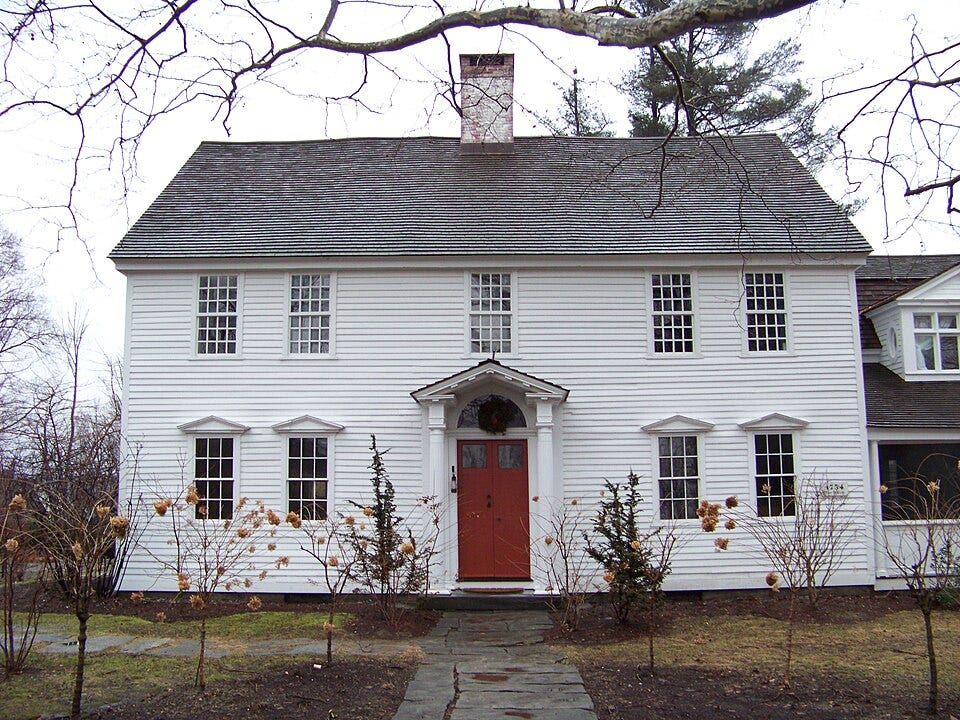
Oliver Wolcott House, South Street, Litchfield, Connecticut. Photo credit: Don Cram, CC BY-SA 3.0. Built in 1753 by Oliver Wolcott, Sr. George Washington stayed here in 1780 during his first visit to Litchfield. Not open to the public.
When he returned to the Continental Congress on October 1, 1776, he was allowed to sign the Declaration. Throughout the Revolutionary War, like some other signers, he would serve back and forth in Congress and on the battlefield.
Wolcott commanded fourteen regiments of militia in the defense of New York. He was eventually promoted to brigadier general and was involved in many engagements. He was sent to New York to reinforce General Putnam on the Hudson River. He joined with Horatio Gates’ army in time to fight at the Battle of Saratoga, a significant victory for the Patriot cause. As a major general in 1779, he defended the Connecticut sea coast against New York Royal Governor William Tryon’s raids on Fairfield and Norwalk. In May 1780, he served on the Council of Safety, the executive committee for prosecution of the war. From here on out, Wolcott had to balance his military duties along with his seat in Congress and making peace with Native American tribes, all of which he conducted successfully.
After the war, he resigned from Congress. He served as commissioner during the Treaty of Fort Stanwix in 1784 to make peace with the Six Nations, then resigned that post in 1785. In 1787, Wolcott was elected as lieutenant governor of Connecticut, a position he would hold for the last ten years of his life. In 1789, he helped conclude a land treaty with the Wyandotte Indians. He would also serve as a chief justice for the court of common pleas in his home county of Litchfield. He would die peacefully on December 1, 1797 at seventy-one years old.
Thanks for reading Kent's Substack! This post is public so feel free to share it.
No posts
Comments
Nothing yet. Say the first thing.
Sign in to join the conversation.