
Please consider supporting The Front Page with a paid subscription: HERE
“The Wall” - that’s what it was called then - had been dedicated just eight months earlier when I visited in June 1983.
Vietnam was still an open wound.
Almost everyone knew someone who didn’t come back.
For those of us who were teenagers at the time, the possibility of going to Vietnam was our worst nightmare. I remember being unable to sleep some nights as a 15-year-old. I was scared.
That first trip to “The Wall” was breathtakingly emotional.
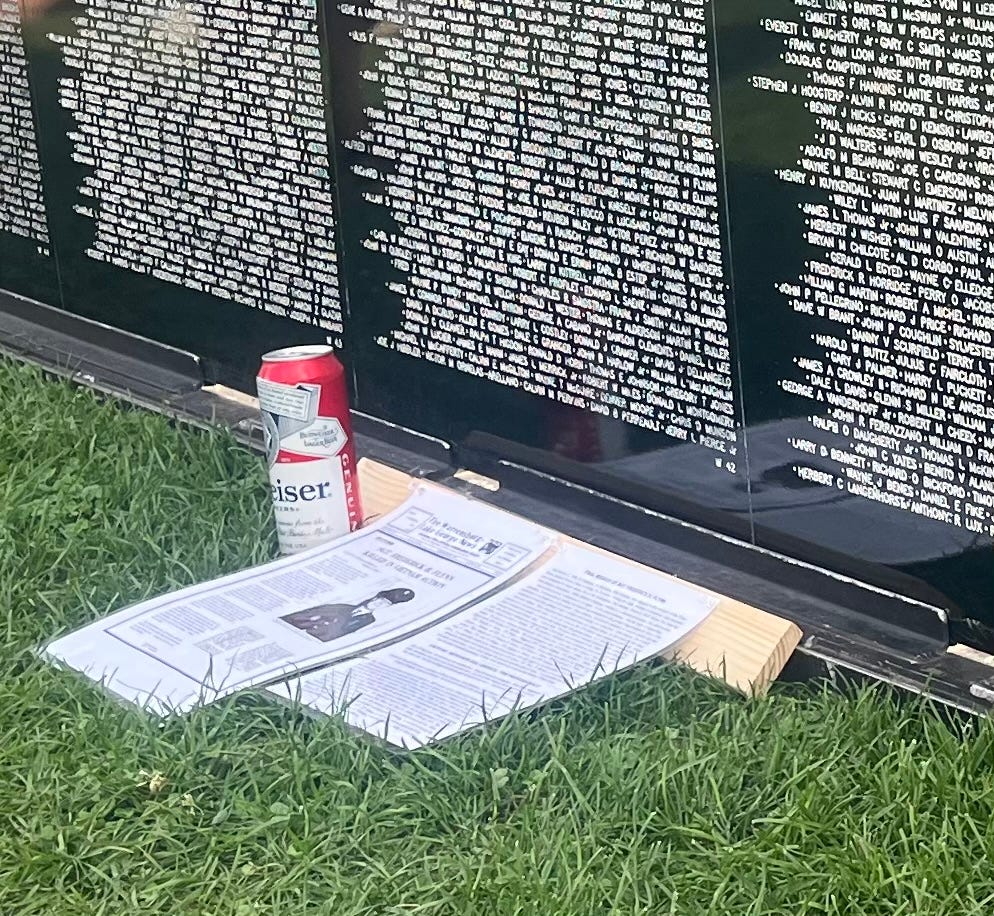
Along the base of the wall, and in the crevices between the 144 panels were flowers, mementoes and letters.
Long letters to those lost.
Heartbreaking letters.
It was not unusual to see people in tears, leaning against the wall or scratching out the name from “The Wall” with a pencil and piece of paper.
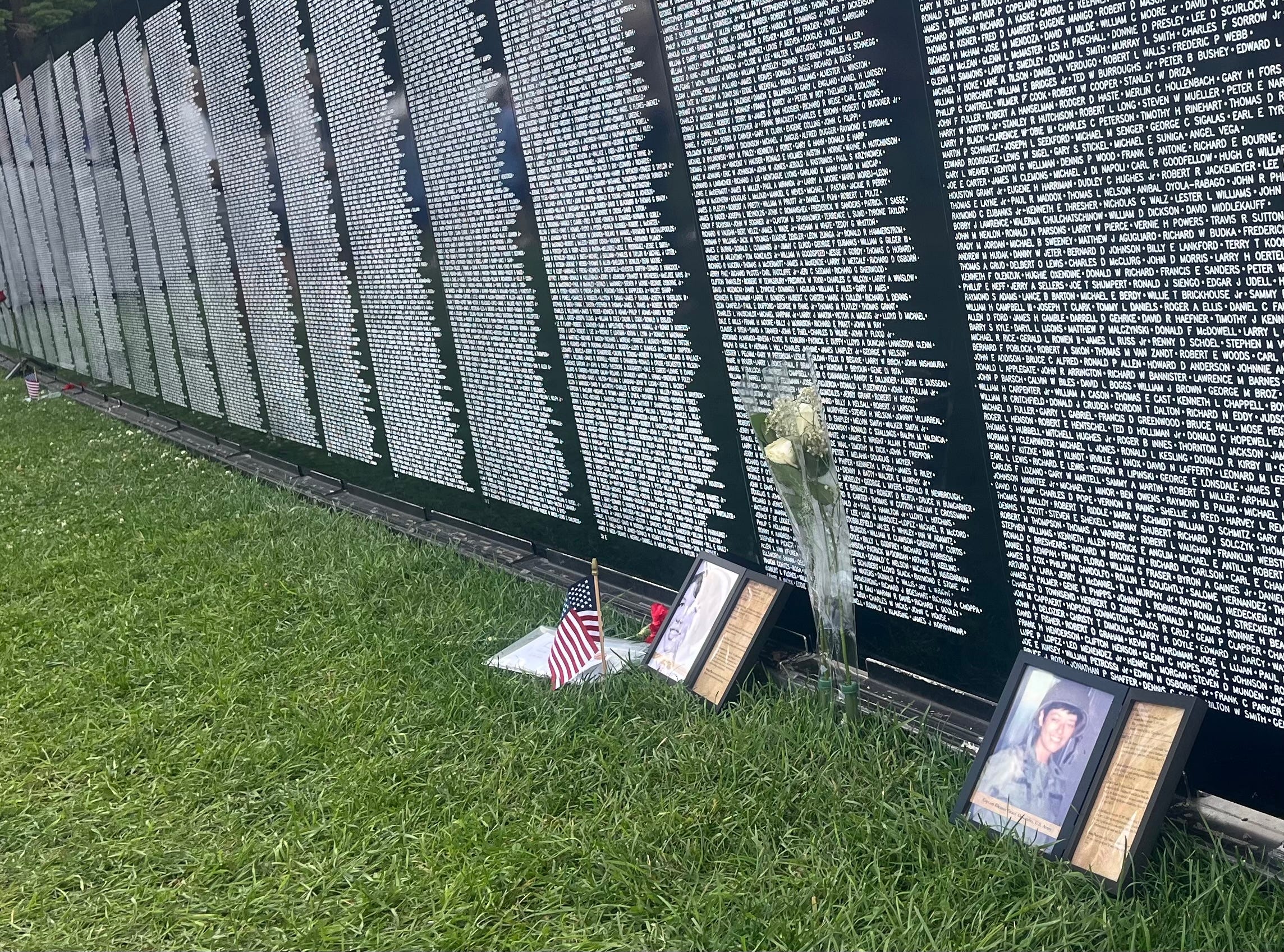
They still do it today.
It seemed to take forever - like the war itself - to cover the 246 feet from one end of two sets of walls to the other.
You had to stop to read the letters.
And once you started reading, you couldn’t stop.
They were from mothers, fathers, sisters, brothers, wives and, maybe worst of all, from soldiers who did come back and couldn’t understand why.
If you weren’t weeping by the time you left, there was something wrong with you.
The names are inscribed in the chronological order in which soldiers were taken. So the wall starts out small and grows and grows and grows until it towers to eight feet over you.
Eventually, it does recede.
That remains so powerful.
Over the years, I have visited many times. I looked up the names and found there were three Tingleys on the wall - one from Connecticut where I grew up - but was not sure how we might be related.
Each night, the National Park Service rangers pick up the items left at the wall and take them to the NPS Museum Resource Center to catalog and store, except for perishable matter such as flowers.
From 1992 to 2003, the items left at “The Wall” were part of an exhibit at the Smithsonian’s National Museum of American History called “Personal History: The Healing of a Nation.”
I remember seeing the exhibit. It was just as emotional as seeing “The Wall” the first time.
Included in the exhibit was the Medal of Honor awarded to Charles Liteky. He renounced the medal and left it at “The Wall” in an envelope addressed to then President Ronald Reagan.
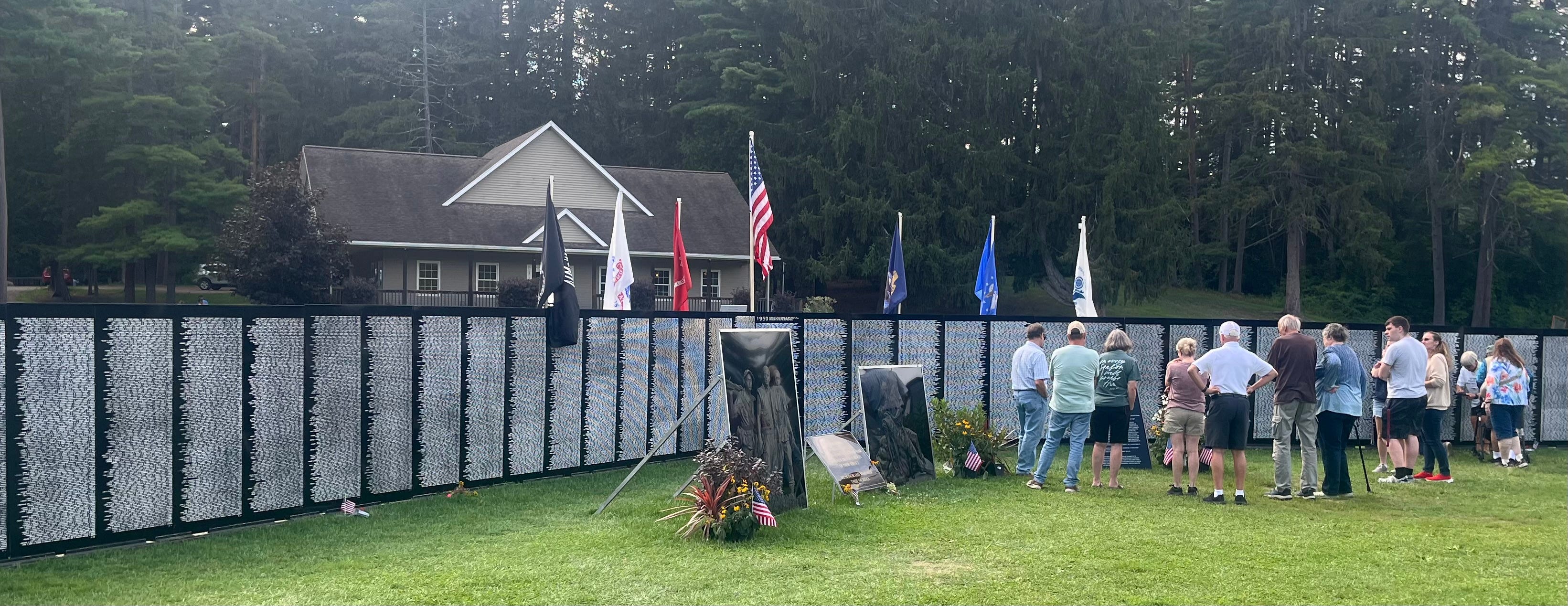
So when I heard the traveling wall had been erected in Crandall Park this week, I visited to pay my respects - again.
The traveling wall is an 80 percent recreation of the one in Washington, D.C.
Warren County reported in its weekly newsletter there were hundreds on hand for the ceremony opening “The Wall” earlier in the week.
But I still didn’t expect many people to be there Sunday.

There were dozens.
They were quiet, respectful and some were still leaving flowers and letters. There were young people, too, and parents explaining - if they could - about Vietnam.
The traveling wall still had power.
It’s hard to believe that when the design was originally unveiled, it was called “a black gash of shame and sorrow” by some.
The Department of Interior would not issue the building permit because of the controversy.
But it was eventually built in just a few months in 1982.
And over the years, because of its power, because of the reaction of the people, it has become a shrine.
Also included at Crandall Park was a memorial to those who died in the 9/11 terrorist attacks and the many U.S. military actions that followed.
“The Wall” was once again a reminder of the cost of war. The memorial to the conflicts that followed showed “The Wall” was not a deterrent.
What happened to Stars and Stripes over this past week was simply un-American and a reminder of what this current administration stands for.
The Associated Press reported Thursday that the longtime publisher of Stars and Stripes, a publication geared toward the men and women serving in the military, had decided to retire.
The retirement was announced in a memo to staff on Tuesday. In the memo seen by the AP, Max D. Lederer wrote it had “become clear that my philosophy of leadership, and my understanding of the value and mission of Stars and Stripes, differ in fundamental ways from the direction the leadership of the Department of Defense has for the organization.”
The AP also mentioned that Stars and Stripes has recently been at the forefront of some of the reporting on conditions for sailors on the USS Abraham Lincoln and concerns for their mental health during the aircraft carrier’s long deployment.
The Pentagon fired the editor and a top reporter at the newspaper on Friday for insubordination after they spoke publicly against any interference by the Defense Department in the military news outlet.
The publisher, who retired a day earlier, was also fired.
The AP reported:
Erik Slavin, editor-in-chief of the military newspaper that is partly funded by the Pentagon, told The Associated Press he was dismissed for insubordination after an interview he gave that objected to potential censorship by the U.S. military. He received a notice of separation, as did publisher Max Lederer — who had just announced his upcoming retirement — and Middle East reporter Lara Korte, Slavin said.
Stars and Stripes has a long history of standing up for the men and women in the military and being independent of the Pentagon. That ended this week and is a direct assault on freedom of the press.
Slavin told the AP he was being fired “for stating in a CBS interview that hypothetical censorship of news for service members would constitute a red line.”
“I stand by the principle that Stars and Stripes must remain editorially independent, as required by law and by the department’s own policies,” Slavin said.
“No one should be surprised that they’re kicking out the one person charged by Congress with protecting Stars and Stripes’ editorial independence,” former ombudsman Jacqueline Smith wrote. She had previously been fired by the Pentagon.
It may seem like you just elected your town supervisor, but because the state is switching to all races being in even-numbered years, all supervisors are up for election again this year.
That means that 16 of the 17 town supervisors in Washington County are up for re-election, and most are running unopposed.
That is the problem with local government.
With no competition, there is no incentive to do the job well.
That was pointed out recently by Democratic Assembly candidate John Gunther of Shushan who is taking on Republican incumbent Matt Simpson.
The Post-Star reported that Gunther called out the Washington County Board of Supervisors after a recent study found that more than 10,000 of its 24,000 household are struggling to afford the basics.
Gunther said there was no discussion of the study results after it was presented to the Board of Supervisors.
“There were no questions, there were no comments,” Gunther was quoted in The Post-Star as saying. “The meeting was over at 12 o’clock and all these white, male, mostly Republican supervisors said, ‘Well, boys, it’s time to go to lunch together.’”
I imagine that is not the type of straight talk that the supervisors are used to hearing. It was probably long overdue.
Gunther is the founder and president of The Works, Inc., a Greenwich-based business that he said employed hundreds of people over a span of 48 years.
The New York Times lost a defamation lawsuit for the first time in more than 50 years this week.
The Alabama jury deliberated for five hours and found The Times guilty of libel after it reported that an Alabama basketball player was in the car where a murder occurred. It later was learned the player was not in the car. While the Times corrected its mistake, it was still found guilty of defaming the individual.
That could have significant implications in litigation against news outlets in the future. Previously, the standard was that a news outlet had to know it was not printing the truth.
“We’re disappointed the jury found The Times liable for an honest mistake,” a Times spokesman said. “We thank the jury for its service, but believe the verdict and award of damages are contrary to law and not supported by the evidence.”
It was reported in the New York Times this week that Walmart had posted its slowest sales growth in years, an indication that Americans are spending less.
While sales were up 2.6 percent for the quarter, that was the slowest growth in more than six years.
“Company executives said the business saw shoppers’ behavior change when the national average price of gasoline surpassed $4 per gallon in July, an indication that American consumers were feeling more pressure than they did at the beginning of the year,” the New York Times wrote.
The latest numbers from the Department of Health and Human Services from late June show that at least 5 million people have lost health insurance, while premiums have spiked for others. That is a drop of 13 percent.
The New York Times wrote in an editorial that a middle-income, middle-aged couple with two children could pay an additional $3,500 a year, more than doubling their premium from before the cuts. Deductibles also jumped this year by about $1,000 a person as people chose cheaper policies that offered less coverage.
Things will probably get worse with cuts to Medicaid kicking in after the midterms.
Substack columnist Heather Cox Richardson pointed out that “Republicans deliberately put off the implementation of most of the Medicaid cuts until after the 2026 midterms.”
Add the United State Post Office to the list of services we might not be able to trust.
President Trump demanded the Post Office restrict mail ballots in an executive order this year. The Post Office issued a 95-page final rule of how it will implement the executive order.
The Post Office memo says it will deliver mail ballots only in states that shared voter data with the federal government. In other words, all the red-leaning states.
I just recently asked for a mail ballot in case I’m out of town in November. That means, if I am out of town, the Post Office will not deliver my mail-in ballot and I will not be able to vote.
I think my rights are being violated.
- Responding to a question about whether Warren County had an assistance agreement with U.S. Immigration and Customs Enforcement (ICE), County Administrator John Taflan reported that Warren County does not have any such agreement. A new state law bans local police agreements with ICE.
- Queensbury at-Large Supervisor David Strainer announced that Queensbury Supervisor John Strough had been named the recipient of the Lake George Association’s James Corbett Award for 2026 for his decades of efforts to protect Lake George.
Ken Tingley spent more than four decades working in small community newspapers in upstate New York. Since retirement in 2020 he has written three books and his play “The Last American Newspaper” is being produced by Capital Repertory Theatre in Albany Sept. 25 to Oct. 18 . He currently lives in both Queensbury, N.Y. and New Orleans, La.
No posts
Comments
Nothing yet. Say the first thing.
Sign in to join the conversation.