
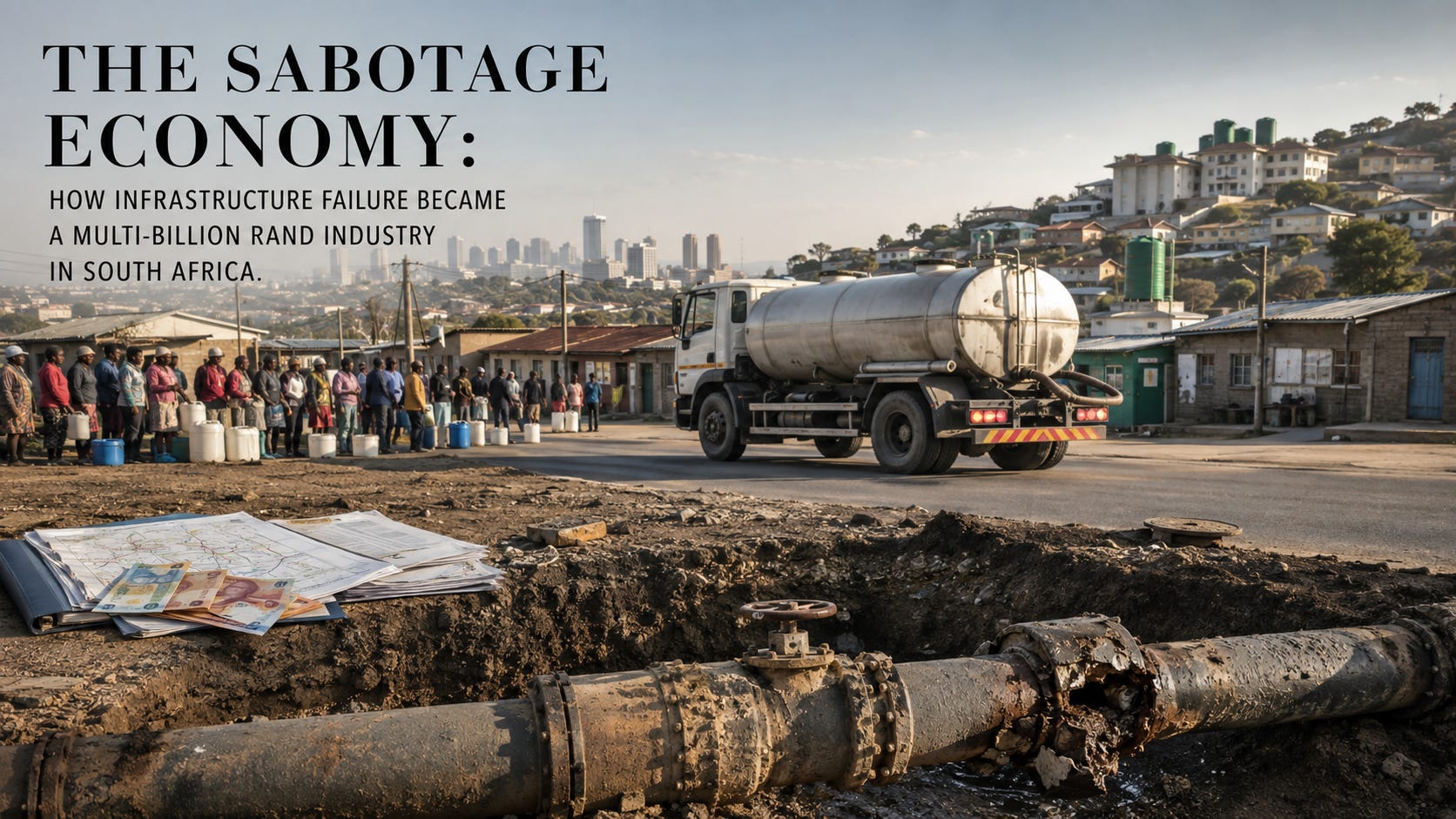
In Butterworth, a commercial hub in the Eastern Cape, engineering reports from the Amathole District Municipality and subsequent portfolio committee briefings in Parliament have documented recurring, deliberate damage to the surrounding bulk water reticulation network. And in multiple recorded instances, during periods when municipal maintenance teams worked to identify why refurbished supply lines kept losing hydraulic pressure, private flatbed trucks were already maneuvering through the unpaved streets of surrounding rural villages, delivering water directly to queues of residents holding plastic containers.
The scene illustrates a profound economic contradiction.
Residents in unserved settlements pay private haulers steep cash premiums for water drawn directly from public distribution points. Meanwhile, the local municipality pays private contractors emergency rates to transport that very water because the public pipes are dry. So the public sector bears both costs: maintaining the permanent network and financing the emergency substitute required when that network fails.
This is not simply a story about drought. The crisis cannot be explained simply by an absence of bulk water, because many of the affected distribution systems have failed even when regional dam storage remained adequate.
Instead, it is a story about the political economy that emerges when the workaround for a broken public service becomes larger, richer, and more organized than the public service itself. The governing dynamic is straightforward: a sabotage economy emerges when the institutions and markets surrounding a failed public service begin rewarding the persistence of failure more reliably than they reward restoration.
Emergency markets are not inherently predatory. The distortion begins when substitute delivery becomes financially durable enough that some participants acquire an economic interest in continued dysfunction. Corruption extracts value from a system, but a sabotage economy becomes far more dangerous because commercial value increasingly depends on the system remaining broken. And the pattern emerges when the market for coping with failure becomes more durable than the institution tasked with eliminating it.
Consider the baseline arithmetic of South African municipal water.
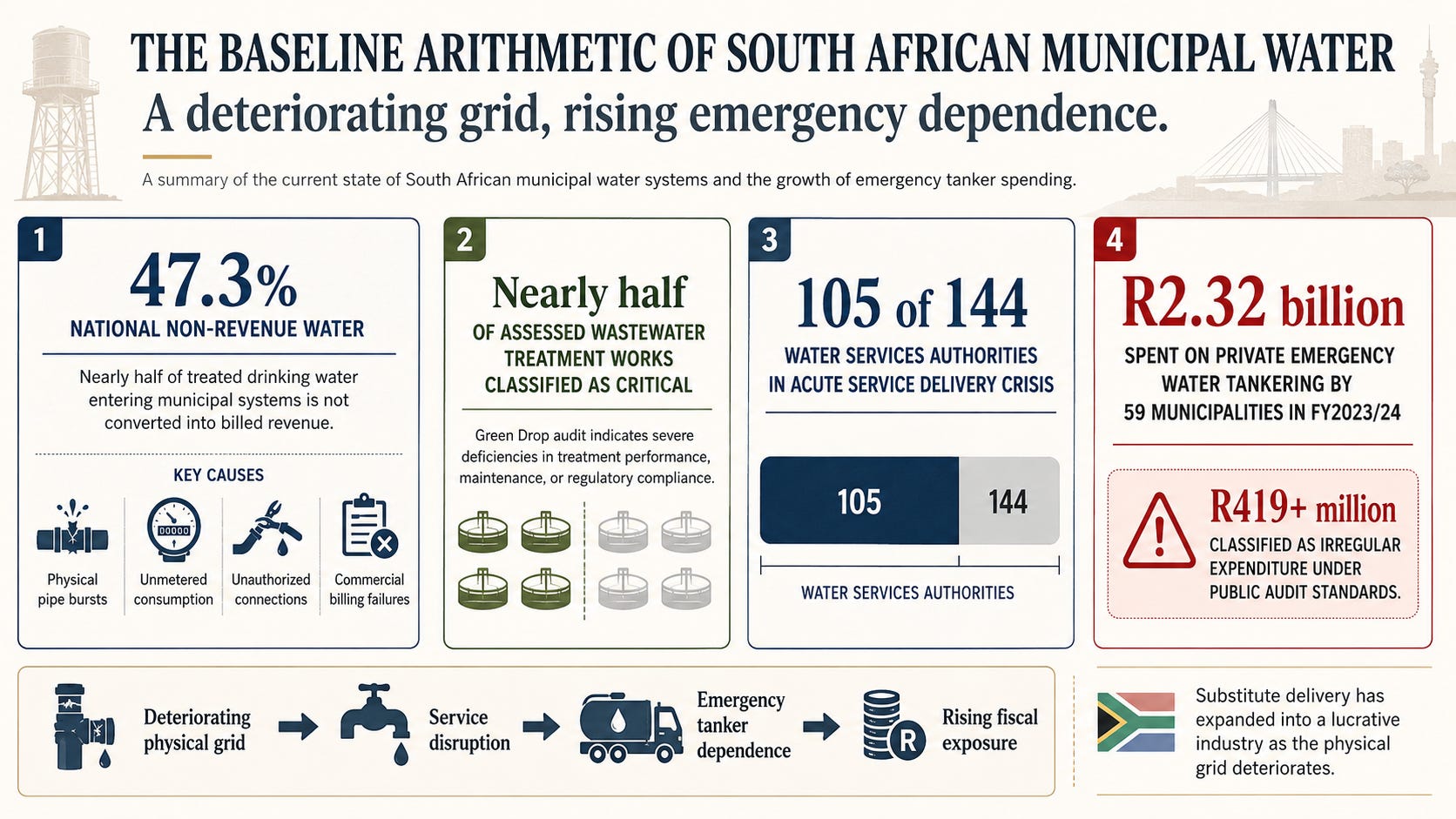
According to the latest No Drop assessment published by the Department of Water and Sanitation, national non-revenue water stands at 47.3 percent. That means nearly half of all treated drinking water entering municipal systems is not converted into billed revenue because of physical pipe bursts, unmetered consumption, unauthorized connections, and commercial billing failures. And that volume represents substantial fiscal losses in treated water that never enters the municipal revenue base.
At the same time, the Green Drop audit classifies nearly half of the country’s assessed wastewater treatment works as critical, indicating severe deficiencies in treatment performance, maintenance, or regulatory compliance. And the national government itself has formally identified 105 of the country’s 144 designated Water Services Authorities as experiencing an acute service delivery crisis.
Yet as the physical grid deteriorates, substitute delivery has expanded into a lucrative industry.
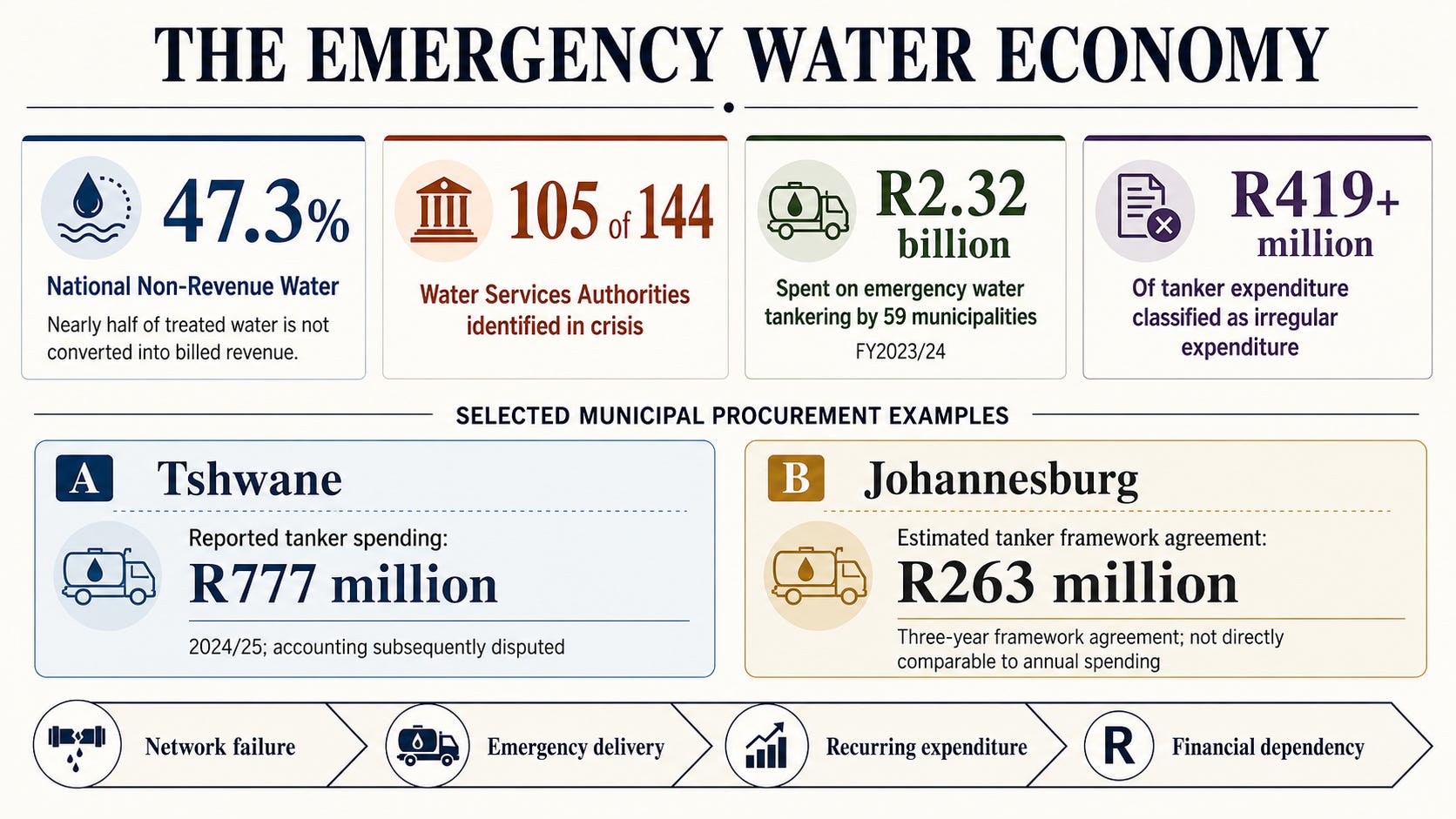
Information presented from the Auditor-General’s water sector investigations reveals that 59 South African municipalities spent approximately R2.32 billion on private emergency water tankering in the 2023/24 financial year alone. And more than R419 million of that expenditure was classified as irregular expenditure under public audit standards.
In several municipalities, emergency water tankering has evolved from an exceptional, short-term contingency into a recurring operational outlay. In the City of Tshwane, reported spending on water tankers reached R777 million in 2024/25, though the municipal council subsequently disputed how prior-year invoices and multi-year commitments were being classified across specific line items. And in Johannesburg, investigative journalists at amaBhungane reported on procurement irregularities surrounding a three-year tanker framework agreement estimated at R263 million, awarded to two relatively little-known entities whose prior operating background became a subject of scrutiny.
When emergency procurement reaches that scale, the incentives governing public management undergo a subtle inversion.
Under normal public economics, emergency procurement exists to buy time. A pump fails, an engineer orders a replacement part, and a tanker keeps a local clinic functioning for three days while the repair is completed. But when a municipality lacks technical personnel and administrative stability, emergency procurement creates wide administrative discretion.
Every prolonged outage increases the commercial value of that discretion. And once an entire fleet of private vehicles is financed by the state to deliver water that pipes should carry for pennies, restoring the pipe stops being an unambiguous public good.
For the contractor operating a fleet of emergency vehicles, a repaired pipe is not a civic achievement. It is the sudden elimination of a valuable revenue stream.
What’s at the root of South Africa’s water crisis?
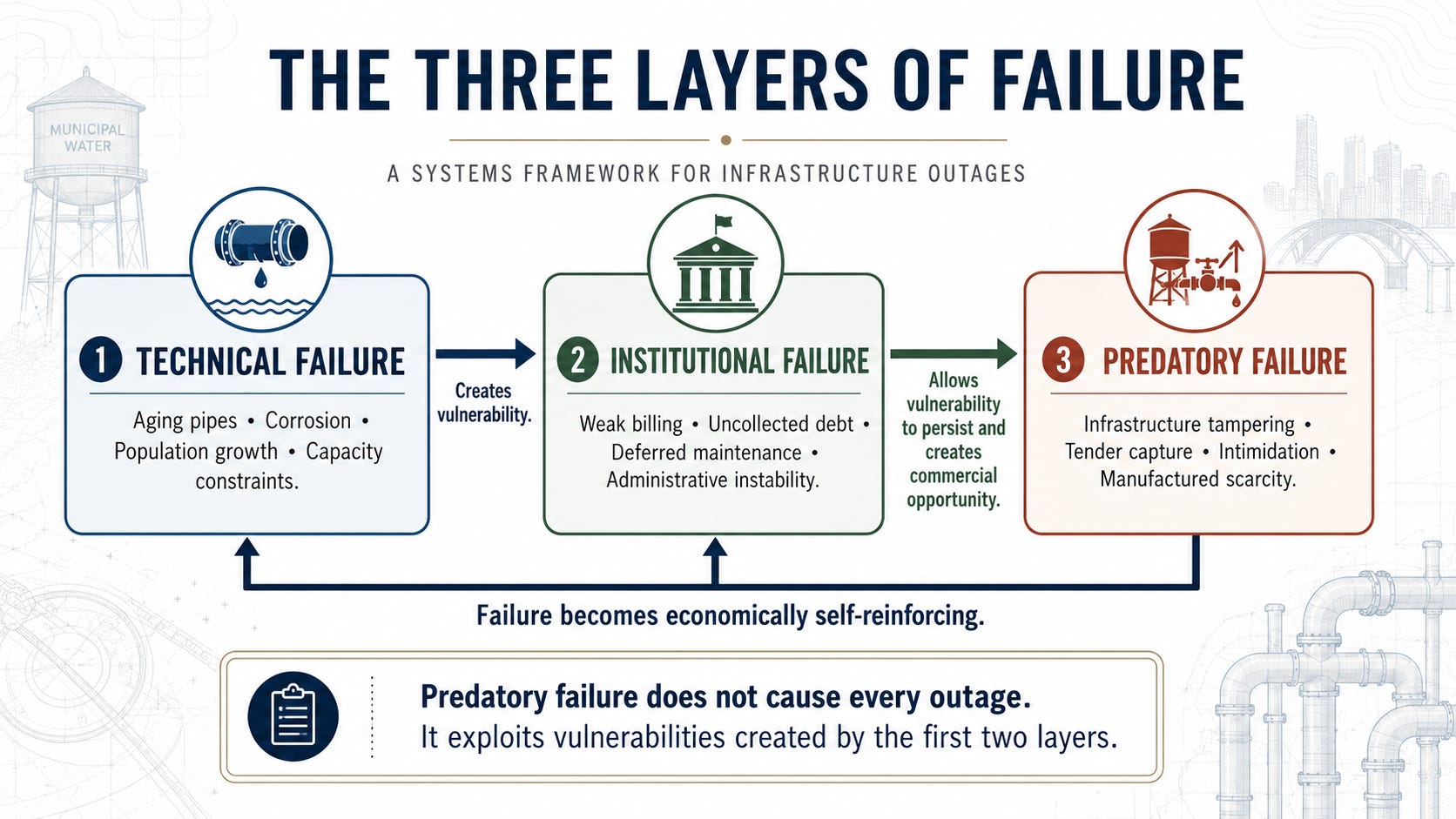
To diagnose how a public utility arrives at this impasse, one must distinguish between three distinct layers of failure that are often blurred together in public debate:
First, technical failure. Pipes age, cast iron corrodes, soil shifts, and rapid urban growth outpaces original network design. A distribution network built decades ago will inevitably struggle when forced to serve a rapidly expanding urban population.
Second, institutional failure. This is the failure of public administration: weak billing systems, uncollected consumer debt, deferred preventative maintenance, and political instability within municipal councils that leads to high executive turnover and administrative paralysis.
And third, predatory failure. This occurs when organized commercial or criminal actors exploit, accelerate, or deliberately manufacture breakdown to extract public funds or enforce private monopolies.
A skeptic could reasonably argue that most of South Africa’s water failures require no predatory explanation at all. Aging pipes, weak collections, rapid urbanization, and poor municipal management can explain a great deal, and in many municipalities, there may be no evidence of organized predation at all. Evidence that a tanker market benefits from failure is not itself evidence that a tanker operator caused the failure; the stronger claim requires direct evidence of interference, intimidation, or procurement manipulation. But the sabotage-economy thesis begins where those conventional explanations stop: it asks what happens after failure itself creates a durable commercial constituency.
Predatory failure did not create South Africa’s water crisis from scratch. Technical deterioration and institutional weaknesses established the vulnerability. But predatory dynamics help explain why, in some documented systems, normal maintenance encounters active resistance.
Consider the documented cases surrounding the Tsojane bulk water supply pipeline in the Eastern Cape.
Municipal engineering briefings and provincial monitoring reports documented instances where newly refurbished infrastructure was repeatedly targeted. Control valves were severed, mechanical fixtures were damaged, and concrete inspection chambers were broken open, cutting off bulk water supply to forty surrounding rural villages.
Following these disruptions, private water tankers were deployed to supply the affected communities under emergency municipal arrangements. But when municipal repair teams and contracted engineers were dispatched to replace the broken valves and restore piped flow, officials reported that maintenance crews encountered verbal intimidation and direct threats from unidentified groups demanding that repair operations halt.
A similar pattern emerged from the South Africa Water Justice Tracker project, a joint research initiative conducted by the South African Human Rights Commission and the University of the Witwatersrand. In structured interviews with officials across 96 water services authorities in seven provinces, municipal administrators repeatedly cited deliberate infrastructure tampering and tender-related intimidation as major operational barriers to restoring regular piped supply.
And in KwaZulu-Natal, the conflict around municipal contracts has had severe consequences. Between 2022 and 2023, eight employees and contractors linked to eThekwini’s water and sanitation division were murdered in targeted shootings. While law enforcement investigations into individual motives remain complex and largely unresolved, municipal labor unions and parliamentary oversight committees have repeatedly warned that the intersection of municipal procurement, internal whistleblowing, and private service delivery contracts has created an environment of extreme personal risk for technical staff.
The physical destruction of a valve is the most dramatic symptom of decay, but the financial mechanics weakening municipal utilities are located on municipal balance sheets.
South Africa’s local government system is trapped in a chain of unpaid obligations. According to National Treasury local government revenue and expenditure reports for the fourth quarter of 2025, the country’s 257 municipalities were owed an aggregate R467.2 billion in outstanding consumer debts. Households accounted for R335.3 billion of this uncollected sum, while national and provincial government departments owed municipalities R27.6 billion in unpaid utility and property service bills.
Weak collection contributes directly to municipalities falling into arrears with bulk suppliers.
Municipalities owed an aggregate R160.8 billion to external creditors at the end of December 2025. Eskom accounted for R110.5 billion of that total, while regional water boards and the Department of Water and Sanitation were owed R30.7 billion. In Johannesburg, the municipal water utility’s high non-revenue water rates and billing shortfalls contributed to an estimated annual operating revenue gap of several billion rand, prompting bulk water board Rand Water to request financial security deposits to manage mounting municipal payment defaults.
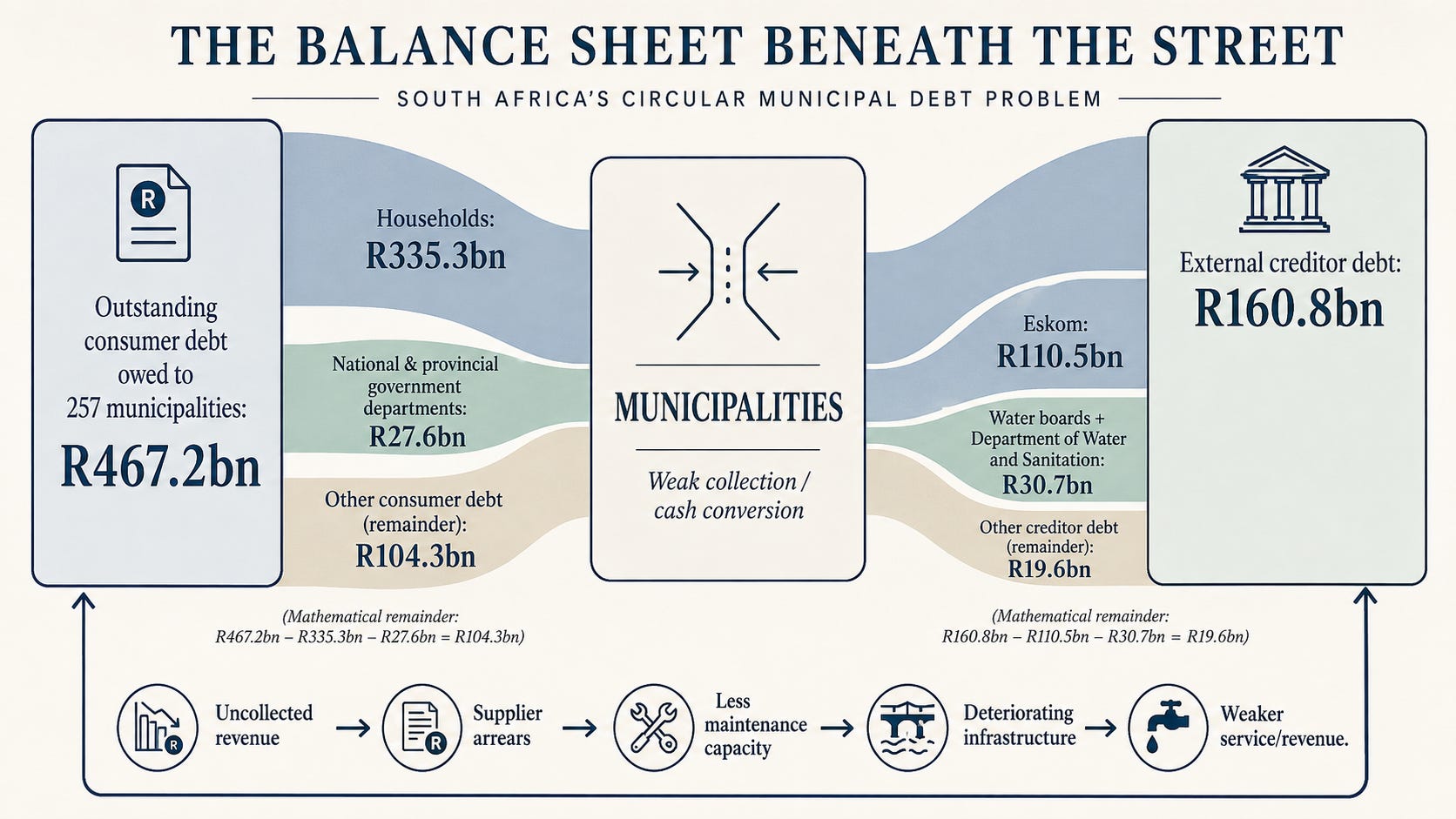
This financial backlog creates an enclavisation feedback loop.
Municipal finance in South Africa relies on cross-subsidization, a structural design documented in National Treasury municipal finance reviews and local tariff policies. High-margin commercial tariffs and utility bills paid by wealthy residential neighborhoods generate the surplus revenue required to fund network maintenance and subsidize basic water allowances for low-income households.
So when piped municipal services become erratic, commercial enterprises and affluent residents take steps to insulate themselves.
Estimates from the Borehole Water Association suggest that property owners across Gauteng province have drilled more than ten thousand private boreholes over the past decade, investing substantial private capital in independent extraction, filtration, and storage infrastructure. Commercial precincts and industrial manufacturers similarly install private treatment units or negotiate embedded off-grid generation arrangements to guarantee operational continuity.
The decision to install a private borehole or storage tank is an entirely rational choice for an individual household or factory. But systemically, it alters the municipal fiscal base.
The erosion of reliable, high-paying demand weakens municipal cash flows and increases pressure on maintenance budgets. And as capital expenditure is deferred, physical reticulation networks deteriorate further, reducing reliability and encouraging more paying users to seek off-grid alternatives. The wealthy purchase distance from public failure, while lower-income households remain dependent on a deteriorating public network and informal tanker markets.
A common reaction to this cascading municipal dysfunction is fatalism: the assumption that state institutions in developing economies are structurally incapable of maintaining complex engineering networks.
Then Eskom complicates the story.
For years, South Africa’s state power utility was the international shorthand for institutional decline. Generating units broke down constantly, maintenance backlogs mounted, diesel spending surged, and regular load shedding disrupted everyday life. The problem was widely described as irretrievable.
Then operational management, maintenance practices, procurement oversight, and plant performance began changing.
By focusing on disciplined outage management and plant reliability across its coal-fired fleet, Eskom stabilized power generation. In July 2026, the utility recorded over 400 consecutive days without nationwide load shedding.
The electricity system still faces long-term structural challenges, including heavy municipal distribution debt, network transmission constraints, and legacy liabilities. But the operational turnaround at the generation level established an important principle: persistent public-system failure is rarely purely technical; institutions, incentives, and operational discipline determine whether deterioration is corrected or allowed to compound.
So Eskom eliminates fatalism as an intellectual excuse for the water crisis.
Eskom’s Next Crisis, Why 2029 Could Bring Load Shedding Back — Chris Yelland Explains
The dynamics visible across South African municipalities are not unique to one country. They represent a recognizable global phenomenon: whenever a state fails to provide a universal public good, the private market that emerges to fill the void can become entrenched enough to alter the political and economic incentives surrounding the restoration of public capacity.
In Karachi, Pakistan, decades of municipal underinvestment and rapid urban migration created chronic deficits in the piped water distribution network. In response, private tanker cartels, widely known as the water tanker mafia, established a dominant presence across the city. Over time, investigative reports and official inquiries documented systematic illegal siphoning from bulk water canals, the bribing of municipal valve operators to restrict piped flow to formal residential zones, and violent resistance against infrastructure projects aimed at extending piped municipal connections. Karachi demonstrates what happens when private substitution becomes predatory.
Karachi Water Tanker Mafia | Featuring Senior Journalist Sohail Rab
And in Nigeria, chronic instability across the national electricity transmission grid fostered one of the largest private diesel generator markets in the world. The commercial ecosystem dedicated to importing, maintaining, and fueling private generators grew into an indispensable private industry. Researchers have observed that the widespread availability of private generation allowed affluent households and commercial enterprises to insulate themselves from grid failure, weakening their direct dependence on public grid reliability. Nigeria demonstrates what happens when private substitution becomes normal.
Unlike Pakistan’s Karachi water system or Nigeria’s heavily privatized backup-power economy, South Africa combines a capable National Treasury, deep financial markets, constitutional service obligations, and an established bulk-water system with severe municipal-level failure. In the structure of its substitute-service markets, South Africa increasingly shows elements of both substitution models: private water substitution is rapidly taking on both the predatory characteristics seen in Karachi and the structural entrenchment seen in Nigeria.
In both international examples, the breakdown began with administrative neglect and capital shortfalls. But once the market for private substitution attained critical commercial scale, it acquired capital, logistical reach, and, in some cases, political influence. The workaround ceased to be a temporary bridge and became a durable commercial ecosystem whose revenues depend on continued dysfunction.
The South African government is now attempting to address these structural issues through Phase II of Operation Vulindlela, the joint reform initiative coordinated by the Presidency and National Treasury.
The primary legislative instrument is the Water Services Amendment Bill, introduced partly to address the longstanding structural accountability problem embedded in the 1997 Water Services Act. Under current legislation, South Africa has 144 Water Services Authorities, many of which simultaneously perform or control operational provider functions. In many municipalities, this arrangement meant the entity responsible for enforcing operational standards was the very entity failing to meet them, while enforcement mechanisms often proved too weak to compel rapid correction.
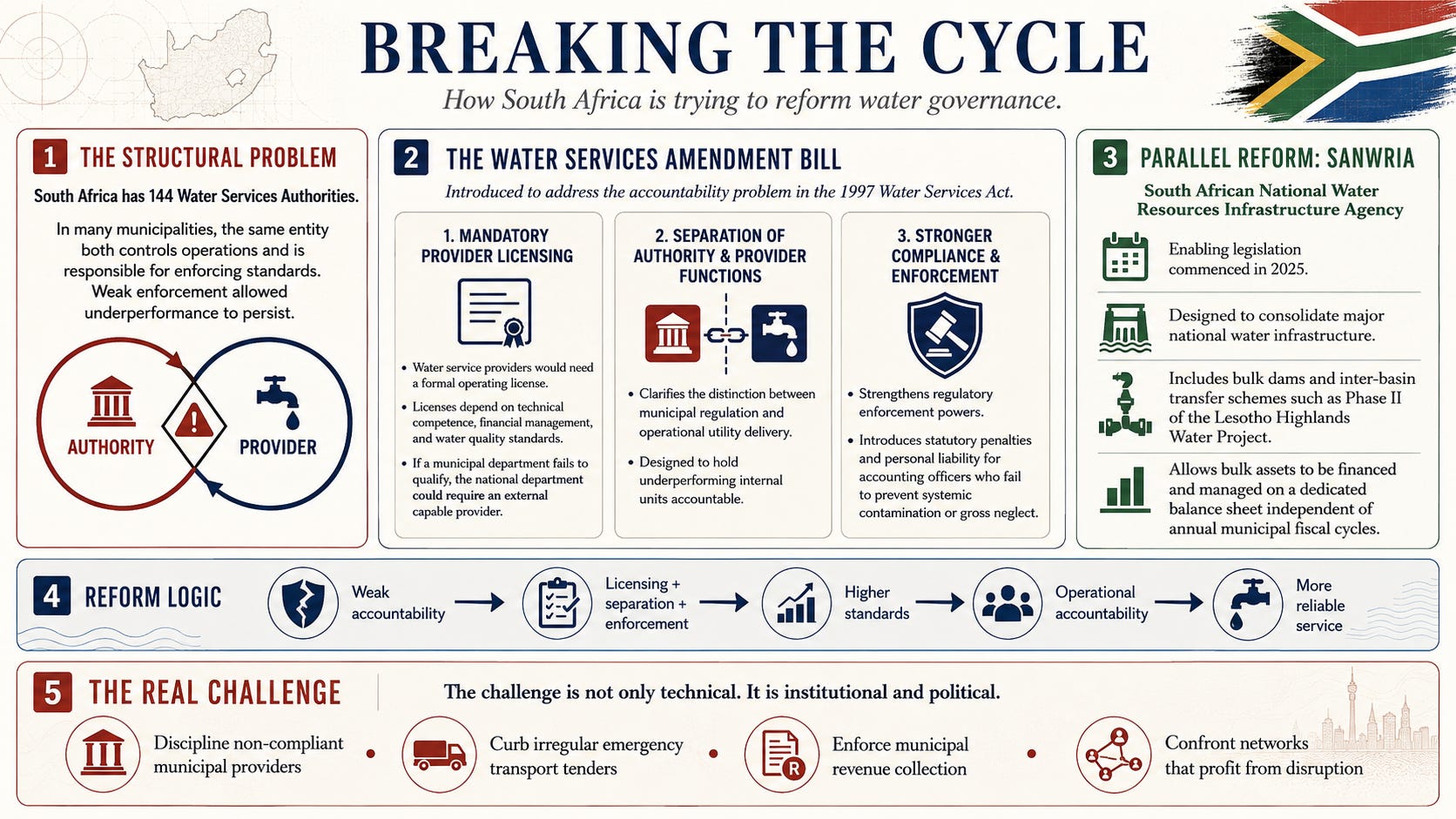
The Amendment Bill proposes three core structural interventions:
First, it would establish mandatory provider licensing. Water service providers would be required to obtain a formal operating license conditioned on meeting minimum technical competence, financial management, and water quality standards. If a municipal department fails to meet the licensing criteria within an established compliance period, the regulatory framework would empower the national department to require the appointment of an external, capable water service provider.
Second, it provides mechanisms for the clearer separation of authority and provider functions, legally distinguishing the municipal regulatory function from operational utility delivery to hold underperforming internal municipal units accountable.
And third, it would introduce enhanced compliance and enforcement mechanisms, strengthening regulatory enforcement powers and introducing statutory penalties and personal liability for accounting officers who fail to prevent systemic environmental contamination or gross infrastructure neglect.
In parallel, Parliament passed legislation establishing the South African National Water Resources Infrastructure Agency, whose enabling legislation commenced in 2025. The agency is designed to consolidate major national water infrastructure, including bulk dams and inter-basin transfer schemes such as Phase II of the Lesotho Highlands Water Project, allowing bulk assets to be financed and managed on a dedicated balance sheet independent of annual municipal fiscal cycles.
Yet the central challenge of these reforms is institutional and political. Restructuring water services requires altering the underlying political economy: disciplining non-compliant municipal providers, curbing irregular emergency transport tenders, enforcing municipal revenue collection, and confronting organized networks that profit from network disruption.
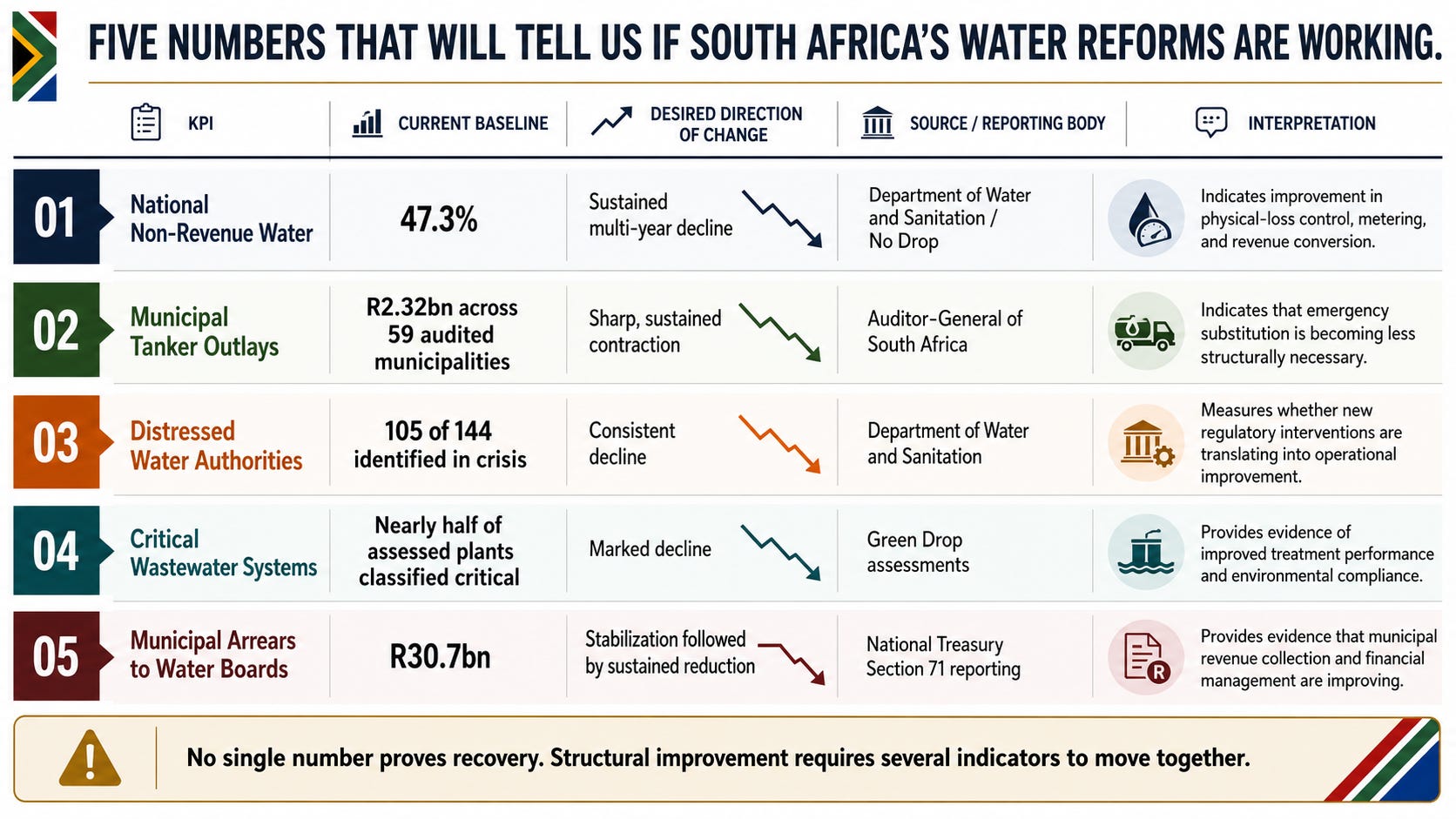
Whether reform succeeds will not be determined by policy announcements or parliamentary debates. It will be determined by whether key operational and financial metrics show measurable progress over the next three to five years.
No single metric is decisive on its own. Tanker spending could fall because communities receive less emergency support rather than because pipes improve, just as municipal debt could fall through accounting write-offs rather than better revenue collection. The indicators matter most when they improve together.
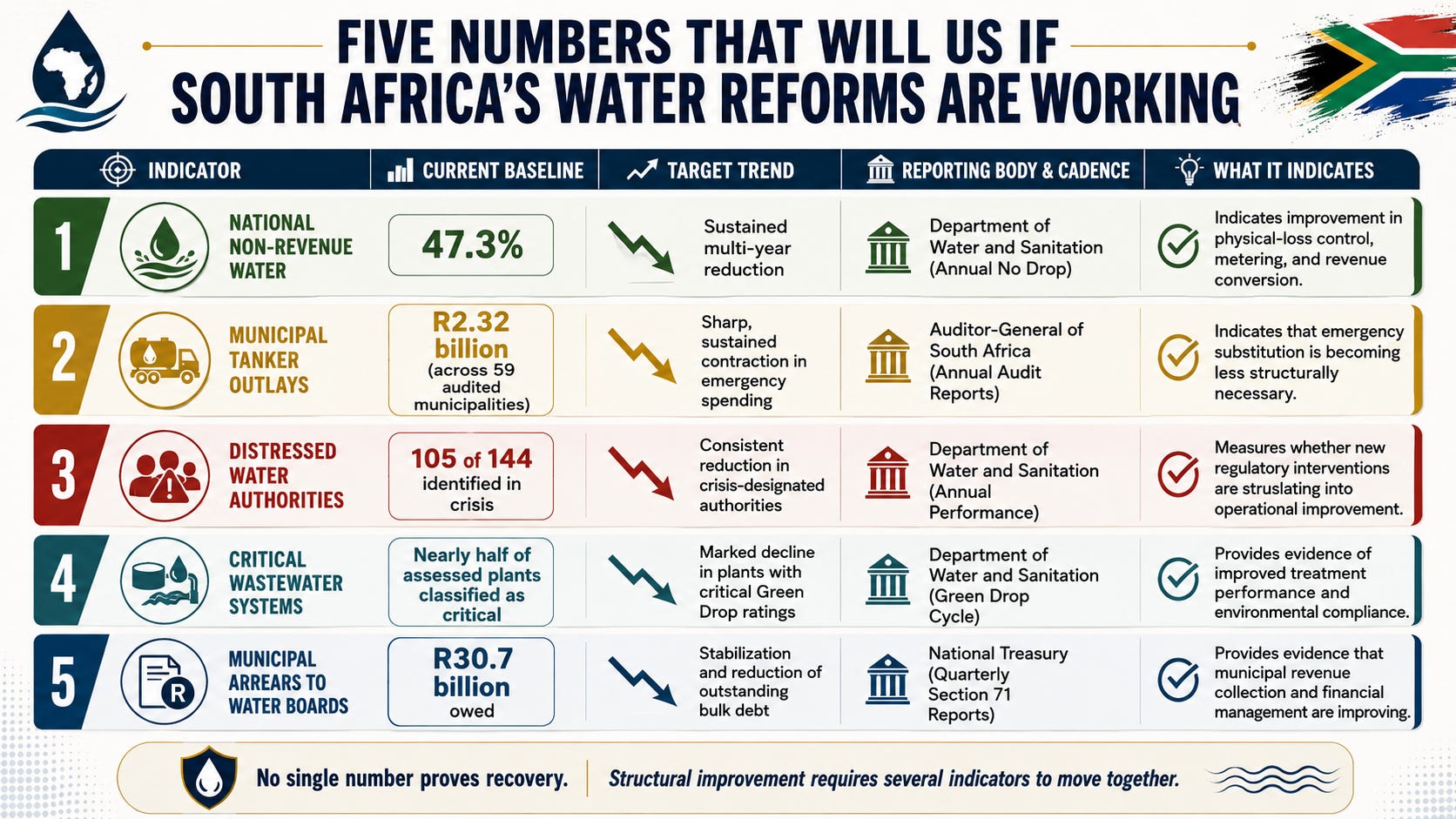
If these indicators improve simultaneously, it will indicate that public state capacity is being systematically re-established. But if they remain stagnant while emergency procurement allocations continue to expand, it will provide strong evidence that the economics of failure continue to govern the sector.
The resident buys a private tank because the municipal tap runs dry.
And the business installs private purification because operations cannot stop.
So the municipal council issues an emergency trucking contract because the neighborhood needs water immediately.
And the contractor expands its fleet because emergency demand continues to grow.
In the predatory version of the cycle, a criminal operative damages a control valve because an empty pipe guarantees a market tomorrow.
And the maintenance engineer defers a pipeline overhaul because the municipal budget has run out of funds.
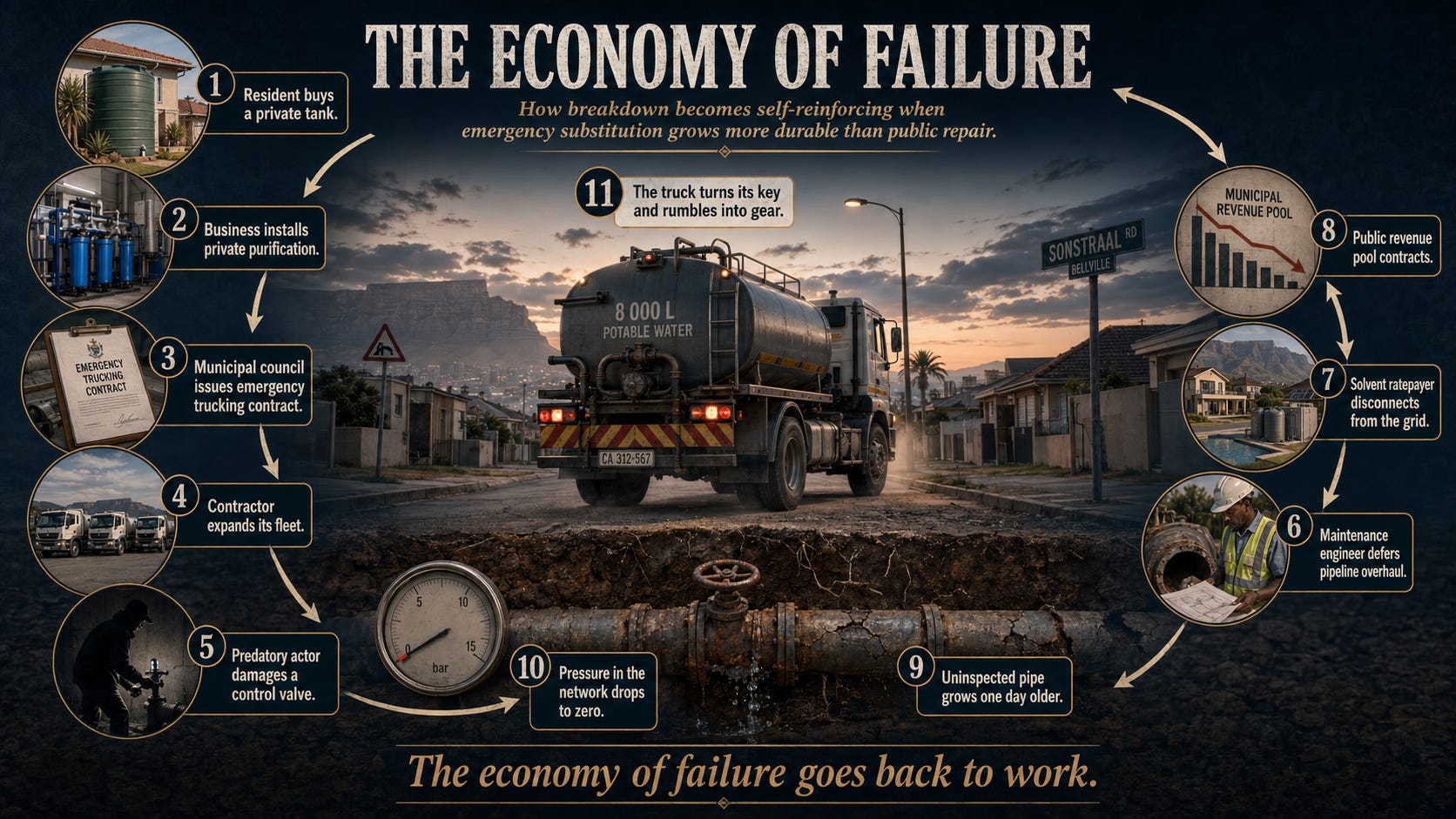
So the solvent ratepayer disconnects from the grid.
And the public revenue pool contracts.
And deep underground, an uninspected pipe grows one day older.
Then somewhere in the early dawn outside a dry suburb of Johannesburg, Durban, or Butterworth, the pressure in the municipal network drops to zero.
Down the street, an eight-ton truck turns its key and rumbles into gear.
The economy of failure goes back to work.
Comments
Nothing yet. Say the first thing.
Sign in to join the conversation.