
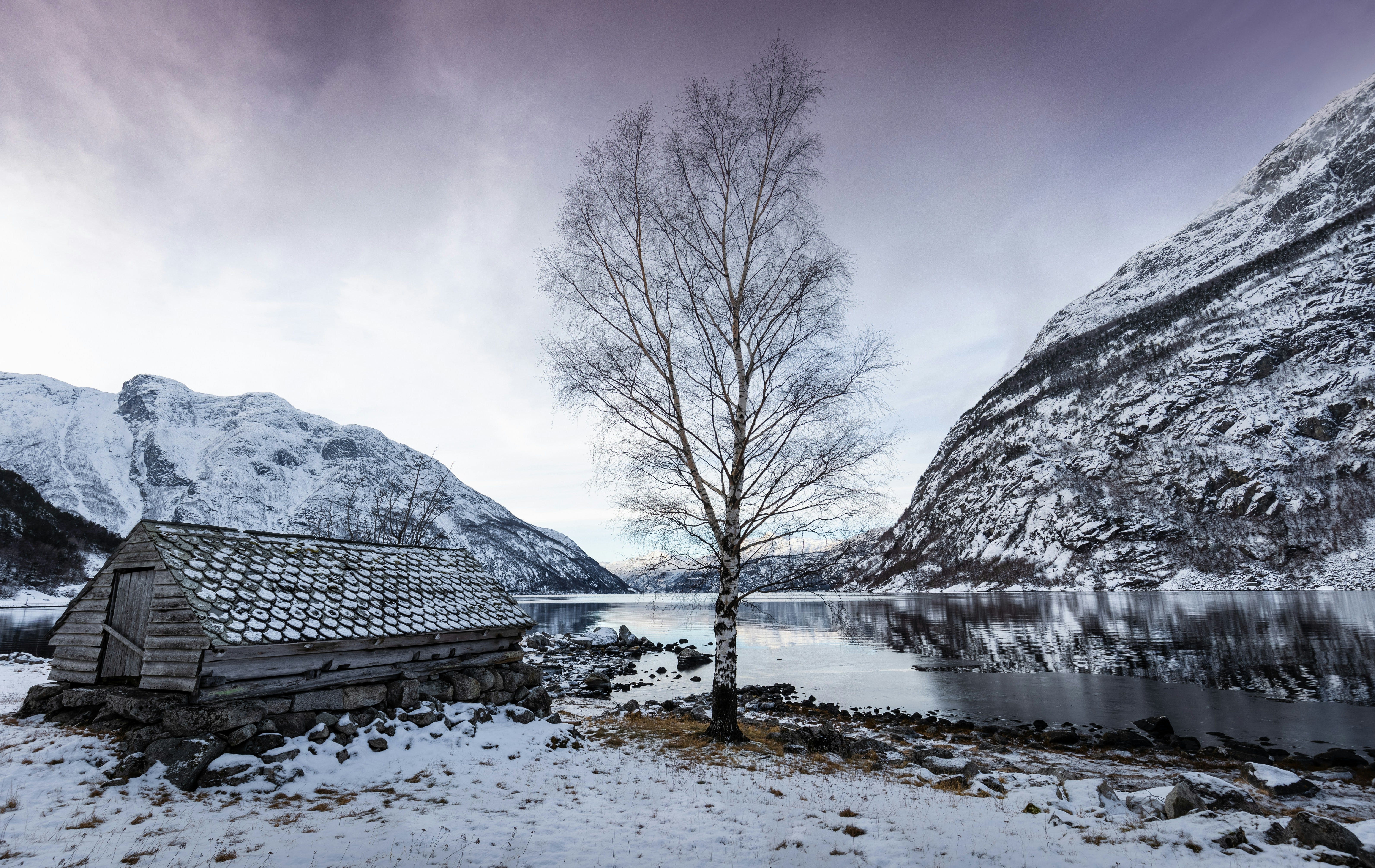
Photo credit to Ben Wicks - Unsplash
(Scandinavia, mid-9th century)
I came north where the sea cuts stone and does not apologize.
The cold bit through wool before I ever stepped ashore. Salt sat sharp at the back of my throat. Pine rode the wind. The fjord slapped black water against rock with a slow, ugly patience that told me exactly what sort of place this was.
Livable, if a man knew how to keep his mouth shut and his hands useful, but leaving no room for large mistakes.
They called the place Fjordheim.
Two hundred souls, perhaps. Fewer, if winter had been honest with them. The sea would decide the count by spring.
Longships rode at anchor, prows curled like sleeping beasts. Nets hung thick with brine. Children ran barefoot through mud cold enough to lame weaker folk. Men watched me without pretending not to. That was good. I trusted suspicion more than welcome.
I came as a wanderer. I always did.
Arne, I called myself then. Arne the Traveler.
It was a decent enough name. Broad shoulders, patched cloak, boots worn at the edges, scars old enough that no one would ask for the whole story unless they were a fool. I spoke their tongue well enough to pass without comment. Not beautifully, but true. The sort of speech that survives storms, blood, and men too tired to admire anything.
Under my skin, the old emerald light stirred at the edge of my being.
I keep it tight.
That had become habit long before this shore. Bind it down. Bury it deep. Leave only the faintest trace—enough that a gifted eye might mistake it for luck, blessing, strength. Anything human enough to be tolerated. Not divinity.
Men will forgive strength if they think it may someday serve them. Gods are another matter. Gods are feared, bartered with, used, worshipped, hunted. I had no wish to be any of those things again.
So I kept my light banked and earned my place the old way.
I hunted with them first. Snow-laced pine. Thin animal tracks. Silence that carried farther than sound. They watched how I moved through the timber, how I set my weight, how little I wasted. I could feel the measuring of them at my back.
When the boar broke from the brush, I did not rush. I let it commit, then cast once. The spear struck clean. Breath became blood. The animal dropped hard enough to shake snow from the nearest branches.
One man grunted. Another nodded once. They hauled the carcass back with me, and that was welcome enough. Meat mattered. Meat fed a village. Boasting did not.
After that, they let me sit nearer the fires.
At night Harald and the other elders drank thick mead in the longhouse and spoke of winters that had taken more than they gave, of sons lost to the sea, of fools who mistook loudness for strength. They did not ask me where I came from. Not at first. That is how you know you are being weighed.
I listened more than I spoke. That counted. When I did speak, I gave them roads, weather, ports that paid fair, kings that did not. Truths that cost me nothing. The dearer truths I kept to myself.
***
The raid came at dusk.
The fjord saw them before we did. Three boats sliding low and hungry, oars muffled, sails furled like held breath. Leather armor. Near sixty strong. Axes bright with wanting. Their auras burned red, sharp and uneven. Greed honed into purpose.
We met them on the shore.
One man died shouting a warning that never finished forming. Another went down with a spear still in his hands, surprise louder than pain. The rest of the village surged forward anyway. There are moments when men run and moments when they understand there is nowhere to go.
I took a bearded axe from a rack by the nets, its oak haft worn smooth by hands that had expected to die holding it. The iron was nicked. Heavy. Honest.
I liked that.
The first man charged too fast, boots slipping on wet stone. He swung wide, confident in noise. I stepped inside his arc and took his arm at the shoulder. The blade bit deep. Blood sprayed the pebbles. The fjord swallowed his scream without comment.
The laugh tore out of me before I could stop it. Not in cruelty. Just breath and motion and the brief, clean joy of being entirely where I was.
A second came low, smarter. He tried for my knee. I let him close, then drove the axe head down through his thigh. Bone cracked through the haft into my palms. He fell into the surf, howling, and the water finished the lesson.
The third did not rush. He circled, eyes narrow, body tight with calculation. A veteran. He feinted once, testing distance, then came in with shield and short blade, aiming not to kill but to break.
I met him head-on.
Shield struck shield. Wood split. The impact ran up my arms and into my teeth. He slashed; I turned it with the haft and drove my head into his face hard enough to stagger him. While he reeled, I buried the axe in his chest and felt his weight sag against it, surprise blooming too late in his eyes.
There were more. Always more.
I wrenched the blade free and moved on. Not chasing kills. Closing gaps. Where a villager faltered, I stepped in. Where a shield wavered, I braced it. I took a blow meant for a boy too young to have a beard and split the man who’d swung it from collarbone to lung.
Spears flew. Axes cracked skulls. Men went down screaming, then stopped. Near the nets, I saw the line bend and stepped into the place it would have broken. The raiders faltered. Their red auras fragmented at the edges. Fear always shows itself.
They finally broke.
Some fled to the boats. Some to the water. A few stood long enough to be taught better. We did not pursue far. The fjord is wide, and vengeance that runs too fast forgets itself.
When it was done, the shore steamed with blood meeting cold.
We counted the living before we counted anything else. Twelve of ours did not rise. One more breathed shallow and would not see another winter. Three were crippled.
No one spoke for a while. Men looked at the dead, the wounded, the broken nets, the blood worked into the stones. The elders moved among them, saying little.
Afterward, hands clapped my shoulders. Voices rose. Someone pressed a horn into my grip.
The elder Harald took my arm in the longhouse, smoke thick with mutton grease and victory. His beard was braided with age and loss, his aura a deep, steady blue—wisdom worn thin but not broken.
“You fight like Odin’s eye is on you,” he said.
I smiled the way men expected.
Let them believe the version that kept them warm.
***
The night did not end with the battle.
It never does.
After the shouting burned itself out and the wounded were bound, after the dead were carried inland and laid where the wind could not worry them yet, the village settled into a wary quiet. Fires were fed. Doors were barred. The fjord resumed its breathing, indifferent to who had spilled blood on its stones.
I washed my axe in the shallows until the water ran clean. The iron steamed faintly, as if it resented being returned to stillness. When I turned back toward the longhouses, another of the elders waited for me.
This one was called Soren. He had been old when Harald first took the seat. His back bent not from weakness, but from years of leaning into weather. His beard was white and thin, his hands knotted like driftwood that had learned patience from waves.
He did not greet me. He sat by the fire with a stick held across his knees, stirring embers that did not need it.
“Sit,” he said. It was not a request.
I sat.
For a long time, we listened to the crackle of pitch and the distant sound of women singing low as they cleaned blood from wool. The smell of iron clung to everything, sweet and wrong.
“You did not fight like a man who fears dying,” Soren said at last.
I said nothing.
He poked the fire again. Sparks climbed and vanished.
“I have seen men who were brave,” he went on. “And men who were desperate. And men who were lucky.” He glanced at me sideways, eyes pale and sharp. “You were none of those.”
“What was I, then?” I asked.
He considered that. Quietly.
“A man who knew where to stand,” he said. “And when.”
The fire shifted. A log settled with a soft collapse.
“When the third raider came for you,” Soren continued, “you waited. You let him choose. That is not how young men fight. And not how old men fight either.”
He leaned back, bones creaking. “That is how mountains fight.”
My light tightened under my skin. I did not let it rise.
“I’ve seen war,” I said. It was not untrue.
Soren nodded. “So have I.”
Silence again. Then, softer: “But not like that.”
He stared into the fire, not at me. I was grateful for that.
“You do not drink like a man who has just won,” he said. “You do not boast. You do not reach for praise like it might slip away.”
His voice lowered. “And when you washed your blade, you thanked it.”
I blinked, surprised despite myself.
“I saw your mouth move,” he said, almost apologetic. “No words. Just… respect.”
I chose my truth carefully. “Tools deserve that,” I said. “They remember how you treat them.”
Soren’s mouth twitched. Not quite a smile. “Aye,” he said. “They do.”
He leaned forward then, close enough that I could smell smoke and old wool and the faint tang of herbs used to keep joints moving when winters stack too high.
“You are welcome here, Arne the Traveler,” he said. “No one will trouble you. Not me. Not Harald. Not the young fools who think strength is something you shout about.”
He met my eyes for the first time.
“But if you are something more than you appear,” he added, voice steady, “then you will remember this place kindly. And you will leave before that ‘more’ brings trouble back on us.”
“I would never harm your people,” I said.
“I know,” Soren replied, without hesitation. “That is why I am speaking to you now.”
He pushed himself to his feet, joints protesting. “One more thing,” he said, already turning away.
“Yes?”
“If the gods are walking again,” he said lightly, “they would do well to mind their manners.”
Then he left me with the fire and the fjord and the weight of being seen.
I sat there until the embers dimmed, listening to the village breathe around me.
***
They gave me a longhouse near the water. Furs on the walls. Nets drying by the door. A tapestry of Yggdrasil stitched by hands that understood hunger as well as myth. The World Tree with its roots in shadow and branches in light.
I lay beneath it that night listening to the water strike the shore and dreamed of neither.
***
The raid’s victory lingered like smoke in the rafters. Harald’s blue aura held steady with pride, and the villagers’ lights burned a little brighter for having survived together.
That night their volva found me by the fire.
Eira moved quietly, but not softly. Her silver-violet aura reached me before her body did, pressing at the edge of my awareness. She held out a rune stick carved with fehu runes.
“Feel it,” she said, her fingers lingering on mine as she passed it over. “Hamingja is like this: luck that multiplies when shared. A man’s strength alone is a well; bound to another’s, it becomes a river.”
I turned the rune in my hand. There was a pulse beneath the carving—faint, deliberate. Her seidr lay in it like a question already asked.
My light stirred. I bound it tighter and gave her only the smallest glimmer.
“And if the river floods?” I asked.
Her eyes narrowed. Violet sparked under the silver.
“Better to direct it than drown.”
She leaned closer, voice dropping low enough that the fire had to work to keep hearing us.
“You’ve more than you show, Arne. I see it. Green as deep forest, bright as forge-fire. Why hoard it? We could weave something unbreakable. The village needs strength like yours.”
I set the stick aside. “Strength unbound invites storms.”
She smiled then, but it did not reach her aura. The silver drew in tighter. Hunger moved beneath it, quick and thin as a starved flame.
“Storms pass,” she said. “Power endures.”
Her hand brushed my arm. A test, nothing more in appearance, and far more underneath. I felt her tug lightly at the edges of my light, careful as a thief trying a latch.
I withdrew gently before she could feel how much more there was.
“Endures for whom?” I asked.
She held my gaze a moment longer than courtesy required, then laughed. Lightly. Almost enticingly. There was edge under it all the same.
“For those bold enough to claim it.”
The fire cracked. Harald called for more mead. Voices rose and fell around us.
But Eira’s violet stayed with me after she stepped back, lingering at the edge of thought.
Watching. Waiting.
***
The volva sent for me two nights later.
Eira lived beyond the last path, in a hut that leaned into the trees as if listening. Mugwort and yarrow dried in the smoke. Bones and feathers hung from the rafters and stirred when the door opened, though the air inside was still. The moment I stepped into her hut, I knew she was the one who had cut the wards into the village doors.
She was slender but not fragile. The sort of woman a careless man would call slight until she fixed her attention on him.
Her eyes were the color of winter sky just before it breaks.
Her aura met me before her voice did. Silver and violet, practiced, hungry, and stronger than it had felt by the longhouse fire. No longer bothering to disguise it.
“You burn like the aurora,” she said, not looking up from her rune stones. “Who are you really?”
“A traveler,” I said. “Seeking knowledge that you keep.”
She smiled then. Measuring.
“Sit.”
I paid her in furs and silver. She weighed them in her hands, then weighed me with her eyes, and seemed satisfied enough with both.
“You have promise,” she said. “We will see how much.”
***
I stayed through the winter.
Snow came early that year, heavy and deliberate, filling the fjord like a held breath. The longhouses hunched lower. Doors hung with bone and iron. Children learned the sound of wolves before they learned the sound of thaw. The sea did not freeze, but it darkened. Steel beneath the sky.
Eira taught when the nights were deepest.
She set another piece of birch onto the fire and watched it catch before she spoke.
“Men think seidr is command,” she said.
I sat across from her with a rune knife in my hand, turning the unfinished wood she had given me. “Isn’t it?”
Her mouth tilted. “That depends on whether the world agrees.”
Wind pressed at the walls. Smoke drifted low for a moment before finding its way out.
“Then what is it?” I asked.
She looked into the fire, not at me. “Listening long enough to hear what is already happening. And being foolish enough to put your hands there.”
“That sounds less like power and more like patience.”
“It is both,” she said. “The impatient die with half-finished workings and singed eyebrows.”
That drew a chuckle from me.
Only the corner of her mouth moved. “Fate is not a road, Arne. It is a loom.”
I said nothing.
She lifted one hand and moved two fingers through the air as though drawing threads only she could see.
“Pull too hard,” she said, “and you snap what was meant to bend.”
One night she taught me hugr. Not by naming it first. By making me feel the lack of it.
“Hold one thought,” she said.
I sat by her fire with sweat gathering under wool while the wind worked at the walls and tried to do as she asked.
“I am holding it,” I said.
“No,” Eira said. “You are holding it, and four others crowding behind.”
I opened my eyes. “This is more difficult than you make it sound.”
“Of course it is,” she said.
I shut my eyes again. Tried once more. Breath in. Breath out. The same word. The same image. The same point driven thinner and thinner until my jaw ached with holding it.
When I finally opened my eyes, she was watching me in a way that had nothing to do with kindness and everything to do with assessment.
“Well?” I asked.
“Hugr,” she said. “The sharpened will. Most men let their thoughts run in ten directions at once and call that freedom. It is a waste.”
“And this is better?”
“The focus cuts,” she said. “So yes.”
Another night she spoke of hamingja. Her voice changed when she spoke of it, closer and possessive enough that I noticed. She held out the carved rune and let my fingers close over it. Hers resting still there a moment too long.
“Luck,” she said. “Inheritance. Protection. Men use small words for large things.”
“What word would you use?”
Her eyes lifted to mine. Firelight moved in them.
“Continuance,” she said. “The force that gathers in a bloodline and chooses whether to remain generous.”
I looked down at the carving again.
“And if it doesn’t?”
Her thumb brushed once across my knuckles.
“Then someone squandered it,” she said. “Or hoarded it until it went mean.”
We carved more runes into birch after that, edges clean and sharp beneath the knife. algiz, the shield. tiwaz, the arrow of justice.
I sang the words into the wind. My voice was rough, untrained, but true enough that the air tightened when I meant it. Galdr did not care whether a man sang beautifully. Only whether he committed.
The first time I raised algiz cleanly, I felt the shield settle around me. Emerald, steady, old as instinct.
Eira’s breath caught.
Most men would have missed it. I didn’t.
She leaned toward me then, eyes bright. “Again.”
And when I did, her praise came sharper than warmth. I learned quickly, she said. The runes listened when I sang.
Her aura still ran silver, but the violet had begun to crowd it. Sharp. Restless. Like birds too agitated to settle on one branch.
We spoke long into those nights.
“Odin paid for everything worth having,” Eira said, turning a carved bone between her fingers. “An eye. Peace. Certainty. There is no wisdom without surrender.”
“That sounds like something a priest says after taking what he wants,” I said.
She laughed softly. “You dislike gods.”
“I dislike bargains dressed up as gifts.”
Firelight moved across her face. “And Freyja?” she asked. “Do you dislike her too?”
“Less,” I said.
“Because she wept gold?”
“Because grief always demands interest,” I said.
That pleased her. I could tell by the way she went still when she was listening hardest.
“And the ravens?” she asked. “Would you have them? Thought and memory, always at your shoulders?”
“No.”
“No?”
“Memory is burden enough without giving it wings.”
She watched me for a long moment after that. “You say things like a man who has carried more of it than most.”
I looked into the fire instead of at her. “Most men carry more than they admit.”
“That is not an answer.”
“It is the one I’m giving.”
Her mouth tilted at that. Measuring, but not offended.
So I relented and gave her stories instead. Deserts that sang at dawn. Rivers older than writing. Cities buried under the weight of their own prayers. Enough truth to feed her curiosity. Not enough to satisfy it.
I did not tell her how old I was.
At some point she began to sit closer.
At first it was nothing. Shared warmth by the fire. Her shoulder brushing mine when the wind pushed smoke back down the chimney. Her hand lingering when she corrected my grip on a rune knife.
I was not blind to her. Winter has a way of sharpening certain hungers, and Eira was not the sort of woman a man dismissed twice.
“You do not root easily, Arne,” she said once, watching me through firelight. “Men like you drift.”
“Roots rot if they hold too tightly,” I said.
She smiled, but the violet in her aura flickered.
Later she taught me a binding song of threads. A galdr meant to tie one hamingja gently to another, shared strength, shared fate. She sat close enough then that I could feel the heat of her through the wool of my sleeve.
“This one is used when two lives mean to walk together,” she said.
She began the galdr softly. I followed her, rougher, slower, learning the shape by ear. When the last note thinned into the firelit air, she did not move back.
“We could be stronger,” she said, eyes bright in the firelight. “Together.”
I heard the invitation in it. For a moment, I let myself imagine she meant only that. Then I heard the claim underneath. I let my aura dim further, smoothing its edges, showing her less than half of what even a gifted mortal might have carried.
“Power shared must be chosen freely,” I said. “Anything else sours.”
Her gaze sharpened.
That night she touched my chest with her palm flat, as if feeling for the shape beneath skin and bone. Her hand moved lower, slow enough to be mistaken for tenderness if a man wanted to be fooled.
For one breath, I nearly let myself believe it.
I caught her wrist and held it there.
“Not this way,” I said.
For a moment she stayed very still. Then she withdrew, smooth as water sliding off stone.
“Of course,” she said lightly. “I forget myself.”
From then on she stepped back.
The lessons continued, but the warmth did not. Her praise grew measured. Her smiles stopped at the mouth. She spoke more often of balance. Of restraint. Of the dangers of hoarding strength.
She watched me differently after that.
As a problem.
***
Another village sent for Eira before the last of winter loosened its grip.
Two men had gone missing in the hills east of Fjordheim. A third came back at dusk without his brother, his face half blood, half frost, babbling of a burial mound that had opened and something inside it that did not stay dead when struck.
No one in Fjordheim wanted that thing walking farther downhill.
So Eira went.
And because I had come north looking for the hand that cut wards into doorposts, because I had spent the winter letting her teach me and watching what she made of power, I went with her.
We walked out under a sky the color of old iron. Snow still lay in the folds of the hills where the sun had not yet earned enough ground to melt it. Eira said nothing at first, but I saw the way her hand rested near the pouch at her belt where she kept her carved bones and threaded charms.
The burial ground sat above a narrow stand of pine where the land swelled up into stone. Three low mounds, one larger than the rest, all ringed with weathered markers half-eaten by moss. The villagers who had sent for her had tied strips of red cloth to the outer stones. A warning, or a plea. Perhaps both.
The bodies lay where they had fallen. Torn open and stiff in the snow, one with his throat crushed, the other with his spine bent wrong as if he had been thrown aside like brush.
Eira crouched beside them and pressed two fingers into the nearest body. Her aura tightened. Silver drawing thin, violet flickering under it.
“Draugr,” she said.
A corpse that refused burial cleanly. Malice fastened to what should have been left behind. I had seen their kind in other lands under other names. Men always believe the dead belong to them until one stands back up and disagrees.
“You can bind it?” I asked.
Eira rose slowly, eyes on the mound. “Yes.”
The answer was confident enough to be honest. But not complete enough to comfort me.
Snow cracked faintly under our boots as we climbed the rise. The entrance to the mound had split open where the earth had settled inward, exposing a low stone passage cut into the hill. Old work. Good stone once. Better sealed once too.
The air coming out of it smelled of wet earth, stale rot, and something drier underneath. Grave dust. Old linen. A chamber that had been long closed, and then opened by hands too ignorant or too greedy to understand what they had woken.
Eira lit a torch and handed it to me.
“I will need both hands free,” she said.
“For the binding?”
Her eyes flicked to mine. “For what comes after.”
That should have warned me more than it did.
We went in bent low, shoulders nearly brushing the stone. The passage narrowed, then opened into the chamber itself. A carved slab stood at the center, split askew. Grave goods lay scattered in the dirt. An arm ring, a rusted blade, shards of worked bone. Something had risen from here angry enough to throw its own death aside.
The torch flame pulled long. Then steadied.
I heard it before I saw it.
A wet dragging sound against stone. Breath without lungs behind it. The sort of sound that makes the body remember older fears than reason can soothe.
It came out of the dark to my left.
Tall once. A man in life, perhaps broad-shouldered and dangerous enough to have been buried with iron. Now it wore its flesh badly. One side of its face had caved inward. The mouth hung open too wide, lips gone black at the edges. Its eyes were not eyes at all anymore, just a bluish sheen sunk deep in rot and old hate.
It moved faster than a corpse had any right to.
Its shoulder drove into my chest and slammed me against the chamber wall hard enough to rattle stone dust loose overhead. The smell of it struck next—grave mold, spoiled meat, old sea salt soaked into wool and bone. One hand closed around my throat.
Strength is different in the dead. They do not measure it. They spend it all at once because they do not expect tomorrow.
I drove my knife up under its jaw. The blade sank in to the hilt.
Nothing.
Just that cold pressure at my throat tightening further.
So that was the lesson. You do not kill what is already dead by teaching it pain.
The draugr slammed me again into the stone. My vision flashed white. Somewhere to my right Eira began to chant, low and fast, voice threading through the chamber like wire pulled through cloth.
The thing hauled me forward and struck me down onto the broken edge of the grave-slab. My shoulder took most of it. Something tore in the old seam of muscle there. I rolled before it could pin me again and came up with the torch sputtering in one hand and my knife in the other.
It lunged.
I drove the fire into its face.
Flame flared bright and brief across dead skin and burial cloth. The smell turned foul enough to sting the eyes. Still it came.
Fire angered it. Knife slowed it.
Neither ended it.
Behind me Eira’s chant changed.
I felt the working before I understood its shape, threads of seidr flung outward, quick and precise, settling over the draugr in crossing lines of silver light. Not visible to any mortal eye, perhaps. To mine they burned clear as wire under moonlight. A net. Fine, intricate, tightening with every word she spoke.
The draugr staggered once as the binding caught.
Then strained against it. The lines trembled.
Eira’s voice sharpened. “Arne.”
I knew what she wanted before she said it. I could feel the weakness in the weave. Hers was skill. Mine was force. The binding would hold for seconds, not long enough.
“Now,” she snapped.
I caught the nearest thread with my will.
I didn’t open myself fully. I only laid a hand, in the older sense, on what she had made and feeding it enough of my light to stop the fraying.
The silver changed under my touch. Emerald bled into it, faint at first, then stronger. The net drew in hard. The draugr thrashed, heels gouging stone, dead hands clawing at lines it could not grasp. Its jaws worked open in a soundless snarl.
Eira stepped forward, eyes wide with focus, and something dangerously close to exultation.
“Hold it,” she said.
I did.
Her hands cut one final shape in the air. Words I had not heard from her before dropped low and terrible into the chamber. Not sung. Pronounced. Judgment laid into old bone.
The net collapsed inward.
For one instant the draugr stood rigid inside it, outlined in silver and green both. Then the whole thing folded into itself with a crack like ice breaking under spring thaw. Flesh, cloth, bone, malice, whatever false knot had kept it moving, shuddered and came apart all at once.
What hit the floor afterward was only what should have been there from the beginning.
Dust. Bone. A few scraps of blackened grave-cloth.
Silence followed.
Not peace, exactly. But the absence of pressure. The chamber settling back into itself. The wrongness gone. I let the binding go at once.
Eira swayed where she stood, one hand braced on the split stone. Blood had run from one nostril down to her lip. Her breathing came quick. The silver in her aura flickered thin with strain.
But beneath that strain, violet burned bright, and she had felt it.
The shape of my power laid briefly into hers, however lightly, however temporarily. The way the net had transformed when I fed it.
She looked at me then with the expression of someone who had seen a door open in a wall she had always assumed was solid.
The chamber had grown colder again after the thing’s destruction, but a different cold. Cleaner. Honest. Eira stood across from me in the half-light, chest rising and falling, eyes bright in a way I had not seen before. Not merely pleased… something dangerously close to triumph.
“We ended it,” she said. “Together.”
There was too much weight on the last word.
I met her gaze and gave her the truth she would like least. “We ended it because you knew how to bind it.”
“And because you made the binding strong enough to matter.”
She stepped closer. Close enough that I could see the pulse beating at her throat, still hard from effort.
“This is what I have been trying to show you,” she said. “The joining. You feel it every time you hold back. You know what we could be if you stopped.”
I said nothing.
She reached for my wrist this time, not abruptly, but with care. Almost reverently.
“You should not have to bury that much of yourself,” she said. “Not with me.”
For one brief breath, standing in the grave-cold dark with the remains of the draugr at our feet, I could almost believe she meant only what she said.
Then the violet in her aura sharpened again.
I eased my wrist free.
“Temporary necessity is not the same thing as consent,” I said.
Something in her face stilled.
Only for a moment. Then composure came back down over it, smooth as ice over still water.
“Of course,” she said.
We climbed out of the mound in silence.
The sky above the pines had begun to pale. Somewhere downhill men were waiting to hear whether the dead would stay dead this time. Eira walked ahead of me, shoulders straight despite her exhaustion.
I watched her once as she went. Her posture had the set of someone who had reached for a thing, been denied it, and not yet accepted the refusal.
By the time we returned the villagers were already coming up the slope toward us, hope and fear warring in their faces. Eira told them what they needed to hear. That the mound was quiet. That the dead men could be taken down and burned cleanly. That the thing beneath had been ended.
All true.
She did not tell them how.
That night she did not send for me. Two days passed before she finally looked at me again. The silver was still there in her aura, but the violet had deepened.
***
She waited for the full moon.
The grove lay beyond the last stand of pines, a ring of stones half-swallowed by moss and age. Power gathered there the way cold gathers in low places. Quietly. Inevitably. When I stepped inside the circle, my skin prickled and my aura tightened on its own.
“Here,” she said, breath quick, eyes bright. “Come here where the roots cross.”
She began the chant before I could finish the step.
Galdr first. Moon and flow braided into command. The stones answered with a faint glow. Then seidr layered over it, threads of will spinning outward from her like a net cast blind.
“Bind your hamingja to mine,” she said again, and now there was no pretense left. Her silver aura flared, violet burning hot within it. Hunger made visible. Her other hand had already gone to the dagger at her belt, thumb resting against the hilt as if this, too, had always been part of the plan.
The net tightened around me, strong, careful, and practiced.
And in that same instant I understood what she had believed all winter: that I could be bound, drawn on, made useful.
I let my light rise.
Not all of it. But enough.
The emerald blaze tore through her weaving like fire through frost. The stones cracked. One split cleanly in two, the sound ringing through the grove like a bell struck too hard. Pine needles lifted in a wind that touched nothing beyond the circle.
“You thought you could cage me,” I said.
She screamed. “I will have your power. You squander it.”
Seidr lashed out from her in desperate waves, silver and violet searching for purchase, trying to knot themselves around my light again.
I answered with galdr.
The runes she had taught burned behind my eyes. The shield rose, emerald and absolute, her magic breaking against it like surf against stone. Beneath us I felt the roots then, Yggdrasil’s vast, patient hum, answering not to her call, but to mine.
Still she would not stop. Her hands cut the air again, sharper now, less disciplined, the working fraying under the weight of her anger.
Then she pulled the blade free. The iron was old and dead-looking, dark as if it had slept in earth too long. Bindrunes crawled thick along both edges. Not a fighter’s knife. A volva’s fastening. Something meant to nail spirit, luck, and will to one place until they could be worked on.
She drove in with it fast, aiming not for the heart, but lower, somewhere she thought she could make the net keep me.
I stepped inside the thrust, knocked her arm hard aside, and the dagger rang against stone as it left her hand.
She staggered back, reaching for a working that would not answer.
The force she had stirred and failed to hold turned on her at last. The pulse that followed was not a strike.
It was the grove setting itself right.
Eira was thrown back against the standing stone, breath driven from her body, aura collapsing inward, silver dimming to a thin, trembling line. The violet sparks guttered and went out. She lay gasping against the stone, her aura flickering like a candle in the wind.
She lived. I made sure of that, laying a hand against the grove’s anger until it eased.
“All winter, and this is what you learned.” I shook my head as the grove still shuddered beneath us. “You might have had more from me than this.”
Her eyes found mine then, and for the first time, she understood.
***
I left her crying in the grove before the moon had set.
The village would still need a volva. Perhaps she would grow into a better one.
Harald had offered me a place at his fire, a future, a community, perhaps even a family. I could have stayed there. Soren might even have made room for me.
But the road was already in my bones, and betrayal sat like a stone in my stomach.
I walked the shore one last time, the fjord whispering against the rocks, the mountains unmoved by anything I had done.
No posts
Comments
Nothing yet. Say the first thing.
Sign in to join the conversation.