
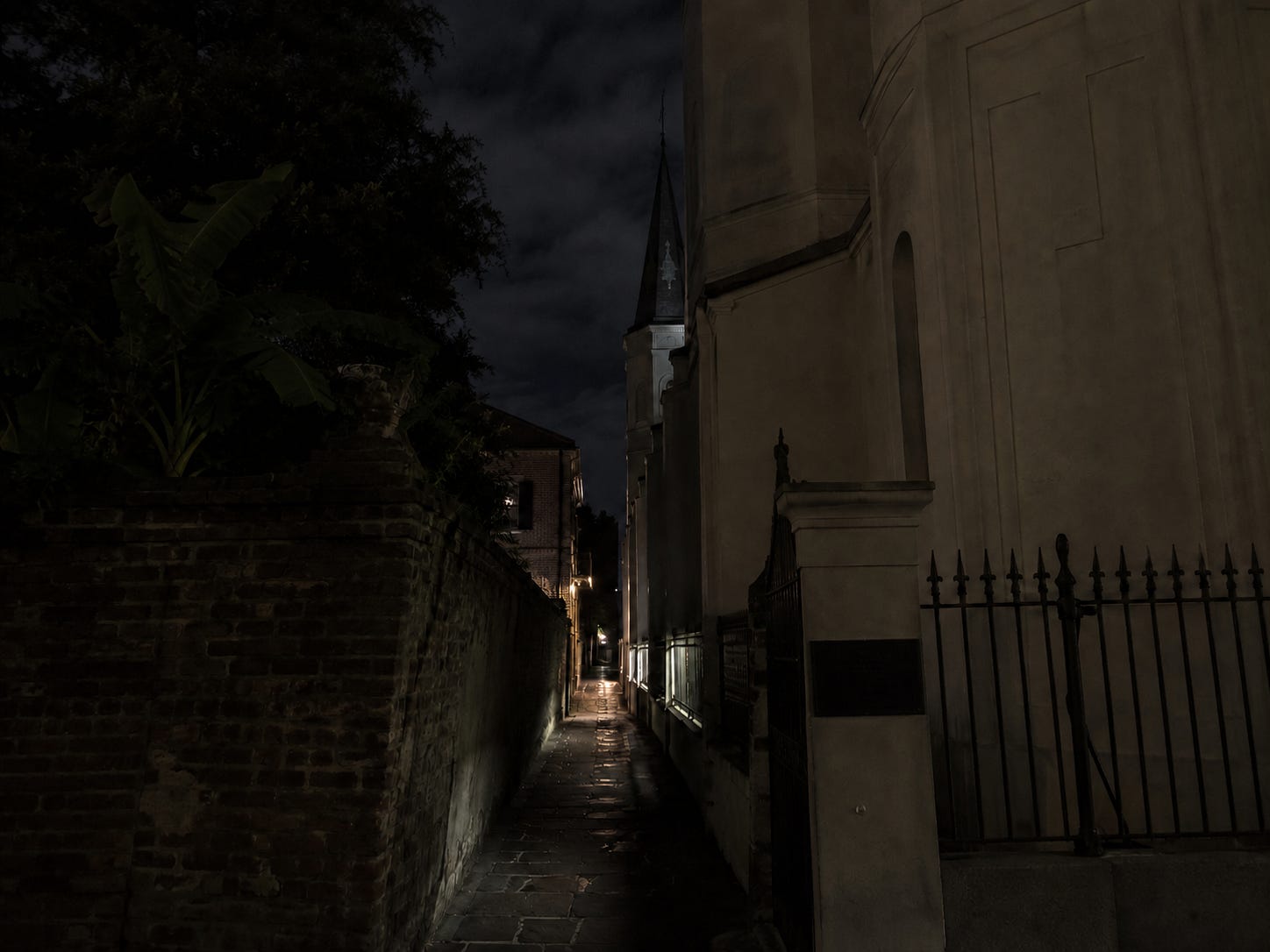
Valentine liked Jackson Square best before it woke all the way up.
At that hour, before the tour groups and the heat and the street-performers with their practiced chaos, the place still belonged to setup. Easels unfolding. Folding chairs dragged over old stone with a slow scrape. A trumpet warming up somewhere near the fence, not yet music, just brass and breath testing each other. Tarot readers smoothing cloth over their little tables as if the cards needed convincing to wake.
She walked through it with a paper cup of coffee in one hand and a beignet in the other, powdered sugar dusting her fingers, the front of her dark shirt, the edge of the worn knapsack slung over one shoulder. Charcoal. A few pencils. Several sketchpads.
She’d been in the city nearly a year now. Long enough to be recognized, not long enough to belong. That suited her. Too much leaked through people once they got close enough.
Val took another bite of the beignet and chose a patch of shade near the iron fence, where the light would stay soft another hour, maybe two. She could see most of the square without being too visible herself.
She sat, set the coffee beside her boot, and pulled the sketchbook free. The charcoal came next, wrapped in a rag that had once been white. Her fingers blackened almost at once. That part always settled her. Paper. Dust. Weight in the hand.
She was halfway through the first loose lines of a flower cart when she noticed the memorial.
It had been moved.
Not far. Just closer to the cathedral. Closer to the broad white front of St. Louis, where the stone caught early light and gave it back softer than it had any right to. Candles clustered in glass jars. Wilted bouquets. Notes curled at the edges from humidity. A few photographs tucked among the wax and flowers, faces smiling from a world that had already stepped away from them.
The city had been trying, in the fumbling public way cities always tried, to make grief visible enough to be honored and contained enough not to stop traffic.
Valentine set the charcoal down in her lap.
The other artists were noticing it too.
They weren’t staring directly, but she watched them glance and then glance away. The way people did when sorrow belonged to strangers and still managed to feel impolite to witness for too long.
Their auras changed near it.
It wasn’t imagination. She had spent too many years learning what color did around grief, prayer, hunger, and lies to mistake this for anything else.
The changes weren’t dramatic. Just color shifting at the edges. Thinning. Dragging. The way wet paint blends when one color is carried into another before either has dried. A bright, talkative vendor passed near the memorial and came out of it muted around the shoulders, his yellow gone dim at the margins. A woman with bracelets up both arms paused near the candles, and when she moved on, the blue around her had a washed-out gray appearance.
Val frowned.
Proximity, she thought first. Then a third person came away dimmed at the edges, and she knew it was worse than that. Her gaze shifted past the memorial, toward the narrow cut of shadow beside the cathedral.
Pirate’s Alley.
Val sketched it twice and threw both drawings away.
Something in it resisted being held still on paper.
Val stared at the alley a moment longer, then reached for the charcoal again. She tried the cathedral first, then the memorial, then the mouth of the alley. The lines crowded immediately. Shadow where there should have been space. Pressure where there should have been air.
Val tore the page free, folded it once, and tucked it into the knapsack without looking at it again. The coffee had gone cold. Powdered sugar still clung to the heel of her hand. Around her, the square continued waking, chairs scraping stone, voices rising, a deck of tarot cards snapping softly into a reader’s hands. But the feeling by the cathedral did not thin with daylight. If anything, it settled deeper.
She walked back to the gallery and worked on other things. A flower cart. A saxophone player near Royal. Nothing came right. Every open space tried to close. By late afternoon she gave up pretending she’d left the feeling behind.
She returned after dark.
Jackson Square had changed its face by then. The vendors were gone. The portrait artists had packed away their boards. Music drifted in from deeper in the Quarter. Jazz from an open bar door, brass softened by distance. The smell of food sat warm over the square: butter, garlic, frying oil, something rich with cayenne and onion. The cathedral stood whiter at night, less welcoming for it.
Val paused near the fence and let the new version of the place settle around her.
She noticed the tour before she looked up. Not the voices first, but the pull of attention gathering around someone practiced enough to make them focus. She lifted her charcoal from the page and watched them drift past the memorial in a loose cluster, their attention tugged between candles, cathedral stone, and the lantern swinging in the guide’s hand.
The guide moved like he knew exactly how much silence to leave between words. The dog at his heel was older, broad through the chest, cloudy-eyed and steady. The dog noticed the memorial before the guide did. Valentine could tell by the way his pace changed, just slightly, enough to show weight where there had only been motion a moment before.
The charcoal went still against the sketchbook. When the woman in the Saints hoodie raised her hand, polite enough, but interrupting just the same, Val was close enough to overhear.
***
“So is this where the priests were buried alive,” the woman asked, nodding past him toward the shadowed side of St. Louis Cathedral, “or is that somewhere else?”
Martin didn’t sigh. He’d learned not to. Sighing made people defensive. Defensive tourists stopped tipping.
“Different scandal,” he said easily, letting the pause stretch just long enough to hook the group. “Same building. New century.”
A few laughs. Phones came up. Lantern light bobbed as people shifted closer, instinctively tightening the circle. Martin adjusted his grip on the handle. It was an old habit, more comfort than necessity. He glanced down at the dog sitting patiently at his heel.
Roux didn’t look at the crowd. Roux never did. His cloudy eyes stayed fixed on the square, on the dark gaps between the benches and the iron fence, on the places where sound didn’t quite behave the way it should.
Martin kept talking.
“Now, Jackson Square looks peaceful,” he said, pitching his voice low enough to feel intimate, “but it’s always been a crossroads. Faith, money, power. Wherever those meet, people tend to leave pieces of themselves behind.”
Someone asked if Andrew Jackson haunted the place. Someone else asked about vampires. A guy in a black Misfits T-shirt asked if anyone had ever actually died on one of these tours.
Martin fielded them all, smooth as a practiced card trick, steering the group toward one corner of the square, where the lamplight thinned and the night pressed closer. Toward Pirate’s Alley, narrow and crooked, a slash of old stone between the cathedral and what used to be the archbishop’s residence.
“This alley,” he said, stopping just short of the entrance, “wasn’t built for tourists. It was built for shortcuts. Smugglers, clergy who didn’t want to be seen, Jean Lafitte himself, depending on which version you like.”
One of the men near the rail leaned forward. “So this is the haunted one.”
“They’re all haunted,” Martin said. “This one just doesn’t bother hiding it.”
That earned him a murmur. He felt the familiar rhythm return. Let them think they were choosing to be afraid.
Roux stood.
Quickly, not stiffly, the way he did when his joints bothered him. He rose all at once and stepped forward, then stopped dead at the mouth of the alley.
His hackles didn’t rise. He didn’t growl.
He simply refused to go any farther.
Martin felt it then. Something off-balance.
“Easy, old man,” he murmured, giving the leash a gentle tug.
Roux didn’t move.
Behind him, someone laughed. “Guess he’s seen this one before.”
“Guess he has,” Martin said, forcing a smile as his pulse ticked up half a notch. Roux had been with him for eight years. Floods, fireworks, drunken parades, costumed idiots lunging for selfies. The dog had never balked like this. Never at a street.
Martin shifted, angling his body slightly between Roux and the alley, still talking, still selling the story. “Pirate’s Alley gets blamed for a lot of things,” he went on. “Cold spots. Sudden headaches. Cameras that won’t work. But most folks just feel—”
He stopped.
Because Roux was looking at him now.
Warning.
Martin swallowed and finished the sentence differently. “—like it’s not meant to be rushed.”
The group waited. Lantern light flickered across old brick. Somewhere deeper in the Quarter, music slid into silence and came back wrong, half a beat off.
Martin laughed again, lighter this time. “We’ll circle around,” he said. “Better view from the other side anyway. Trust me.”
There was a ripple of disappointment, but it passed. People followed when he turned. They always did.
As they moved away, Martin glanced back once.
The alley looked the same as it always had. Damp stone. Shadow. Nothing a camera could catch. But the air inside it felt… held. As if someone had paused mid-breath and forgotten how to let it go.
Roux didn’t relax until they were halfway across the square.
“Yeah,” Martin murmured, rubbing the dog’s grizzled head as the crowd trailed along. “I felt it too.”
Roux leaned into the touch, satisfied, and sat.
Martin cleared his throat, lifted the lantern, and launched into the next story about duels, betrayals, and the kind of deaths people liked to imagine because they came with explanations.
The crowd leaned in again. The rhythm returned. Question, pause, answer. Roux settled at his heel, though Martin still felt the alley at his back like a hand not quite withdrawn.
The tourists were watching him, waiting to be led somewhere safer than whatever had just happened. He smiled and kept talking.
***
By the next night, Martin had convinced himself Roux’s hesitation was a fluke.
Dogs got odd sometimes. Age did that. A joint twinge, a smell that tripped an old memory, a mood he couldn’t translate. He’d spent enough hours on these streets to know that if you gave a place too much meaning, it started charging you rent.
The group was smaller tonight, six instead of twelve, and quieter in a way he didn’t love. More locals. Fewer people looking for a story they could laugh off afterward.
Things held together until the memorial slowed them. A young woman in a knit cap stopped at the candles, staring at the photographs with the stillness of someone who recognized something in them. Martin waited.
A man at the back, mid-thirties, ball cap, a little too restless, shifted his weight and glanced toward the narrow cut of darkness beside the cathedral.
“Is that the alley?” he asked. “The pirate one.”
“It’s an alley,” Martin said, keeping it light. “And yes, tourists call it Pirate’s Alley because it sounds cooler than ‘stone corridor where you’ll bump shoulders if you’re not careful.’”
Ball Cap nodded, smiling like he’d already decided something. “Can we go through it?”
Martin started to say no. He’d redirected last night and nobody had argued, but tonight the group had that quiet entitlement some people wore like a coat. They didn’t make noise. They made decisions.
“We’re going to take the wider path,” Martin said. “Better view, better lighting, fewer—”
Ball Cap stepped away from the group.
Not far. Just a few paces. Toward the alley’s mouth.
Roux stood.
It wasn’t a bark. Not even a growl. Just a sudden, full-body decision. The leash drew taut as Roux leaned forward and then angled himself sideways, positioning his old frame between Martin and the alley like a gate.
Martin’s pulse ticked up.
“Hey,” he said, tone easy, as if the man had wandered toward a street performer and not something else. “Sir. Stay with the group.”
Ball Cap held up both hands. “Relax. I’m just looking. I wanna see if it’s cold.”
Behind him, a woman laughed softly, uncomfortable. “Don’t be an idiot.”
Ball Cap took one more step.
And the air in the alley changed. Subtly, but unmistakably. The night that had been soft with river dampness turned dense, like someone had pressed a palm over your mouth and told you to breathe anyway.
Martin felt his own breath catch. He wasn’t superstitious. He didn’t believe in ghosts.
But he believed in the way his body reacted before his brain caught up.
Roux’s ears flattened. He didn’t lunge. He didn’t panic. He stared into the alley as if his body remembered something his mind didn’t need explained.
Martin tightened his grip on the lantern. The light didn’t flicker. It didn’t dim. It simply looked smaller than it should have.
Ball Cap blinked.
His expression shifted from cocky to puzzled, like he’d forgotten what he was doing mid-step. He glanced back at Martin, frowning.
“What the hell,” he muttered, and the words didn’t carry the way they should have, swallowed by the alley like cotton.
Martin took a step forward to retrieve him by force if he had to.
Roux moved with him, shoulder brushing Martin’s shin, pushing. Not away, but sideways. Redirecting. Herding.
“Okay,” Martin said, more firmly. “That’s enough.”
Ball Cap shook his head hard, as if clearing water from his ears. He stepped backward out of the alley’s mouth, and the pressure eased so fast Martin felt slightly dizzy from the release.
The group exhaled in a ragged chorus, most of them not realizing they’d held their breath.
Ball Cap forced a laugh. “Weird. Felt like… like walking into a walk-in freezer.”
“That’s the cathedral shadow,” Martin lied smoothly. “Stone holds cold.”
The woman who’d been staring at the memorial didn’t smile. She was watching Ball Cap’s face with the focused attention of someone checking for concussion.
Martin smiled anyway, because that’s what he did. He raised the lantern and gestured them away. “We’re going to continue,” he said. “Next stop has a better story and fewer idiots trying to prove something.”
A couple of people chuckled. Ball Cap looked vaguely offended, but he stayed with the group.
They moved.
Martin kept his pace steady, but his mind was no longer on rehearsed lines. He kept glancing back at the alley without meaning to, the way you glanced at a door you weren’t sure you’d locked.
Across the square, Valentine’s pencil had stopped moving.
She didn’t need to hear the words. She saw the man’s aura wash out at the edges as he neared the alley. Saw the old dog brace. Saw the guide lie cleanly, the way people did when they meant to keep others safe.
The alley looked unchanged. Stone. Shadow. A narrow mouth beside the cathedral.
But the alley had noticed them.
Valentine closed her sketchbook with slow care, as if sound itself might be too sharp, and slid off the wall.
Toward home. Toward the small things she could control.
If places could fill up, they could empty.
She had to stop feeding this one.
***
Her apartment sat above the gallery like an afterthought. One bedroom, a narrow kitchen, windows that caught evening light. She set her sketchbook on the small table by the window and stood there for a moment, listening to the square breathe. Footsteps. A laugh too loud. A violin warming up somewhere near the fence.
Downstairs, the gallery lights were still on. The owner must have decided to stay open late again, betting on night traffic and impulse buyers. Val considered going down to help, then changed her mind.
She needed to make something first. Charcoal, not pencil. Something broad. Forgiving.
She pinned a fresh sheet to the board and started with the cathedral—not the whole thing, just the suggestion of height and curve. She let the lines stay loose, imperfect. Then she added the candles, not as points of light but as soft interruptions in shadow. Negative space mattered more than accuracy tonight.
She worked fast, hands moving before her thoughts could catch up. Every time she hesitated, the lines crowded. Every time she trusted the motion, the drawing opened.
When she finished, she sat back and looked at it from a distance. The cathedral felt like a shelter again, not a magnet. The candles looked like they belonged where they were, not like they were spilling outward.
“Good,” she murmured, though she didn’t know to whom. Val placed the drawing in a plain mat and took it downstairs.
The gallery owner raised an eyebrow when Val set it on the counter. “New?”
“Tonight,” Val said. “Window, if you’ve got room.”
The owner examined the charcoal and paused. “This one’s… quieter.”
Val nodded. “That’s the idea.”
They swapped out a louder piece with bold colors, a street performer mid-shout, for the charcoal cathedral. The window changed immediately. Less spectacle. More invitation. People slowed when they passed, then moved on without clustering.
She didn’t stop there.
Val carried a box of sidewalk chalk and returned to the cathedral, knelt near the iron fence and began to draw. Just lines. Arrows that didn’t look like arrows. Curves that suggested paths without dictating them. She placed them so that feet followed without thinking. Toward the benches. Toward the performers. Away from the narrow cut beside the cathedral.
The chalk was only the visible part. The real work lay in attention. In where it gathered, where it slipped, and how gently she could persuade it elsewhere.
A few tourists stopped to watch. A child tugged a parent closer. Someone asked what it was supposed to be.
“Nothing finished,” Val said lightly. “It’s better while it’s changing.”
They nodded, satisfied by the non-answer, and drifted on. Val completed the work and drew back to watch.
Across the square, Martin was starting another tour. Val recognized the cadence of his voice even before she saw him. Measured, practiced, friendly without being familiar. Roux padded along at his side, leash slack, posture easy. Good sign.
As the group approached the memorial, they slowed, but they didn’t stop. The chalk lines did their quiet work, guiding feet along a wider arc. People glanced at the candles, read a name or two, then kept moving. No one lingered long enough to sink.
The alley stayed dark and unremarkable.
Martin felt the difference before he understood it. The square was still heavy, but it no longer pooled. Roux stayed loose at his side, and his jokes landed.
When they reached the place where the alley branched off, no one asked about it.
Martin took the route he’d planned to take anyway and told a story about a duel that ended badly for both participants. It was the kind of story that let people imagine danger without inviting it closer.
As the group moved on, he glanced toward a nearby gallery window and frowned.
The new drawing caught him by surprise.
He stopped just long enough to register it. The way the cathedral seemed to step back instead of looming, the way the light felt free. He didn’t know what to call it. Art, instinct, some Quarter superstition with better manners than most. But the square had shifted under someone’s hands.
Roux noticed the pause and looked up at him, tail giving a single, satisfied wag.
“Yeah,” Martin murmured. “I know.”
Later, when the tours ended and the square thinned, Val sat on the steps near the fence and wiped chalk dust from her hands. The lines on the ground were already smudging, softened by shoes and humidity. Good. Nothing permanent should pretend to be.
She watched the alley from a distance. It didn’t feel friendly. It didn’t feel safe.
But it felt quieter.
Like a room after the music stopped.
Val stood and headed back toward the gallery, already thinking about what she’d put in the window tomorrow. Something open. Something that suggested air.
***
Later, when the last of the tour had drifted toward bars and balconies, Martin stopped outside the gallery window.
Roux sat beside him without prompting, gaze turned toward the cathedral and then away again, as if the question had eased but not vanished.
The drawing in the window caught Martin harder up close. St. Louis was still there, the candles too, but the whole thing had been opened somehow. The light no longer crowded at the edges. The square looked like it could breathe.
Valentine stood just inside the doorway, charcoal still ghosting her fingers.
“You changed it,” he said.
“The drawing?”
Martin glanced up. “The feeling.”
That earned him a longer look than she’d given him before. Not suspicious. Weighing.
“That sounds like something a tour guide says when he wants someone else to explain his story for him,” she said.
One corner of Martin’s mouth moved. “Maybe I’m off the clock.”
Roux rose and crossed to her without hesitation. Valentine crouched, offering her hand first. The old dog leaned in, accepted the touch, and settled.
“Well,” Martin said, watching that, “he likes you better than most people.”
“He likes honesty,” Valentine said.
“That a warning?”
“Just an observation.”
Martin looked back toward the alley. “Something’s wrong there.”
Valentine followed his gaze. “Yes.”
He waited. When she didn’t add to it, he said, “You want to give me the version for civilians?”
She almost smiled. “Too many people have been stopping in the same grief, in the same place, for too long. It stays when they leave.”
Martin let that sit. Strange as it was, it felt closer to true than anything else he’d come up with.
“And the chalk?” he asked.
“Just room,” she said. “Sometimes that’s enough.”
Roux pressed once into her hand, then stepped back toward Martin.
“Martin,” he said after a beat, as if the introduction had become unavoidable.
“Valentine.”
He nodded first toward the window, then the alley. “They helped.”
“I know,” she said.
This time, when he smiled, it wasn’t for a crowd. “Alright,” he said. “Good.”
“Oh.” he paused, turning back. “And this is Roux.”
Then he touched two fingers to the brim of nothing, tugged Roux’s leash lightly, and moved back into the street.
***
Morning in Jackson Square arrived softly, like an apology.
Valentine watched it from her second story window with a mug of coffee cooling in her hands. The square was never empty, not really, but at this hour it felt porous, the night’s impressions lifting off stone and iron as the light crept in. The memorial remained where the city had placed it, candles melted into small wax lakes, flowers bowed under their own weight. A few people stood there already, heads inclined, careful not to speak.
Valentine set the mug down and opened her sketchbook. She didn’t draw the alley. She drew routes. Curves that suggested movement, pauses that felt intentional. She drew the square as a system rather than a subject: performers as eddies, benches as anchors, open stone as current.
Not to erase the grief, just to keep it moving.
Downstairs, she rotated the window again before the gallery opened. The charcoal cathedral stayed. She added two smaller pieces, one of Jackson Square sketched wide and open, another of a violinist caught mid-movement, bow hovering above strings. Nothing sensational. Nothing that demanded stopping.
People slowed anyway. Looked. Moved on.
Valentine taped a small card beside the display, hand-lettered, simple:
Open nights. Please move gently through the square.
By mid-morning, she was on the square with chalk again, this time lighter, subtler. No arrows. Just gentle interruptions where feet naturally hesitated, widening paths by suggestion alone. She worked where shadows fell in the afternoon, knowing the heat would soften the lines and the city would finish the job for her.
Across the square, Martin finished his coffee from a paper cup and clipped the leash onto Roux’s collar. The old dog stretched, content, then looked toward the cathedral and away again, as if the question had already been answered.
They’d altered their route officially now. Tours flowed better for it. Even the tips held.
Martin paused by the gallery window, longer this time. He didn’t go in. He just nodded once at the new drawing.
“Good morning, Valentine,” he said quietly, and moved on.
The memorial stayed for weeks.
Some nights were heavier than others. Anniversaries. Festivals. A sudden swell of visitors. On those nights, Valentine adjusted. She swapped the window pieces. She redrew the chalk.
The alley never stopped being an alley. It didn’t turn friendly. It didn’t empty completely.
But it stopped collecting.
Near the end of the month, Valentine noticed the candles thinning. Notes curled and were removed. Flowers browned and disappeared. The city began, gently, to reclaim the space. When the memorial was finally taken down, the square breathed easier. So did the alley.
Martin paused by the fence while Valentine scuffed the last of the chalk thin with the side of her shoe.
“Looks quieter,” he said. “I kept waiting for it to feel wrong again, and it just… didn’t.”
Val glanced toward the alley. “It is.”
Roux stood beside him without tension in his shoulders, old eyes half-lidded, as if the matter had been settled to his satisfaction. Val squatted and stroked his head.
Martin let out a breath through his nose. “Well. I like that. Roux likes that.” He grinned. “And my tips like that, so I’m calling it a win.”
Valentine almost smiled, her eyes softening.
He made it sound like a joke, but coming from him, it meant more.
Later, Valentine stood at her window and watched the square do what it had always done: hold joy and sorrow side by side without letting either dominate. She crossed her arms and leaned against the wall, content.
She hadn’t fixed it. She’d only helped it pass.
And for now, that was enough.
If you enjoyed this story, and would like to support my work with a simple tip:
No posts
Comments
Nothing yet. Say the first thing.
Sign in to join the conversation.