
This email may be truncated in your inbox. To make sure you are reading the entire post, please move yourself along to a web browser!
Website | Instagram | Shop Absolument | Book Recs
If you enjoy this writing and imagery, would you mind liking, commenting, or sharing it with a friend?
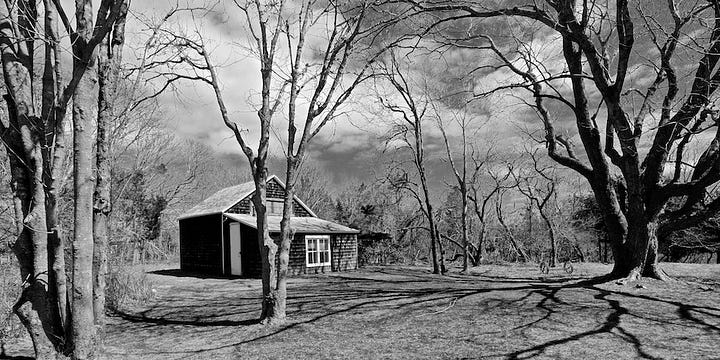
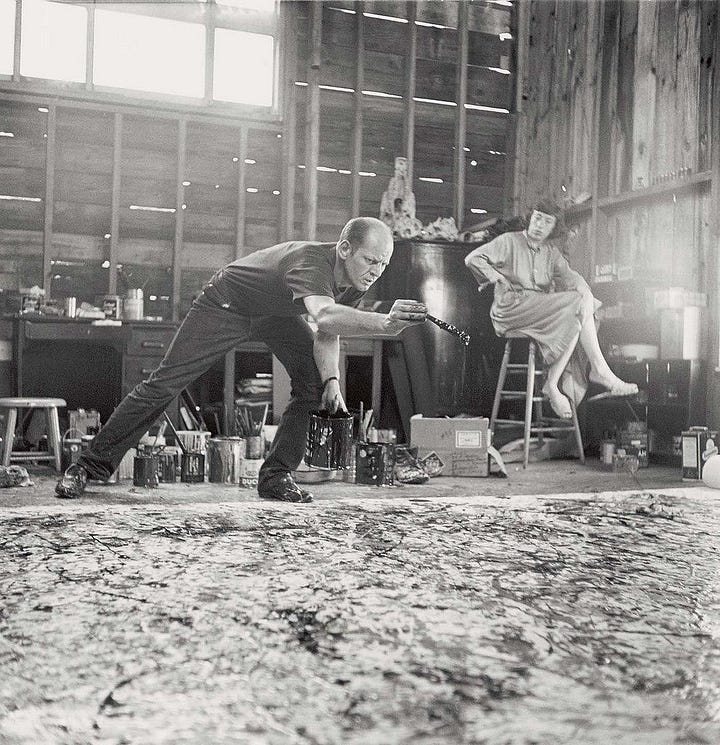
❥ With the passing of David Hockney, I’ve been thinking even more intensely about the legacies that artists leave behind. This week marks the anniversary of the world losing the terrific artist, Lee Krasner, in 1984. Lately, I keep finding myself spending more time in Lee’s corner, admiring her fortitude and explorations; her home and studio in Springs, New York; her independence, her ways of carving out new languages in painting; and how her story—even right here—inevitably always makes its way back to her husband, Jackson Pollock.
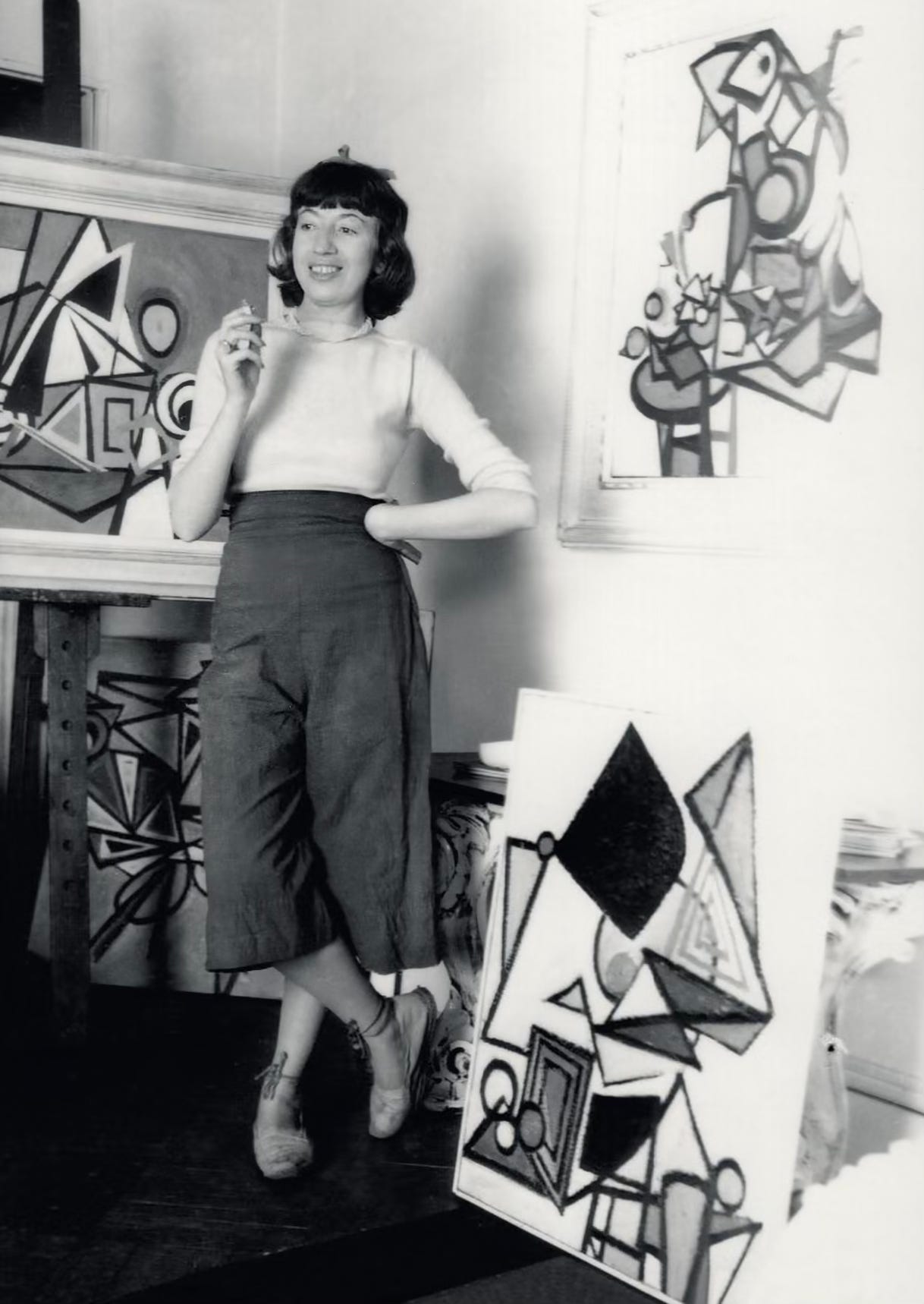
During research, I keep checking the sources of other writers, and they often point back to an incredibly strong Lee interview: an oral history from 1972 conducted by Doloris Holmes—a performance artist and poet—for the Archives of American Art, Smithsonian Institution.
Sometimes I’ll read an artist interview that absolutely steals the breath from me. Usually, they’re text-heavy, and even though they refer to art, they aren’t accompanied by nearly enough photographs. Or any pictures at all! I’ve hyperlinked her words, hoping that you’ll follow the tracks to other art stories, and added some color photographs of the artwork and people she refers to with care. My hope is to give you some extra room for exploration and visuals to make Lee’s words even shinier. What follows is a Krasner-led art history lesson.
*All text displayed below is not my own—it belongs to Lee Krasner, Doloris Holmes, and the Smithsonian Institution’s Archives of American Art oral history project.
You can excitedly read other art history lessons from these infinitely interesting artists and art collectors:
DOLORIS HOLMES This is Doloris Holmes interviewing for the Archives of American Art. We are documenting the Protest Art Movement of the 1970s. This evening I am interviewing Lee Krasner. Lee, in front of me, I have an issue of Art in America which appeared in August 1965. There is a series prepared by the Archives of American Art.
One in particular has to do with the general abstract expressionist movement. I note with interest that about seventy-three artists are mentioned in this article, only four of which are women. Marisol is mentioned, Hedda Sterne, Alice Mason, and Louise Nevelson.
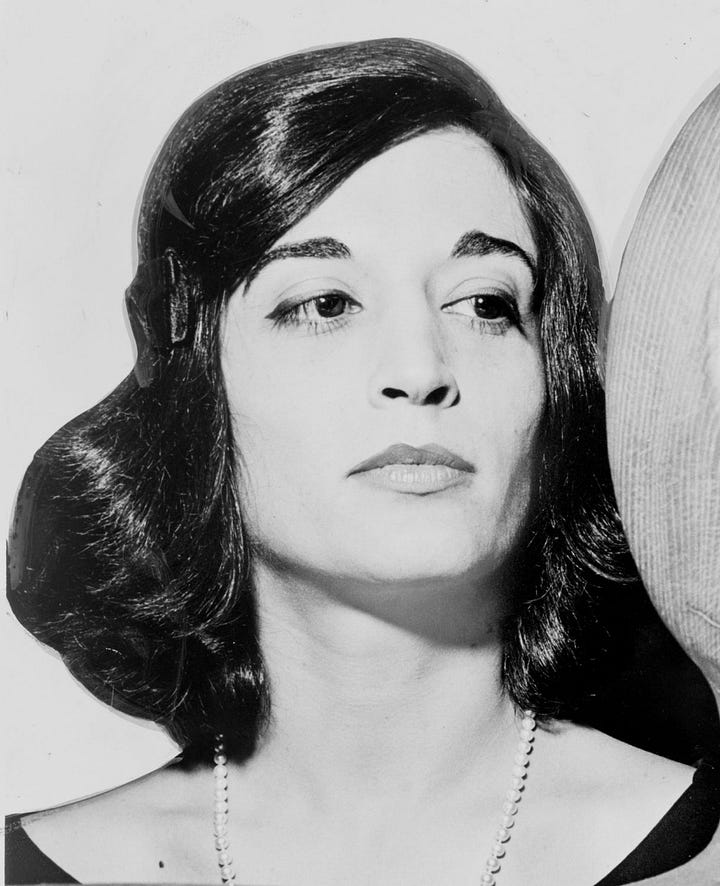
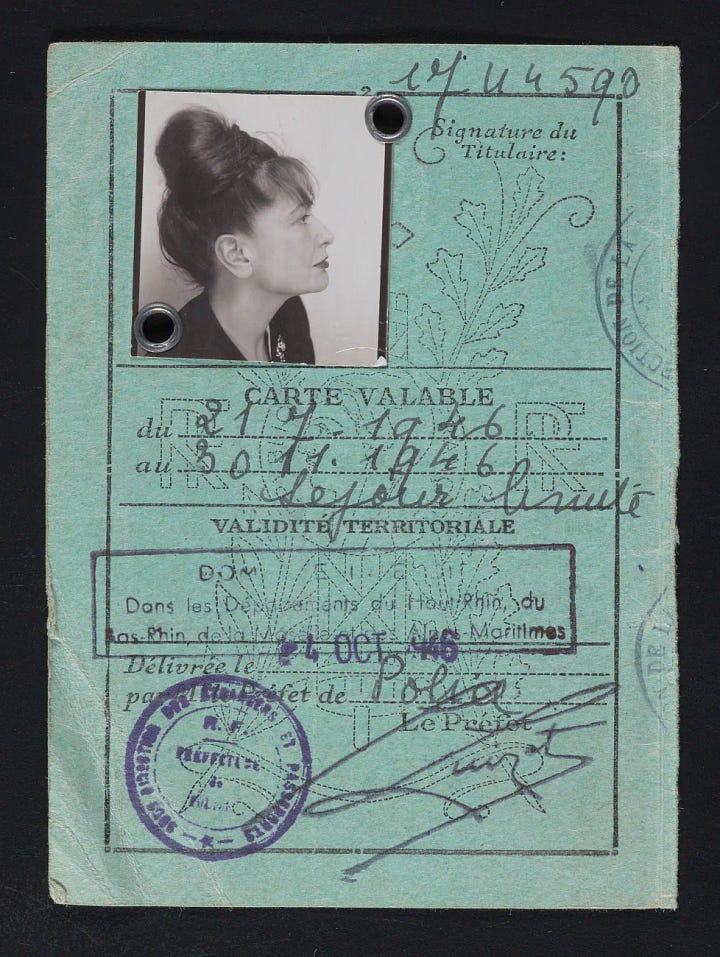
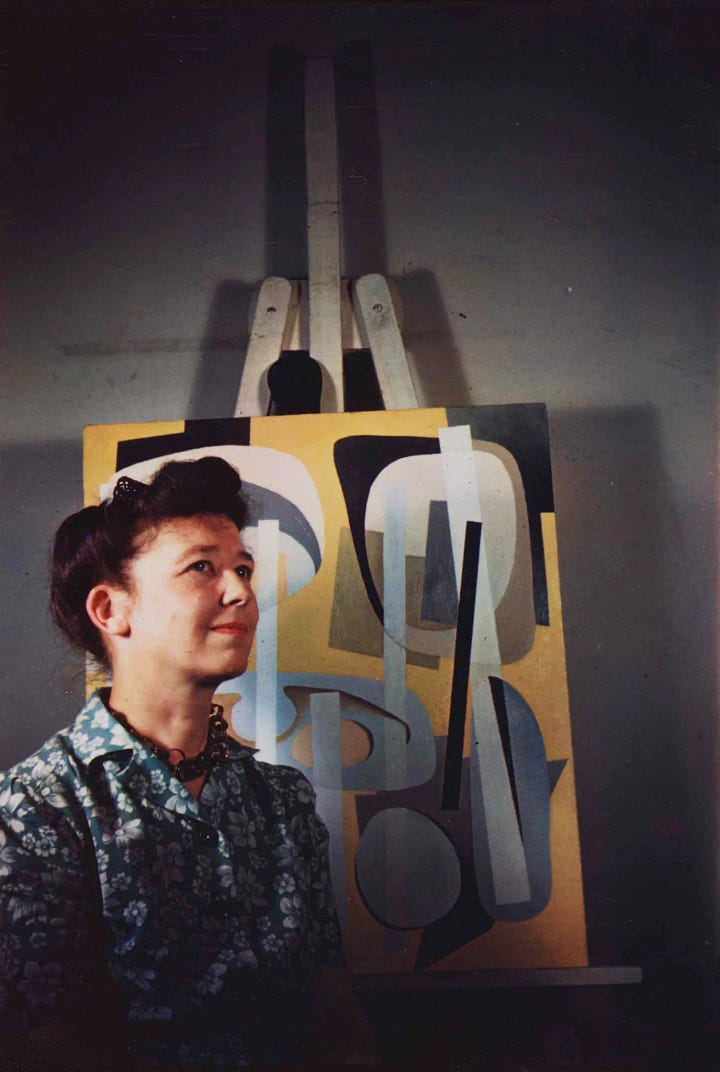
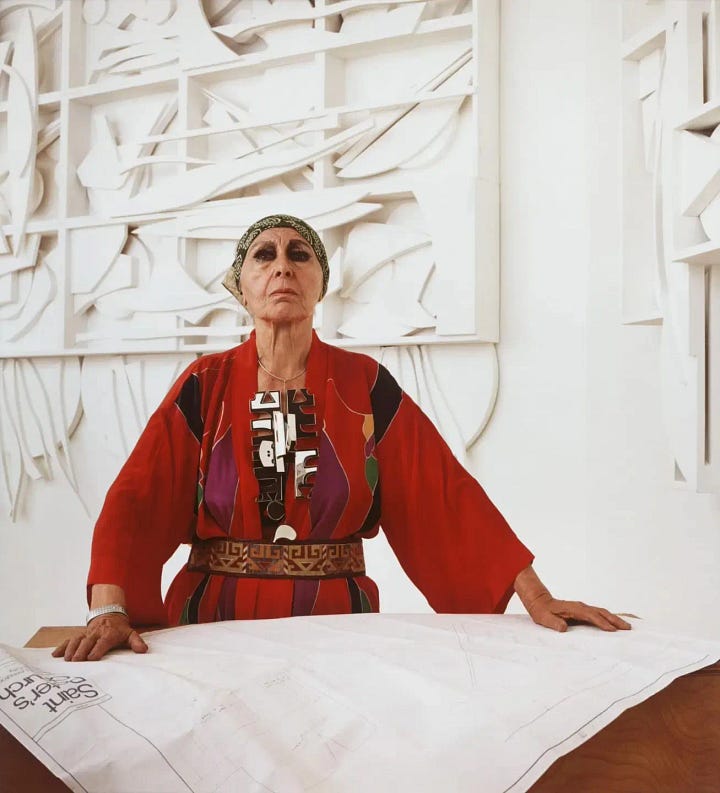
If you were to rewrite this article, what are the names of some of the female artists working around that time that you would include?
LEE KRASNER Well, let me say I’d like to throw out a few names of female artists dating possibly from the late 1935 to the mid-1940s, or a little later if you like.
That is to say, women artists that I was aware of: Loren MacIver, I. Rice Pereira, Louise Bourgeois, Jeanne Reynal, Anne Ryan, Sonja Sekula, Louise Nevelson, Alice Mason, Gertrude Greene, Suzy Frelinghuysen, Leonor Fini, Dorothea Tanning, Vieira de Silva, Barbara Hepworth, and lastly but hardly least, Miss Georgia O’Keeffe.
Now I know when you restrict it to abstract expressionism, some of these names would have to be removed.
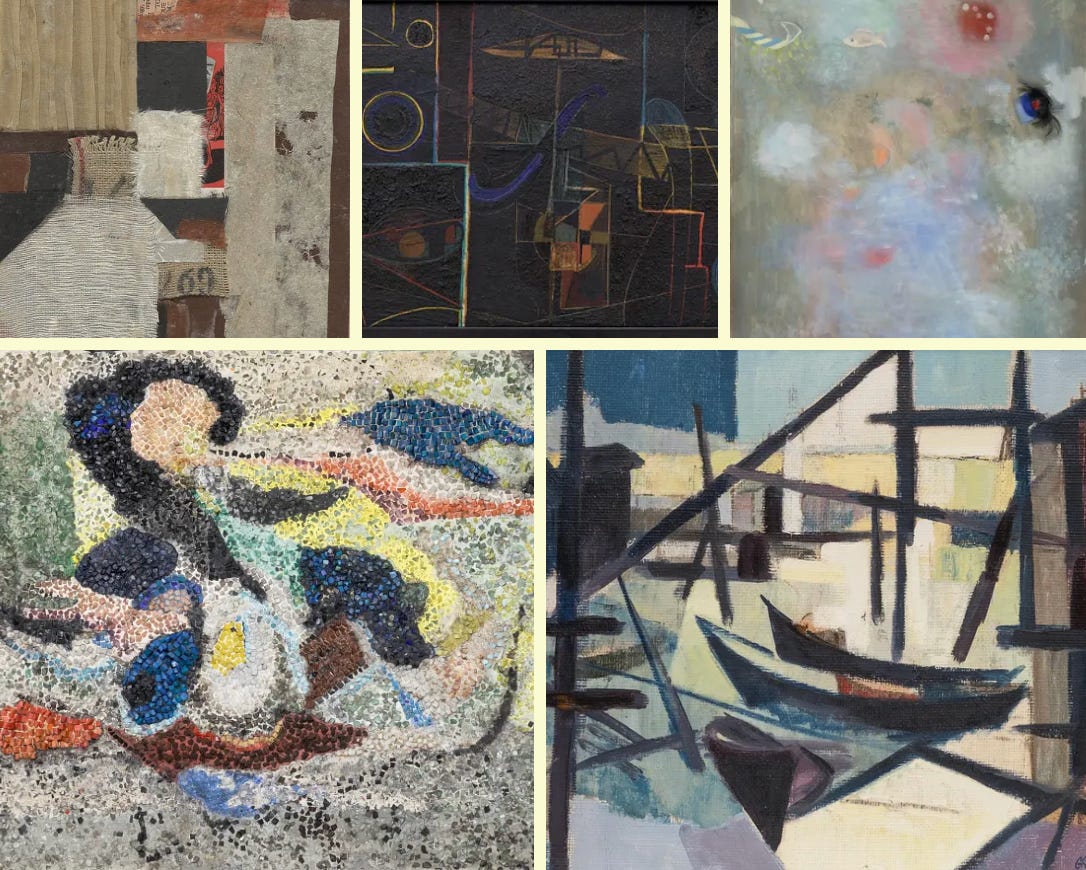
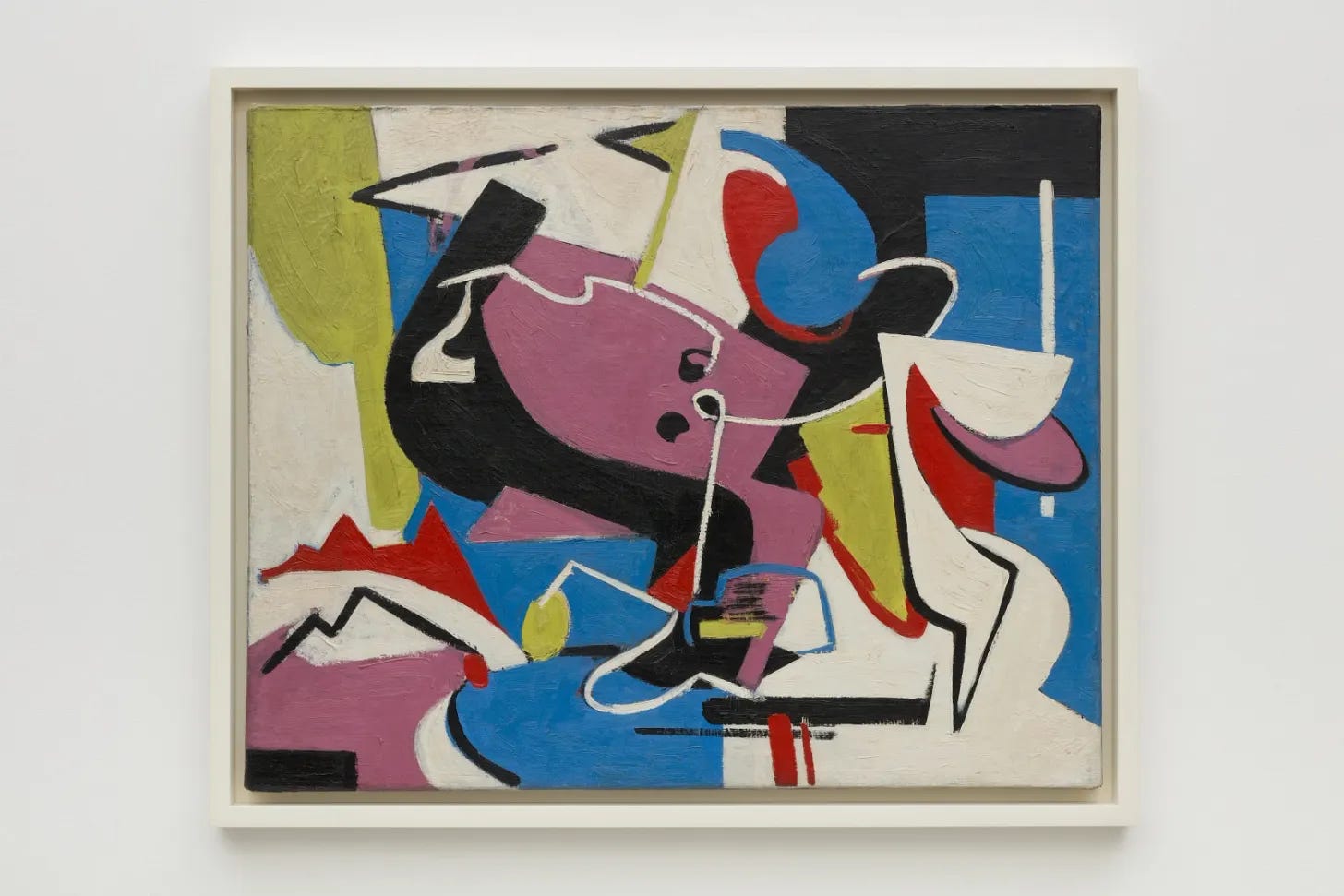
DOLORIS HOLMES But these are women who are consistently working at a caliber that you would certainly consider professional artists. Can you tell me whether you feel that these typical women have gotten enough recognition for their work? Do you have any sense as to whether there was discrimination against them as female artists?
LEE KRASNER That’s a difficult question. Certainly some of the names I’ve read off to you have gotten recognition. Others I daresay haven’t. Now as to what they experienced in terms of discrimination I’m not prepared to say; I can only speak for myself and my own experience.
DOLORIS HOLMES I also notice in the same article mention of at least two different groups which involved abstract expressionist artists. One was the Eighth Street Art Club, apparently a group that got together to discuss issues, and another group was organized around a particular issue and picketed in front of the Metropolitan Museum. Were you asked to be a member of either one of these groups?
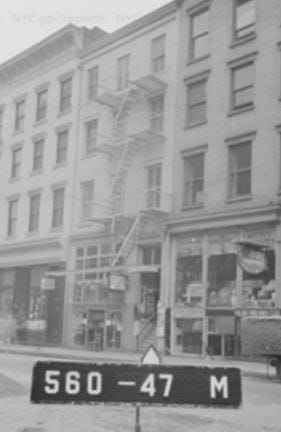
Or can you mention other groups that you were, or were not, invited to become a member of?
LEE KRASNER I was certainly asked to become a member of the Eighth Street Club; that’s one of the groups that you mentioned. But I never became a part of it. I guess for one thing, living out here (East Hampton) would have made that very difficult; it was all year-round living out here. And also because I’m a little uncomfortable about any kind of groups or clubs. I tend not to like to join. Nevertheless, I’ve been in a few.
With regard to “The Irascible Eighteen,” that was never a group, so to speak.
The issue was a specific issue at the Metropolitan. There was an organized protest. Since Jackson [Pollock] and I were out here, all I can say about that is that the phone rang one day, I picked it up, Barney Newman was at the other end. He said that he wanted to speak to Jackson and that it was important. I got Jackson on the phone. Jackson told me what the phone call was about. But I wasn’t asked to become part of it. My sympathies were certainly there. But since I wasn’t asked to become part of it, I don’t appear as one of “The Irascible Eighteen.”
DOLORIS HOLMES How about your relationships, artistic and personal, to the men who were involved in this general abstract expressionist movement? Generally in some of the women’s groups that I belong to it has been said that men really do exclude women from getting information about where you can show, about, getting names of curators to whom you can send your slides, about getting material concerning supplies, and so forth. Have you had any experiences similar to this?
LEE KRASNER I’m trying to pinpoint your question; it’s a little difficult for me to grasp it. I haven’t experienced it in the sense that the secrets are kept within the confines of the male domain. Since I lived here with Jackson for many years, and since that was more or less one of the centers of this movement, all that sort of information was available to me. I didn’t have to pry into corners to get at what was happening.
DOLORIS HOLMES All right. Well, let’s be more specific then. Do you feel that male artists were helpful to you in getting you into shows?
LEE KRASNER Well now, that’s more reasonable. Yes, there were male artists that were helpful in getting me into shows, and there were male artists that I don’t feel were helpful.
For instance, John Graham was very helpful in getting me into an exhibition of French and American Painting, this was in 1942.
As a matter of fact, that’s how I meet Pollock; he’s invited to the same show.
[Kelsey note: The first thing Jackson Pollock ever said to Lee Krasner at a party a few years earlier, while he was drunk, was, “Do you like to fuck?” The epitome of romance, right?]
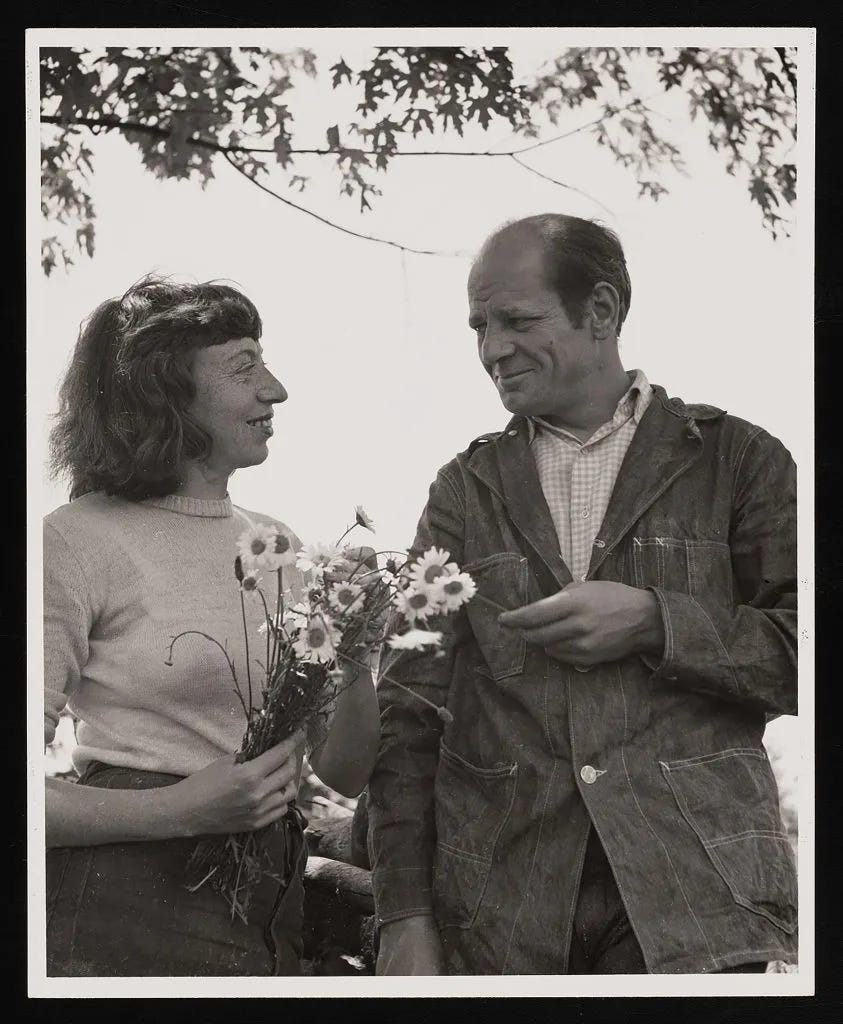
There was Pollock himself who asked Betty Parsons to come and look at my work with regard to showing me. And indeed she did come and did schedule a show for me in 1951.


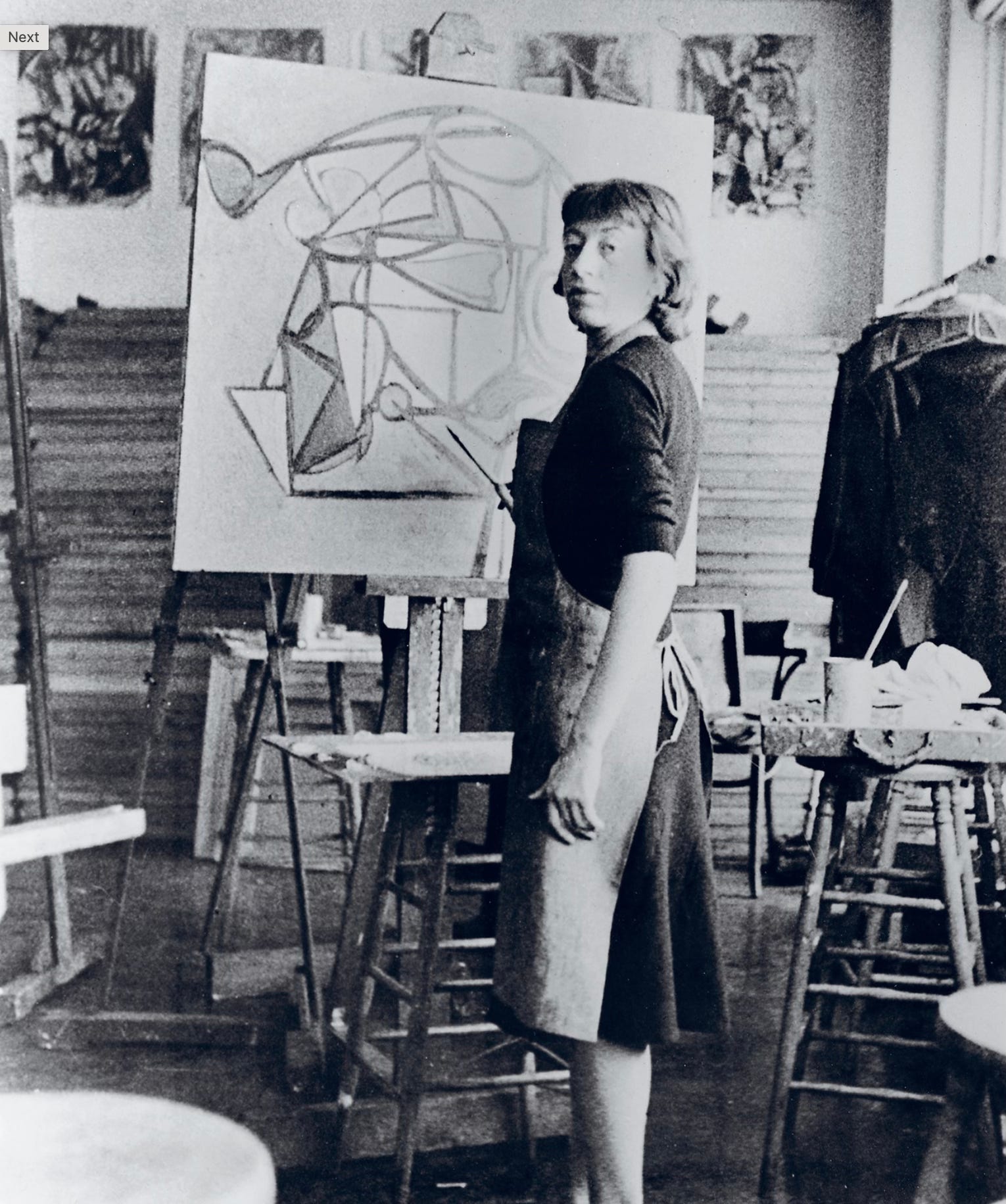
On the other hand, someone like Hans Hofmann, who was one of the only instructors I had ever had in all as against former teachers at the Academy and Cooper Union. I can remember very clearly his criticism one day when he came in and said about the painting up in front of him, “This is so good you would not believe it was done by a woman.” Well, that’s pretty difficult to understand.
DOLORIS HOLMES It’s a kind of a mixed compliment, in other words?
LEE KRASNER Well, yes. You know, you get a cold shower before you’ve had a chance to receive the warmth of the compliment.
DOLORIS HOLMES I remember before when we talked on another occasion you did tell me something about a long series of discussions that you had with Barnett Newman. This I believe had something to do with a Synagogue that he was making. This was an interesting story.
LEE KRASNER Indeed I think it’s an interesting story. Barnett Newman and I had a long running battle which was never resolved since Barnett died last year.
The argument or battle that we had going for some ten or twelve years was on my rejection of the position of the female in Judea. This he would not accept. His point of view was that I misunderstood it; mine was that I understood it too clearly and rejected it. And so from time to time we picked up the argument. It ran through a period of years.
One day at a very large party, which was quite a traumatic party for me in many respects, in between one thing I had just gotten through with and before I hit the next thing, Barney appeared from some place and said, “Lee, have you seen my Synagogue?” I said, “Where is your Synagogue?” He said, “It’s at the Jewish Museum.” I said, “No, I haven’t seen it. Why do you want me to see it?” He said, “It’ll resolve that argument we’ve been having all these years.” And I said, “In what sense?” He said, “You will approve of where I placed the women in the synagogue. It will end the argument.” And I said, “Where did you place the women, Barney?” And he said, “On the altar.” Whereupon I—well—used no uncertain terms about how I felt about it and said, “You sit up on the altar; I just want the next empty seat in the next pew that’s vacant.”
DOLORIS HOLMES Beautiful: That’s a beautiful story. To go on to speak about other members of the abstract expressionist movement, certainly one of the leaders has been Willem de Kooning.
My own personal reaction to his work is that there is indeed an undercurrent of anti-feminism in it. I cannot analyze with any authority why he chose to do the series on women, but it is my sense, partly as a former psychiatric social worker, that Freudianism and the abstract expressionism movement reinforced a general antifeminism in the culture.
Do you have anything in particular to say about de Kooning as an artist and about his series on women in particular?
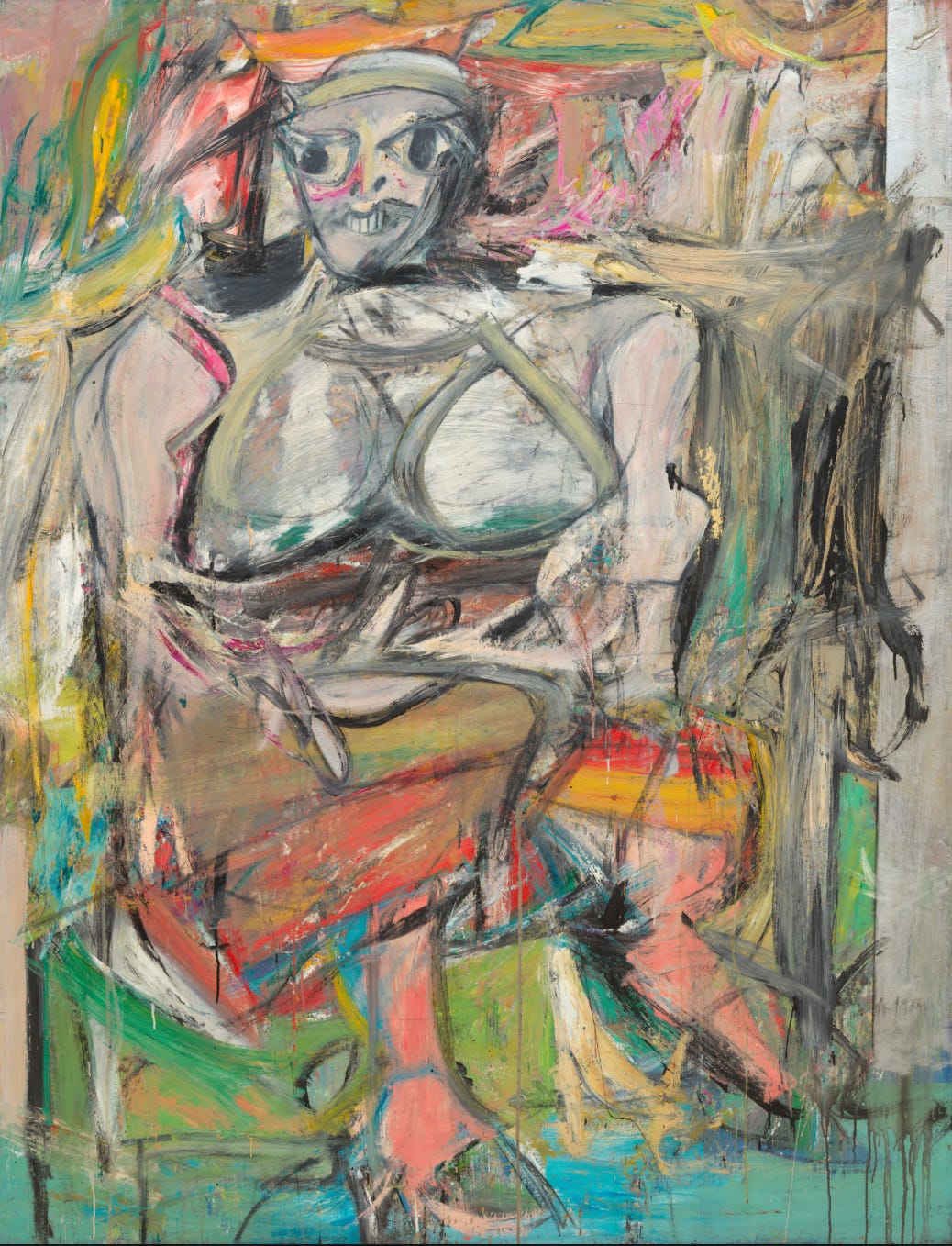
LEE KRASNER Well, with regard to de Kooning, certainly he is one of the leading forces in this movement. With regard to his series on women, I reject them one hundred percent; I find them offensive in every possible sense; they offend every aspect of me as a woman, as a female.
DOLORIS HOLMES Explain that a little bit more.
LEE KRASNER On the other hand, when you introduce the Freudian aspect in abstract expressionism I must say I haven’t thought of it in those terms. I must give it a little more thought. Now when you speak of a kind of chauvinism, or domination of the male there, certainly I’ve had many such experiences. Whether we’re discussing de Kooning’s series on women, or whether it’s the authoritarian or autocratic image of, let’s say, Rothko or Newman all of which I can see that you might read as the Freudian aspect, so to speak - I would have to sit with this a while longer to come to some conclusion of my own.
On the other hand, you must keep in mind that the seat of contemporary painting was the Paris School, and here in New York was a body of people that were - now we can safely say - crashing through that, so that I’m not sure at this point whether it was entirely a male Freudian aspect (unless you want to take all of civilization as we have known it, all of Western thought, and speak of it in those terms), it would be difficult for me to pinpoint quickly this particular, epoch, this period, this movement in history.
DOLORIS HOLMES So what you’re saying is you don’t think that the abstract expressionist movement was any more anti-feminine than any other prior group? Is that what you’re saying? I remember the last time we talked you did bring up the whole question of the Jewish Prayer, for example. Is that the kind of thing that you’re saying?
LEE KRASNER I’m speaking of all of Western civilization. A while back I spoke about my argument on the role of the female in Judea. Now, my own shattering experience in relation to this is that I was raised in an orthodox Jewish home and said a morning prayer every morning, only I said it in Hebrew, it was taught to me in Hebrew and I never knew the meaning; unfortunately only some thirty years later I read a translation of the Prayer, which is indeed a beautiful prayer in every sense except for the closing of it; it said, if you are a male you say, “Thank You, O Lord, for creating me in Your image”; and if you are a woman you say,“Thank You, O Lord, for creating me as You saw fit.”
And this is when I had started long running battle with Barney Newman on the rejection of the female role in Judea, not to mention in Christianity which follows.
DOLORIS HOLMES Fine. I don’t understand, however, what you mean when you say that you were upset by the women series that de Kooning did. Were you upset on a purely aesthetic basis?
LEE KRASNER It’s very difficult for me to separate content and aesthetic bases. To me if they don’t become one, it’s a rejection of the painting. So that I am incapable of, or refuse to allow that aspect of myself to start to break down that I accept it aesthetically and reject content. To me that series is offensive in very possible sense.
DOLORIS HOLMES Then I must respond by saying that the aspect of the “Women” series that offends me is simply how distorted de Kooning made so many of the female images. I don’t think that the images were necessarily representative only of women. I think they may have represented other psychological phenomena.
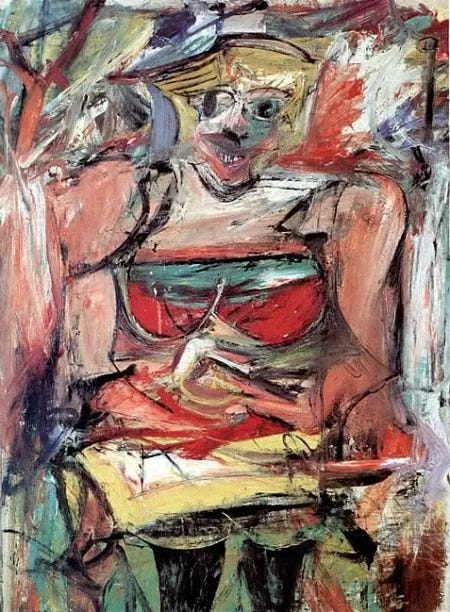
For example, in this culture the male must be overly aggressive in order to be male, and when the man in this culture rejects women he’s also rejecting his own passivity, his own desire to rest, to meditate. It seems to me that unknowingly perhaps, or even knowingly, de Kooning was distorting the female figure because of his own personal problems about these kinds of concerns in his own life. Do you have anything to add to that?
LEE KRASNER No. No more than whether the female as he projects it there is the outside female or whether it’s the female within himself makes no difference to me at all. It’s the hatred and hostility toward the female; whether it be within himself or be really the outside female doesn’t change my attitude toward what I’m confronted with.
DOLORIS HOLMES I’ve been involved with a number of women’s groups over the past three years. One of the issues that always gets discussed is the influence that the woman involved with the male artist, what influence that woman has had on his work.
Can you tell me what kind of influence you feel that you’ve had on Jackson Pollock’s work?
LEE KRASNER That’s a loaded question. I pride myself on my objectivity but here I don’t think I’d be objective enough to know. Unfortunately when two people live closely together as Jackson and I did we affect each other and we must have in many areas. With regard to his painting, I daresay that the only possible influence that I might have had was to bring to Pollock an awareness of Matisse.
DOLORIS HOLMES What do you mean by “an awareness of Matisse?” Are you talking about shapes? About movement of figures? Colors?
LEE KRASNER No. It wouldn’t have happened that way because we had little talk about art in these terms in the whole period I lived with him. But my enthusiasm and my feeling about Matisse, which I certainly would express often, could possibly have moved him a little in that direction.
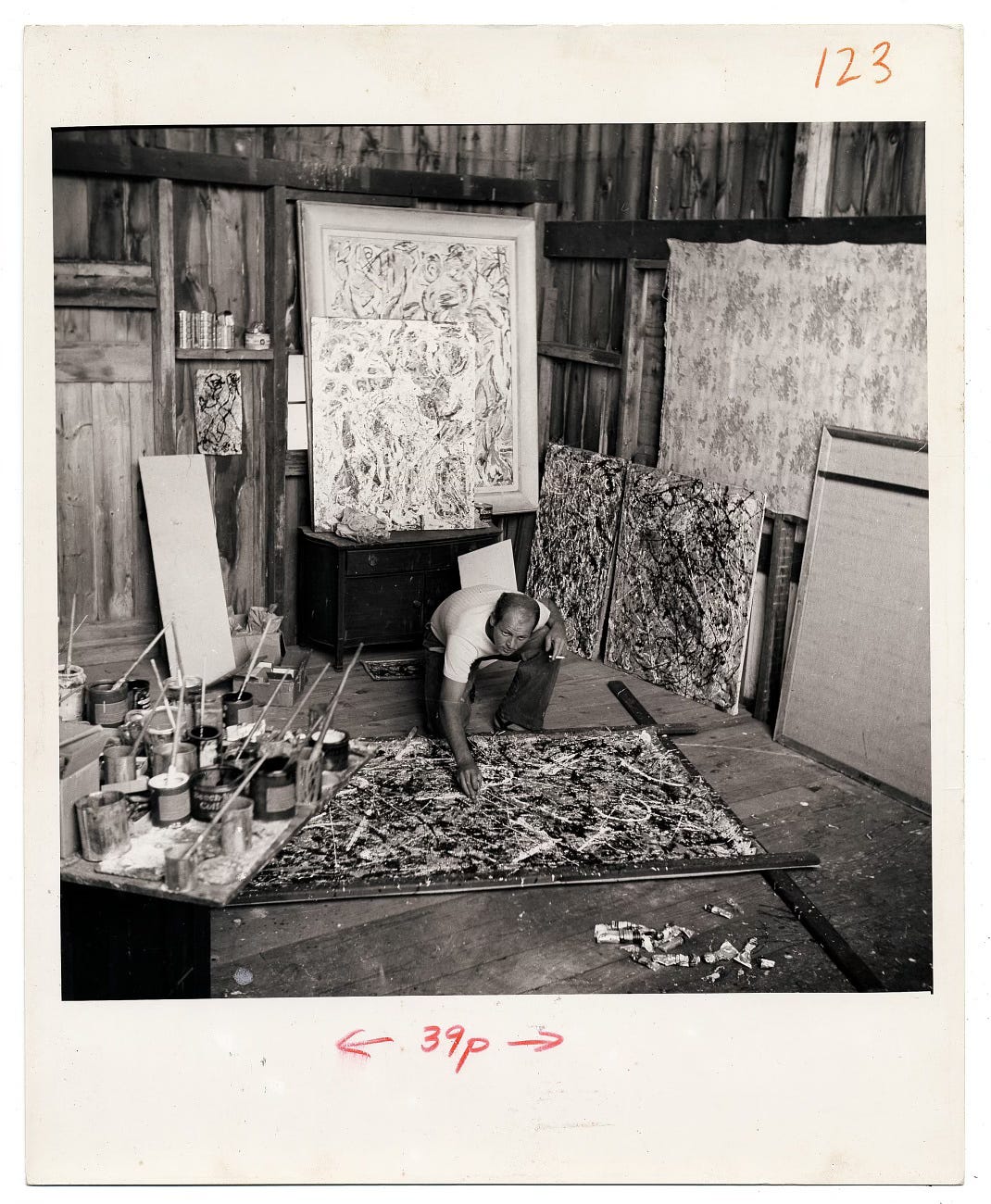
DOLORIS HOLMES Now I know from my knowledge of Jackson that of course he did go through different periods. One influence that any woman has on her husband or her lover is to encourage or discourage various activities with which he may be involved. To be more specific, do you remember when he began to do the drip painting? Were you around at that time? Did you express approval of it? Did you share his enthusiasm?
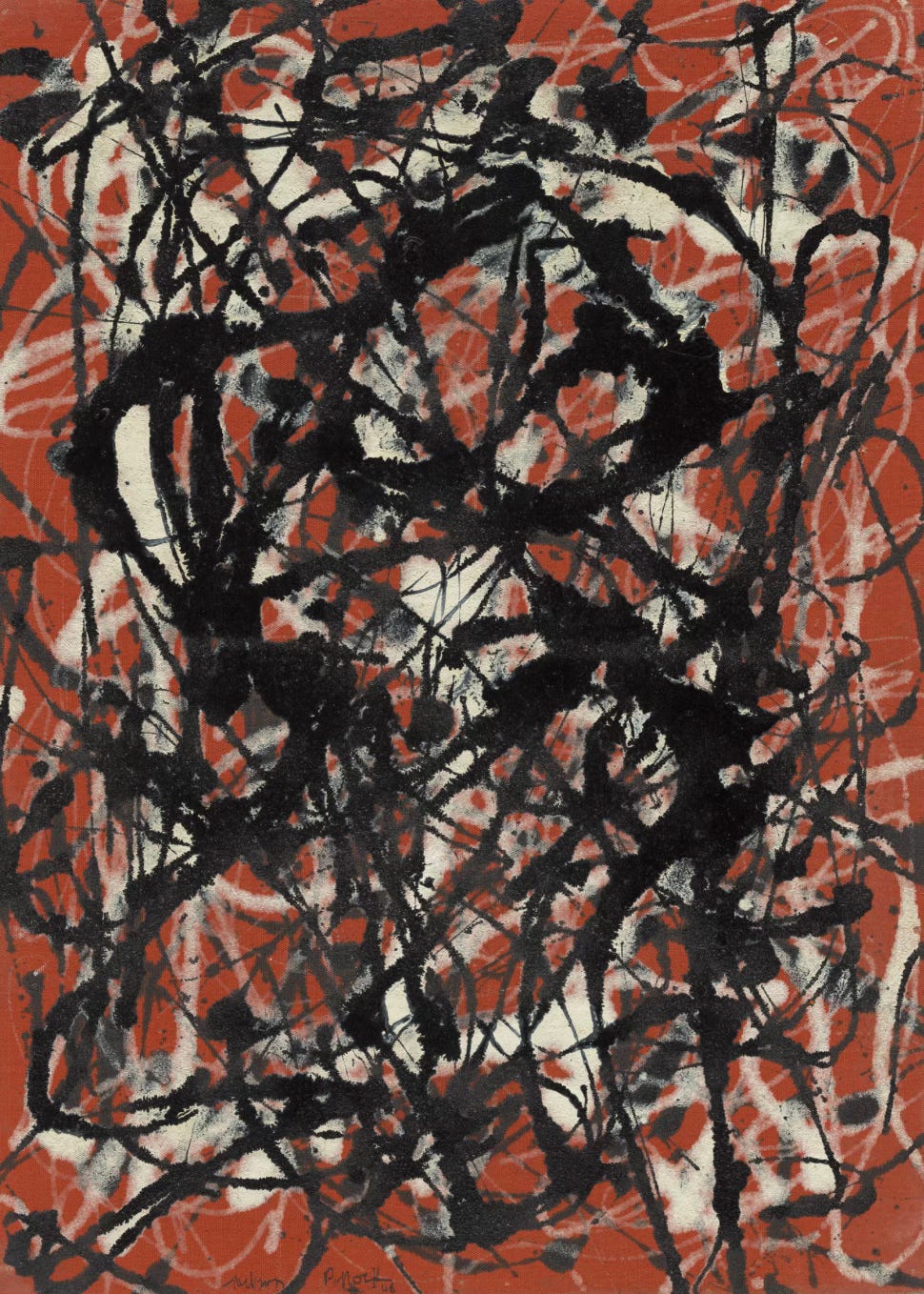
LEE KRASNER Yes, I was around at the time and indeed I did express my enthusiasm. And I think he very much appreciated that enthusiasm. Because if you remember the time at which this so-called drip painting came about it was way out on a limb at that point, and I think he welcomed my enthusiastic response.
Your question was “How long was he active as an artist?” Well, I don’t know the date, maybe it’s 1947 or 1948 is the first of the so-called drip—I can’t remember. But the fact is he had his first solo show and he showed every year thereafter. So it was a matter of a few years and these were coming in as, you know, shockers, one show following the other. I didn’t mean here that the reaction to the so-called drip paintings was greater than, let’s say, the impact of the first, second, or third shows.
DOLORIS HOLMES Let’s get into another way in which I feel you probably were helpful to him. You said that you were enthusiastic about his work. Did you introduce him to people in the art world?
LEE KRASNER Indeed, I did. When I met Pollock and responded to his work the way I did, which was, as I said, very enthusiastic, I certainly brought people in that I knew to see his work. Through Herbert and Mercedes Matter, who were close friends of mine at the time we got Sandy Calder in to see his work, we got James Johnson Sweeney in to see his work; I got Hofmann over to see his work; and just about anyone I knew that I felt would understand or appreciate the work.
DOLORIS HOLMES This is certainly the kind of influence that a lot of women have had and have been very instrumental in helping their husbands or their lovers which has not received any recognition, and I’m very glad that you have mentioned these things.
Another question that I want to, get into is the question as to what it has been like for you to be a woman artist? For example, you mentioned before that as a student Hans Hofmann gave you a very mixed kind of compliment. Do you feel that it has been a disadvantage for you to be a female artist?
LEE KRASNER Again that’s a rough question. Let me put it this way: it hasn’t been easy going. But I’m still not clear as I’m speaking to you now whether it has been because I’m a woman artist or because I am Mrs. Jackson Pollock, so that I feel in that sense it’s more than what’s known as a double load.
That is to say, if I were Lee Krasner but had never married Jackson Pollock, would I have had the same experience I have being Mrs. Jackson Pollock?
DOLORIS HOLMES I sense that you feel confused, first of all, and secondly that in a sense there were certain advantages to being married to Jackson Pollock. On the other hand, the fact that you weren’t operating as an individual always left you with a question as to whether you were being judged as an individual or as the wife of Jackson Pollock. You did, however, mention about the fact that you were never, given a retrospective in this country. Now this seems very unusual to me since you have been so intensively involved with the movement for so long.
LEE KRASNER That’s true. I haven’t been offered a retrospective here in this country. But I was offered one in England, which I accepted and was very happy to be able to see a large span of work.
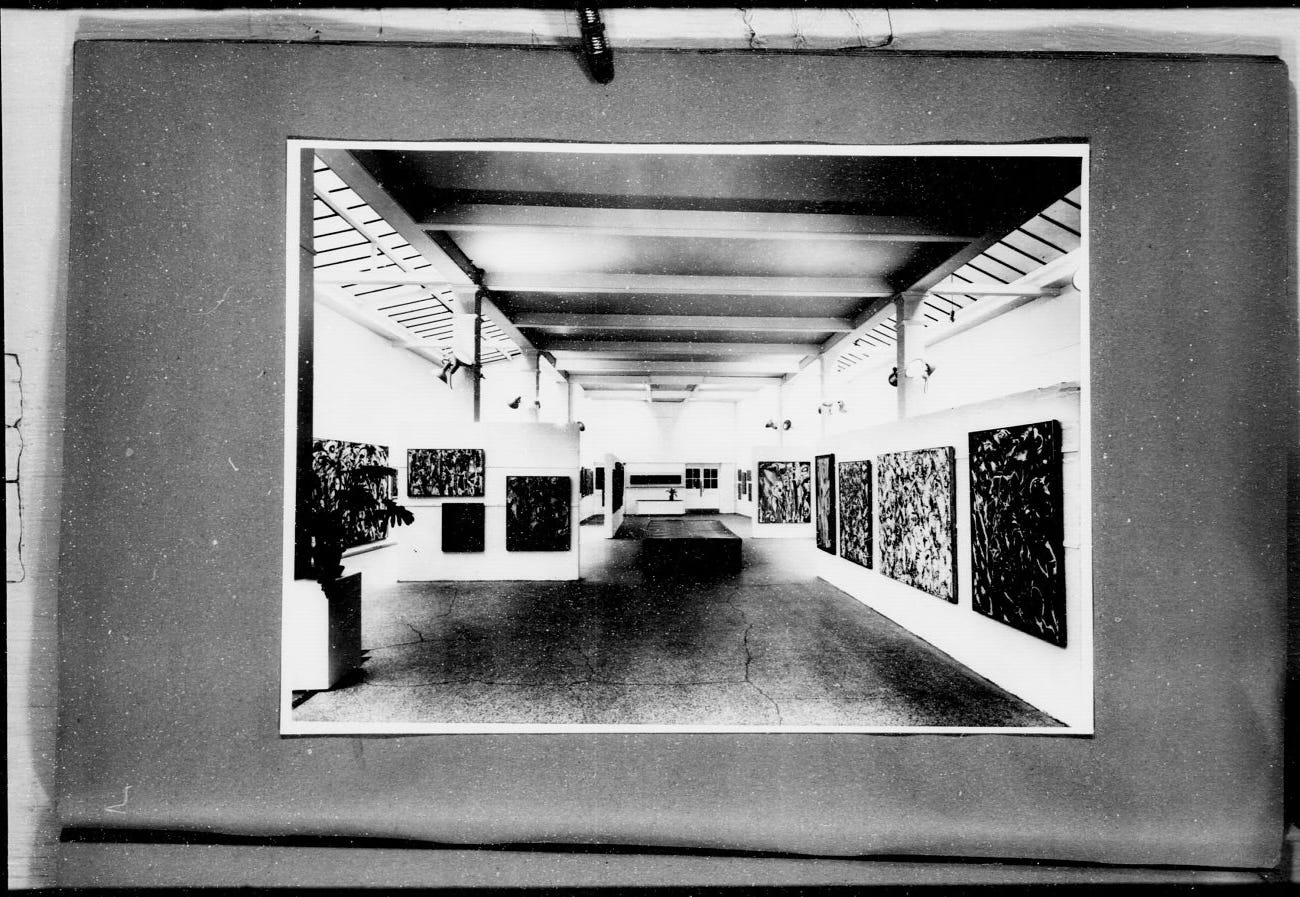
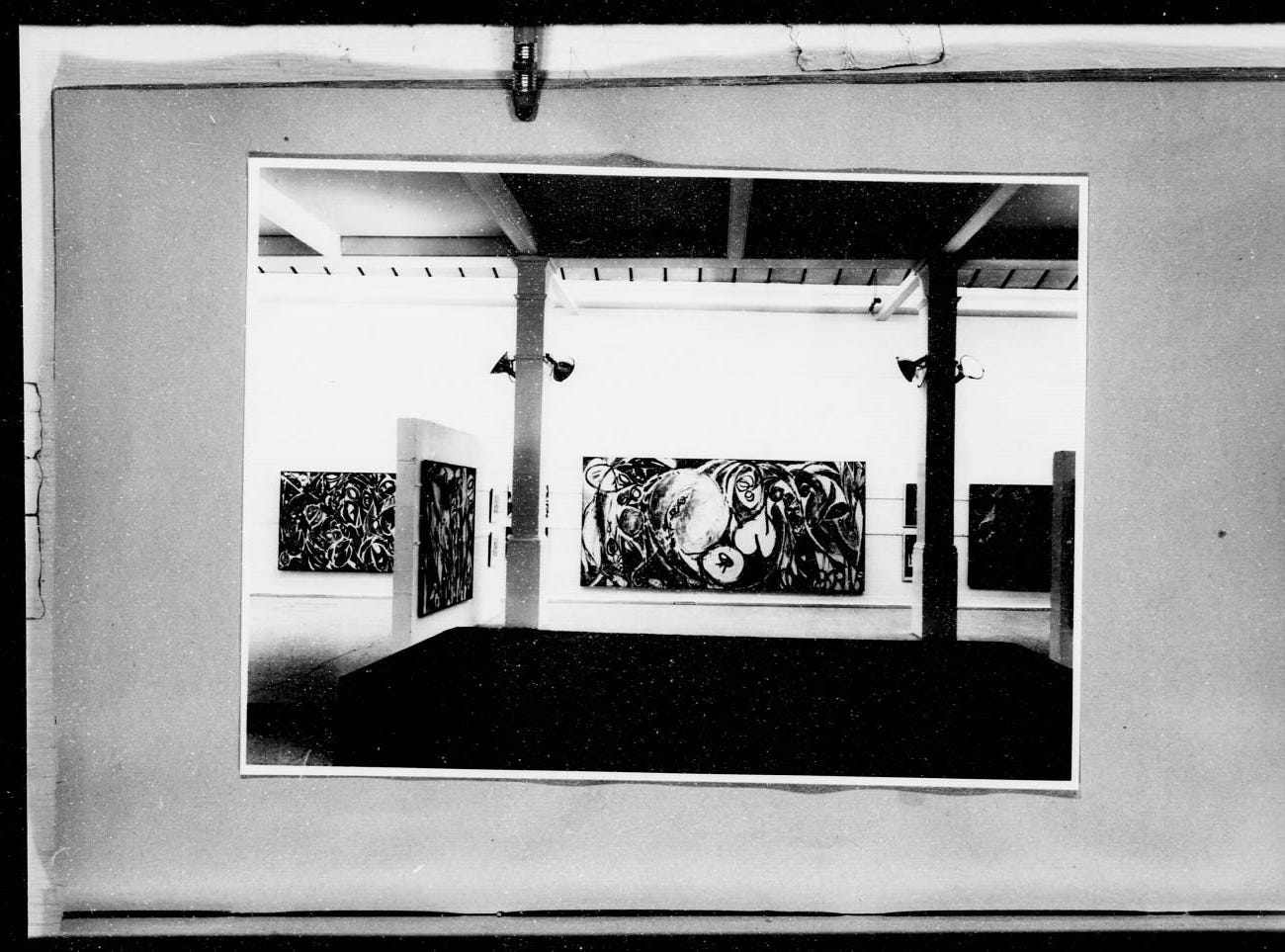
This is terribly important for the painter, I think, because it’s the only occasion on which you can see a real period of work before you. Now why I wasn’t offered one I would say is a combination of the fact—or maybe I’d have to say principally because I am Mrs. Jackson Pollock.
You’ve got to remember that Pollock is dead now since 1956, and that I am the executor of his estate. Consequently I behaved with the paintings as I saw fit. I stepped on a lot of toes. And I think even today it’s difficult for people to see me, or to speak to me, or observe my work, and not connect it with Pollock. They cannot free themselves. So this may be one of the reasons I’ve not been offered a show. I wouldn’t know if there are others.

If you didn’t get enough Lee, there’s another Archives of American Art oral history that’s well worth the read. And the book Art Talk: Conversations with 15 Women Artists by Cindy Nemser has a great Lee section! (Readable PDF here.)

While looking at protest art from the 1960s-70s decade, I found this incredible news story video from 1958 about a fire that broke out at MoMA. Ah!!! Some workers were repairing an air conditioning unit when some smoke started coming out of the vent. Then, some buckets of paint caught fire and sent the whole museum into a flurry. The black-and-white video shows men being carried out on stretchers—one guy died, and thirty people were injured—windows being crashed into to allow the smoke to escape, and people rushing some of the world’s most famous paintings onto the street like burglars. One of the artworks was an all-time favorite of mine, Marc Chagall’s The Birthday. I actually yelped a little while seeing it leave the building! A half dozen paintings were damaged, including a Monet painting valued at over $100,000 at the time (close to one million dollars today).
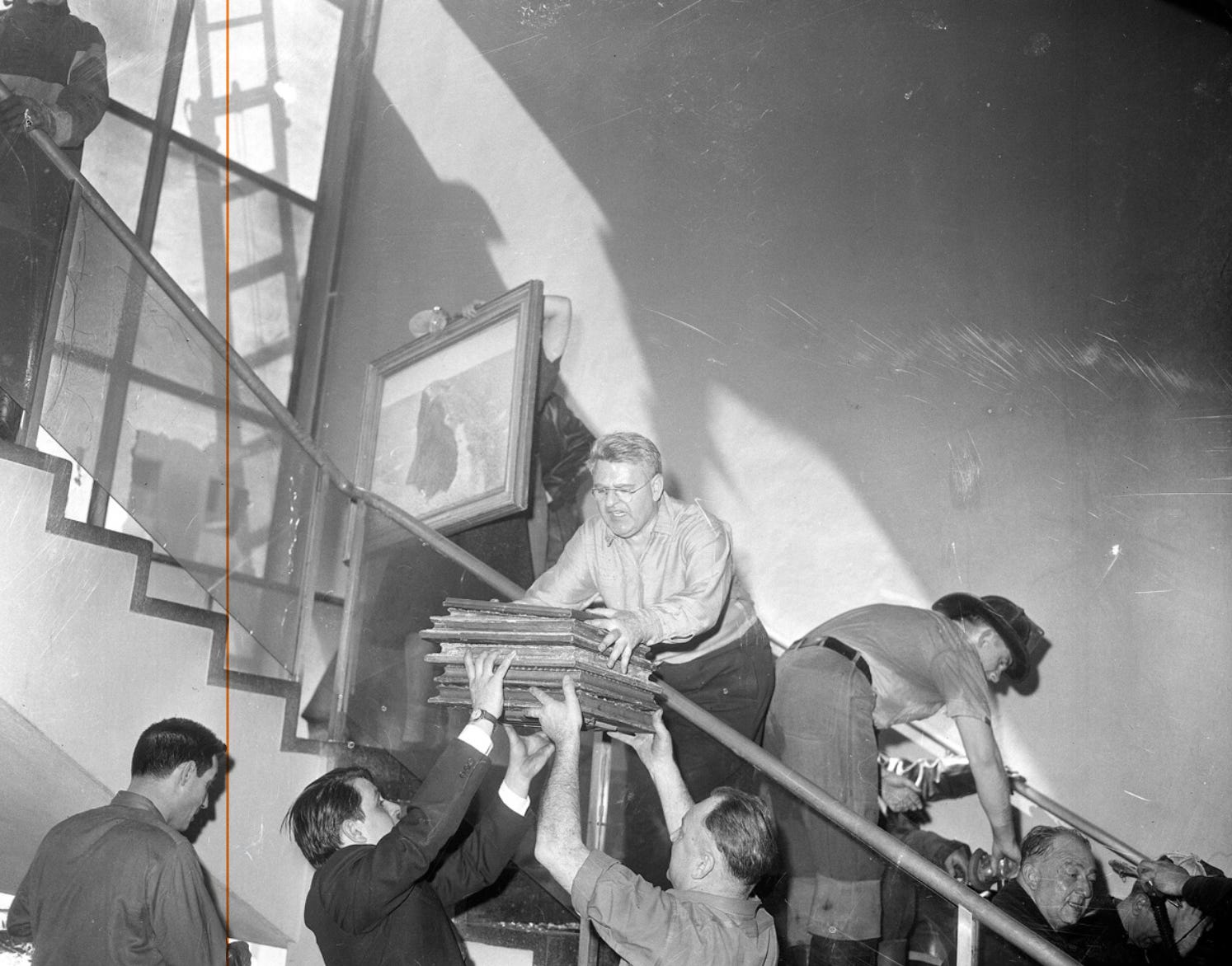
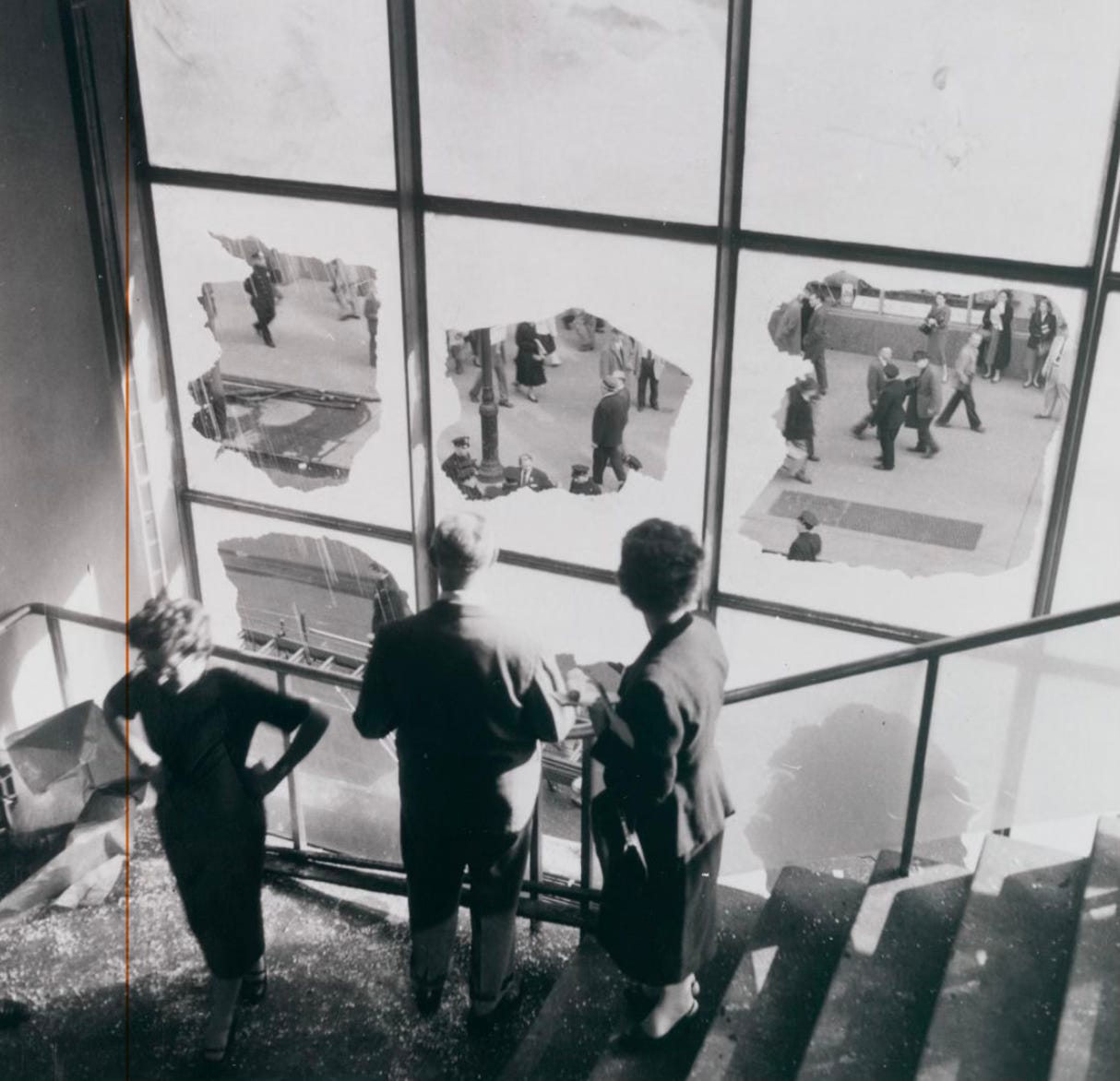
As someone who has had to rescue historic objects from a building during a fire warning, and after the trauma of the Palisades Fire in Los Angeles, this whole event feels anxiety-inducing!
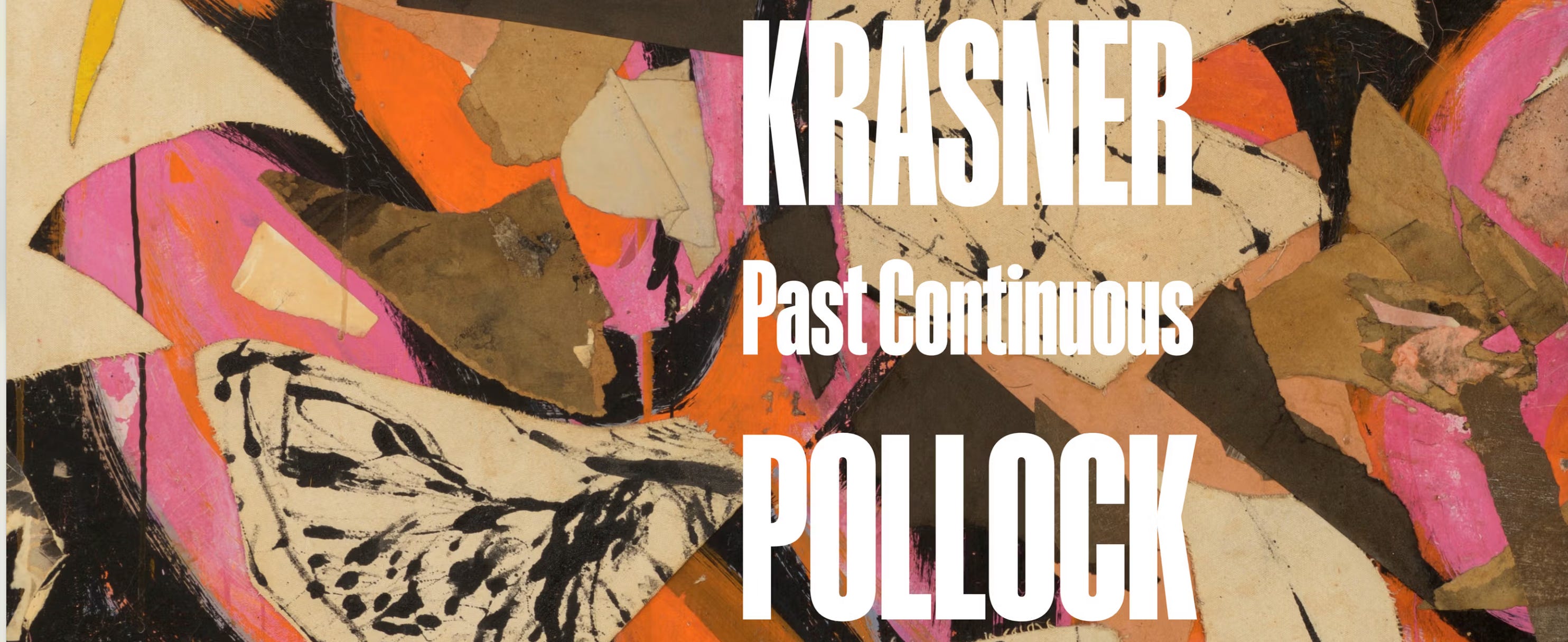
“Lee Krasner (1908–1984) and Jackson Pollock (1912–1956) met as emerging artists in New York in the winter of 1941. They married in 1945 and moved to Springs, Long Island, where they remained entwined personally, artistically, and professionally until Pollock’s untimely death. While Pollock’s reputation historically eclipsed Krasner’s, today, both artists’ practices are rightly recognized as central to the innovations of art from the mid-20th century onwards. This exhibition continues and amplifies this reevaluation, on their own terms and in dynamic relation to each other.
Krasner and Pollock: Past Continuous is the first major New York presentation devoted to either artist in more than 20 years. Featuring over 120 works, it is the first exhibition to look at the full arc of their careers together.”
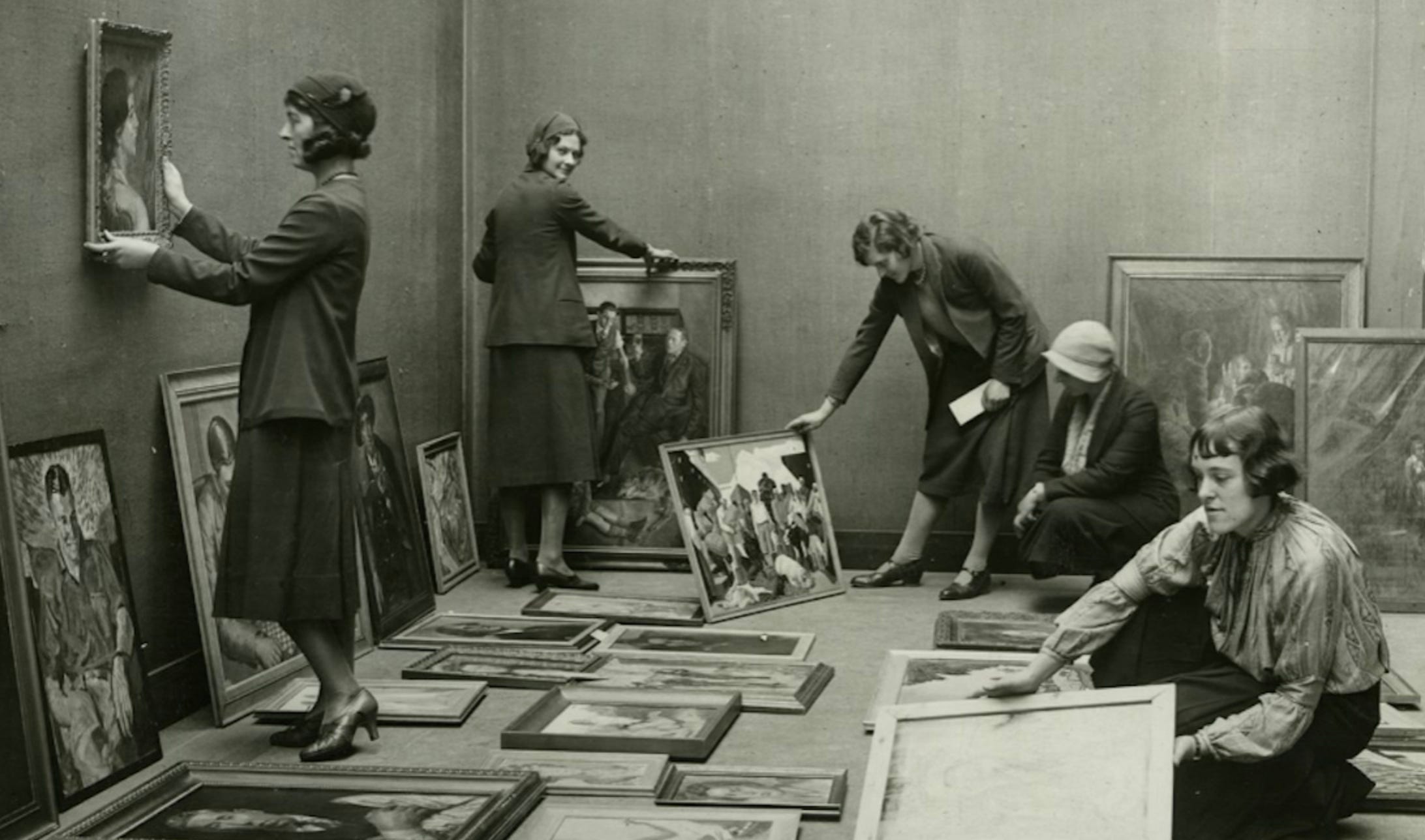
Love this 1931 photograph of the Whitechapel Gallery London and its Association of Students’ Sketch Club. I always think I would have been a woman who was burned at the stake in the witch trials and probably a modern painter in the 1930s. I would have loved to be Lee’s friend.
The Frelinghuysen Morris House & Studio is on my very urgent need-to-visit list of historic homes (so is the Pollock-Krasner House). It was the living and workplace of George L. K. Morris and Suzy Frelinghuysen in Massachusetts, who were members of the American Abstract Artists, established in 1930s New York.
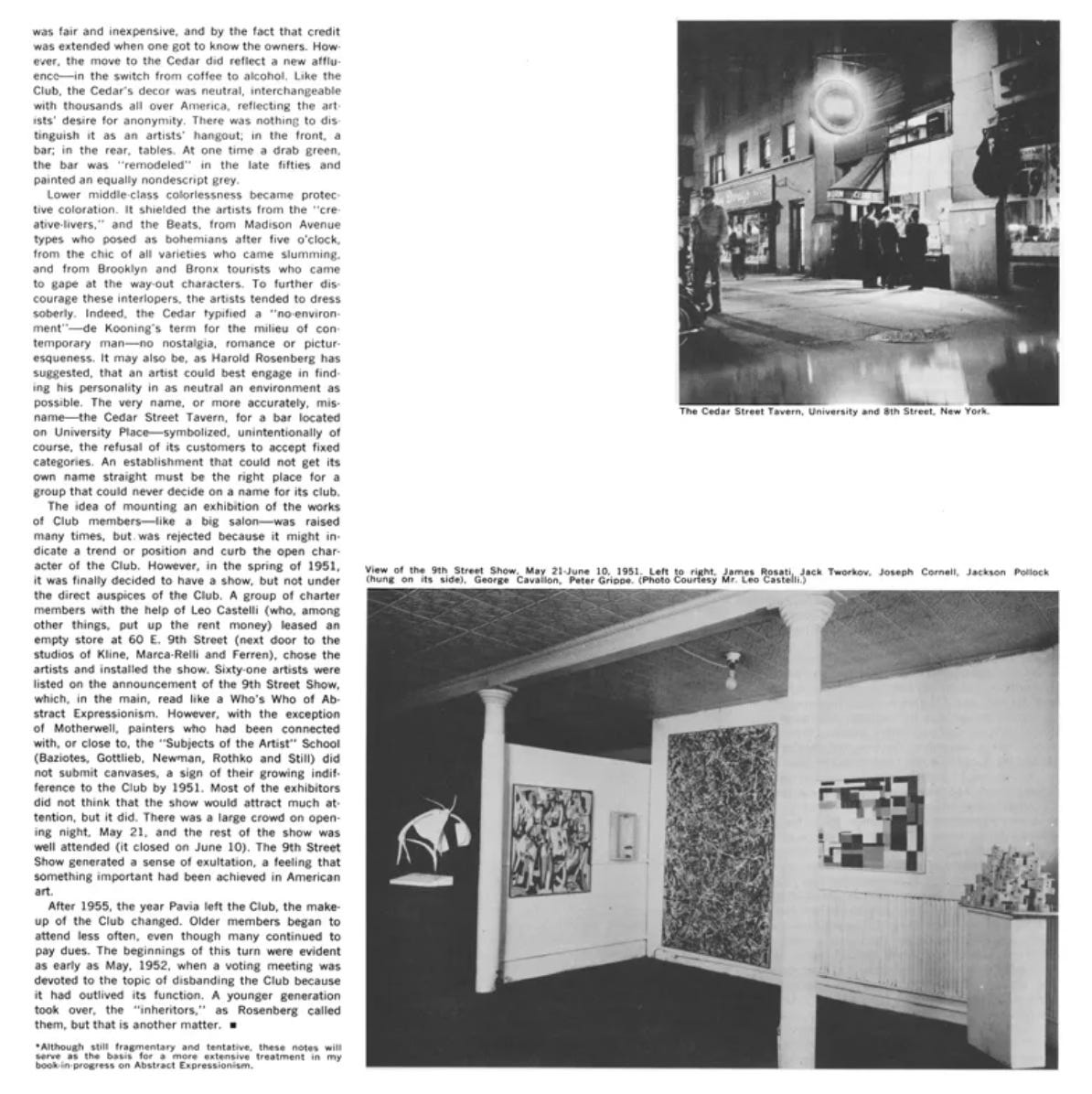
A really good article about The Club, from ARTFORUM in September 1965.

Kelsey Rose
Comments
Nothing yet. Say the first thing.
Sign in to join the conversation.