
This essay first appeared in HeartWood Literary Magazine, Issue 21.
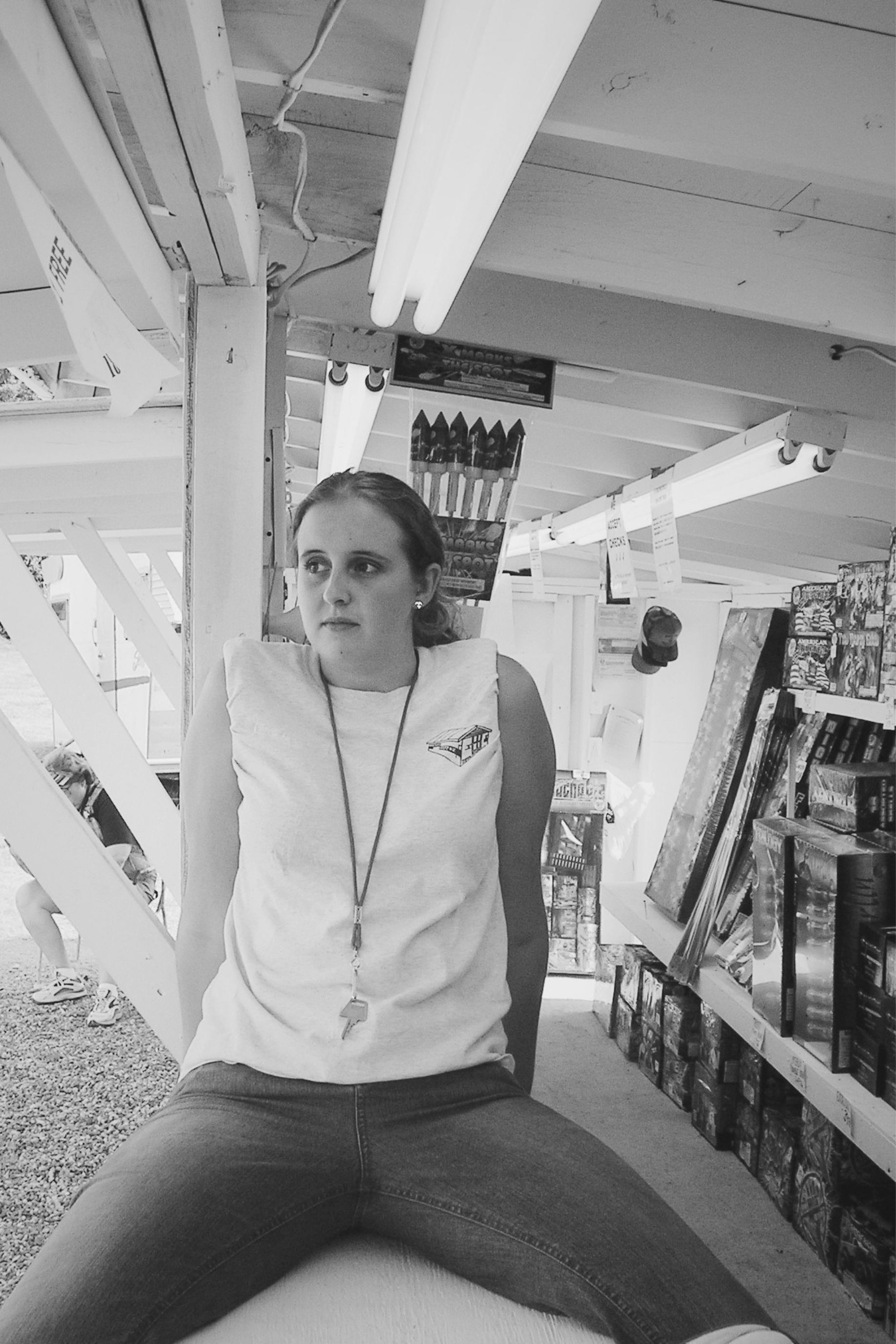
The 19-year-old author with lingering culture shock after a semester abroad in Accra, Ghana being asked to explain the difference between Artillery Shells and Repeaters.
The first place I ever learned to read people was in a plywood shack off Jacksboro Highway, where the gun sat next to the cash box and the customers brought their own beer. For a decade of my life, I spent school holidays manning the counter of my family’s fireworks stand in a small town west of Fort Worth, Texas. The shack was cramped with pink carpet stapled over warped boards and a hole in the floor. It was shabby, but it taught me how danger and desperation announce themselves long before anyone opens their mouth.
By the time I was twelve, I’d already watched fistfights erupt over spilled beer, drug addicts gum their requests for change, drunk cowboys leer at me and my prepubescent sister, and my family’s yearly income vanish into sticky fingers. That’s why we kept a pistol by the cash box—you never knew what the ten days before July Fourth might bring.
Ben, my mother’s longtime boyfriend, grew the fireworks stand from a one-window shack into an eight-window operation that functioned as a community center. In a town of barely a thousand people, the stand became a local landmark and was regularly featured in the local paper. Ben was so good at the business that he earned an entire year’s income in the two weeks when it was legal to sell fireworks in Texas.
Imagine a man who quoted Noam Chomsky while sporting a long, thin braid down his back. Ben looked like every other man in that corner of Texas—a trailer, a pickup truck, a rat tail—but he was unlike the customers who assumed he was one of them. He’d grown up in East Texas around people just like them, which meant he understood their rhythms, their suspicions, and how to stay out of trouble. In that part of Texas, belonging could save you.
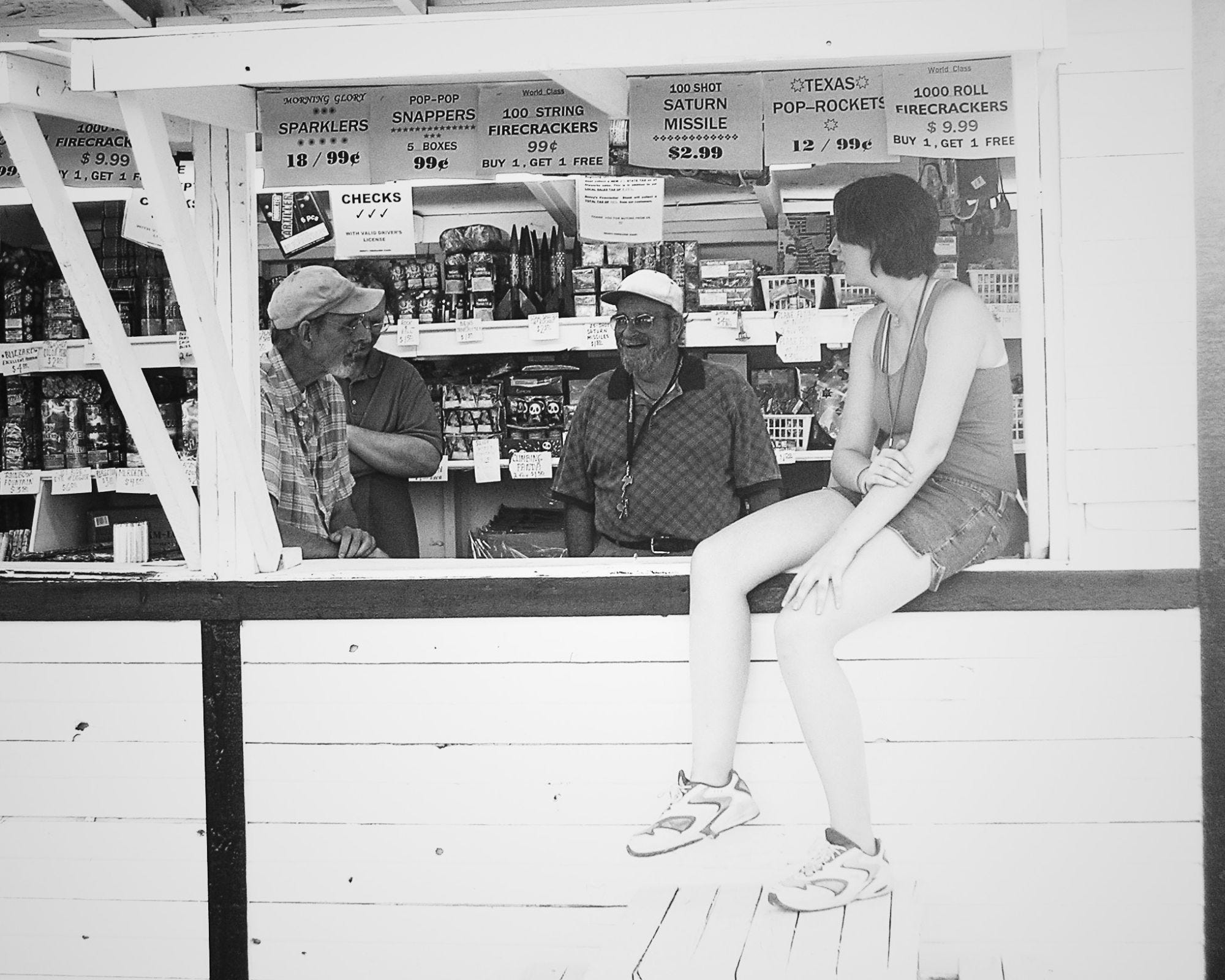
A group portrait of the people entrusted with thousands of dollars worth of explosives. Ben is in the middle of it all, as usual.
Outside the stand, Ben was someone else entirely. In the nineties, Ben worked as the overnight groundskeeper at a hospice center where my mother volunteered as a nurse for patients with HIV and AIDS, many of whom were former drug users with active warrants. When Fort Worth police periodically raided the place to make their monthly quotas, Ben locked the doors and refused to let them haul out the sick and dying men. It was there that he first met my mother, another liberal, drawn to the same work and the same people.
I grew up hearing stories about how Ben helped shuttle refugees from El Salvador across the Texas border as part of a Quaker-organized rescue network, and how he’d “hold his nose,” as he put it, organizing for conservative Democrats in North Texas. None of that made it into his daily persona at the fireworks stand. He hid the parts of himself that would’ve made him a target, the way progressives in red states learn to do. A good thing, because fireworks season in Azle, Texas was high-stakes theater.
I watched him shift identities seamlessly. He could talk prayer circles with church ladies, deer hides with good ol’ boys, and litter sizes with dog-breeding grandmas. They all loved him for it. Shirtless teenagers spilled out of pickup trucks and offered him warm Bud Lights like a tribute. And when a group of rough-looking men pushed to the front of the line, Ben would lengthen his vowels, lower his voice, and become the kind of man who might have a boot knife. He wasn’t lying, not exactly. He was performing. And in a place where trouble traveled fast, performance was the way Ben kept us safe.
What none of the customers ever saw was how fast he dropped the act. They’d walk away and Ben would roll his eyes. “A lot of these people have never been housebroken,” he’d say after someone ashed a cigarette on the counter or a kid took a backhand. He didn’t mind taking their last dollar, but he struggled with the way hard lives made hard edges.
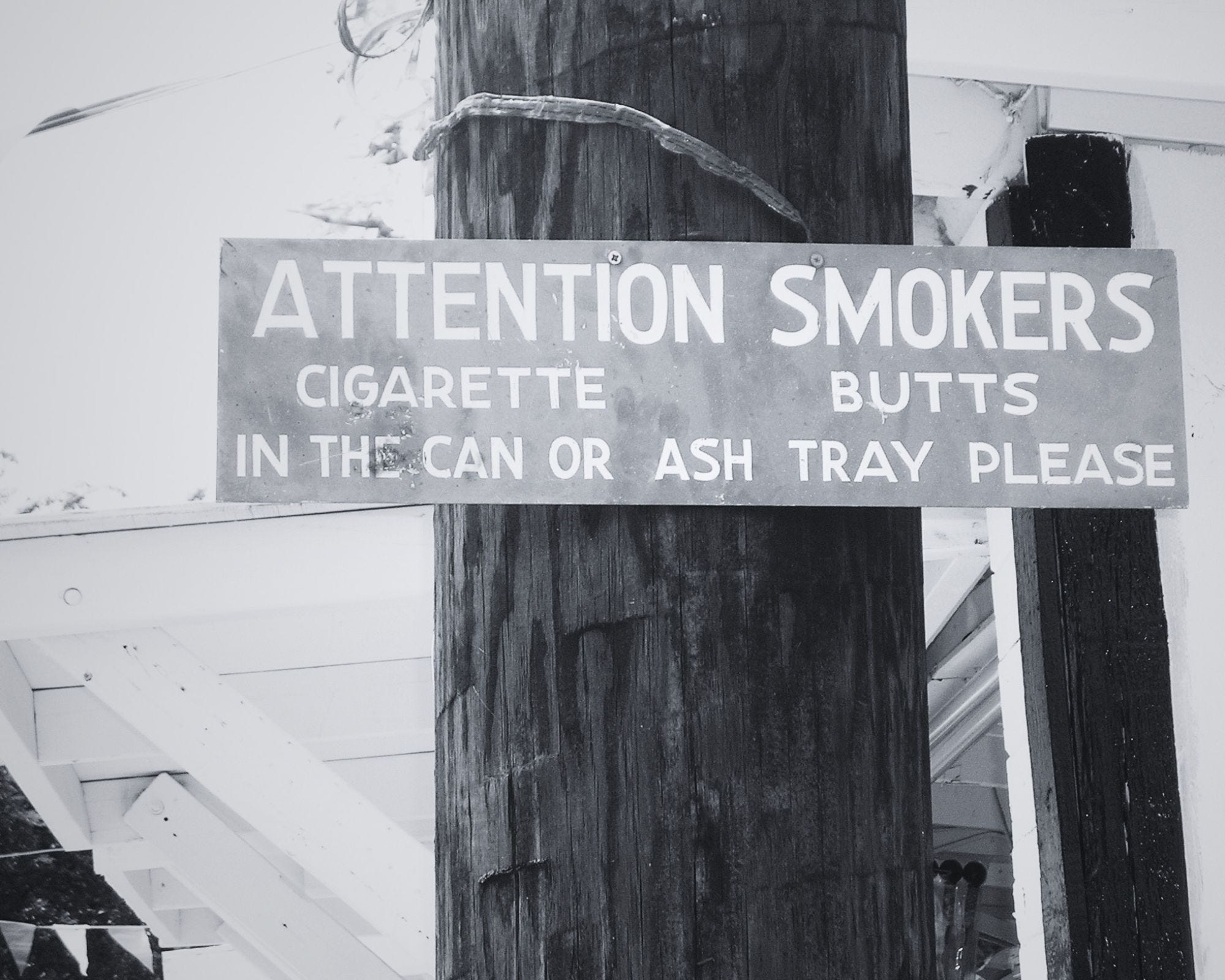
A real sign we had all over the fireworks stand. Naturally, no one read it, because “freedom.”
Ben often ricocheted between contempt for customers and an almost compulsive need to intervene in their lives. Sometimes that looked like a free bag of fireworks for the grandkids, and sometimes it looked like offering a job to the most desperate people, even when it was clearly bad for us, the two teenage girls from the suburbs.
James was often one of the last customers to leave the stand at night. An adult meth addict, he had a stare that felt like a hand sliding somewhere it shouldn’t. Half his front teeth were missing; his face was deeply weathered and permanently flushed with messy blond curls shoved under a trucker hat. He perpetually smelled of sweat and carried the breathless, startled energy of someone always searching for his next fix. He worked for us one summer, as did his traumatized girlfriend, who often showed up at the stand with fresh bruises.
James lingered around my sister and me. He leaned against the siding, letting his eyes rest on us too long. I was afraid of him and pitied him at the same time, and I never wanted to be left alone in his presence. I learned to narrow my eyes, cross my arms, to stand like the kind of girl who would shoot first and never ask questions. No one intervened. We were left to manage our own fear, the way children often are when adults confuse proximity with supervision.
Thanks for reading Cheese Toast with White People. Feel free to send this post to someone who also survived an unsupervised childhood.
At the end of that summer, we discovered five thousand dollars missing from the cash box. Even then, Ben let James move into the empty trailer behind the stand, next to Jay, a retired, half-blind handyman living out of a similarly abandoned camper. Our land filled with lives Ben tried to hold, even when holding them cost the rest of us.
Sometimes, Ben brought in his friends from the city to help at the stand. Grayson, an actor-artist with almost no idea what any firework actually did, improvised elaborate descriptions with absolute confidence. “This one is fabulous—dazzling colors, loud crackles, you can’t leave without it.” When a man came looking for a fountain called Dreamer, Grayson picked up a Reflection and said, “They changed the name and spruced up the packaging, sir.” The man bought it without hesitation.
Karl, a photographer new to fireworks, treated the place like a living anthropological exhibit. He adored the shirtless, toothless, tattooed country characters far more than the rest of us. Quietly peeking around corners with his massive camera, he snapped shots of everything: shirtless men in cutoffs with trunks full of artillery shells; barefoot kids shoving Black Cats in their pockets; tired grandmothers corralling punky adolescents with M-60s.
And then there were Brenda and Linda, a lesbian couple with matching blonde hair whom I adored. Brenda was tall, with deep laugh lines, and could sling a fat box of artillery shells over one shoulder. She was one of the first women I ever saw outwork a man. Her pet iguana, “Ike,” was my favorite creature on earth, and my sister and I would fight for the chance to go to their house to see him in his floor-to-ceiling enclosure munching on trays of fresh produce.
If the customers had known the crew behind those windows—artists, queers, liberals, oddballs—they might have peeled out of the parking lot. Instead, they assumed we were one of them. That was the trick. Or the con. Or maybe, as I’d later understand, the performance required to stay paid and unharmed.
Standing behind the counter, I began to see how want moves through a body. People with no shoes and no teeth handed over whole paychecks for explosives that would burn out in minutes. Children who’d lost fingers to fireworks returned to the stand year after year. Men drunk before noon counted nickels for a single string of Black Cats. I used to wonder why the poorest customers spent so much on something so temporary. But poverty teaches you to take your joy fast, loud, and all at once. Before anyone can take it from you.
My favorites were always the barterers. One man who’d been coming to the stand for years often traded his woodworking for fireworks. Once he brought us a beautiful, handmade oak cradle and asked us to “keep it in the family.” The kids across the street often showed up with a sack of homemade barbecue. We’d get jars of pickles, buckets of fried chicken, and every now and then a fresh snow cone melting down the sides of a Styrofoam cup. Poor people will give you their best stuff; rich people just give you money. I learned that at twelve.
Fire danger was constant, the kind of background hum you got used to until it roared to life. One afternoon, Ben lit a broken bottle rocket and shot it from his bare hand. I remember him chuckling like a kid as it sputtered, shot upward, and arced across the highway. His grin vanished when it dropped into the tall grass on the other side of the road and flames leapt up in a hungry line.
My mother shouted for me to find my sister, her voice sharp with panic. Grayson, tall, lanky, moving like a cartoon character in crisis, took off across Jacksboro Highway with a clunky, water-based fire extinguisher, dodging cars as he ran. Somehow, the flames never hopped the asphalt. They died out on the far side of the road, leaving a blackened patch of grass and all of us shaken.
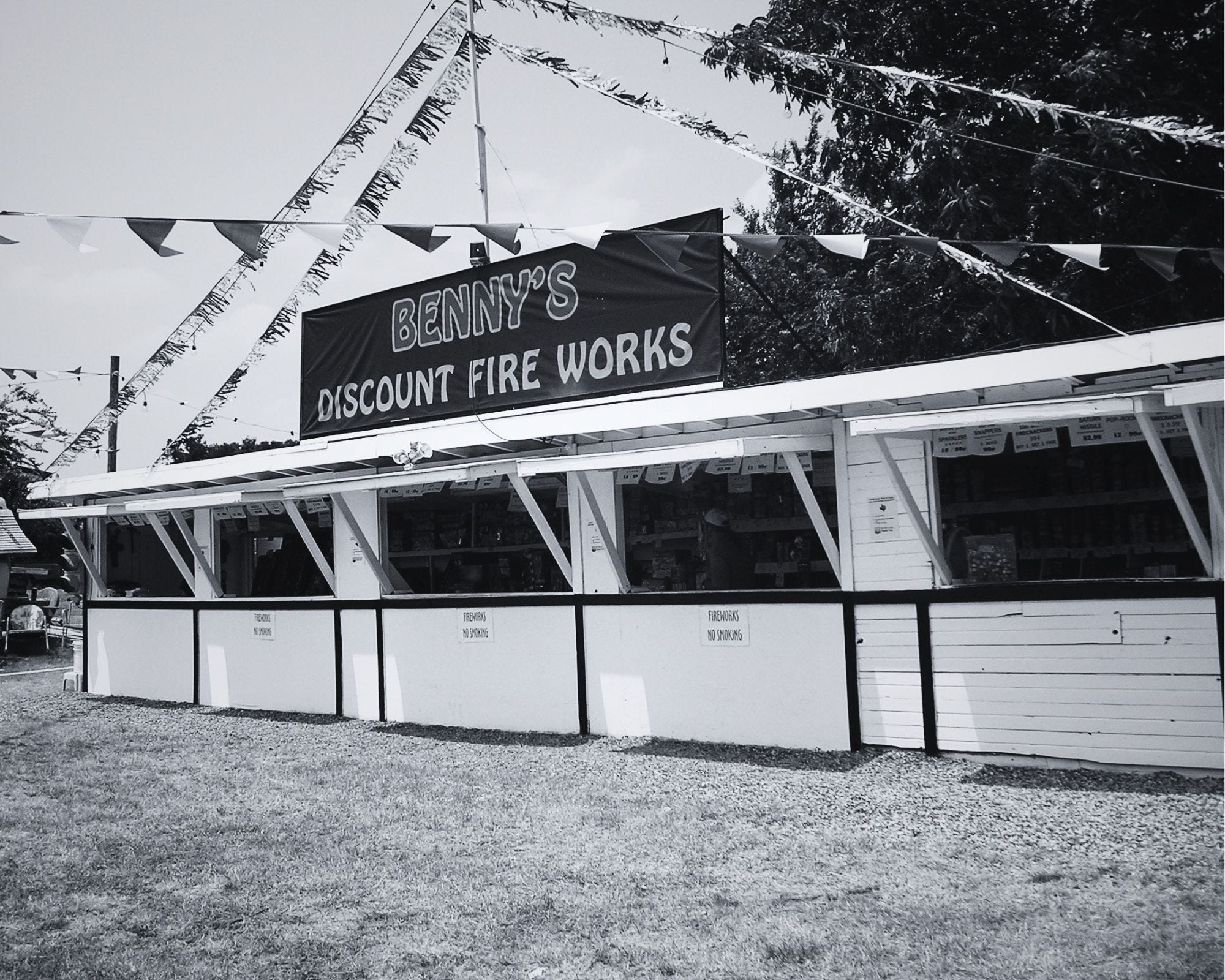
The stand on a very normal Texas day, meaning it was 104 degrees and someone was probably smoking near the artillery shells.
Another day, teenagers from the lake (the “rich” part of town) rolled up in a lifted truck wanting illegal bamboo fireworks. Of course, Ben had them in the back. He let the boys shoot them off on our land behind the stand for a premium price. They tied a bundle of bamboo sparklers together to make a homemade “bomb;” it spiraled into the air like helicopter blades and landed a hundred feet over our fence in a patch of pine trees. One went up in a whoosh of orange flames.
The third fire was the one that scared me most. My cousin, only five at the time, dropped a morning glory sparkler in the dry grass in front of the trailer. Flames raced across the field in seconds. My mother panicked and told us to fill pots with water from the kitchen sink. We darted back and forth, sloshing water through the smoke, until Ben came barreling up the driveway yelling, “Grab the hose!”
But the moment that cut deeper than any fire came from a different kind of danger. A sharply dressed Black man and his young son were leaning against the counter comparing fountains when a drunk local planted his pale arms on the plywood and asked, “Hey, y’all got any n—-chasers?”
The air went still. Even the ever-present whine of cicadas hushed.
Ben lifted his eyes. “Sir,” he said, “those are called whistle chasers. Only idiots call them that.”
The Black father slid a little to the right, placing his body between the man and his child.
The drunk blinked. “Oh, uh, well I’se always called ’em that. Ever since I’se a kid.”
Ben’s disgust sharpened. “Well,” he said, “no one I know calls them that. Oh wait—there was this one other idiot who used to call them that…”
That insult landed a little closer. The White man blinked, confused, considering whether he’d just been called stupid twice. He muttered something and shuffled to another window. In another fireworks stand, off another highway, things could have gone very differently.
By then I’d learned the stand was a place where you could witness the full range of human gratitude and cruelty in a single hour. It taught me how to read danger before it had a name, how to scan for exits, how to adjust my voice and posture to keep myself safe. But it also taught me there are moments when you don’t adjust, when you choose who you are instead.
If my childhood had a classroom, it was that shack with the pink carpet and the loaded pistol. And the lesson that stayed with me was this: even in the most combustible places, there are ways to hold your ground without blowing everything up.
Share this piece with someone who knows the past is never as charming as the photographs make it look.
Just can’t get enough of Cheese Toast with White People or its humble, lactose-intolerant author? Delightful. Here are a few ways to hang out with me professionally before the universe collapses or your cheddar burns, whichever comes first.
May 11: I have one more spot open for book proposal consultations this month, in case your nonfiction book a needs a little structure, strategy, or loving-but-firm editorial attention.
May 21: I’m co-hosting a free Write Up class on Creative Recipe Writing with Betty Williams and Rebecca Blackwell. Come learn how to make your recipes more alive on the page. Free and open to the public!
June 5: I’m interviewing Kristin Donnelly and Kate Leahy from Everything Cookbooks for Write Up’s How to Become a Cookbook Collaborator conversation about what cookbook collaborators actually do, how to break into the work, and how collaborative cookbooks come together.
June 25: I’m hosting a class at the Author’s Guild on Getting Started as a Professional Ghostwriter. Free for members! [Link to come]
June 26–27: I’m presenting at EFACON26, the Editorial Freelancers Association’s virtual conference, where I’ll be teaching workshop on Ghostwriting as a Freelance Business: Finding Your Lane, Your Clients, and Your Boundaries.
September 9: Write Up’s Book Proposal Intensive begins again. Join our 12-week workshop for turning your book into a polished, submission-ready proposal with community support and personalized feedback.
Anytime: Join our Write Up circle community: a cozy, chaos-free corner of the internet for anyone working on their first book! Always free to join.
Comments
Nothing yet. Say the first thing.
Sign in to join the conversation.