
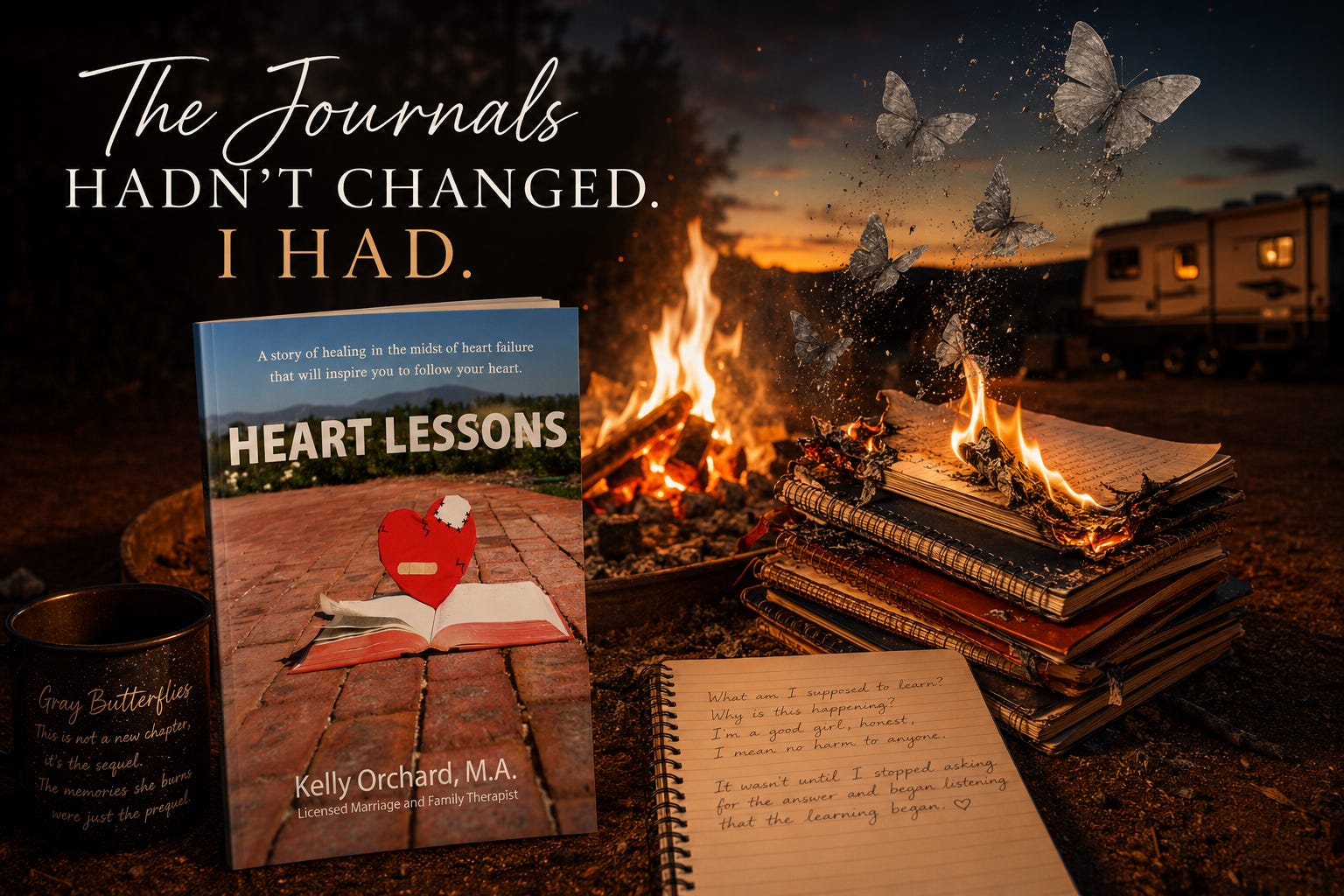
Twenty years ago this month, my heart failed.
That sentence still feels strange to write.
In some ways, it feels like yesterday. I can still remember the weakness, the confusion, the shallow breathing, the strange sense that something was very wrong even though I didn’t yet understand what.
In other ways, I don’t feel like that woman anymore.
Not because I reject her.
I don’t.
I appreciate her. I love her. I value her.
She kept going through things she didn’t fully understand. She raised her children. She worked. She built. She adapted. She kept writing. She kept dreaming.
But she was carrying far more than she knew.
I have kept journals since I was fifteen years old.
Not fancy journals. Not beautiful leather-bound books arranged neatly on a shelf.
College-ruled notebooks.
Big ones.
Five-hundred-page notebooks filled with prayers, observations, arguments with myself, fragments of stories, dreams I didn’t know how to pursue yet, scenes, dialogue, family history, grief, frustration, confusion, and the ordinary details of a life that rarely felt ordinary while I was living it.
By the time I started my full-time RV journey, I had around forty of them.
Forty journals.
That is a lot of paper.
It is also a lot of past.
Those journals had already served one major purpose. Years after my heart failure, while I was finishing graduate school and beginning the long transition into the mental health field, people kept asking me the same question.
They would look at my resume and see radio.
Decades of radio.
Broadcasting. Consulting. FCC compliance. Family business. Management. Marketing. Stations. Clients. A whole life built around transmitters, studios, sales, programming, and everything that happens behind the scenes to keep a radio station alive.
Then they would look at the fact that I was becoming a therapist.
Eventually, someone would ask, “What happened?”
So I told the story.
I told them about the heart failure.
The recovery.
The procedures.
The grief.
The way my life had been interrupted.
The way the interruption eventually redirected me.
And more than once, someone in the mental health field said, “You should write a book about that.”
So I did.
Heart Lessons became my first book. I wrote it before I was licensed. In fact, after I became licensed, I had to update the cover.
That feels very on brand for me. I launched the book, then caught up with the credentials. Life is rarely tidy. I’ve stopped expecting it to be.
When I wrote Heart Lessons, I went back through my journals and pulled from the raw material of that season. The fear was there. The medical details were there. The questions were there. The faith was there. The anger and grief and confusion were certainly there.
I thought I understood the story.
And I did.
At least, I understood part of it.
I understood that an undiagnosed arrhythmia had caused my heart to work so hard that it weakened and went into failure. I understood the procedures. I understood the recovery. I understood that I had been forced to slow down. I understood that my life had taken a turn I never would have chosen, but eventually came to value.
What I did not yet understand was how much stress I had been carrying before my heart failed.
Even then, while writing the book, I didn’t see it clearly.
I saw the medical crisis.
I saw the spiritual lesson.
I saw the career shift.
I saw the surrender.
But I still didn’t fully see the stress.
Years later, when I began traveling full-time in my RV, I started reading those journals again.
This time, it was deliberate.
I wasn’t casually reminiscing. I wasn’t wandering through the past with a cup of coffee and a sentimental soundtrack.
I had a purpose.
I knew those journals carried more than my personal history. They held characters. Settings. Scene ideas. Premises. Poems. Dialogue. Memories I had forgotten. Pieces of stories I had been collecting for decades without always knowing where they belonged.
I had always wanted to write fiction.
That dream had never gone away.
So as I began RV life with Kismet, who was still just a puppy then, I also began reading through the journals with the intention of mining them for story material. I was alone more than I had been in years. I was learning how to manage my own rig. I was learning the rhythms of the road. I was learning how to travel with a dog who was learning the world at the same time I was learning this new version of mine.
And I was reading my old life in five-hundred-page increments.
One journal could take days.
Sometimes a week.
The process was part research project, part excavation, part farewell tour.
And somewhere in the middle of all that reading, something shifted.
The journals hadn’t changed.
I had.
I was no longer reading them as the woman who wrote them.
I was reading them as a therapist.
As a mother whose children were grown.
As a woman who had lived through more grief.
As someone who had since lost my brother Brad and both of my parents.
As someone who had spent years sitting with clients while they tried to understand stress, trauma, grief, anxiety, depression, resilience, identity, and the ways the body keeps score even when the mouth says, “I’m fine.”
That was when I saw it.
The denial.
The internalized stress.
The pressure I had normalized.
Before my heart failure, if a doctor had asked me whether I was under stress, I would have said no.
In fact, I did say no.
I thought of myself as calm. Steady. Capable. Pretty chill.
And outwardly, I probably was.
I wasn’t explosive. I wasn’t dramatic. I didn’t fall apart in public. I had learned how to hold things together.
But holding things together is not the same as being well.
I was a single mother raising teenagers.
I was self-employed.
I was working with my dad.
I was involved in FCC consulting and radio business development.
I was trying to provide stability for my children.
I was trying to prepare for a bigger career.
I was trying to keep finances, family, work, health, and identity moving in the same direction.
That isn’t nothing.
But at the time, I treated it like nothing.
I had become very good at functioning under pressure.
So good, in fact, that I didn’t recognize it as pressure.
That is what I see now.
Not with blame.
Not with regret.
With recognition.
My heart failure was caused by an undiagnosed arrhythmia. That is the medical fact of my story.
But twenty years later, after reading my journals through a different lens, I can no longer dismiss the possibility that prolonged, unmanaged, internalized stress played a larger role than I understood at the time.
I can’t prove that.
I won’t pretend to.
But I can say this: the woman in those journals was not as “fine” as she thought she was.
She was tired.
She was trying.
She was surviving.
She was carrying the past, the present, and the future in both arms and wondering why she felt worn out.
By the time I finished reviewing the journals, they had done their work.
They had helped me write Heart Lessons.
They had given me poems.
They had given me ideas.
They had given me pieces of stories that may still become scenes in novels I haven’t written yet.
They had let me visit the woman I used to be.
And then I knew it was time to let them go.
I didn’t want to keep carrying forty journals from place to place.
Not physically.
Not emotionally.
There is something strange about carrying your past around in boxes. You move houses, and there it is. You change cities, and there it is. You begin a new life, and there it sits in the closet, waiting.
At some point, I didn’t want the boxes anymore.
I had taken what I needed.
The stories stayed.
The weight did not have to.
So I burned them.
Not all at once. Not dramatically. Not as an act of anger.
It was more like release.
I wrote a poem during that season called Gray Butterflies.
A few lines still say it best:
The wind swoops up and carries her plight
Like a gray butterfly in the morning light.
This is not a new chapter, it’s the sequel.
The memories she burns were just the prequel.
That is what it felt like.
Not destruction.
Completion.
The journals had held my life for decades.
Then they became smoke, ash, and gray butterflies.
And I was still here.
Lighter.
Not erased.
Not empty.
Not disconnected from the woman who wrote them.
Just no longer carrying all of her pages.
Twenty years after heart failure, I understand something I could not have understood then.
The crisis was not the only lesson.
The recovery was not the only lesson.
Even writing Heart Lessons was not the final lesson.
Sometimes the same story has to be read more than once.
Sometimes the first reading helps you survive it.
The second helps you understand it.
And the third helps you let it go.
The journals are gone.
The stories remain.
The lessons remain.
And the woman who wrote them?
I carry her differently now.
This Week’s Heart Lesson
This week’s excerpt comes from Chapter Three of Heart Lessons: Lessons in Listening.
I was having a constant battle with myself as I lay on the couch. At the time, I didn’t completely realize I was moving through the cycles of grief. I kept asking what I was supposed to learn—not so much from self-pity, but from a desperate hope that if I learned the lesson quickly enough, it would all be over.
I began to wonder what I had done wrong. I kept asking and praying, “I’m a good girl. Honest. I mean no harm to anyone.”
Was I hanging on too tightly to a thread of the person I thought I should be?
It wasn’t until I stopped asking for the answer and began listening that the learning began.
Continue the Journey
This week’s video explores why I wrote Heart Lessons and the surprising realization that came years later when I revisited the journals that helped create it.
If you’d like to read the full story, I’m giving away a free digital copy of my first book, Heart Lessons: A Story of Healing in the Midst of Heart Failure That Will Inspire You to Follow Your Heart.
If you’re navigating a life transition, career change, grief journey, health challenge, or simply trying to figure out what’s next, I also offer complimentary confidential consultations
Before you go, I’d love to hear from you:
Have you ever looked back on a season of your life and realized the lesson was different than what you thought at the time?
Leave a comment and join the conversation.
No posts
Comments
Nothing yet. Say the first thing.
Sign in to join the conversation.