
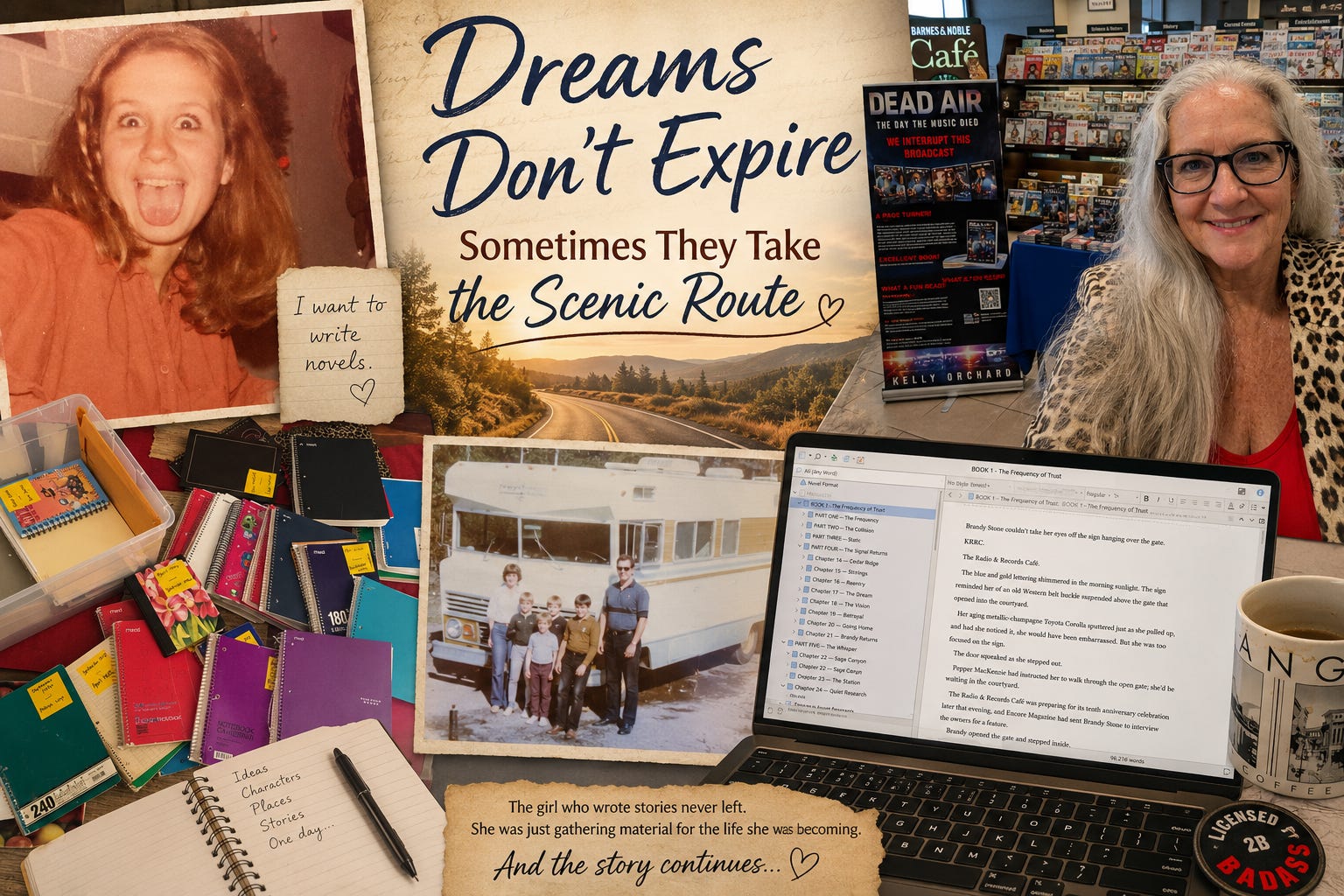
I think I was reading Nancy Drew when I first realized I wanted to write stories.
Not essays.
Not articles.
Not personal development books.
Stories.
The kind with clues, characters, secrets, danger, friendship, and enough mystery to make a girl keep turning pages in the back of a motorhome while the country rolled past the window.
One summer, my brother and I had a reading competition.
He read The Hardy Boys.
I read Nancy Drew.
I don’t remember who won. Knowing my family, I’m sure someone kept score. There were four of us. Competition was not exactly discouraged.
But what I do remember is becoming completely absorbed in those books and wondering how someone had created them.
How did a person sit down and make up a whole world?
How did they know what happened next?
How did they build a story that made me want to keep reading?
I wasn’t only reading.
I was studying without knowing I was studying.
That happened a lot on our summer RV trips. Long stretches of highway meant long stretches of reading. Before phones, tablets, streaming, and whatever other glowing device now saves parents from the sound of four children asking how much longer, we packed books.
Library books.
Scholastic Book Fair books.
Books stacked beside the seats, tucked into corners, carried into campgrounds, read by flashlight, read while someone else was arguing over who got the better spot at the dinette.
Reading was part of travel.
So was imagination.
By the time I was thirteen, I had written what I considered my first book.
It was in a spiral notebook.
I took it to school with me and wrote chapters whenever I could—during breaks, between classes, and probably during a few classes where I was supposed to be paying attention to something else.
History, maybe.
Which, considering my father’s educational road trip agenda, feels mildly disrespectful.
I would write a chapter, hand the notebook to a friend, and wait while she read it. She loved it. She encouraged me. Then I would write another chapter.
Looking back, I recognize the pattern.
Write the story.
Hand it to someone who cares.
Receive encouragement.
Write the next chapter.
That little spiral notebook was not a hobby.
It was evidence.
The novelist was already there.
Life, however, had other material to gather.
I grew up in radio. I worked in radio. I raised children. I helped build businesses. I worked with my dad doing FCC compliance consulting. I wrote articles, kept journals, studied people, watched how systems worked, listened to conversations, gathered details, and moved through one season after another.
The dream of writing novels never left.
It just didn’t get the front seat for a while.
Other books came first.
Heart Lessons came from my experience with heart failure, recovery, grief, faith, surrender, and the life change that eventually led me into the mental health field.
Kelly Orchard’s Apple A Day began as an audio feature after a radio programming consultant suggested that, with my name, voice, and therapy background, I should create short mental health messages people could listen to on their phones. This was before podcasting had become the thing everybody now claims they invented, so it felt fresh and useful.
The idea became sixty-second messages.
Then client handouts.
Then journaling prompts.
Then four seasonal books.
Flipping the Format on the Fear of Failure grew out of my Licensed2BBadass work, radio consulting, leadership development, and the WKRP framework I created to help people recognize fear, resilience, and performance patterns in their professional lives.
All of those books mattered.
They still matter.
But none of them were the original dream.
The original dream was fiction.
Characters.
Scenes.
A world I could build.
A story someone would want to keep reading.
The first novel that began to take real shape was Dead Air: The Day the Music Died.
And it started during heart failure.
That still surprises me, even though I lived it.
While my life was being interrupted by medical appointments, procedures, fatigue, uncertainty, depression, and the long process of trying to get my strength back, I started writing chapters of Dead Air.
Then I handed them to my dad.
He read them.
He loved them.
He gave me his input.
And then I wrote more.
It was the same rhythm from when I was thirteen, only this time the person waiting for the next chapter was my father.
There is something tender about that now.
At the time, I don’t know if I fully understood how important it was. I was sick. I was tired. I was trying to make sense of a life that had gone sideways. My radio career had been disrupted. My plans were no longer cooperating. My body certainly wasn’t.
But the story gave me somewhere to go.
Writing Dead Air helped me function.
It pulled me toward something creative when depression kept trying to pull me under.
Still, life interrupted again.
Heart recovery took time.
Graduate school took time.
Becoming a therapist took time.
Work took time.
Other books took time.
Grief took time.
Family took time.
So Dead Air went on the shelf.
Not abandoned.
Shelved.
There is a difference.
For years, I carried the dream quietly.
Sometimes I thought the first novel would be The Radio & Records Café. That world had been stirring for a long time too. Pepper, Perry, the café, the station, the music, the unfinished business of love and trust and timing.
But a friend who knew the premise of Dead Air encouraged me to dust that one off first.
So I did.
Eventually, after years of carrying it, shelving it, returning to it, doubting it, revising it, and finally deciding it was time, Dead Air became my first published novel.
The thirteen-year-old girl with the spiral notebook would have understood.
So would the woman recovering from heart failure, handing chapters to her dad.
So would the woman who carried forty journals around for decades because she believed they held more than memories.
They held material.
Characters.
Settings.
Scenes.
Premises.
Poems.
Fragments.
Evidence of the writer who had been there all along.
When I began RV life and started reading those journals again, I wasn’t just looking backward. I was harvesting.
I was looking for story.
And once the journals had given me what I needed, I let them go.
That cleared space.
Not only in my trailer.
In me.
Today, I’m deep into work on The Frequency of Trust, the first book in the Radio & Records Café trilogy.
The draft is finished.
I have found an editor.
And I now have a deadline to submit the manuscript.
Just writing that sentence gives me chills.
A deadline to submit the manuscript.
There are dreams that arrive with trumpets.
Mine arrived with notebooks, detours, FCC files, therapy notes, radio stories, grief, RV roads, and a golden retriever who has very strong opinions about when I should stop editing and throw a toy.
Looking back, I don’t think the dream was delayed.
I think it was gathering material.
Every interruption became part of the story.
Every detour added something I could not have written without living it first.
The dream wasn’t waiting for me somewhere in the distance.
It was traveling with me all along.
Dreams don’t expire.
Sometimes they take the scenic route.
This Week’s Heart Lesson
This week’s excerpt comes from Chapter Five of Heart Lessons: Lessons in Patience.
Patience is a lesson I must learn every single day. I know this is an area where all humans fall short. We live in a society of instant gratification.
The path of life has many stops and starts.
I often have to remind myself and my clients that our journey isn’t linear. There are seasons when we are moving forward, seasons when we are standing still, and seasons when we seem to be moving backward no matter how hard we try to move forward.
Whether in your career path or your personal life path, you will face obstacles, and patience is something that needs to be learned on a daily basis.
Continue the Journey
This week’s video explores one of the lessons that kept showing up throughout my heart failure journey and beyond: patience.
Not passive waiting.
Not giving up.
But learning to trust that some things take longer because they are still becoming.
If you’d like to read the full story, I’m giving away a free digital copy of my first book, Heart Lessons: A Story of Healing in the Midst of Heart Failure That Will Inspire You to Follow Your Heart.
If you’re navigating a life transition, career change, grief journey, health challenge, or simply trying to figure out what’s next, I also offer complimentary confidential consultations.
Before you go, I’d love to hear from you:
What dream has stayed with you longer than you expected?
Leave a comment and join the conversation.
No posts
Comments
Nothing yet. Say the first thing.
Sign in to join the conversation.