

You know that moment right before you tell the truth?
Your body knows it’s coming. Your chest tightens. Your breath shortens. Your hands shift involuntarily. And your voice—if you can access it at all—doesn’t quite sound like your own.
Something in you is calculating risk faster than your conscious mind can follow.
For some of us, speaking up doesn’t just feel uncomfortable.
It feels dangerous.
I have an ancient, embodied framework for this.
In what I understand to be my first lifetime, I lived as a Persian man who spoke truth to my community about the king and his guardsmen, who relied on domination to maintain power over us all. And, I was unalived for it.
You don’t have to believe that story to understand what I’m pointing to.
Only that some of us carry fear that feels older than our current circumstances. Older than our relationships. Older than anything we can neatly explain.
For as long as I can remember, my body has responded to certain expressions of authority—loud, domineering, certain of their own rightness—as if something real were at stake.
And still, in this lifetime, I keep being placed in moments that ask me to speak the truth. To be the one everyone else looks to as the leader.
We’re taught that power looks like control. Like certainty. Dominance. The ability to take up space without question.
But most of what we’ve been shown as power is something else entirely.
It’s fear, structured.
It’s fragility, protected.
It’s the need to override, silence, or intimidate to avoid being challenged.
It’s unintegrated trauma.
And somewhere in my body, I have always known the difference.
Knowing, of course, is not the same as acting.
At sixteen, I stood up to a volleyball coach whose angry ego filled the gym. I don’t remember the exact words I used each time he exerted his force or cornered me, but I remember the adrenaline. The calculation. The moments I chose not to back down, despite the trembling.
At twenty-four, I set a boundary with my biological mother that functioned as an ultimatum. When it wasn’t met with mutuality, I walked away—and have never looked back. Though my heart has certainly processed the pain.
As a young business owner, I fired a handful of clients over fourteen years—bullish women and men accustomed to being deferred to, who expected access without accountability. My body shook every time because I feared that I would lose everything, and I did it anyway.
In learning spaces, I’ve spoken directly to people in positions of authority—naming harm, calling out performative allyship, refusing to collude with silence simply because discomfort hung heavy in the room.
Just last month, sitting in standstill traffic in New York City, a man approached my car, locked eyes with me through the windshield, and attempted to open my passenger door. There was no time for nuance. No time for measured tone or careful language. What came out of me was loud, deep, and immediate. Enough to stop him and persuade him to move on.
This matters.
Because while I no longer define power as volume, I understand now that access to volume—when survival requires it—is also part of my power.
None of these moments felt powerful in the way we are taught to recognize power.
They felt risky.
They felt exposing.
They felt like standing at the edge of something my body had been trained to avoid.
What I see now is that they were not random; they were all initiations.
Each one asking the same question: Can you stay with yourself while you tell the truth in the presence of someone who wants you to comply?
The body doesn’t forget what it has learned about survival.
If speaking once led to harm—whether in this lifetime or one you understand more intuitively—your system will do everything it can to prevent you from taking that risk again.
Freezing is intelligent.
Fawning is adaptive.
Silence is protective.
These are not signs of weakness. They are evidence of a body that has learned what it costs to be seen.
But the body is not fixed. It is shaped by repetition. And every time you choose to stay—to remain in yourself while you speak—you introduce new information into the system.
Not all at once. But enough.
My relationship to power has changed.
Power is not dominance.
It is not control.
It is not the ability to override another person’s reality.
Power is the ability to remain in relationship with yourself (even when someone else is trying to pull you out of it).
It is the willingness to set a boundary even when your voice shakes.
It is choosing truth over approval, again and again, until your body begins to understand that speaking does not equal annihilation.
And sometimes—when it matters—it is also the ability to get loud.
If you are someone who struggles to speak in moments like these, I want to be precise: There is nothing wrong with you.
You are not weak.
You are not failing at something that others find easy.
You are working against patterns that were never yours alone to carry.
Power is not something you are given. It is something you practice. In small moments. In imperfect language. In voices that tremble and voices that rise.
And one day, without ceremony, you will find yourself in a moment that used to silence you—and you will still feel the fear, but you will stay, and you will speak.
That is how the illusion breaks.
Not all at once, but in the body.
If this sounds like the work you are in, you don’t have to do it alone.
Learning to use your voice—especially if your body has learned that speaking is dangerous—is not a cognitive exercise. It’s not something you think your way into.
It’s something you practice—gently, gradually, and in relationship.
This is the work I am doing more and more as a somatic intimacy practitioner.
I work with people who know, on some level, that their power is there—but who struggle to access it when it matters. People whose bodies override their intentions. People who go silent, or comply, or leave themselves in the moment and wish, afterward, that they hadn’t.
Together, we create space for your body to respond the way it wants to.
Not the way you think it should.
Not the way you’ve been told is “appropriate.”
But the way that is true.
We work with voice.
With all the choices that are actually available to you.
With boundary-setting that doesn’t require you to harden or abandon your tenderness to be effective.
Because the goal is not to become louder as a personality, it’s to become more available to yourself.
To know, in your body, that you can stay.
That you can speak.
And that if a moment ever calls for it, you can turn up the volume.
Inner Eros Mini Workshop
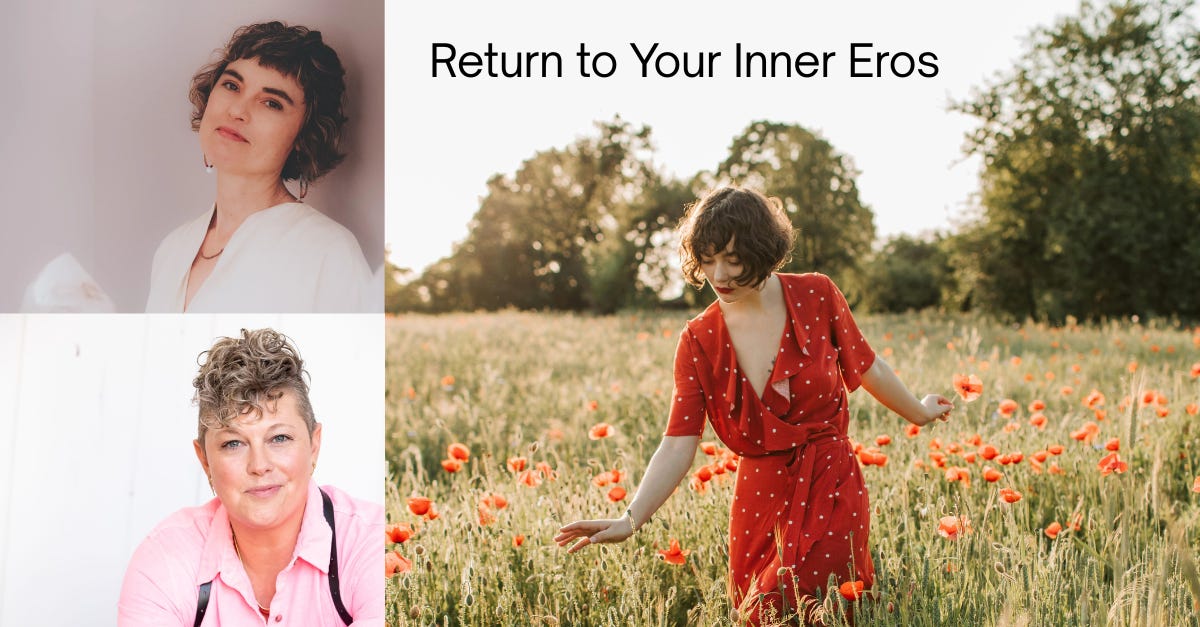
Speaking of becoming more available to yourself, my friend Katie Todd and I are running a virtual workshop next Saturday called Return to Your Inner Eros. So, come play with us for 90 minutes on May 9th… and leave feeling more awake, alive, and lit up in your body! Details at klcampbell.com/eros
Comments
Nothing yet. Say the first thing.
Sign in to join the conversation.