
It must be true. Andy Burnham is doomed. Why else would we be told so often that each of the last five prime ministers has set a new record for being the least popular occupant of that office? It follows that Burnham is heading to Downing Street at a time when voters are becoming ever more disillusioned with their leaders – and that, before long, he will be the next victim of an unforgiving electorate. That’s the doleful effect of dangerous cultural divisions, poisonous social media and rowdy behaviour at Westminster.
Except that the facts tell a different story. I can’t guarantee that Burnham’s ratings won’t sink to unplumbed deaths. What I do suggest is that the past record warns against an assumption of unavoidable disaster for the new prime minister.
Ipsos – formerly Mori – has been charting satisfaction ratings for almost half a century. The following table shows their worst ratings recorded for each of the eleven prime ministers that we have had in that time.
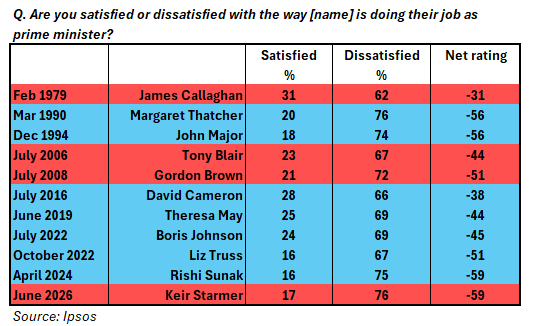
The first point is that every prime minister has suffered bouts of unpopularity: times when at least 60 per cent of the public were dissatisfied with the way they were doing the job. But beyond that they fall into four groups:
** Two whose worst ratings stayed above minus 40 (Callaghan and Cameron)
** Three whose worst minus ratings were in the mid-40s (Blair, May and Johnson)
** Two whose worst ratings were minus 51 (Brown and Truss)
** Four whose worst ratings were minus 56- 59 (Thatcher, Major, Sunak, Starmer).
If we ignore what happened before 2016, we see a steady downward progression from minus 38 to minus 59. This is the basis on which some observers say there are forces at work that make voters increasingly hostile to our national leaders.
Let’s inspect the numbers more carefully. If we are picky, Starmer’s worst rating did not set a new record. He stemmed the slide by having the same rating as Sunak, not a worse one. But there are two more substantial reasons to question the thesis of unstoppable public hostility.
The first is that Ipsos’s figures for Truss are from their poll conducted from October 5-12, 2022. She announced her resignation on October 20. It’s clear from other polls that her reputation collapsed in her final days. In a poll conducted from October 14-16, YouGov recorded a net rating of minus 70 (favourable 10 per cent, unfavourable 80). YouGov’s worst figures for Starmer, from last December, were 15-76 per cent: terrible, but not as catastrophic as for Truss. She, not he, is the true current holder of the wooden spoon.
Secondly, and more importantly, we should not ignore what happened before Cameron’s time. Voters had broadly the same low opinions at some point of Thatcher and Major as of Sunak and Starmer.
So public hostility to prime ministers is nothing new. Moreover, the story from Cameron to Sunak is easily explained, not by some irresistible force directing public attitudes, but the particular circumstances of each premiership:
** Cameron losing the Brexit referendum
** May brought down by Tory divisions over Brexit
** Johnson lying over partygate
** Truss being run over by the financial markets
** Sunak taking over the Tory party when voters had already decided to boot it out of office
That said, there is evidence of an historical shift – but it happened well before the 1980s. The figures come from Gallup, which used to track the reputations of politicians until 2001. In his six years as prime minister, from 1945 to 51, Clement Attlee’s worst rating was minus nine. Winston Churchill (1951-5) and Anthony Eden (1955-57) never had negative net ratings. (In fact, Eden was more popular after the disastrous Suez invasion than he was before.) Harold Macmillan was the first post-war prime minister to have a negative net rating in double figures: minus 19 at the height of the Profumo crisis in April 1963.
The modern era of unpopular spasms really began with Harold Wilson (minus 34 in May 1968) and Edward Heath (minus 26 in June 1971). Since the 1980s, there have been fluctuations but no clear trend in the worst figures recorded by each prime minister.
This is not to say that Burnham will find it easy to gain public approval. Labour, and not just Starmer, is unpopular. On the other hand, he showed in Makerfield that he can win votes. He increased Labour’s share of the vote by ten percentage points. This was the largest ever surge in a fully contested by-election by a party of government defending one of its own seats.
Burnham’s fate is not written in the stars or determined by history. It will be down to him to persuade voters of his merits and his policies – and his fault if he fails.
No posts
Comments
Nothing yet. Say the first thing.
Sign in to join the conversation.