
Here’s your starter for ten. Can you tell the difference between 3p and £207?
You can? I thought so. Sadly, it seems that the leader of His Majesty’s Opposition cannot.
Last week, Kemi Badenoch was asked about her plan to reintroduce the two-child benefit cap. A Guardian reporter put it to her that this “will mean more children growing up in poverty, and there is evidence that they will have worse educational outcomes, and this will cost the state more in the long term.”
Badenoch replied:
“I think it’s very, very important that people understand the argument here. I disagree with the premise that the Guardian has. The measures for relative child poverty change depending on how many billionaires come in and out of the country.”
I agree that “it’s very, very important that people understand the argument here”. Debates about the incidence of poverty, the best way to tackle it, and the role of the tax system, all play a large role in our politics. So they should. However, for that debate to be constructive, we need to agree on the facts. The quote above is one of two recent occasions when Badenoch and her party have cut the facts adrift.
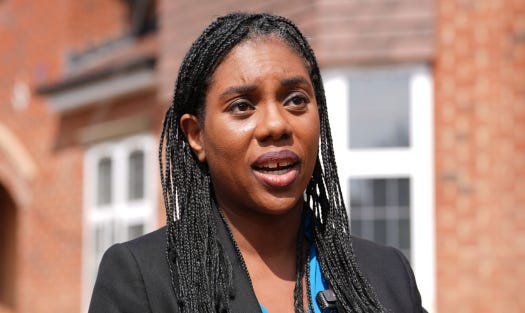
First, that comment about the impact of the very rich. Her logic is clear. Here is a notional example that illustrates her point. Suppose Britain’s government manages to attract 100 billionaires from abroad, each earning £100 million a year. (Billionaires should be able to generate that kind of income.) This would increase Britain’s total annual household income by £100 times £100 million, or £10 billion.
According to the Office of National Statistics, the UK has 29 million households. Those billionaires would increase the average household income by £10 billion divided by 29 million. This works out at £345 a year.
The standard definition of the poverty line is 60 per cent of the income of families in the middle. On Badenoch’s logic, if the average rises by £345 a year, the poverty line rises by 60 per cent of that, or £207 a year. That’s £4 a week – not a trivial amount – even though nothing changes in the lives of families affected.
On those figures, Badenoch would not only be right; she would be identifying a serious flaw in the way we deal with poverty in Britain today.
Instead, she is wrong. Her reference to billionaires makes sense only if she assumes that the middle income used to calculate the poverty line is the average, or mean, of all incomes. But that’s not how these sums are done – not least because of the way a relatively small number of very rich people can distort the mean. That’s precisely why Badenoch’s billionaires are not allowed to shift the poverty line.
Instead, the key figure is the median: the household midway between the very poorest and the very richest. Halfway to 29 million is 14.5m. (It’s not quite as simple as that, because the calculations used to determine the poverty line vary according to the sizes of different households; but the principle remains.)
Now, if 100 billionaires come to Britain, the number of households rises by 100 As a result, the halfway point rises by 50.
In round numbers, in and around the middle of the income distribution, each £1000 band for annual income contains one million households. Fifty households is one 20,000th of one million. So, raising the median by 50 people moves the median income by £1000 divided by 20,000, or 5p a year. Applying the 60 per cent calculation to the poverty line, and the impact of those footloose billionaires is just 3p a year.
Dear Kemi, please write out fifty times, 3p is less than £207.
When you have done that, could you move to your second inaccuracy, and correct a mistake in May in a party document you introduced: “Alternative King’s Speech”?
Its first section is headed “Welfare Reform Bill.” It says:
“For the first time ever, the total welfare bill is now higher than total receipts from income tax.”
That is simply wrong. In fact it is the exact opposite of the truth.
Within days of the Conservatives publishing this statement, Fullt Fact, the excellent fact-checking site, exposed the error. Their analysis led to a letter to Badernoch from Penny Young, the interim chair of the UK Statistics Authority (UKSA) criticising the statement.
Their verdicts are well worth reading in full. Here’s the essence. The way the official welfare figures are published can be traced back 13 years 2013/14. During the decade of Tory rule, the total welfare bill was already higher than receipts from income tax in every single year.
What’s more, the implication in the Tory document, that welfare spending has been rising faster than income tax receipts, is also wrong. Apart from the Covid episode, tax receipts have been gradually catching up. Indeed, the Office for Budget Responsibility (OBR) expects income tax receipts to overtake total welfare spending in the current financial year. By 2031, the difference is projected to be £14 billion. A more truthful statement would be:
“For the first time since we have comparable data, the present Labour government has made sure that income tax receipts will exceed the total welfare bill. Year by year, income tax receipts are growing faster than the welfare spending ”
That would correct the most clear-cut error, but there is more to come.
Some months ago I discussed the way politicians have a habit of saying things that are technically true but which mislead their audience. There is an old, recently revived, word for this: “paltering”. I cited examples of both Labour and Conservative politicians doing this.
Before the incorrect statement about welfare spending, Badenoch’s report sets the context for its argument about what needs to be done:
“The welfare bill has spiralled out of control, with millions of people on benefits when they should be working.”
The Tories say their objective is to reform Universal Credit (UC) and Personal Independence Payments (PIP), and withdraw welfare from “those who are not citizens of this country”. These are policies that deserve to be debated. This year, UC is expected to cost £88 billion and PIP £32 billion. These numbers are too big. Badenoch is right to want to bring them down by getting more people off benefits and into work.
However, she misses out the vastly more expensive part of the “total welfare bill”: the state pension. The OBR expects this to cost £159 billion this year.
One might expect that the Tories, when making such a fuss about the “total welfare bill”, would acknowledge, even if just in passing, the extent to which by far its greatest recipients are elderly folk like me. But no: there is no reference anywhere in the document to “retired”, “pension” or “triple lock”.
Consider what any normal person – that is, anyone who doesn’t carry the finer details of government spending in their head – would reasonably conclude from the Tory document. It refers solely to the various ways in which PIP, UC and other benefits should be spent in order to get back to work. The insertion of the word “total” is a classic example of paltering. Strictly speaking, it is true, for it broadens the meaning of welfare to include the state pension. But it does so in the manner of a smart magician misdirecting its audience. It conceals the extent to which its complaint about the burden of “bad” welfare relies on including the numbers for the “good” help given to pensioners.
On June 24, Young’s letter from UKSA to Badenoch criticised both the specific error about the link between welfare spending and income tax receipts and the wider failure of the Tories to clarify the true character of the “total welfare bill”:
“Approximately 55% of social security expenditure is spent on pensioners, with the State Pension forming the single largest component… we are concerned that the inaccuracy of the “first time ever” element of the claim, combined with the absence of this contextual explanation, could lead to misunderstanding among members of the public about welfare spending.”
The Tories could put this right. An honest revision to this part of their “alternative King’s Speech”, would note that, under Labour, tax revenues are about to overtake welfare spending. It would then say:
“When we talk about the “total welfare bill”, we are well aware that its biggest component by far is the state pension. The most straightforward way to cut welfare spending in the long term would be to end the triple lock. Only this month, the OBR has shown that if we keep it, the combination of demographics pressues and the triple lock will will almost double the cost of the state pension over the next fifty years. At today’s prices, that would increase its annual cost by £130 billion. We know the policy must change at some point. The IFS has shown how this could be done without dragging a single person into poverty. Unfortunately, I’m too weak to take this on just now.”
Perhaps Badenoch can devise a less humiliating correction. I’d love to see it. At the time of writing this post, and despite the admonition from the UK Statistics Authority, the “alternative King’s speech” remains unchanged on the Conservative Party website.
No posts
Comments
Nothing yet. Say the first thing.
Sign in to join the conversation.