
Surprise! I had a hysterectomy. What a boring announcement to make, I know. Next time I’ll make sure I have something more fun to share with you. Like a book, or, I don’t know, a Valentine’s Day fascinator that doubles as a chocolate box. (Spoiler alert: I did complete one of those.) But for now, let’s talk about my yeeterus journey. The great organ harvest. My monthly subscription cancellation.
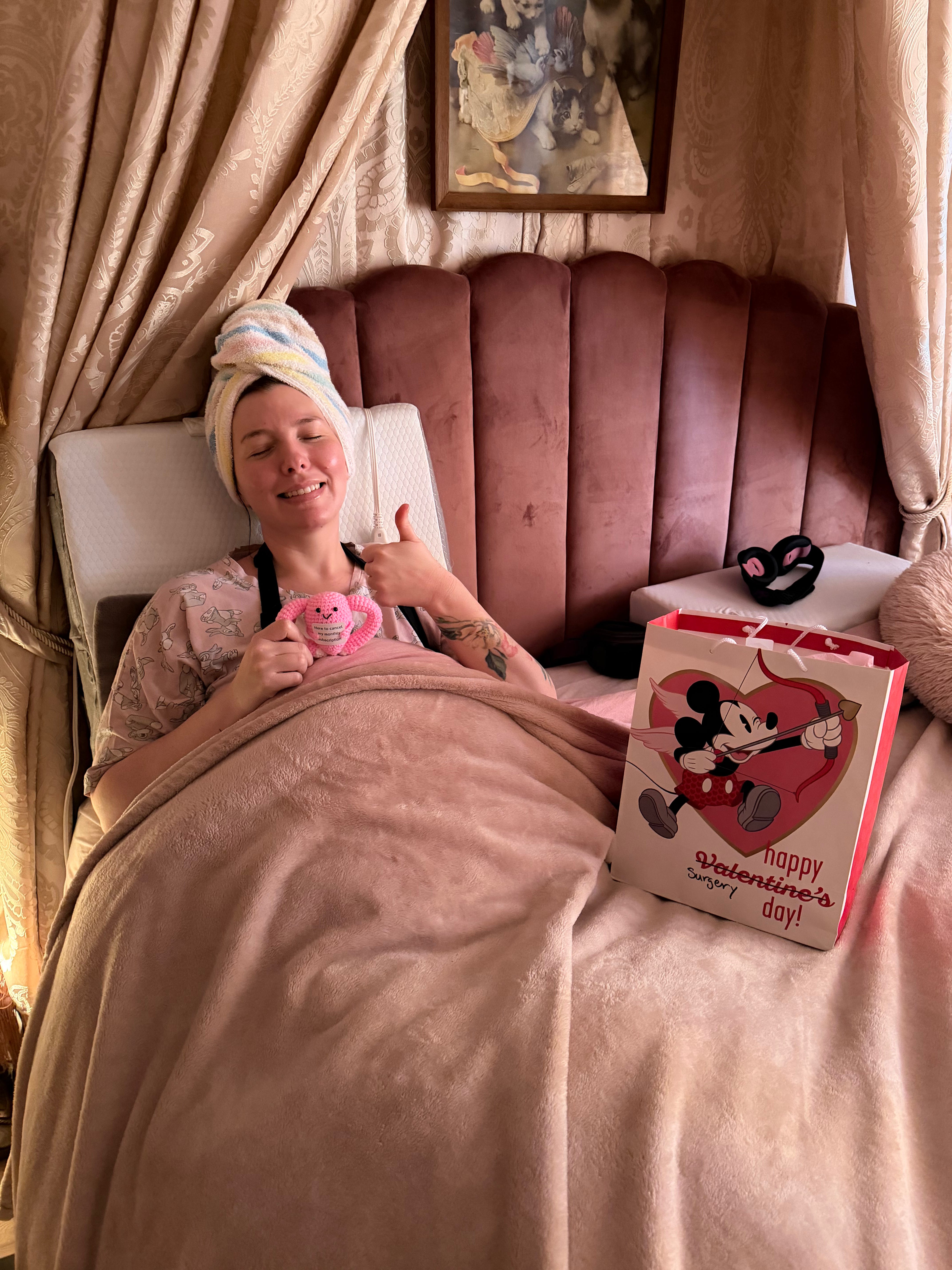
I wasn’t sure if I would even share that I got a hysterectomy. I thought I might just ghost for a while and come back when ready, like I do pretty much any other time I feel like I need a break. I haven’t even told many of my friends or family that I had the surgery! I wasn’t hiding it; it just wasn’t something I felt the need to announce.
As for online, where I’ve historically and notoriously overshared so much of my life until more recent years — I didn’t share much online before my surgery for two reasons:
I didn’t want anyone to try to talk me out of it.
As well-meaning as strangers on the internet can be, a flood of unsolicited medical advice can be exhausting. I just needed to trust my decision. I only wanted the advice from my surgeon and a few people I know in real life who have had the same procedure.
And honestly, I think limiting that advice to people I know and trust (instead of sourcing opinions from everyone and everywhere) really helped me feel at peace and prepare for a realistic outcome. One of my friends and my sister’s neighbor both had practical tips and personal recommendations that came in handy during recovery, and my surgeon made sure I was as prepared, informed, and supported as I could possibly be.
I walked into surgery pretty unbothered. I felt confident about my decision. I was more worried about the downtime. And about Bobby, who was (and remains) worried about me. But I’m doing okay so far. I’m only 5 days post-op, so I’ll have to give you another update about the healing process, but right now…I’m really, really happy with my decision. And I decided I wanted to share more about it. You know, for old time’s sake. Here’s what led to my decision, what my symptoms were like, for anyone else who’s quietly suffering and wondering if they’re being dramatic.
Sometimes the problem with shared experiences is that we assume “shared” means “identical.” Maybe that’s why chronic pain is so often dismissed. For me, it’s embarrassing to even bring it up. How do I know what everyone else is feeling? Maybe my pain scale is calibrated differently. Maybe my 5 is another person’s 10, or vice versa. Maybe I’m just a fragile little weakling. Or maybe I’ve been toughing it out for so long that I’m not sure what “normal” feels like anymore.
Menstrual pain might be in the top five of that category. As common as headaches and migraines are, there’s at least a little more sympathy around a debilitating migraine. Most people can tell the difference between their tension headache and my inability to form a sentence or see out of one eye.
But periods are treated less like an ailment and more like a pesky yet inevitable part of being a woman. A shared experience. An essential part of the cycle. A necessary discomfort in the miracle that is life. It can be difficult to decide what’s normal and what’s not, especially when you’re not very comfortable talking about it.
I knew I had endometriosis since I was a teen, but I also knew several people who had it without symptoms, so I wasn’t sure if the pain I felt was abnormal. I was also one of the lucky ones whose symptoms were managed with hormonal birth control, until I could no longer take it anymore due to the migraine type I have. So I just decided to muscle through it. I knew it was painful, but I also knew I could handle it. And since I knew I didn’t want kids, I wasn’t worried about how it would affect my fertility. Doctors had pretty much the same reaction: we’ll cross that bridge if you change your mind.
It wasn’t until I got a little more comfortable talking about the messier reality of periods that others would say, um, yeah maybe that’s not normal.
Despite being raised in a family that’s notoriously open, honest, and unbothered by anything others might deem embarrassing, I’ve always been the opposite. I won’t change in front of other people. I’m far more private than most realize. And I’m what some might call a prude.
I didn’t tell my mom when I got my period; I just started taking my older sister’s pads and tampons. Pretty sure everyone figured it out eventually, but the idea of anyone knowing I was going through puberty or that I had any bodily functions at all was humiliating. And that feeling didn’t really leave me until my thirties. So I wasn’t exactly swapping stories about menstruation with anyone.
To give you an idea, when I read that NASA once sent 100 tampons for Sally Ride’s 6-day stint in space, I laughed at how little men knew about periods. She would probably only need about 60 or 70, right? Because the thing was, if my period was even starting during a trip, I packed at least a 48 pack of tampons and a full case of pads — and usually had to buy more once I got there. (Side note: not a lot of tampon options in Japan.)
So I have one thing in common with the men at NASA: I also have no idea what a reasonable amount of tampons is.
Imagine my surprise when I heard about people free-bleeding. Me, changing my pad and super-plus tampon every 45 minutes to an hour and still bleeding through every pair of underwear, pants, sheets. I had a waterproof mattress cover at home, but had to sleep on a towel at hotels in case I didn’t wake up enough throughout the night. Still, I had to hand-wash the sheets in the bathtub more than once.
And you’re telling me people are out here free-bleeding??
Are they walking around like Patrick Bateman after a fresh kill? Or do they bleed so minimally that it isn’t a public health hazard? And if so, how do I Freaky Friday with one of those lucky ducks?
I timidly brought up the amount of blood loss at my women's wellness exam. Instead of just describing my flow as heavy, I got a little more specific about blood clot size and frequency, doubling up on tampons and pads every hour, and periods sometimes lasting for weeks. And what do you know? Turns out that’s not everyone’s experience.
Pain might be subjective, but blood loss is not.
So, maybe my pain levels weren’t enough to merit further treatment when I was young and quick to say, “Okay, thanks, Dr!” and never push back. But the combination of a new, attentive gynecologist and some bloodwork that suggested I might be losing too much of it did the trick. She ordered ultrasounds, further bloodwork, and told me I shouldn’t be suffering like this, so let’s figure something out.
Ultrasounds can’t show you everything, but mine showed enough to give a decent picture: I had a large subserosal fibroid, as well as multiple smaller intramural and submucosal fibroids that were enlarging my uterus and putting a lot of pressure on my bladder and colon. I also had a hemorrhagic ovarian cyst, so my doctor asked me to come back in six weeks to see if it resolved. I felt relieved to know that there was a reason, and therefore a possible solution, to my ever-increasing misery.
Six weeks later, on no sleep after a night at the hospital with my grandpa, I filled my bladder with a whole lot of water in anticipation of my pelvic and transvaginal ultrasound. I was already going through a lot, and the ultrasound tech said some extremely unkind things to me that made me cry. Instead of having an ultrasound, I left in tears, desperate to pee but too embarrassed to stop at the restroom.
I didn’t go back to my gynecologist for almost two years because it was easier to just live with the pain. Because it was normal, right?
By the time I felt brave enough to say anything about my experience, the tech no longer worked there. I can only hope she found a different career path. Or that she was just having a really bad day and took it out on the wrong person.
Eventually, I could no longer ignore the MyChart messages reminding me I was overdue for my exam. When I finally went in, it was with a new gynecologist who asked why I never returned for my follow-up.
And this is the part I want to be clear about: I don’t blame any of my doctors for how long and drawn-out this became. The truth is, I didn’t advocate for myself at all. I would ask, “Is this normal?” and if the answer was yes, I would just say, “Okay.”
Even when I finally found someone who did advocate for me, all it took for me to completely shut down was one cruel encounter with someone who woke up on the wrong side of the bed. I’m just not good at championing myself. I’m quick to assume I’m being dramatic, or that I’ll embarrass myself by asking more questions.
Anyway. After my exam, she scheduled more ultrasounds and assured me I would not see that old tech (because she didn’t work there anymore). By this time, I had another subserosal fibroid (this one was pedunculated), but otherwise things looked pretty similar with just a little bit of growth. Two large fibroids — a grapefruit and an orange — and multiple smaller ones that they could see. More cysts. Nothing crazy, just something to keep monitoring while we try to control the bleeding.
Not long after, I was called in for an endometrial biopsy. My gynecologist was honest and told me it would hurt, so I was prepared. I had no pain management, and it hurt… pretty badly… but I didn’t flinch. The nurse was so sweet — rubbing my arm, telling me I was a hero. She looked at the doctor and said, “Isn’t she a hero?”
So I asked what it’s usually like.
The doctor told me that a lot of the time, she can’t even complete the biopsy because it’s so painful. That women scream. Sometimes they jump off the table. And then the next step is sedation.
And while I appreciated the kindness and the gentle bedside manner, I felt horrible for the women who suffer through that kind of pain and then have to do it all over again. Because yes, I can handle it (my periods feel similar to that sometimes) but it was way more than “a pinch” or “mild cramping.” It lasted for the entire length of Hotel California…which was the strangely haunting soundtrack of my biopsy.
“What this tells me,” my doctor said, “is that you are used to a lot of pain.”
She scheduled a surgical consult.
“Are you particularly attached to your uterus?” my gynecologic surgeon asked.
I giggled at the phrasing. I don’t remember exactly how I responded, but the general message was not at all. She’s been nothing but a hostile tenant, claiming squatter’s rights any chance I even threatened to evict her.
I appreciated that when she asked whether I wanted kids, she didn’t question my resolute answer: still and always, no. There was no “You might change your mind.” Granted, my ever-increasing age might give me the privilege of no longer being second-guessed. But still, I noticed. I liked her right away.
After reviewing my tests, asking lots of questions, and doing another physical exam, she went through all my options. There are medications like Lupron that can help with fibroids, but because of my high risk of breast cancer and migraines with aura, she didn’t want to take that risk. I was already on tranexamic acid to help with the bleeding. It worked, but the main side effect for me was horrible headaches of which I already have too many, and it was not worth it.
So my options were basically: monitor and live with it, go the surgical route to excise the endometriosis and remove the fibroids at a minimum, or go all the way and have a hysterectomy.
I wasn’t sure I was ready for any of that. Not because I was attached to my uterus, but because it’s obviously a pretty major surgery with a decent amount of downtime — and between the expense of the surgery and not being able to work as a self-employed person, that was the scariest part.
A myomectomy was also an option, but she said it was likely she’d have to go back in and do it all again in just a couple of years. So she offered a total hysterectomy as a more definitive option — while keeping my ovaries so I wouldn’t go into menopause.
But was getting a total hysterectomy…dramatic?
By the time I had my surgical consult, my hair was back to coming out in clumps. I had tinnitus 24/7. I was out of breath after the slightest exertion, and I hit a wall at 3 p.m. every day. My headaches and migraines were increasing in length and severity, and no amount of iron seemed able to keep my levels up. There were days when I felt like I was moving in slow motion, barely able to keep my eyes open.
My bladder felt like it was constantly under pressure; I had to pee all the time with very little relief. This is coming from someone who used to be able to stop once on a 17-hour road trip. And pelvic pain? Forget it. I knew from blood work that I was anemic and had other common deficiencies (B12, D) but how much of this would be solved by a hysterectomy? Everyone kept saying, “Welcome to perimenopause!” but was I in perimenopause for the last decade?
My surgeon said that while that was possible, all signs pointed to the obvious images before her (and many tests were done to rule out other issues). She did a pelvic exam and physically felt one of my larger fibroids (and honestly, that hurt worse than the endometrial biopsy). So my repeated fear that they’d go in there and find nothing, she said, wasn’t possible.
But babes, I was still obsessing over that irrational thought even after I woke up from anesthesia. It’s part of my OCD.
So I told her I would think about it. She sent me a lot of information, told me to follow up with her any time and that she would support whatever decision I made.
It took a little shuffling around of my schedule, a few pep talks from people who’d had the same surgery, and one more consult with my very patient, very awesome surgeon.
But in the end, I finally made the appointment and started the journey to surgery. Before I knew it, surgery day was here.
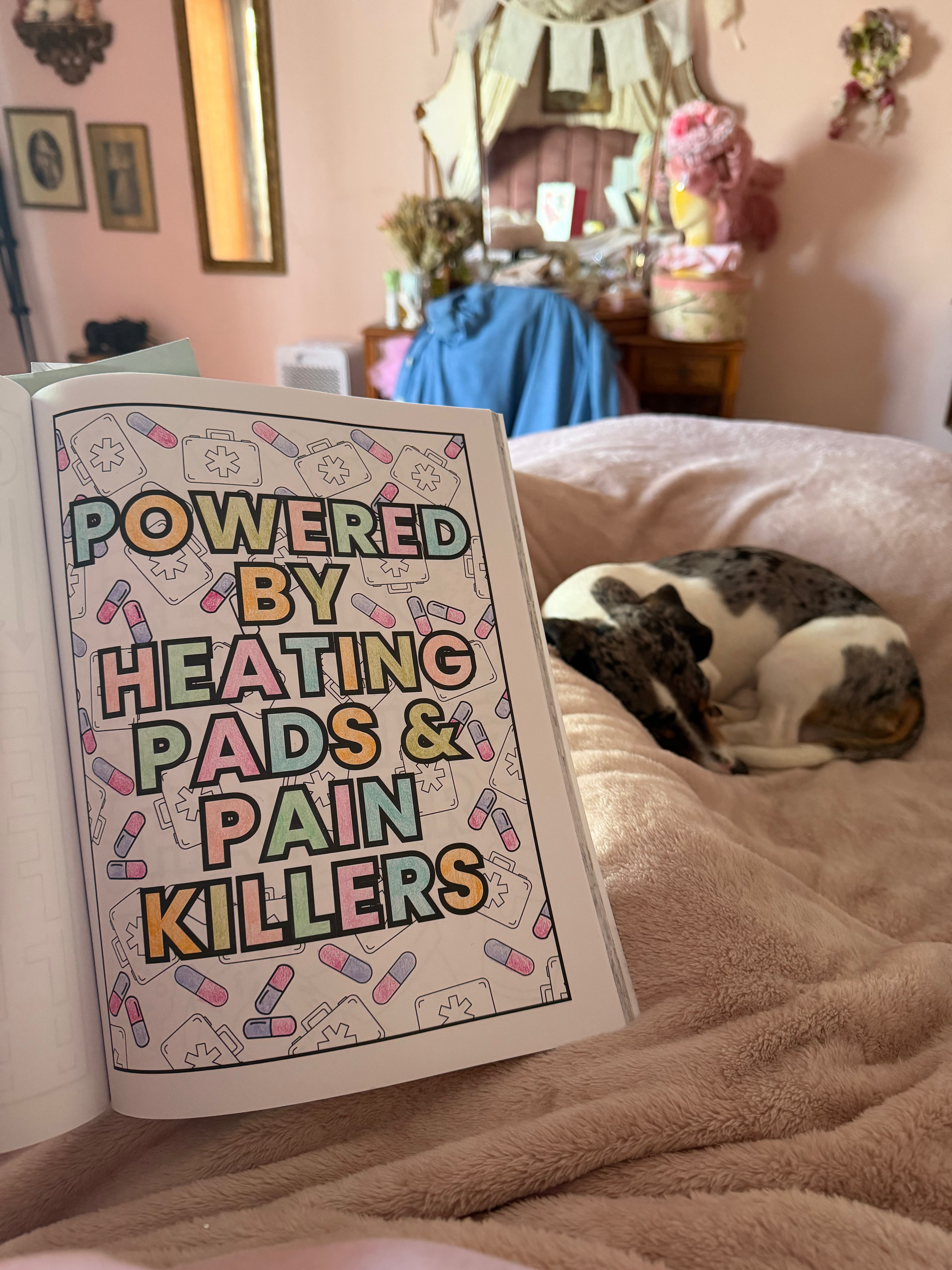
And now, the healing begins! Well, it started on the 6th. But still, I know I have a long way to go. Speaking of, I’m pretty exhausted by typing all this out — so I’ll tell you about the surgery & post-op experience once I have more energy.
Comments
Nothing yet. Say the first thing.
Sign in to join the conversation.