
Miyazaki has the most refreshing and pure take on masculinity I have seen on the silver screen. In this post, I hope to showcase why I think so. My intention is not to explain the movies and do the whole lit-crity, CliffsNote analysis. I simply wanted to explain what I got out of watching these movies and hearing Miya-san talk about them and his process.
Here, Miyazaki shines through with his Unwritten rule of love
I've become sceptical of the unwritten rule that just because a boy and a girl appear in the same feature, a romance must ensue. Rather, I want to portray a slightly different relationship, one where the two mutually inspire each other to live - if I’m able to, then perhaps I’ll be closer to portraying a true expression of love.”
- Hayao Miyazaki
Miyazaki has a beautiful way of portraying how two people can come together to elevate each other. This to me is an absolute breath of fresh air. A saving grace from the parade of melodramatic Hollywood romances.1 Out here in the West, some boy-girl screen time has to, JUST HAS TO, lead to some drama. Some trope we can cocoon into. Maybe it's left us emotionally short-sighted. We may not see past the veil of romance and find that there is more to a relationship. Miyazaki takes care to treat this.
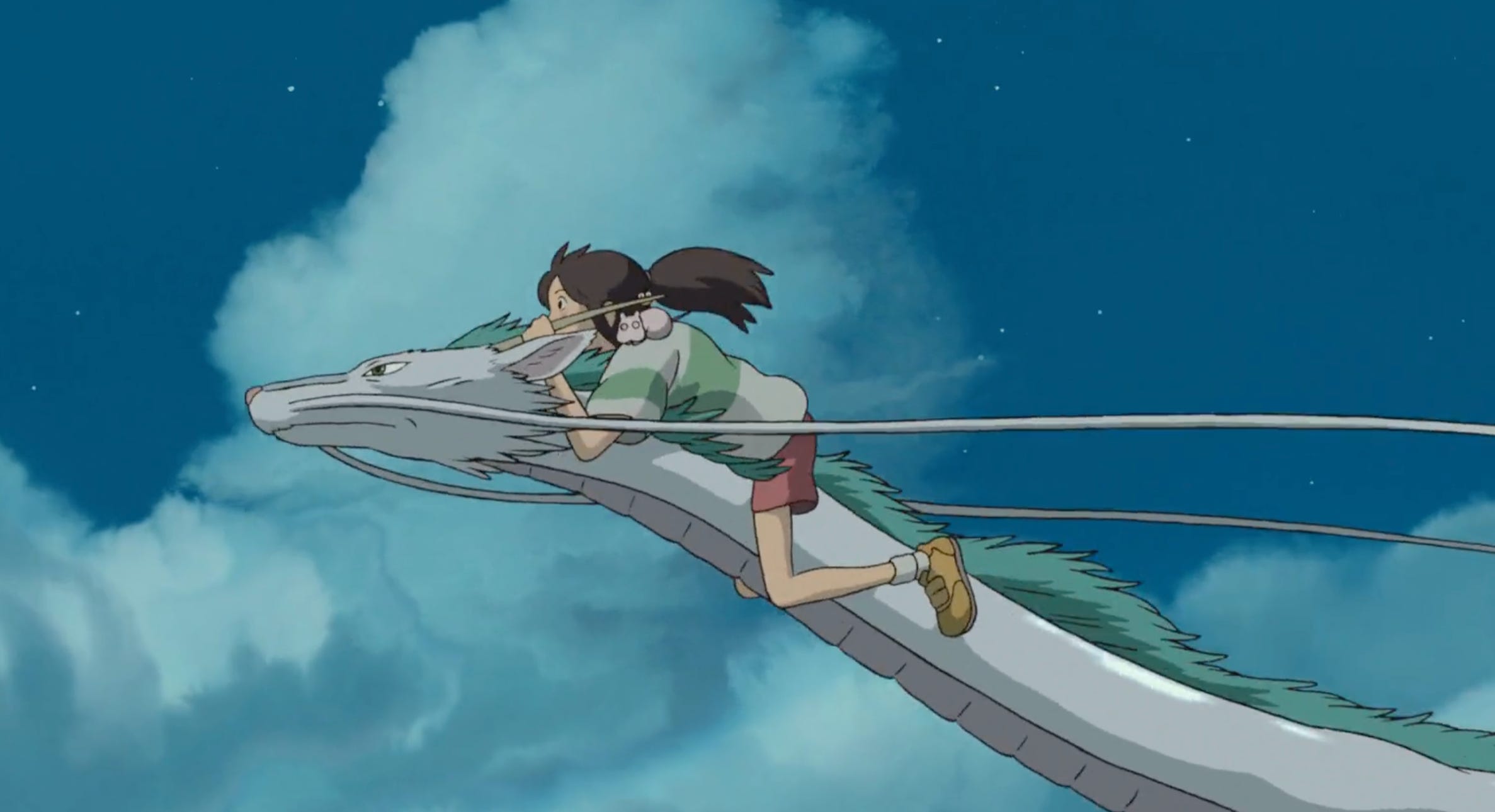
Spirited Away is a marvellous example of this ethos. Haku and Chihiro have the most inspiring relationship. Uniquely here, it's about helping each other find themselves. Rather than romance, we get to discover the protagonists as they navigate this fantastical world.
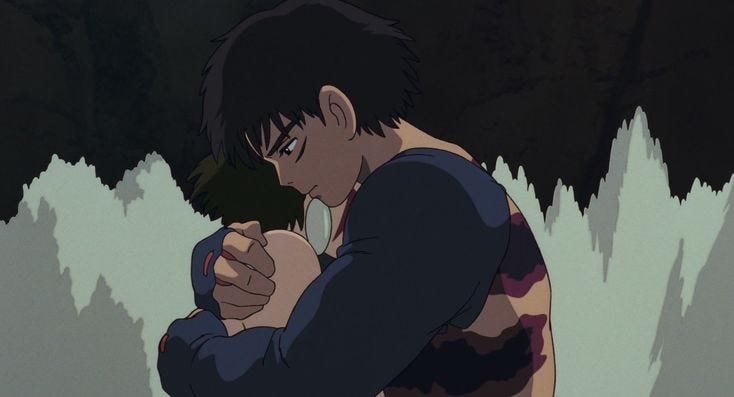
Princess Mononoke is again another such timeless reminder. The relationship between Ashitaka and San is not driven by your cookie-cutter romantic pursuits but by profound mutual respect. Once again, there is more to flush out between the two sexes than a trivial romance. They both have duties. They both have made sacrifices. They are bound by their obligations yet can open up to be there for each other. Love, it seems, can do better than drama and romance.
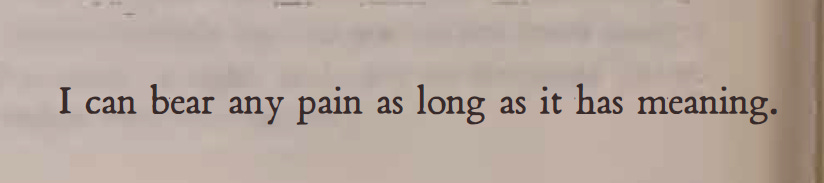
This quote from Murakmai in 1Q84 is the cornerstone for several male characters in Miyazaki's films. The great master himself has to suffer and work arduously to translate his animations into films. Perhaps that's why he writes stoic and dutiful characters.
The Boy and the Heron is Miyazaki's most intimate film. He draws a lot on his own life to write the character of Mahito. In the movie (not spoiling, relax), Mahito is given a choice to stay eternally in a fantasy world or to return to the real world. Given a chance at eternal bliss, Mahito still chooses the pain of reality. A lesson that goes further. A solemn reminder that we cannot live in the fantasy worlds we've lost. We've got one reality and it's worth fighting for. And it's worth coming back to. Try as we may to leave it.
Grave of the Fireflies - although Miyazaki didn't direct this movie, I just couldn't help myself. No other war movie has so deeply represented the loss of humanity in war and the ultimate cost.2 Seita, the older brother, does everything in his power - beg, borrow, steal to take care of Setsuko. Seita would bear all manners of pain and angst to be there for his sister. His purpose lay in ensuring Setsuko was all right.3
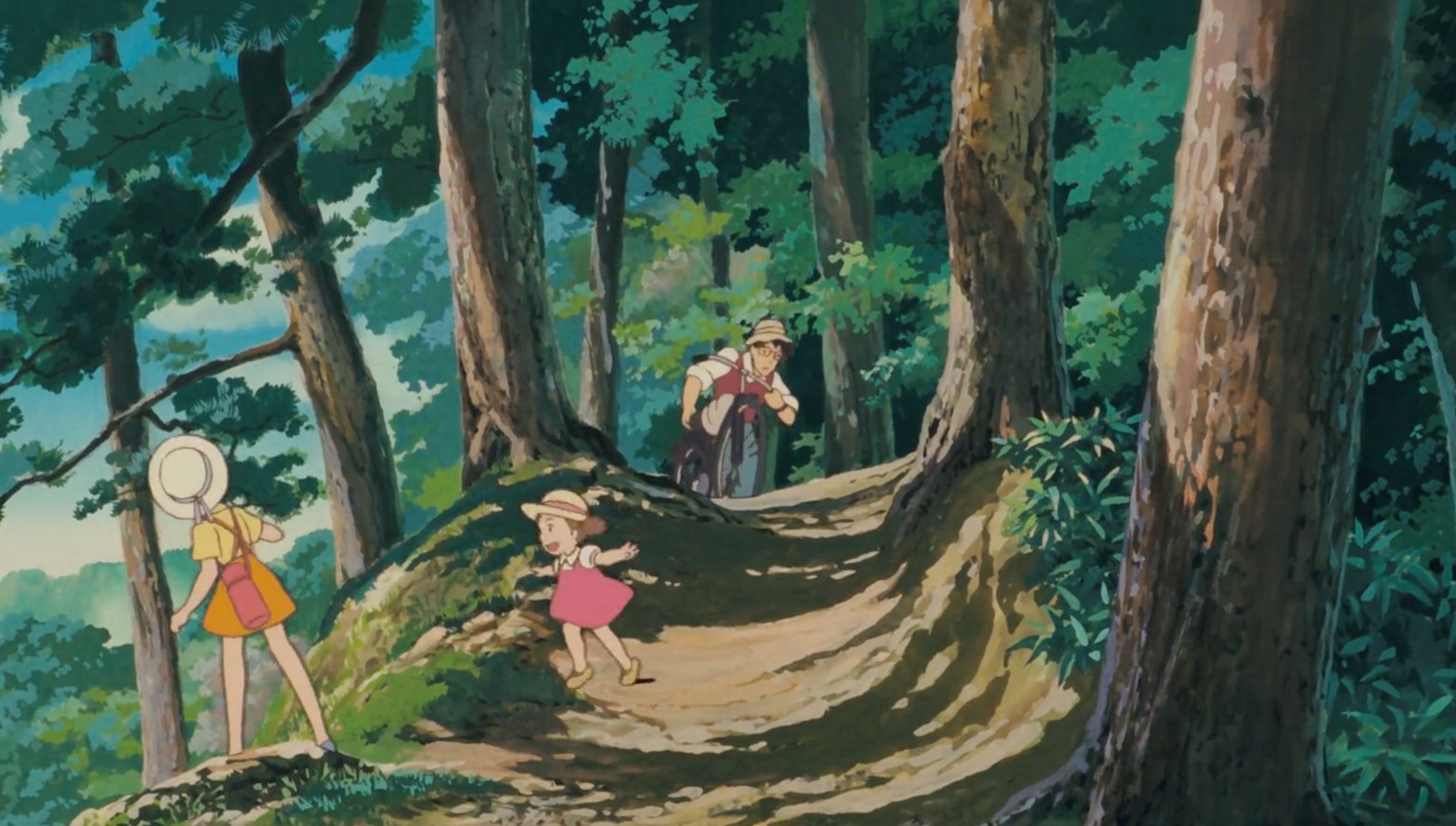
My favourite example is My Neighbour Totoro. Kasuakabe here has a quiet strength. And at its root in this movie, I think fatherhood and masculinity are represented as having a duty. But this duty is not a burden. Rather it is a gift. And we should treat it as such.
Here I want to talk about an amalgam of the ideals of Miyazaki and Miyazaki's characters. Both I believe are equally pertinent to the topic at hand.
Though I did make Porco Rosso a foolish film. (...). Because I've been making films for kids. That film wasn't for kids. How did this happen? What am I doing with this film? I'm not really sure how I ended up with this. Am I strange?
- Hayao Miyazaki in The Kingdom of Dreams and Madness
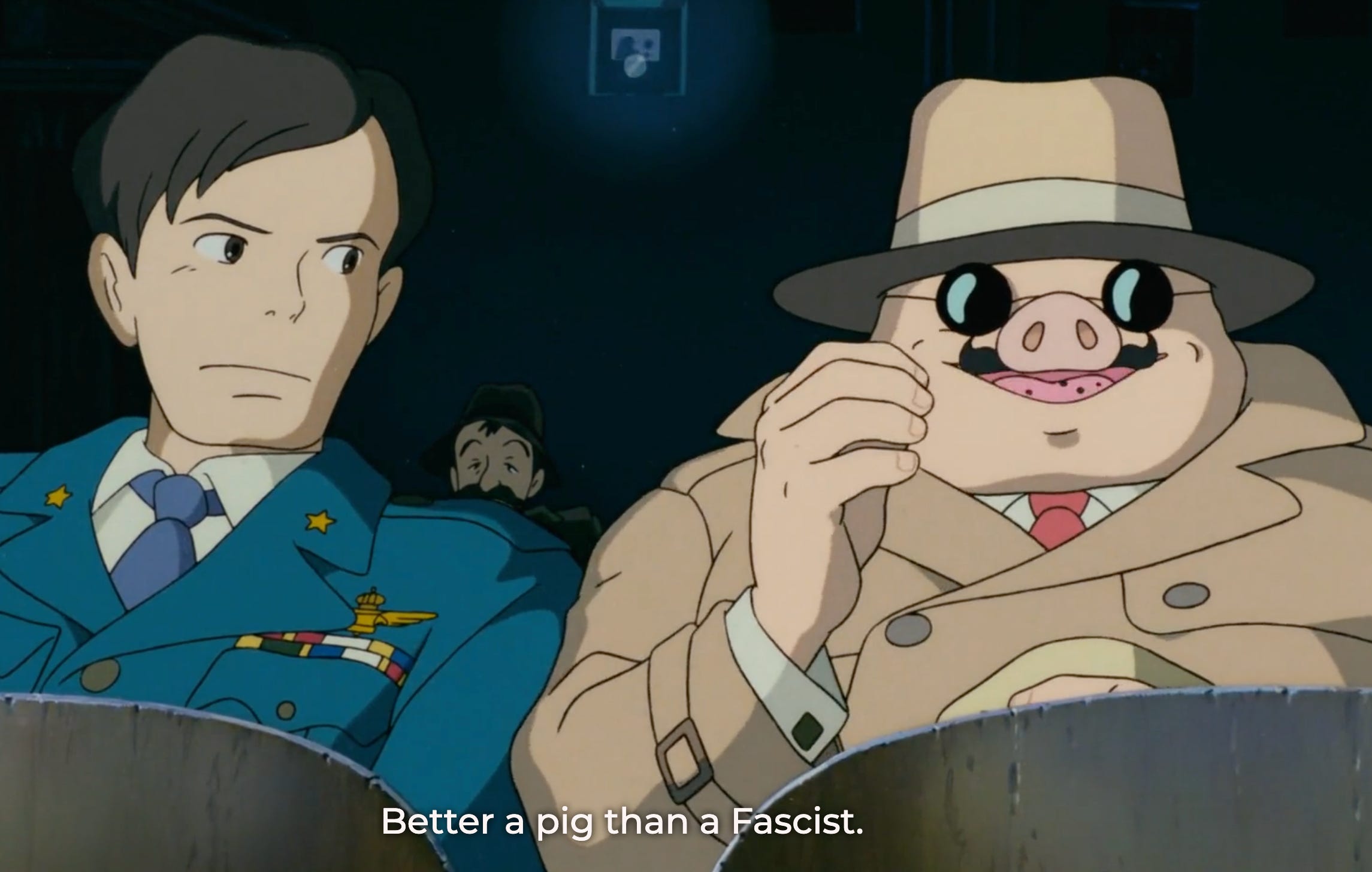
In Porco Rosso, we see Porco, an aviator who got turned into a pig. Better yet a war hero that got turned into a cynic. And we see him grappling with humanity. Or rather his disillusionment with it. Beyond the visuals and the comedy, it might be fundamentally about finding your "humanness". That the little acts of compassion are what keep the large evils at bay.
This has been and continues to be my favourite Miyazaki movie and is indeed as Miyazaki says - a film that wasn't for kids.
“I would like to make a film to tell children "it's good to be alive".
- Hayao Miyazaki
Something that needs no explanation from the great master himself. I highly doubt anyone has ever felt bored watching a Miyazaki movie. There's always that unique magic. Like being inside a toddler's mind. And so it goes with life, I feel. Growing up, we gravitate to talking about things we see and things we understand. So all our conversations stay on a rather boring human level. Talking to children, however, opens up a whole new universe. Nothing is out of reach. Everything is possible.
That no movie I ever write will ever end or promote an "it's not worth it" attitude.
It is imperative that you give these characters something to fight through in tandem with something to fight for.
Don't try and write a romance. There's more to stories than that. A romance is best unspoken.
These kinds of internal struggles must be of the characteristically "show don't tell". I would hate if a character broke into monologue about their strifes.
Reality is worth fighting for. In a time, where everyone is building gadgets to escape, embracing the imperfect ache of reality is to come to terms with what it means to be human.
This is the first of the Inspirations series. This series is where I document who I take inspiration from in my journey to become a filmmaker. As posted earlier, I will commit to making a post in this series once a month. The other series, Essays, will continue but with a less exacting schedule. I will post there when I feel there is something to post about.
The works I referenced making this piece, in no particular order, are:
- Princess Mononoke
- Porco Rosso
- My Neighbour Totoro
- Grave of the Fireflies
- Spirited Away
- The Boy and the Heron
- The Kingdom of Dreams and Madness
- What it means to be an artist
- Jonathan Ross interviews Hayao Miyazaki
I know this isn’t the entire Miyazaki filmography. I’m still missing a couple bangers. I will get to watching them but these spoke volumes to me already.
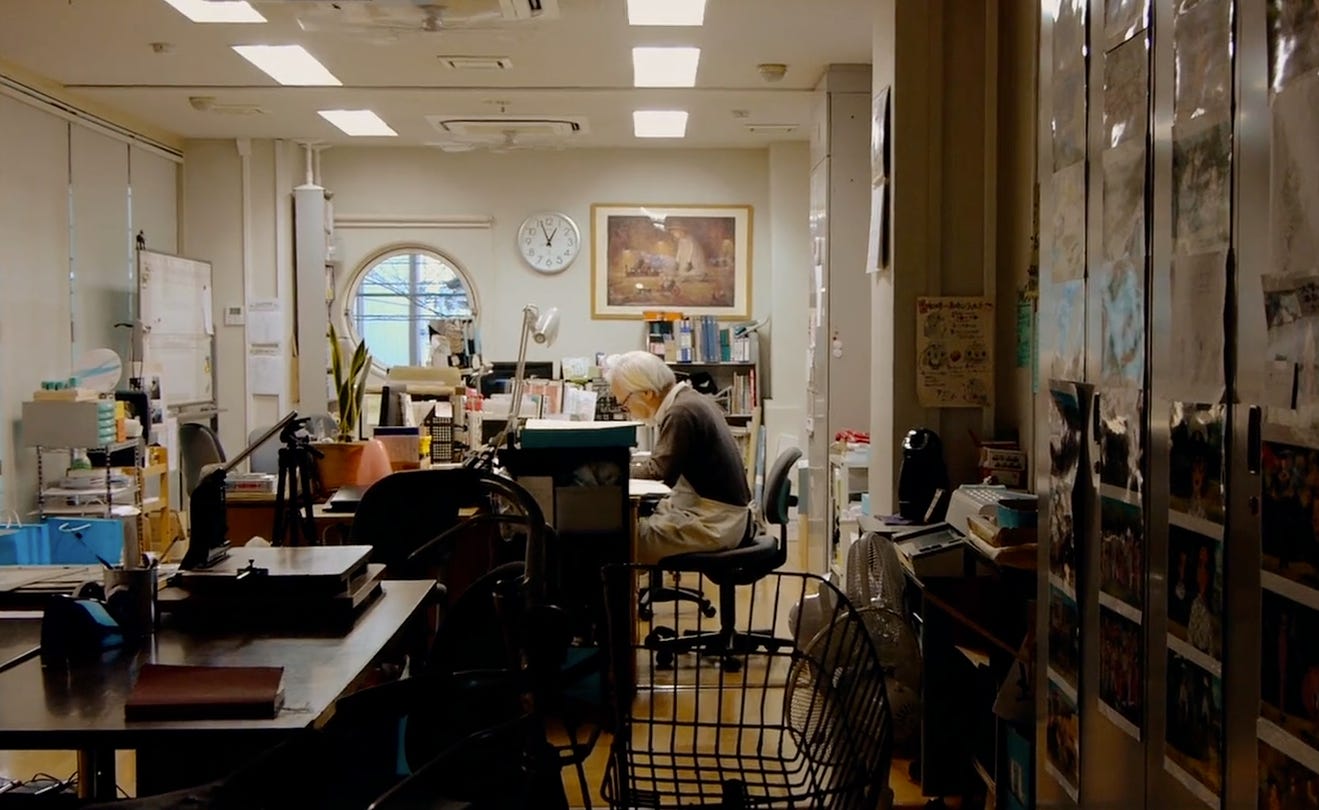
I think about this photo a lot
And if you ask me rather cheesy. But not you La La Land. You hold a special place in my heart.
‘All Quiet on the Western Front' and 'Come and See' are close runner-ups.
I implore you, dear reader, to watch this movie. No words can describe why I have a lump in my throat every time I talk about this movie.
Comments
Nothing yet. Say the first thing.
Sign in to join the conversation.