
Choked with feelings he wished he could tear out, Nightingale knelt and drew shaking fingers over the latch. The lid opened and there, resting within like a body in its coffin, was the token which was soaked in so much bloodshed. Nightingale lifted it and stared, wracked with indecision, into its aureate glow. The agony it awoke was almost alluring.1
Choosing the extract from Leeward to accompany this piece, I had a long list of options. Captain Nightingale’s Nile medal is very important to explaining his journey: his beautiful, shining token marks a glorious battle that turned incredibly tragic. Each time his accolade is brought up, whether by excited young midshipmen or older officers, it does not spark pride, but guilt. It becomes a tangible symbol of what he fears and what haunts him: his own doubts, trauma, and a terrible loss.
I explored this pivotal battle in another short piece, so this will be just a brief summary of the incident.
In 1798, Rear-Admiral Horatio Nelson located the enemy French fleet at Aboukir Bay, there to support Napoleon Bonaparte’s invasion of Egypt and potentially, his foray towards British India. In a striking move, the British ships destroyed the French fleet at anchor and scuppered Napoleon’s attempts to disrupt British trade and influence. It became one of the seminal moments of Nelson’s career, as well those of his ‘band of brothers’: the captains and officers who surrounded him.
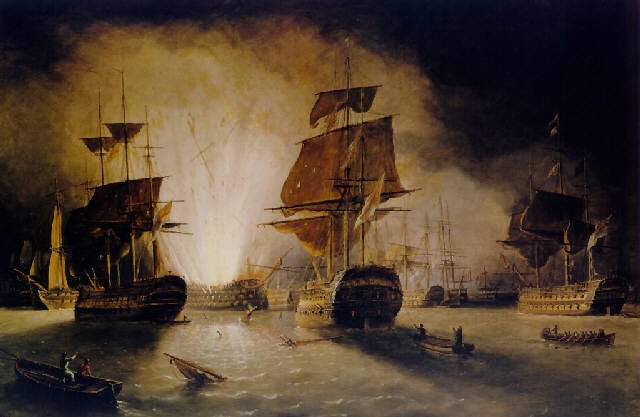
During this period, medals given for specific campaigns were not the norm. Rewards for officers and men came most generally in the form of prize money: money paid to sailors and officers when captured ships and cargoes were valued according to a fixed system. Officers and men could become fabulously wealthy from such prizes, and the prospect of it was arguably a factor in men signing onto vessels, often with ‘lucky’ captains.2
For captains and admirals, as in the case of Nelson at the Nile as well as others such as Edward Pellew who became Baron Exmouth, titles could be bestowed as a form of reward. Slightly later than Leeward’s setting in 1800, the Lloyds Patriotic Fund, from 1803, produced silver plate and presentation swords, especially for battles such as Trafalgar.3
Previous to the Nile, the Naval Gold Medal was given. The first of these was rewarded following the Glorious First of June in 1794 and continued to 1815 with the capture of USS President by HMS Endymion.
Alexander Davison acted as Nelson’s prize agent, as well as the sole agent for the prize ships captured at the Nile. He paid for the ‘Medal for the Nile’, a series of rewards given to men who participated in the battle.
The medals reflected the ranks of the recipients. For admirals and captains, they were gold; for officers below Captain, they were silver; for petty officers they were copper; and for the ratings they were ‘bronzed copper’.4
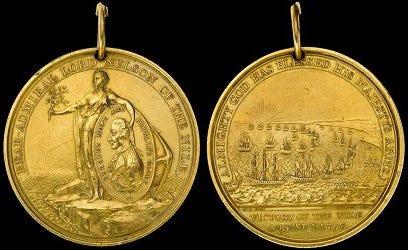
As seen in the image, these medals illustrated the specifics of the battle itself. On the reverse, the British ships are about to enter the action at Aboukir Bay, and on the obverse is a symbol of British victory: Peace sitting by the sea with an olive branch and a shield displaying Nelson himself5 (modest as always).
It was bitter recompense. A piece of silver would not bring Leroy home. Nightingale would have traded all the medals in the world for that. Each time he thought of his own it turned his stomach. Every fragment hid how close he had been to losing the Lion and how Leroy had been the price paid for victory.6
Captain Nightingale receives a gold medal for his participation at the Nile, something which he spends the book obsessing over. Eventually, he makes a drastic decision that heavily involves the token.
Although medals were not given posthumously, Nightingale applies for a special one to be made for his lieutenant, Leroy Sawyer, who dies at the Nile (not really a spoiler, considering it happens on page 7). Leroy’s sister is later stated to wear it in commemoration of her brother.
The Nile medal represents what I find so rewarding about writing historical fiction: being able to incorporate real objects and stories into fictional narratives, a symbol which follows a character from the start of the book to the end.
Further Reading:
Andrew Lambert, Nelson: Britannia’s God of War (London: Faber & Faber, 2004)
Images:
Richard Brydges Beechey, Battle of the Nile
Katie Daysh, Leeward (London: Canelo, 2023), p. 10
Roy & Lesley Adkins, Jack Tar (London: Abacus, 2008), p. 61
Katie Daysh, Leeward (London: Canelo, 2023), p. 95
No posts
Comments
Nothing yet. Say the first thing.
Sign in to join the conversation.