
The Lion’s upper deck seethed with death. Courtney stepped down a ladder slippery with blood, having to leap over some of the missing rungs. The evisceration of the Lion’s armaments and stores awaited him: guns blown from their carriages, gaping voids in the Lion’s flanks, powder horns spilled, bits of the capstan thrown to the four winds. The entire galley had been ripped apart with fragments of the black stove scattered about the floor. Butchery painted the deck, dead and dying men as far as he could see through the acrid smoke. Gun crews worked around their slaughtered mates, continually sponging out the cannons, reloading, wadding, running them out and firing.1
The Battle of Trafalgar, fought on 21 October 1805 between the British and Combined Franco-Spanish fleets, is perhaps the most famous naval battle of all time, and one of the most famous of all battles.
Tackling this battle in the third book of the Nightingale/Courtney series, A Merciful Sea, was probably the most intimidating thing I’ve ever had to write. The fictional HMS Lion takes part in the conflict as part of Vice-Admiral Horatio Nelson’s weather column, piercing the heart of the enemy line. Many of the things that happen to the Lion come from true events; aside from that fictional ship and the also-fictional Spanish Mistral which they battle, everything is real.
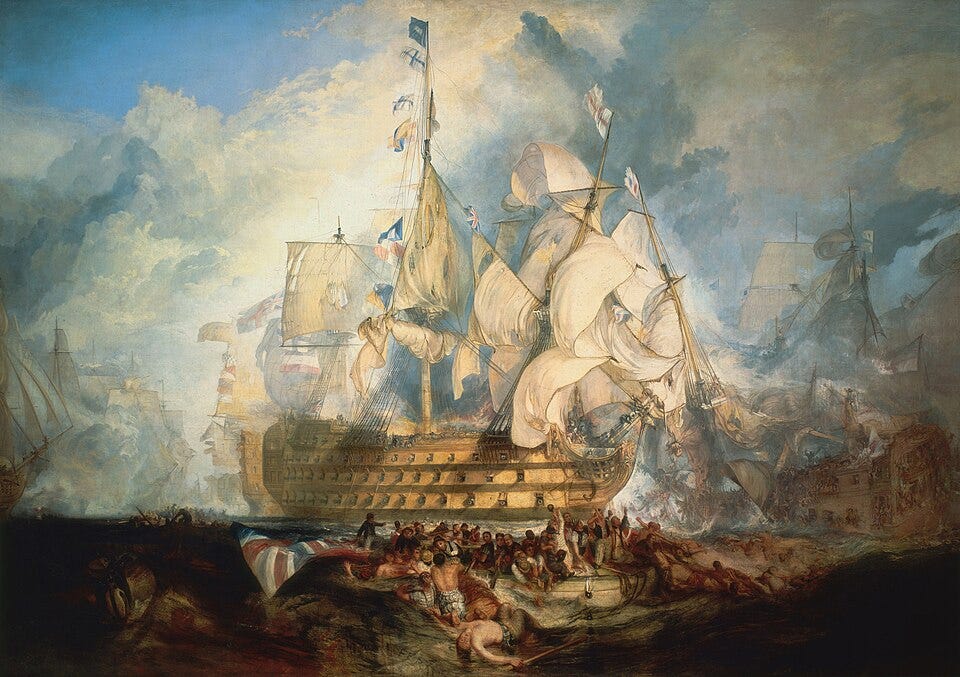
Although Trafalgar is now famous as a singular battle, it was part of a long and complex campaign that covered the Mediterranean all the way to the Caribbean. I will go into this elsewhere but a very basic summary is that Napoleon Bonaparte sought to invade Britain via the English Channel. Various schemes were put in place, with plans to combine French and Spanish fleets which were blockaded in European ports by the British Royal Navy.
At the end of March 1805, Vice-Admiral Pierre-Charles Villeneuve escaped his blockade at Toulon and made a crossing of the Atlantic Ocean to reach the West Indies. Here, he was joined the Spanish commander Federico Gravina – the plan was to rendezvous, draw away the British fleet, and then sweep back across the ocean to cover the invasion flotillas to England. After searching European waters for the escaped enemies, Nelson crossed the Atlantic in extraordinary time but was unable to locate Villeneuve in the West Indies.
The Franco-Spanish Combined fleet returned to Europe where Villeneuve was intercepted by Vice-Admiral Robert Calder off Cape Finisterre (an action some have argued was as important in scuppering the fleets as Trafalgar but which led to Calder being court martialled for not pressing the attack2. The fleets went back into port and the blockades continued.
By the time Nelson arrived at Cadiz in September, following a short period of leave, the Combined Fleet were preparing to move against Britain again.
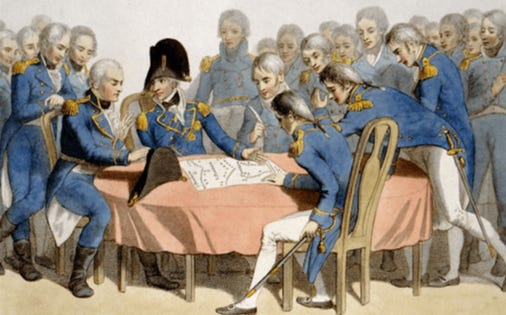
One of the reasons Trafalgar is so famous is because of Nelson’s tactics. There has been endless debate as to whether these were the first of their kind or inspired by similar methods before.
The general strategy for naval battles tended to be to arrange fleets into parallel lines of battle, with ships firing into one another3. Nelson’s schemes were to divide his fleet into two columns going, under full sail, straight into the line of the enemy. This was daring; for a long while, the British would be vulnerable to heavy gunfire – however, once ‘breaking the line’, they would be able to utilise their superior rates of fire to cause havoc to the Combined Fleet.
There was also planned to be a third column, a flying squadron, but this did not occur in the battle.
The Trafalgar Memorandum details Nelson’s rationale of giving captains the initiative to bring their ships close to the enemy and use their own judgements. What was desired was a complete and utter victory4.
On 19 October 1805, HMS Sirius hoisted a signal to show that the enemy was coming out of port at Cadiz. For this day and the next, the British fleet gave general chase to Villeneuve and Gravina, with ships indicating through blue lights which direction the enemy had been seen5.
On the morning of 21 October, the two fleets were around 11 miles apart and northwest of Cape Trafalgar6. There were 27 British ships of the line against 33 of the Combined Fleet. The British fleet formed their two columns: the weather column under Nelson and the lee column under Vice-Admiral Cuthbert Collingwood.
There was plenty of time to prepare for battle, certainly in the light airs, meaning the ships could not progress much faster than around four knots7. It took around six hours from daybreak until the fighting began. One of the preparations, aside from the usual clearing for action, was to paint the iron bands around the lower masts yellow to distinguish from the black bands on the French vessels8 – something that would be needed in the coming close-quarters action.
After 11am, another of the most famous moments of the battle occurred: HMS Victory hoisted the signal ‘England expects that every man will do his duty’.
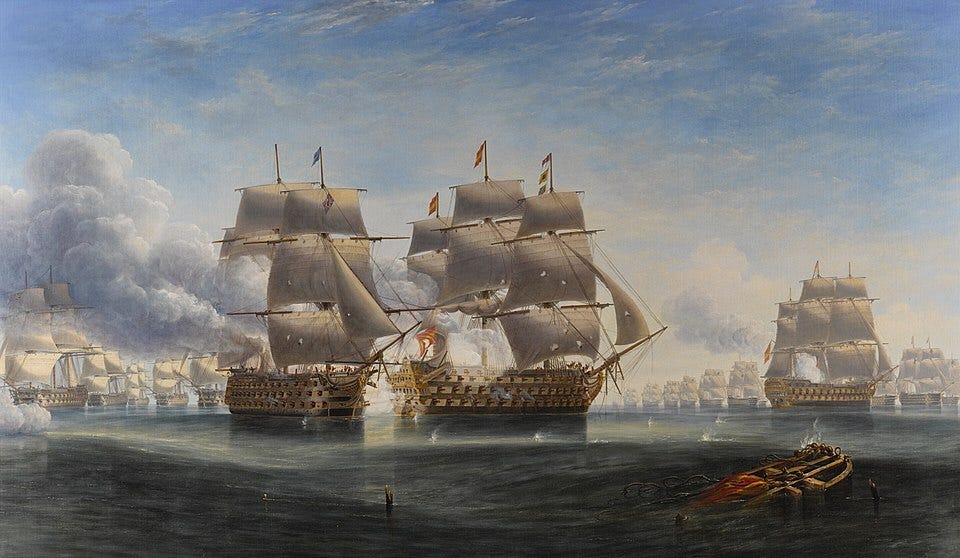
To the south, Collingwood had engaged. His Royal Sovereign appeared like a phantom through the fog and plunged into the heart of the enemy line. As he did, Courtney saw the damage to his flagship, but with a mighty roar, the Royal Sovereign slammed beside her targeted enemy vessel and Courtney felt the broadside in his own chest.9
The lee column was the first to enter the engagement. Collingwood’s flagship, the Royal Sovereign, broke the line sometime after noon, firing double-shotted broadsides into the Santa Ana. One record claims that over 400 were killed in this single attack but that is most likely an exaggeration10. However, it does clearly illustrate the bloody and visceral nature of the battle.
What is certain is that the Royal Sovereign was alone for some minutes, surrounded by Spanish and French vessels (another account states that the cannonballs crossed so much that they were colliding11 although this might be another exaggeration). Belleisle came to Royal Sovereign’s defence but many ships fought without backup, blasting at each other at extremely close range.
Bellerophon held to its title of ‘the hardest ship in the fleet’12, becoming entangled in Aigle and, after destroying much of the French ship’s lower decks, elevated her guns at such an angle to destroy the upper too.
There are extraordinary stories of individual ships within this column, such as Mars, whose captain was killed by a broadside, and Polyphemus. Within around two hours, the lee column had effectively defeated the enemy rear.
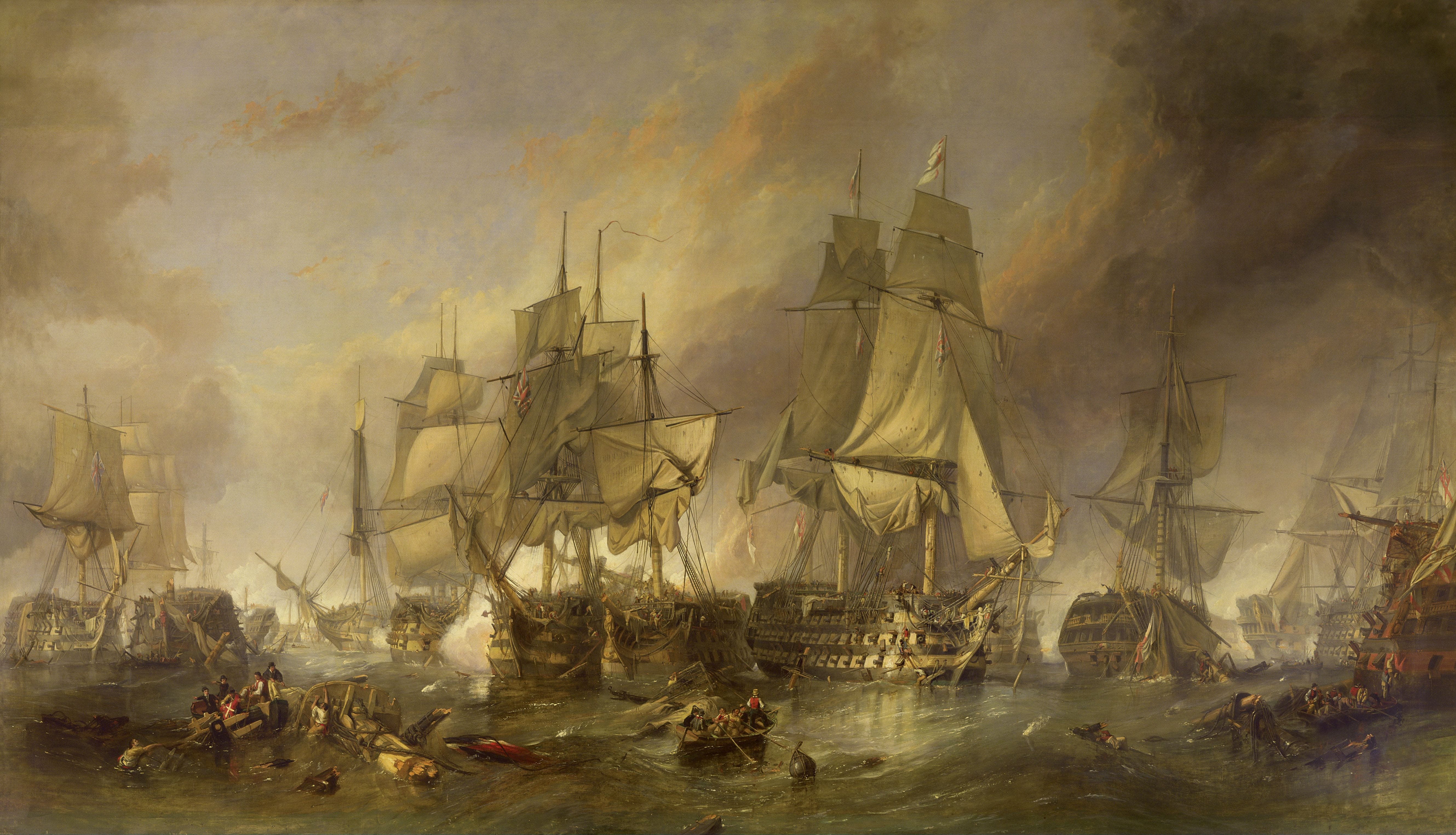
Courtney’s attention wrenched back as a shot tore through the Victory’s main t’gallant sail. He stared at the ragged gap, just a pinhole from where the Lion was astern of her. But it seemed to draw a curious hush over the weather column. The world dropped into silence. For a moment, Courtney closed his eyes, aware of his blood, his heartbeat, every one of his tense limbs.
And then hell opened its mouth.13
Nelson, in Victory, led the weather column into battle, entering around 40 minutes after Collingwood had engaged14. It is said that they were unable to return fire for over 30 minutes, having to bear the enemy’s gunfire as they sailed towards the line15. The shape of the enemy line meant the British ships were surrounded – but it also meant that, once through the line, the British ships could take on multiple ships at once.
Victory broke the line under the stern of Bucentaure and became enmeshed in a ferocious fight with Redoutable, utterly destroying her stern and taking down more than two hundred of her men16. Victory quickly lost her wheel and so had to be steered from the gunroom below (something which also occurs to the fictional Lion).
Another of the incredible ships from the battle is Temeraire, known as the Fighting Temeraire. When the Redoutable crashed into her, the crew lashed down the French vessel’s bowsprit to ensure she did not escape, soon followed by also securing the Fougueux to her. The Temeraires boarded the Redoutable via her downed mizzenmast, taking possession of the ship17.
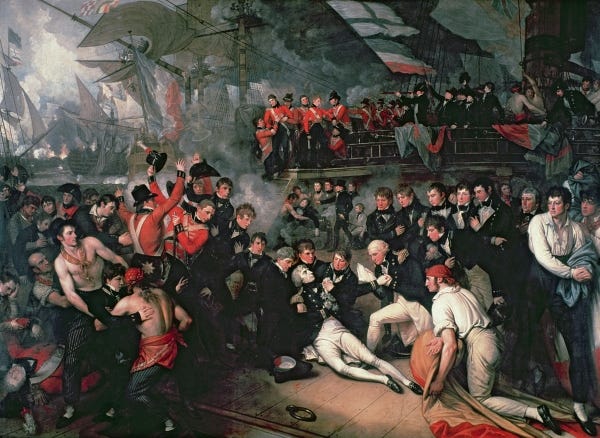
Just after 1pm, Nelson was brought down by a shot fired from the mizzen top of the Redoutable. He was taken below but died a few hours later - just after being informed of the ultimate victory of the battle.
Now, Courtney staggered through those same decks, taking stock of the damage and the dead. Every timber had been christened in blood, every seam clogged with gore. Each of the Lion’s masts had been cut down to some degree; nearly all of the canvas had shredded; the bowsprit entirely severed; the rudder ravaged; holes gouged in her hull; the bows shot away. All of this could be repaired.
The lives of the men could not so easily be returned.
It was a dear victory, one which would be felt across families in all ends of society.18
Overall, Trafalgar marked a resounding defeat for the Combined Fleet. The British had captured or destroyed nineteen ships while not losing a single one of theirs. The casualties rates for the French and Spanish were abysmal, with estimates reaching up to 6000 killed and wounded19.
Following the battle, Collingwood chose not to obey Nelson’s wishes of anchoring the fleet and took it out to sea (many ships lacked the ability to anchor, considering the huge damage). A great gale blew in and many of the prize ships were lost or eventually burnt.
The story of the storm is an absolutely incredible one, with enemy aiding enemy (the Spanish were especially receptive to British injured sailors, allowing them into the harbour of Cadiz to be treated20). There is a whole post, and story, needing to be written about these weeks following the battle.
The little HMS Pickle arrived in England in November 1805 with news of Trafalgar and of Nelson’s death. In December, HMS Victory returned with Nelson’s body onboard. Nelson was given a full state funeral which thousands attended.
There has been much debate over the effects of Trafalgar upon British security. The wars continued after 1805, but the battle had given Britain supremacy of the seas21 and utterly annihilated the Spanish navy, undermining the country’s strength22.
Blockade was resumed against France. Napoleon’s plans for invasion continued, but with reduced command of the ocean, focus was given to battles on land rather than at sea.
It is clear that Trafalgar has lived on in historical consciousness. This little post is a fraction of the extraordinary events that occurred that day, and during the preceding campaign.
Tackling such a famous battle, with multitudes of sources covering it, was terrifying - but ultimately, Chapter 29: Hellfire is one of my favourites across the whole trilogy. I hope I have managed to capture at least some of the terrifying, bloody, and dramatic experiences that would have occurred in those wooden walls.
Images:
JMW Turner, The Battle of Trafalgar
Lord Nelson explaining to the officers the plan of attack previous to the Battle of Trafalgar
John Wilson Carmichael, HMS Royal Sovereign raking the stern of the Spanish flagship Santa Ana
William Clarkson Stanfield, The Battle of Trafalgar
Benjamin West, The Death of Nelson
Katie Daysh, A Merciful Sea (London: Canelo, 2025), p. 292
David Lyon in Robert Gardiner, Chatham Pictorial Histories: The Campaign of Trafalgar (London: Chatham Publishing, 1997), p. 129
Roy & Lesley Adkins, The War for all the Oceans (London: Little, Brown, 2006), p. 164
Andrew Lambert, Nelson: Britannia’s God of War (London: Faber & Faber, 2004), p. 291
Tim Clayton & Phil Craig, Trafalgar: The Men, the Battle, the Storm (London: Hodder & Stoughton, 2004), p. 138
David Taylor in Robert Gardiner, Chatham Pictorial Histories: The Campaign of Trafalgar (London: Chatham Publishing, 1997), p. 145
Christopher Lee, Nelson and Napoleon (London: Headline, 2005), p. 324
Andrew Lambert, Nelson: Britannia’s God of War (London: Faber & Faber, 2004), p. 295
Katie Daysh, A Merciful Sea (London: Canelo, 2025), p. 287
David Taylor in Robert Gardiner, Chatham Pictorial Histories: The Campaign of Trafalgar (London: Chatham Publishing, 1997), p. 148
Christopher Lee, Nelson and Napoleon (London: Headline, 2005), p. 333
Christopher Lee, Nelson and Napoleon (London: Headline, 2005), p. 335
Katie Daysh, A Merciful Sea (London: Canelo, 2025), pp. 286-7
David Taylor in Robert Gardiner, Chatham Pictorial Histories: The Campaign of Trafalgar (London: Chatham Publishing, 1997), p. 151
Andrew Lambert, Nelson: Britannia’s God of War (London: Faber & Faber, 2004), p. 301
David Taylor in Robert Gardiner, Chatham Pictorial Histories: The Campaign of Trafalgar (London: Chatham Publishing, 1997), pp. 152-3
Katie Daysh, A Merciful Sea (London: Canelo, 2025), pp. 304-5
Andrew Lambert, Nelson: Britannia’s God of War (London: Faber & Faber, 2004), p. 307
Tim Clayton & Phil Craig, Trafalgar: The Men, the Battle, the Storm (London: Hodder & Stoughton, 2004), p. 373
Roy & Lesley Adkins, The War for all the Oceans (London: Little, Brown, 2006), pp. 170-1
Roger Morriss in Robert Gardiner, Chatham Pictorial Histories: The Campaign of Trafalgar (London: Chatham Publishing, 1997), p. 184
No posts
Comments
Nothing yet. Say the first thing.
Sign in to join the conversation.